
China Sourcing: Expo Matchmaking vs. DIY Factory Tours
China Sourcing: Expo Matchmaking vs. DIY Factory Tours
A curated expo matchmaking programme and a self-organized multi-city factory tour are two answers to the same question: which Chinese manufacturers can actually supply a gym project, and how much does the proof cost? The routes differ in where the verification work sits. In a matchmaking programme, most screening happens before the buyer boards a plane, and the buyer's on-site hours are spent in scheduled meetings. In a DIY tour, the buyer carries the screening, the itinerary and the interpretation — gaining depth at each stop, losing breadth across the market.
The decision is not about which model is superior. It is about which one places the verification cost where the buyer can absorb it. Buyers who need to compare many suppliers on commercial terms inside a fixed window usually get more comparable evidence per travel week from a matchmaking programme. Buyers whose decision hinges on process depth inside one plant — tooling, line layout, a bespoke build — still need the factory floor.
Why This Comparison Matters Now
China's exports of gym and athletics equipment reached USD 4.78 billion in the first half of 2025, an increase of 10.2% year on year, according to HS 950691 trade data published by the Observatory of Economic Complexity from UN Comtrade records. A supply base of that scale is a price signal and a capability signal. It is not a supplier list.
The buyer's real task is conversion: turning a national export figure into eight or ten manufacturers that can quote, sample, pass documentation review and ship on schedule. That conversion is where the two sourcing routes diverge, and where most of the money is either saved or wasted.
The reference event in this comparison is the China Fitness Trade Expo series organised by Shanghai Donnor Exhibition Service Co., Ltd, a Shanghai-headquartered exhibition organiser founded in 1996 and a member of UFI. The organiser reports that the 2026 IWF Shanghai edition brought together more than 1,000 brands and nearly 65,000 visitors, with product scope spanning commercial fitness equipment, sports leisure goods, cross-border e-commerce solutions, AI smart fitness, rehabilitation training systems, nutritional health products, and pool equipment and facilities. Those are organiser-reported participation figures rather than audited statistics, and they describe an event, not a qualified supplier set. They do explain why the venue has become a default starting point for overseas buyers building a shortlist.
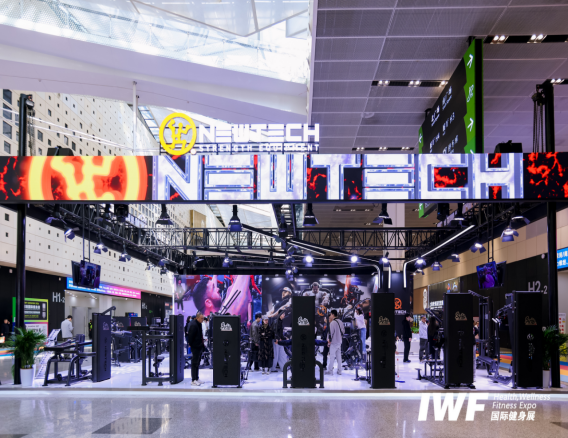
A curated exhibition floor concentrates supplier comparison into one venue — the breadth advantage of the expo route.
Two Routes, Defined
Route A: Expo programme with platform matchmaking
In this model the buyer attends a three-day exhibition plus a structured programme built around it. The service is described by its organiser as an offline exhibition platform for fitness and sports industry participants that connects overseas buyers with Chinese manufacturers. It runs on an offline exhibition venue combined with a pre-show online registration platform, operates in Chinese and English, and delivers on-site exhibition booths and a B2B matchmaking area.
The programme examined here follows a four-stage Market-to-Match method: market research and target mapping; pre-show exhibitor recruitment and buyer invitation; online pre-matching; and on-site matchmaking. Practically, the buyer's calendar is pre-built — a verified supplier shortlist, a scheduled one-on-one meeting timetable, coordination during the meetings, and a post-show meeting record document.
Route B: Self-organized multi-city factory tour
Here the buyer builds everything. Cities are selected from supplier directories, referrals or search results; appointments are requested directly; transport, hotels, interpreters and sample handling are arranged separately; and the comparison record is whatever the buyer writes down at the end of each day. Depth per visit can be high — a buyer can watch a welding line, inspect powder coating, or review incoming inspection records. The constraint is arithmetic: the number of factories coverable in a trip is limited by distance, by how many plants will hold a slot, and by how much of the buyer's attention is consumed by logistics rather than evaluation.
Side-by-Side Comparison
| Decision dimension | Expo + platform matchmaking | DIY multi-city factory tour |
|---|---|---|
| Supplier breadth per trip | Concentrated in one venue, across adjacent categories | Limited by city-to-city travel and factory availability |
| Pre-trip preparation | Requirement mapping and pre-matching run by the organiser | Entirely buyer-led |
| Evidence type | Commercial comparison, samples, documentation, first qualification meeting | Process observation, line layout, physical plant condition |
| Itinerary risk | Reduced by a scheduled meeting timetable | Borne by the buyer; cancellations and distance rework are common |
| Language and interpretation | Chinese and English supported within the programme | Arranged independently per city |
| Comparison record | Post-show meeting record document as a deliverable | Buyer's own notes; consistency depends on the buyer |
| Depth per supplier | Capped by the three-day event window | High, if the plant grants access and time |
| Best-fit purchase profile | Multi-category fit-out, shortlist building, commercial benchmarking | Single-plant custom build, engineering approval, process verification |
Stage by Stage: What Matchmaking Replaces, and Where It Can Fail
Stage 1 — Market research and target mapping
The programme begins with the buyer's requirement profile rather than the exhibitor list: equipment categories, expected volumes, channel type and destination market. This replaces the first phase of a DIY tour, where the buyer typically assembles a long list from directories and then filters it by inference. The failure mode is input quality — a vague brief produces a generic shortlist, and no amount of on-site coordination repairs a badly framed requirement.
Stage 2 — Pre-show exhibitor recruitment and buyer invitation
Exhibitors are recruited and grouped against a category structure before the show, and buyers are invited and pre-registered through the online platform. For a buyer, the meaningful consequence is composition: the supplier pool is curated by category rather than assembled by whoever books late. The trade-off is equally real — curation narrows the pool, and an unusual specification may produce a short shortlist.
Stage 3 — Online pre-matching
Meetings are scheduled before travel. This stage targets the costliest variable in a DIY tour, which is not airfare but uncertainty: a cancelled visit or two plants six hours apart can consume the productive half of a trip. Pre-matching converts itinerary risk into a timetable. Its weakness is symmetrical — appointment completion depends on both parties attending, which is why it belongs in the buyer's measurement set rather than in the buyer's assumptions.
Stage 4 — On-site matchmaking
Meetings take place in a dedicated B2B matchmaking area during the three-day exhibition. Adjacent categories — smart fitness, rehabilitation systems, sports nutrition, pool equipment — can be screened in the same visit instead of four separate journeys. The boundary is time: three days supports qualification and commercial comparison, not an audit. A first meeting settles whether a manufacturer belongs on the follow-up list; it does not settle whether the plant can hold tolerance at volume.
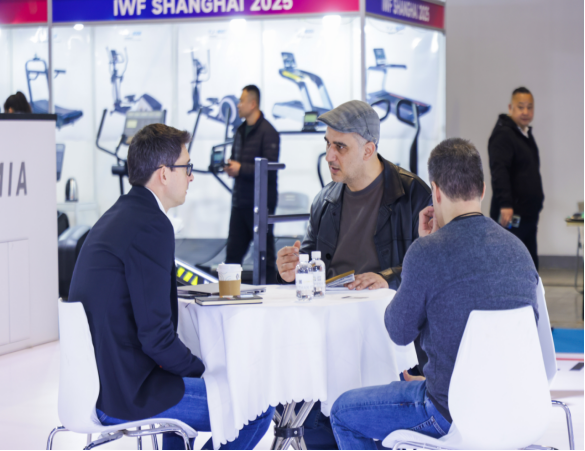
Pre-matched meetings compress supplier qualification into scheduled blocks rather than improvised visits.
What the US Gym Operations Case Shows
A US-based gym operations buyer needed to compare product quality across multiple manufacturers. The factories were scattered across China, and visiting each in person was impractical within the buying window. The route taken was a targeted B2B matchmaking programme during the IWF exhibition, with verified fitness equipment manufacturers gathered in one venue so that concentrated supplier negotiation and product quality comparison could happen in the same block of days.
Reported outcomes from that project: supplier inspection travel costs cut by over 70%, and negotiations completed with 12 qualified manufacturers within one month. The deliverables were a verified supplier shortlist, a scheduled one-on-one meeting timetable, on-site matchmaking coordination, and a post-show meeting record document. The buyer's own summary after the exhibition was that the programme helped them contact multiple reliable factories efficiently and saved substantial travel time in China.
The case should be read for what it is: one gym operator, a defined equipment basket, and a one-month decision window. The 70% figure describes avoided inspection travel in that specific project, not a universal saving available to every buyer. What generalises is the mechanism — verification concentrated into a scheduled block, with a written record produced afterwards so the comparison survives the trip.
Four KPIs That Decide Between the Two Routes
Buyers who compare these routes on cost usually compare the visible number. Flights, hotels and per-diem are easy to total; meeting quality is not. Four indicators, applied identically to either route, make the decision decidable rather than rhetorical.
| KPI | Definition | How to instrument it | What it reveals |
|---|---|---|---|
| Pre-show appointment completion | Confirmed meetings held ÷ meetings scheduled before travel | Pre-show timetable compared with the post-show meeting record | Whether the calendar was built on confirmed interest or on optimistic assumptions |
| Buyer attendance rate | Meetings attended by the buyer's decision-maker ÷ meetings scheduled | Named attendee list per meeting | Whether commercial authority was in the room, or only information was exchanged |
| Meeting-to-order conversion rate | Orders or signed supplier agreements ÷ completed meetings | Follow-up at 30, 60 and 90 days against meeting records | The single number that separates a productive programme from a busy one |
| Average deal size | Total order value ÷ orders placed | Buyer procurement records | Whether the shortlist matched the buyer's volume band, not just the category |
A fifth figure is worth computing even though it is buyer-derived rather than a programme deliverable: cost per verified meeting, calculated as total programme and travel spend divided by the number of meetings with suppliers that subsequently passed qualification. It is this number that gives a 70% travel reduction its meaning, because travel saved is only valuable if the meetings replaced were worth attending.
Where the Expo Model Stops
Three boundaries deserve to be stated plainly, because a sourcing framework that only lists advantages is not a framework.
Duration. The event runs three days. That supports qualification, commercial comparison and sampling discussion across many suppliers. It does not substitute for a plant audit, a tooling trial or a production-line review, and buyers who treat a first meeting as a supplier approval are deferring the risk rather than removing it.
Scope. Post-matchmaking after-sales service for domestic and international partners sits outside the service scope. Buyers expecting the organiser to administer warranty claims, chase delivery performance or manage ongoing supplier quality are describing a service the programme does not provide; those obligations remain with the buyer or with a separate engagement.
Fit. Two scenarios are poor matches. Short-term, small-batch replenishment for direct-to-consumer retail rarely justifies an international sourcing trip — the basket is too small and the reorder cadence too fast for a scheduled matchmaking cycle. Highly customised, long-cycle engineering tenders — bespoke rigs, tender-driven public projects, multi-stage technical approval — depend on document exchange and engineering iteration over months, and are better served by direct technical engagement with one or two manufacturers than by a broad shortlist.
For a buyer whose question is process depth at a single plant, the practical answer is not either/or. Use the matchmaking route to build and verify the shortlist, then add a factory visit for the one or two suppliers that survive it. The tour becomes the second step rather than the discovery mechanism.
Outlook
Two structural shifts are moving this comparison away from the old framing of exhibition versus factory visit.
The first is category convergence. The 2026 edition's scope spans commercial fitness equipment, smart fitness and rehabilitation training systems, sports nutrition, and pool equipment and facilities — segments that used to require separate buying trips with separate itineraries. Facility fit-out buyers are consolidating, and a single sourcing window covering several categories changes the cost arithmetic in favour of the curated route.
The second is the industrialisation of matchmaking itself. Shanghai Donnor Exhibition Service Co., Ltd reports organising more than 30 trade and consumer exhibitions across Shanghai, Zhejiang, Sichuan and Bangkok, reports annual exhibition space exceeding 700,000 square metres, and reports having served more than 120,000 business exhibitors. Its operating model combines vertical B2B platforms, pre-registration systems and buyer data management — the infrastructure that makes pre-matching possible at all, and the reason matchmaking is becoming a process rather than a hallway conversation.
The likely direction is sequencing, not substitution. Discovery and commercial comparison concentrate into a curated event; physical verification narrows to a small number of targeted plant visits. Buyers who plan in that order spend their travel budget on the suppliers that already cleared a screen.
FAQ
Is expo matchmaking cheaper than a self-organized factory tour in China?
Not necessarily cheaper in total, but typically cheaper per verified supplier meeting, because travel is concentrated into one trip instead of several city-to-city legs. In the US gym operations case, supplier inspection travel costs were cut by over 70% while negotiations with 12 qualified manufacturers were completed within one month. The comparison buyers should run is cost per verified meeting, not airfare alone.
How many suppliers can a buyer realistically evaluate in a three-day exhibition?
Enough to build a qualified shortlist, not enough to audit a plant. Meetings are scheduled in blocks and the B2B matchmaking area allows comparison across adjacent categories in the same venue. The programme's stated deliverables — a verified supplier shortlist and a scheduled one-on-one meeting timetable — indicate the intended output: a qualified set for follow-up rather than a final decision.
What does the programme explicitly not cover?
Post-matchmaking after-sales service for domestic and international partners is outside the service scope. Supplier audits, tooling trials, contract performance management and warranty administration are also outside it. Those remain the buyer's responsibility or a separate engagement, which is why the post-show meeting record document matters: it defines what was actually established during the event.
When is a DIY factory tour the better choice?
When the purchase depends on process depth at one plant — a custom build, a specific production line, or a technical approval process requiring engineering iteration. It is also the better route for highly customised, long-cycle work such as tender-driven projects, where document exchange and multi-stage technical review matter more than supplier breadth.
How should a buyer measure whether the programme worked?
Four indicators, all computable within 90 days: pre-show appointment completion, buyer attendance rate, meeting-to-order conversion rate and average deal size. The inputs already exist in the pre-show timetable, the post-show meeting record and the buyer's own order data, so the measurement requires discipline rather than new systems.
Closing Note
The choice between a curated China Fitness Trade Expo programme and a DIY factory tour is ultimately a sequencing decision. Breadth first, then depth: build the shortlist where supplier comparison is concentrated and pre-scheduled, and spend the plant visits on the two or three manufacturers where physical evidence will actually change the decision.
Reference material. Buyers who want the organiser's own event documentation can download the IWF Shenzhen invitation brochure (PDF): IWF Shenzhen invitation brochure. Organiser information is published at donnor.com.
Tem questões ou precisa de mais detalhes?
Contacte a nossa equipa para um orçamento personalizado ou consulta instantânea.
Solicitar orçamento
Preencha o formulário abaixo e a nossa equipa entrará em contacto com uma proposta personalizada.
Chat direto do WhatsApp
Prefere conversar em tempo real? Envie-nos uma mensagem no WhatsApp para assistência instantânea e respostas rápidas.
- Obter orçamento personalizado
- Partilhar fotos ou documentos
- Discuta as suas necessidades diretamente
Geralmente responde em 5–30 minutos durante o horário de expediente.