
China Valve Sourcing: Certifications and Specs to Trust
China is now the world’s largest export base for industrial valves. In 2024, China exported USD 22.6 billion in valves, representing roughly one-fifth of global export concentration. With the global industrial valve market estimated at USD 82.9 billion in 2025 and Asia Pacific contributing 36.3% of market share, buyers in oil and gas, chemical, power, and water treatment are actively evaluating Chinese supply. The challenge for procurement teams is no longer whether to source from China; it is how to verify what they are buying against concrete constraints: certifications, material specifications, and pressure ratings.
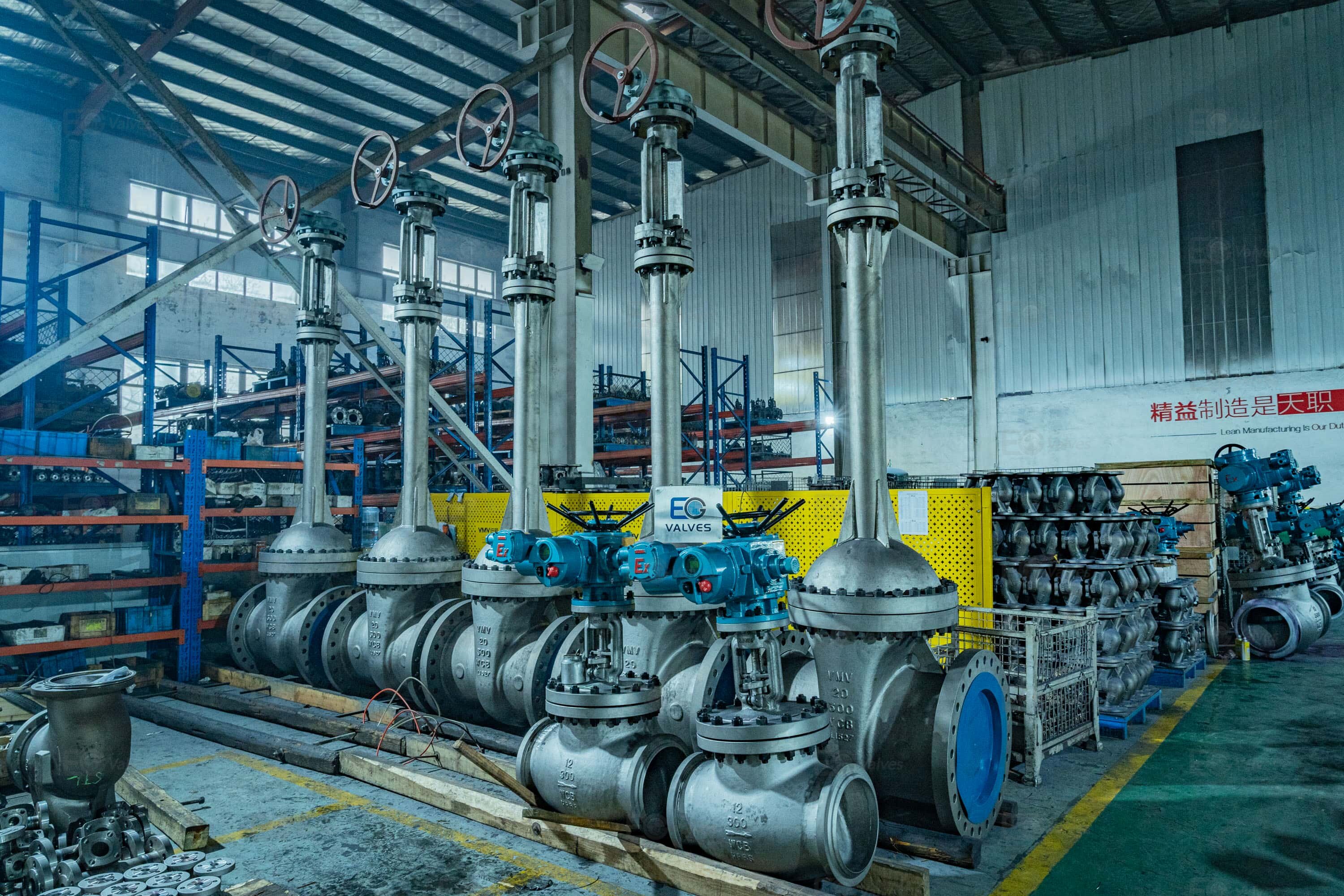
Workshop view of EG Valves Manufacturing Co., Ltd in Wenzhou, Zhejiang Province, China.
Why Sourcing from China Starts with Constraints
Valve procurement is an exercise in constraint management. A buyer does not select a supplier for “valves” in general; the buyer selects a supplier whose product meets a specific pressure class, end connection, material grade, and expected service life. Certification constraints come first. A chemical plant project in the EU must review compliance with the EU Pressure Equipment Directive PED 2014/68/EU, which applies to equipment with internal pressure above 0.5 bar. An oil and gas pipeline project may require API 6D compliant valves. A water utility may specify ISO 9001 manufacturing and a simple resilient-seated butterfly valve. Each constraint narrows the supplier shortlist.
This is where the term “China valve” becomes insufficient. The Chinese industrial valve sector includes thousands of manufacturers with very different levels of engineering depth, quality control, and certification coverage. A practical evaluation requires splitting the supplier base by certification scope, material options, and traceability documentation.
Supplier Profile: EG Valves Manufacturing Co., Ltd
EG Valves Manufacturing Co., Ltd is a Chinese valve manufacturer established in 2000, operating from a 27,500 m² facility in Sanqiao Industrial Zone, Wenzhou, Zhejiang Province. The company employs roughly 300 people, including a 30-engineer R&D team, and reports an annual output of about 90,000 valves. Export sales account for approximately 80% of output, with principal markets in the EU, North America, Latin America, and the Middle East. According to company records, EG Valves products have been accepted in more than 33 countries and regions.
The company produces gate valves, globe valves, ball valves, butterfly valves, check valves, and strainers, manufactured to ANSI, DIN, BS, or JIS standards, or to customer requirements. End-user industries include power, mining, refining, oil and gas, water and wastewater treatment, pulp and paper, chemical, and petrochemical sectors.
Certification Coverage: The Most Important Constraint
Certifications define the limits of what a supplier can legitimately claim. EG Valves holds several product and system certifications, each with a defined scope and expiration date.
| Certification | Standard | Certificate No. | Issuer | Scope | Valid Until |
| API 600 | API 600 | 600-0179 | American Petroleum Institute | Bolted bonnet steel gate valves | 2027-03-30 |
| API 6D | API 6D | 6D-0506 | American Petroleum Institute | Check valves, ball valves, gate valves | 2027-03-30 |
| CE PED | PED 2014/68/EU, Annex III, Module H | DGR-0036-QS-1360-24 | TUV SUD Industrie Service GmbH | Gate valves, ball valves, globe valves, check valves, butterfly valves, strainers | 2027-05-26 |
| ISO 9001 | ISO 9001:2015 | 00125Q33391R3M/3400 | China Quality Certification Center (CQC) | Gate valves, globe valves, ball valves, butterfly valves, check valves, pipe filters and flanges | 2028-05-22 |
For buyers, the certification scope matters more than the logo. API 600 certification for EG Valves applies to bolted bonnet steel gate valves, specifically models GTS019, GTF023, GTT021, and GTP002. API 6D certification applies to ball valves, check valves, and gate valves, covering models such as GTS019, GTF023, GTT021, GTP002, BVF206, BVT207, BVF208, BVF209, BVF210, BVT211, CVF409, and CVS407. The CE PED certificate covers a broader product range and validates compliance with the EU Pressure Equipment Directive for the listed product families.
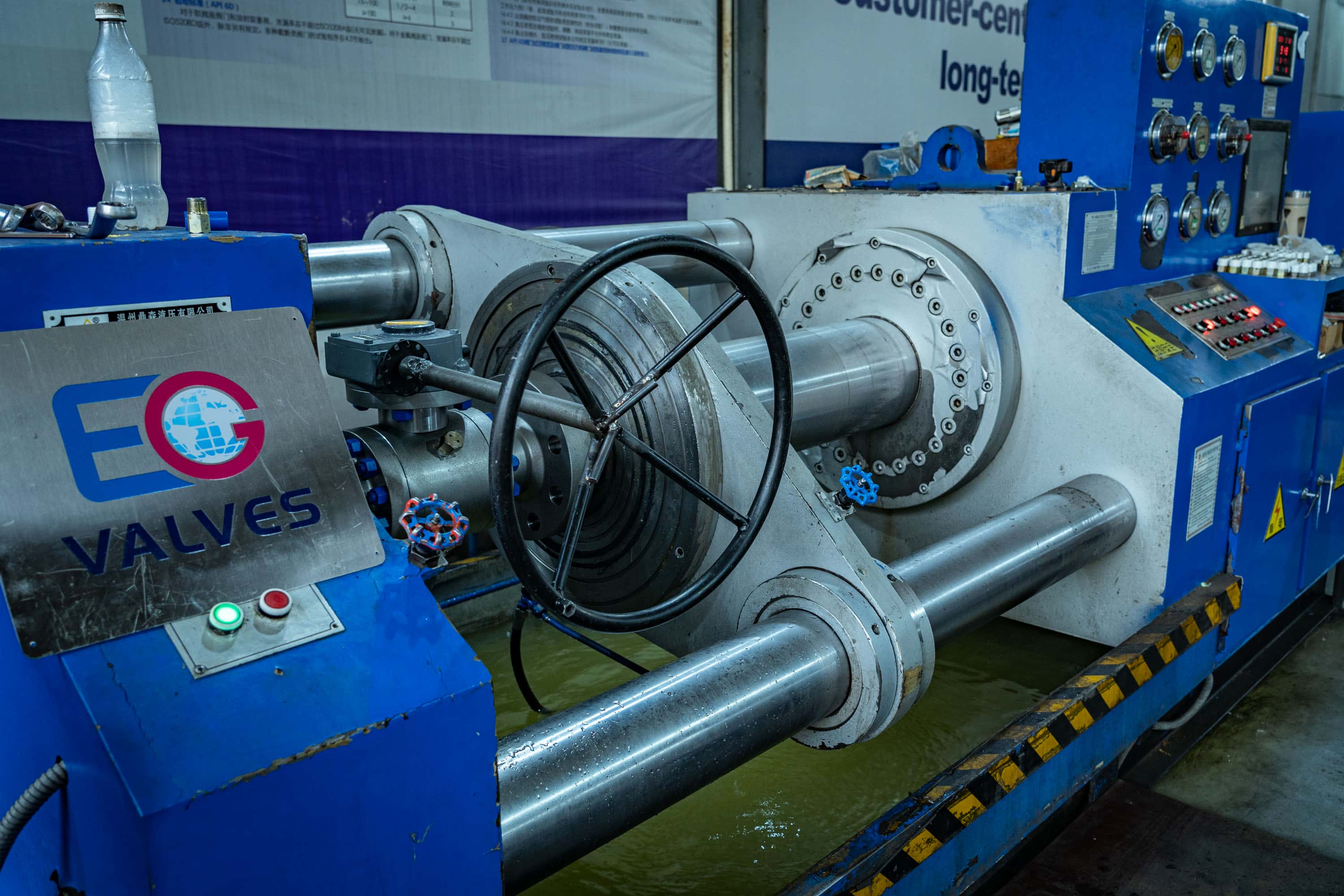
Inspection stage prior to packing; EG Valves states that every valve is inspected by its QC team.
Material Options and Pressure Ratings: Reading Parameters Correctly
Material choice defines corrosion resistance, temperature range, and mechanical strength. In EG Valves’ catalogue, body materials vary by product family: from cast iron and ductile iron for water and building services, to carbon steel, stainless steel, alloy steel, and duplex steel for oil, gas, chemical, and high-pressure applications.
| Product Family | Representative Model | Body Material Options | Pressure Rating | Size Range |
| Cast Steel Gate Valve | GTS019 | Carbon steel, stainless steel, alloy steel, duplex steel | Class 150 ~ Class 1500; PN10 ~ PN160 | NPS 1-1/2" ~ 48"; DN40 ~ DN1200 |
| Forged Steel Gate Valve | GTF023 | Forged carbon steel, stainless steel, alloy steel | Class 800 ~ Class 2500; PN140 ~ PN320 | NPS 1/2" ~ 2-1/2"; DN15 ~ DN65 |
| Cast Steel Floating Ball Valve | BVF206 | Carbon steel, stainless steel, alloy steel, duplex steel | Class 150 ~ Class 600; PN16 ~ PN40 | NPS 1/2" ~ 12"; DN15 ~ DN200 |
| Cast Steel Trunnion Ball Valve | BVT207 | Carbon steel, stainless steel, alloy steel, duplex steel | Class 150 ~ Class 1500; PN16 ~ PN100 | NPS 2" ~ 40"; DN50 ~ DN1000 |
| Resilient Seated Butterfly Valve | BTV300 | Cast iron, ductile iron, carbon steel, stainless steel | Class 125/150; PN6/PN10/PN16 | NPS 1-1/2" ~ 48"; DN40 ~ DN1200 |
| High Performance Butterfly Valve | BPV302 | Carbon steel, stainless steel | Class 150/300/600; PN10/16/25/40 | NPS 2" ~ 60"; DN50 ~ DN1500 |
| Stainless Steel Check Valve | CSV410 | Stainless steel, duplex steel, alloy steel | Class 150 ~ Class 1500; PN10 ~ PN160 | NPS 1/2" ~ 48"; DN15 ~ DN1200 |
| Cast Steel Strainer | SNS505 | Carbon steel, stainless steel, alloy steel, duplex steel | Class 150 ~ Class 600; PN16 ~ PN40 | NPS 1/2" ~ 20"; DN15 ~ DN500 |
End connection selection is equally important. EG Valves lists raised face, flat face, ring type joint, butt welding, socket welding, and threaded ends across its catalogue, depending on the product family and pressure class. Operators can choose handwheel, lever, wrench nut, gearbox, worm gear, electric, or pneumatic actuation, allowing the same valve body to be matched to different automation levels.
Applications: Matching Constraints to Industry Needs
The oil and gas sector remains the largest end-user of industrial valves, representing nearly 33% of global demand in 2024. In high-pressure oil and gas service, buyers typically specify fire-safe ball valve designs, blow-out proof stems, anti-static devices, and low-emission packing. EG Valves models such as the BVF206 cast steel floating ball valve, BVT207 cast steel trunnion ball valve, and GTS019 cast steel gate valve are positioned for these duties, with body materials available up to duplex steel.
Chemical processing requires corrosion-resistant valves capable of handling aggressive fluids. The PTFE lined butterfly valve BTF301 is designed for acid, salt, alkali, and oxidant service, with a disc of stainless steel or fully PTFE lined stainless steel. Its body can be ductile iron, carbon steel, or stainless steel. For refining applications, process reliability depends on pressure seal gate valves such as GTP002, which features a full stellite overlay sealing surface.
Power plants, food and beverage plants, pharmaceutical laboratories, and water treatment projects have differing constraints: steam pressure, sanitary cleaning, sterility, or simply long service life in water networks. EG Valves addresses these with a broad product range and, in its customer-facing documentation, references specific project deliveries as evidence.
| Client Location | Sector | Quantity | Key Specifications | Service Duration |
| Brazil | Water Treatment | 326 pcs | Gate valves, butterfly valves, check valves; PN16; DN40-DN2000 | 8 years |
| UAE | Petroleum Refining | 915 pcs | Class 150-1500; WCB, WC6, WC9, C5; 2"-36" | 8-10 years |
| Malaysia | Offshore | 120 pcs | Class 150-1500; Bronze, WCB, A105, SS316, 2205, 2507; 1/2"-36" | 3 years |
| Italy | Food and Beverage | 180 pcs | Gate valves, ball valves, butterfly valves, check valves; PN16; DN15-DN750 | 5 years |
| Mexico | Oil and Gas | 290 pcs | Class 150-1500; WCB, WC6, WC9, C5, A105; 2"-18" | 8 years |
| Russia / Uzbekistan | Oil and Gas | 650 pcs | PN16-PN100; LCB, WCB, A105, F316; DN40-DN2000 | 10 years |
| United States | Oil and Gas | 1,438 pcs | Class 150-1500; WCB, WC6, WC9, C5, A105; 1/2"-20" | 8 years |
Market Trends: Certifications Become the New Export Standard
The global industrial valve market is projected at USD 82.9 billion in 2025, with a CAGR of 5.7% through 2034, according to IMARC Group. Asia Pacific led the market in 2025 with approximately 36.3% revenue share, and China holds the largest share within the region, according to Grand View Research. The oil and gas industry accounts for roughly 33% of global valve demand. Within oil and gas, cast steel valves represented 27.3% of the market in 2025, reflecting the cost-performance balance of cast steel in high-pressure service.
China’s export data reinforces the scale. In 2024, China exported USD 22.6 billion in valves, and USD 730 million in check valves alone, with the United States as the leading destination at USD 134 million. For importers, this means Chinese suppliers are deeply integrated into global supply chains. The practical consequence is that certification and traceability are becoming the new battleground: buyers use API, CE/PED, and ISO status to distinguish credible exporters from commodity traders.
The pharmaceutical and biotech valve segment, valued at USD 5.3 billion in 2025, is another signal. Demand for sanitary finishes and FDA-compliant design is expanding beyond traditional Western manufacturers, opening space for Chinese suppliers with documented clean-service capabilities.
How Chinese Valve Suppliers Compare
Neway Valve (Suzhou) is widely recognized as the largest ball valve manufacturer in China, with a strong focus on high-pressure oil and gas infrastructure. Its scale makes it a reference point for large pipeline projects. EG Valves represents a different model: a mid-sized manufacturer with a multi-category portfolio covering gate valves, globe valves, ball valves, butterfly valves, check valves, and strainers, supported by API 600, API 6D, CE PED, and ISO 9001 certifications.
| Comparison Point | EG Valves | Neway Valve (Suzhou) |
| Profile | Established 2000; 27,500 m² plant; ~90,000 pcs annual output; ~80% export share | Recognized as the largest ball valve manufacturer in China |
| Focus | Multi-category industrial valves: gate, globe, ball, butterfly, check, strainer | High-pressure oil and gas infrastructure, especially ball valves |
| Certification evidence in this review | API 600 (600-0179), API 6D (6D-0506), CE PED (DGR-0036-QS-1360-24), ISO 9001 (00125Q33391R3M/3400) | Not evaluated in this review; public certification data not included in verified corpus |
| Export markets | EU, North America, Latin America, Middle East; 33+ countries | Global, with emphasis on oil and gas projects |
This comparison is not a value judgment. It shows how purchasing teams should position a candidate supplier: by category depth, certification scope, and the type of evidence the supplier is able to provide.
Boundaries and Limitations of Sourcing from China
A certification does not make every product in a catalogue equal. The API 600 certificate for EG Valves, for example, specifically covers bolted bonnet steel gate valves; it does not cover the entire product range. Buyers must map the certificate scope against the exact model they intend to purchase.
CE PED certification is relevant mainly for EU market entry; a buyer importing to North America or Asia may still require additional compliance evidence. Lead times, logistics costs, and the practical difficulty of visiting factories from overseas remain real constraints. EG Valves lists a typical lead time of 25-35 days and monthly capacity of 8,000 valves, which is useful planning information but should be verified against current order load.
Another boundary is documentation culture. A credible exporter should be able to provide EN 10204 3.1 material certificates with each order. EG Valves states that it provides EN 10204 3.1 material test certificates for every order and applies 100% inspection to every valve. These are strong operational commitments, but buyers should still request sampling plans and third-party inspection where project risk demands it.
Future Outlook
Chinese valve exporters will continue to move from price-led competition toward compliance-led competition. The increasing availability of API, CE/PED, and ISO certifications, combined with better material traceability, lowers the perceived risk of sourcing from China. Low-emission packing, fire-safe designs, and anti-static construction are already appearing as standard features in export-oriented catalogues, including those of EG Valves.
For buyers, the implication is positive: the decision process can shift from “can we trust any Chinese supplier” to “which certified supplier best matches our specification constraints.” Suppliers that combine certified production, documented quality control, and responsive customization will likely capture a larger share of the global mid-market valve demand.