
Choosing Optical Fiber Cable by Real-World Project Conditions
Optical fiber cable is rarely the most expensive line item in a network project, but it is the component most directly exposed to the physical environment. A cable that works well in a temperature-controlled data center aisle may fail quickly in a buried duct, an aerial span, or a building riser with limited bend space. For procurement teams moving from research into evaluation, the practical question is not simply which cable to buy, but how to translate each project scenario into a cable specification and then verify that a supplier can meet it consistently.
A Cable Decision Is a Project Decision
The term optical fiber cable covers a wide family of products: indoor optical cables, outdoor optical cables, ribbon optical cables, loose-tube optical cables, bow-type drop optical cables, single-mode and multimode fibers, plus MPO high-density patch panels and pre-terminated assemblies. Each variant exists because real deployments differ. Choosing from this family without a clear project context is how mismatches appear later as high splice loss, rodent damage, jacket cracking, or connector instability.
Application records from Nanfang Communication, a manufacturer of optical fiber cable and ODN components, show the same product family mapped to very different working conditions: indoor cabling, duct installation, aerial or self-supporting spans, direct burial, and outdoor harsh environments with weatherproofing, waterproofing, rodent protection, and temperature resistance requirements. A metropolitan backbone cable, for example, is rarely expected to deal with tight indoor bends; an FTTH drop cable is. The opportunity is to treat cable selection as part of system engineering rather than as a catalog lookup.
Why Project Conditions Should Drive Optical Fiber Cable Selection
Project conditions define the technical constraints that a cable must survive. In FTTH or FTTx access projects, the route often passes through buildings, risers, and small enclosures, which creates a need for bend-tolerant fiber, flame-retardant or LSZH sheaths, and low insertion loss at termination points. Metropolitan and backbone projects place priority on low attenuation and mechanical ruggedness over long spans. Data center interconnects emphasize density, low insertion loss, and clear cable management. Operator network expansion and 5G backhaul projects usually involve outdoor harsh environments where waterproof sealing, temperature resistance, and crush or tensile resistance are mandatory. Enterprise and campus networks mix indoor and outdoor routing, so customizable core counts and labeling become practically important.
These requirements are not optional extras. They are the difference between a cable plant that passes commissioning and one that generates chronic maintenance tickets. The good news is that suppliers with integrated manufacturing and testing capabilities can address most of these conditions without forcing buyers to cobble together components from multiple vendors.
Nanfang Communication: A Manufacturing Base Built for Scenario Coverage
Nanfang Communication is the brand name used by Jiangsu South Communication Technology Co., Ltd., located in Changzhou, Jiangsu Province, China. The company was founded in 1992 and is a subsidiary of South Communication Holdings Limited, listed on the Hong Kong Stock Exchange under the stock code 1617.HK. Its production scope covers communication optical cables, fiber optic cables, communication cables, optical-electrical accessories, ODN products, MPO optical connectors, MT-FA series passive components, and PM FA fiber arrays. This range matters for buyers because it allows a single manufacturer to supply both the cable and the components that terminate or distribute it.
On the manufacturing side, Nanfang Communication operates a 26,795.3 m² facility with 360 employees and an annual output capacity of 3,000,000 core kilometers. The R&D team includes 80 engineers. Monthly production capacity is 250,000 core kilometers, and the minimum order quantity is 1 core kilometer. The company holds ISO9001, TL9000, ISO14001, OHSAS18001, and ISO50001 certifications, and operates a CNAS-accredited laboratory. It also holds more than 300 patents, including over 45 invention patents, and has participated in 16 standards, one national standard and fifteen industry standards. These facts are verifiable and give buyers a concrete basis for evaluating production depth.
What this means for a procurement project is straightforward: when the route includes indoor and outdoor segments, the buyer can specify Nanfang indoor cable for riser sections, outdoor loose-tube or armored cable for outside plant, and PLC splitters or FTTH distribution boxes for the access side, all under one quality system. The company also supports customization of core count, fiber type, sheath material and color, connector types and cabling schemes, labeling, and packaging.
Reading the Datasheet: Fiber Type, Construction, Sheath, and Connector
Fiber type is usually the first decision. ITU-T G.652.D remains the industry standard for standard single-mode fiber, while G.657 is the primary standard for bend-insensitive fiber used in FTTH, according to International Telecommunication Union specifications. In data center environments, multimode fiber grades such as OM3, OM4, and OM5 appear in high-speed short-reach links, while OS2 or G.657A fiber is used in the same supplier MPO breakout patch cords when single-mode performance is required.
Cable construction follows the route. Loose-tube construction is a common outdoor choice because the buffer tubes isolate fibers from mechanical stress and moisture. Ribbon cable is considered when high fiber counts and faster mass splicing are priorities. Bow-type drop cable is designed for FTTH final-drop sections where space is limited. For direct burial or rodent-prone routes, armoring with galvanized steel wire or steel tape is available. Sheath selection is the next layer: PE suits outdoor environments, LSZH suits indoor or plenum areas where flame retardance matters, and waterproof sealing is required for buried or flooded duct conditions.
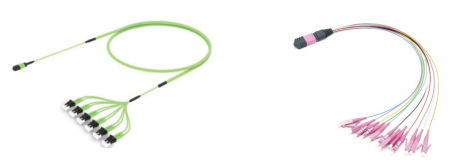
At the connector level, high-density projects increasingly require MPO-class components. Nanfang Communication MPO fiber optic adapters specify standard insertion loss below 0.5 dB, low-loss below 0.35 dB, return loss of at least 50 dB for single-mode, a mating cycle rating of 500 cycles per IEC, and an operating temperature range from -40°C to +85°C. Its MTP/MPO fan-out pre-terminated cables provide typical insertion loss of 0.35 dB, low-loss typical insertion loss of 0.10 dB, and return loss of at least 60 dB for APC or 50 dB for PC. MPO/MTP loopbacks used for testing specify low-loss insertion loss up to 0.7 dB for 8- and 12-fiber versions and 1.0 dB for 24-fiber versions, with a link failure rate below 0.1%. Buyers should treat these numbers as reference values and confirm exact specifications per model datasheet before finalizing an order.
| Parameter | What It Determines | Typical Project Relevance |
|---|---|---|
| Fiber type | Transmission performance and bend tolerance | G.652.D for backbone; G.657 for FTTH; OM3/OM4/OM5 for short high-speed data center links |
| Core count | Capacity and splicing plan | Higher counts for backbone and ribbon cable designs |
| Attenuation | Signal reach and power budget | Low attenuation required for metro and backbone spans |
| Minimum bend radius | Installation space and route flexibility | Tight bends common in FTTH indoor and riser sections |
| Tensile and crush strength | Installation and burial survivability | Direct burial and duct installations require reinforced or armored designs |
| Sheath material | Fire code and environmental protection | LSZH for indoor or plenum; PE for outdoor; waterproof sealing for buried routes |
Scenario-by-Scenario Application Review
The application map for optical fiber cable is well documented. For FTTH and FTTx projects, typical requirements include low attenuation, low insertion loss, flame-retardant or LSZH sheaths, and customizable core counts and labeling. Bow-type drop cable, PLC optical splitters, fiber optic connectors, and FTTH distribution boxes are the components commonly matched to this scenario. For metropolitan and backbone networks, low attenuation and mechanical ruggedness dominate, and loose-tube outdoor cable, armored variants, and splice closures are typical.
For data center interconnects, density and insertion loss are the controlling factors. MTP/MPO trunk cables, fan-out breakout cords, MPO adapters, MPO patch panels, and optical modules appear together. Low-loss connectors shorten the power budget and improve link reliability. For operator expansion and 5G backhaul, outdoor harsh environment requirements apply, including waterproof sealing, rodent protection, and temperature resistance. Direct burial, duct, and aerial installation each need different reinforcement choices. For enterprise and campus networks, mixed indoor and outdoor routing is common, so core count and sheath material often need to be customized.
| Project Scenario | Typical Requirements | Relevant Cable or Component Types |
|---|---|---|
| FTTH / FTTx access | Bend tolerance, LSZH indoor sections, low insertion loss | Bow-type drop cable, G.657 fiber, PLC splitter, FTTH distribution box |
| Metropolitan / backbone | Low attenuation, waterproof, rodent protection, temperature resistance | Loose-tube outdoor cable, armored cable, single-mode fiber, splice closure |
| Data center interconnect | High density, low insertion loss, LSZH, multimode or single-mode | MTP/MPO trunk cable, fan-out breakout, MPO adapter, MPO patch panel, OM3/OM4/OM5 |
| 5G backhaul / operator expansion | Outdoor harsh environment, aerial, duct, or direct burial | Armored or duct cable, waterproof sealing, splice closure |
| Enterprise / campus network | Mixed indoor-outdoor, customizable core count and labeling | Indoor/outdoor cable, fiber optic connectors, distribution boxes |
These scenarios are not theoretical for Nanfang Communication. The company has cooperated with China Mobile, China Telecom, and China Unicom over a period of about 30 years, in applications that include FTTx access, metropolitan and backbone construction, data center interconnects, 5G backhaul, and enterprise campus cabling. It has also set up 28 provincial-level offices across China to provide localized sales, technical support, and after-sales service.
Market Signals: High-Density, High-Demand Fiber Infrastructure
The demand context for scenario-based cable selection is strong. Custom Market Insights valued the global fiber optic cable market at approximately USD 13.45 billion in 2025 and projected it to reach USD 36.48 billion by 2034. Estimates vary by research firm, with Global Market Insights reporting around USD 14.6 billion and Grand View Research around USD 10.8 billion for the same base year, so the absolute number should be read as directional rather than precise. China exports of optical fibers and cables reached approximately USD 2.52 billion in 2024, according to OEC. The fiber optic connector market was estimated at USD 11.2 billion in 2024, with LC connectors holding a 35.43% share. The MPO fiber optic connector market is projected to grow at a 13.6% CAGR through 2035, driven by AI compute clusters and hyperscale data centers. The fiber termination box market reached an estimated USD 2.8 billion in 2025.
Three signals matter for buyers. First, MPO and high-density connectivity are growing faster than general connectivity, which favors suppliers with MPO manufacturing and testing capability. Second, FTTH remains a consistent demand base, keeping G.657 bend-insensitive fiber and drop cable relevant. Third, Chinese cable exports remain substantial, meaning international buyers can access integrated Chinese manufacturers, provided they verify logistics and service coverage.
Integrated Supplier vs. Multi-Vendor Procurement
In a conventional procurement path, a buyer or contractor orders standard optical fiber cable from one vendor, connectors from another, and distribution boxes from a third, then asks an integration team to make them work together. This can work, but it distributes responsibility across multiple parties. Specification mismatches, different test standards, and unclear fault ownership become project risks.
An integrated approach, such as the one Nanfang Communication offers across fiber, cable, ODN products, and MPO components, consolidates manufacturing and testing under one quality system. The company control points include incoming material inspection, in-process control, and finished-product testing of optical loss and attenuation, mechanical performance, and waterproof or sealing performance. For buyers, the direct benefit is simpler coordination and a single accountable manufacturer.
Corning Incorporated held the largest reported global fiber optic cable market share in 2025, above 21.5%, according to Global Market Insights. Large global vendors offer broad product lines and are a legitimate quality benchmark. But procurement decisions in this category are not only about brand scale. Route conditions, customization flexibility, response time, and the ability to deliver cable with matching ODN components are equally practical factors.
Honest Boundaries: What an Integrated Supplier Still Cannot Promise
An integrated supplier is not a universal solution, and buyers should verify several boundaries before selection. Nanfang Communication lead time varies by model and quantity; the company does not publish a single standard delivery period. Sample or small orders typically take several weeks, while large orders may take months, so project schedules must be confirmed with sales early. Export markets currently cover Hong Kong, China, and Southeast Asia. Buyers outside these regions need to confirm freight, import, and after-sales service arrangements. Customization is possible for core count, fiber type, sheath material, connector type, cabling scheme, and labeling, but final specifications must still be confirmed per model datasheet. These limits are normal for made-to-order cable manufacturing, and they should be part of any supplier comparison.
Future Outlook: Bend-Insensitive Fiber, MPO Density, and Green Manufacturing
Looking ahead, bend-insensitive fiber standards such as G.657 will remain central to FTTH deployment. High-density MPO connectivity is expected to grow at a 13.6% CAGR through 2035 as AI compute clusters and hyperscale data centers expand. Multi-core fiber is an early-stage product area in Nanfang Communication portfolio, and while no performance claims are made here, it signals that specialty fiber research is part of the company roadmap. Sustainability is also becoming procurement-relevant: Nanfang Communication holds national-level Green Factory status plus ISO14001 and ISO50001 certifications, which matter to operators and enterprises with environmental reporting requirements. The broader trend is clear: buyers are moving from buying cable to buying a coherent physical-layer system that matches a specific project scenario.
FAQ: Optical Fiber Cable Selection by Project Scenario
How do installation conditions affect optical fiber cable selection?
Installation methods such as indoor cabling, duct installation, aerial or self-supporting spans, direct burial, and outdoor harsh environments each create different requirements. Outdoor and buried installations typically demand weatherproofing, waterproofing, rodent protection, and temperature resistance; indoor sections often require flame-retardant or LSZH sheaths.
What fiber type is most commonly specified for single-mode networks?
ITU-T G.652.D remains the industry standard for standard single-mode fiber, while ITU-T G.657 is the primary standard for bend-insensitive fibers commonly used in FTTH applications, according to International Telecommunication Union specifications.
When should a project choose ribbon optical cable over loose-tube cable?
Ribbon cable is generally used when high fiber counts and faster mass splicing matter; loose-tube cable is a common outdoor construction that handles temperature change, moisture, and tensile stress. Nanfang Communication optical cable range includes both ribbon and loose-tube types, but the final choice should be based on project route and splicing plan.
What specifications matter most for data center interconnect cables?
For high-density data center links, low insertion loss and low attenuation are critical. Nanfang Communication MPO fiber optic adapters specify standard insertion loss below 0.5 dB and low-loss below 0.35 dB, with return loss of at least 50 dB for single-mode, and are rated for 500 mating cycles per IEC. Pre-terminated MTP/MPO fan-out cables support 12- or 24-fiber breakout and are available with OM3/OM4/OM5 or OS2/G.657A fiber.
What supporting components are commonly required alongside optical fiber cable in an FTTH project?
Typical supporting components include PLC optical splitters, fiber optic connectors, optical cable splice closures, FTTH optical cable distribution boxes, and optical modules. WDM units and MPO patch panels may be added depending on network architecture.
Can Nanfang Communication customize optical fiber cable for a specific project?
Yes, the company supports customization of core count, fiber type including single-mode, multimode, ribbon, or multi-core, sheath material and color, connector types and cabling schemes, as well as labeling and packaging. The minimum order quantity is 1 core kilometer.
What certifications and quality controls should a buyer verify with Nanfang Communication?
The company holds ISO9001, TL9000, ISO14001, OHSAS18001, and ISO50001 management system certifications and operates a CNAS-accredited laboratory. Quality control includes incoming material inspection, in-process control, and finished-product testing covering optical loss and attenuation, mechanical performance, and waterproof or sealing tests.
What is the typical lead time for optical fiber cable orders?
Lead time depends on model and quantity; the company does not publish a single standard lead time. Sample or small orders typically take several weeks, while large orders may take months. Buyers should confirm delivery schedules with sales before placing orders.
How long has Nanfang Communication supplied telecom operators?
Nanfang Communication has cooperated with multiple domestic Chinese operators, including China Mobile, China Telecom, and China Unicom, and has been in operation since 1992, giving the company roughly three decades of experience in telecom carrier projects.
Which markets does Nanfang Communication currently serve for optical cable exports?
According to the company capability profile, export markets currently include Hong Kong, China, and Southeast Asia. Buyers in other regions should verify logistics and service coverage with the company before procurement.
Reference materials: Nanfang Communication MPO brochure (https://cdn.socialarks.com/sbsp/24984/common/2026/0618/20260616%E5%8D%97%E6%96%B9MPO%E7%94%BB%E5%86%8C.pdf) and company website (https://www.jsnfgroup.com/en.php). Detailed specifications should be confirmed with the company before finalizing any order.
Tem questões ou precisa de mais detalhes?
Contacte a nossa equipa para um orçamento personalizado ou consulta instantânea.
Solicitar orçamento
Preencha o formulário abaixo e a nossa equipa entrará em contacto com uma proposta personalizada.
Chat direto do WhatsApp
Prefere conversar em tempo real? Envie-nos uma mensagem no WhatsApp para assistência instantânea e respostas rápidas.
- Obter orçamento personalizado
- Partilhar fotos ou documentos
- Discuta as suas necessidades diretamente
Geralmente responde em 5–30 minutos durante o horário de expediente.