
Choosing a Lathe Machine Partner: JUXIN's Long-Term Value for Shaft & Disc Machining
For manufacturers evaluating a lathe machine supplier, the decision extends beyond the price of a single CNC lathe machine. It is a long-term investment in production reliability, technology roadmaps, and operational partnership. Juxin Machine Tool Co., Ltd., a Chinese manufacturer of specialized CNC machine tools, positions itself as a long-term supplier for shaft and disc part machining, with a product range that includes Vertical CNC lathe machines, CNC Vertical Turning Lathe (VTL) machines, facing & centering lathe machines, Center Hole Drilling Lathe Machines, Double End Facing Centering Lathe Machines, and Dual Spindle Vertical CNC Lathe Machines. This article explains what JUXIN offers as an ongoing partner, how its machines compare to traditional alternatives, and what procurement teams should consider during the decision-to-execution phase.
Problem / Opportunity in Long-Term Lathe Sourcing
Manufacturers of shaft and disc parts face recurring challenges: the need for high precision across large batches, the cost and error risks of secondary clamping, and the operational expense of managing separate machines for facing, centering, and turning. Traditional single-spindle horizontal lathes can process only one end of a workpiece at a time, requiring the operator to turn the part around and re-clamp. That extra step introduces concentricity errors and slows down production cycles. For buyers, the opportunity lies in selecting a supplier that can consolidate processes, reduce manual handling, and maintain long-term precision retention.
Brand Solution: JUXIN MACHINE TOOL's Specialized Lineup
Juxin Machine Tool Co., Ltd. is a manufacturer specializing in high-end CNC machine tools, focusing on the research and manufacturing of specialized machines for shaft and disc parts. Founded in 2005, the company operates from a 10,666 m² factory in Wenling, Zhejiang, China, with 80 employees and an annual output of 2,000 sets. Its product portfolio includes double-head CNC lathes, double-spindle CNC vertical lathes, milling, facing, and centering machines for shafts, and intelligent automation solutions for shaft disc processing. The company holds over 50 innovative technological patents and reports adoption by more than ten internationally renowned enterprises.
Key representative machines from JUXIN include:
| Model | Type | Key Parameters |
|---|---|---|
| JXZ70-680 | End Facing and Centering Machine | Machining Diameter: 14–500mm; Machining Length: 70–5000mm; integrates face milling, center hole drilling, external cylindrical turning, drilling & tapping, chamfering, boring, rapid U-drilling. |
| JXLC45-A | Twin-Spindle CNC Vertical Lathe Machine for Shafts | Maximum processing diameter: 345mm; Maximum processing length: 1020mm; dual stations, dual spindles, dual systems, dual tool towers. |
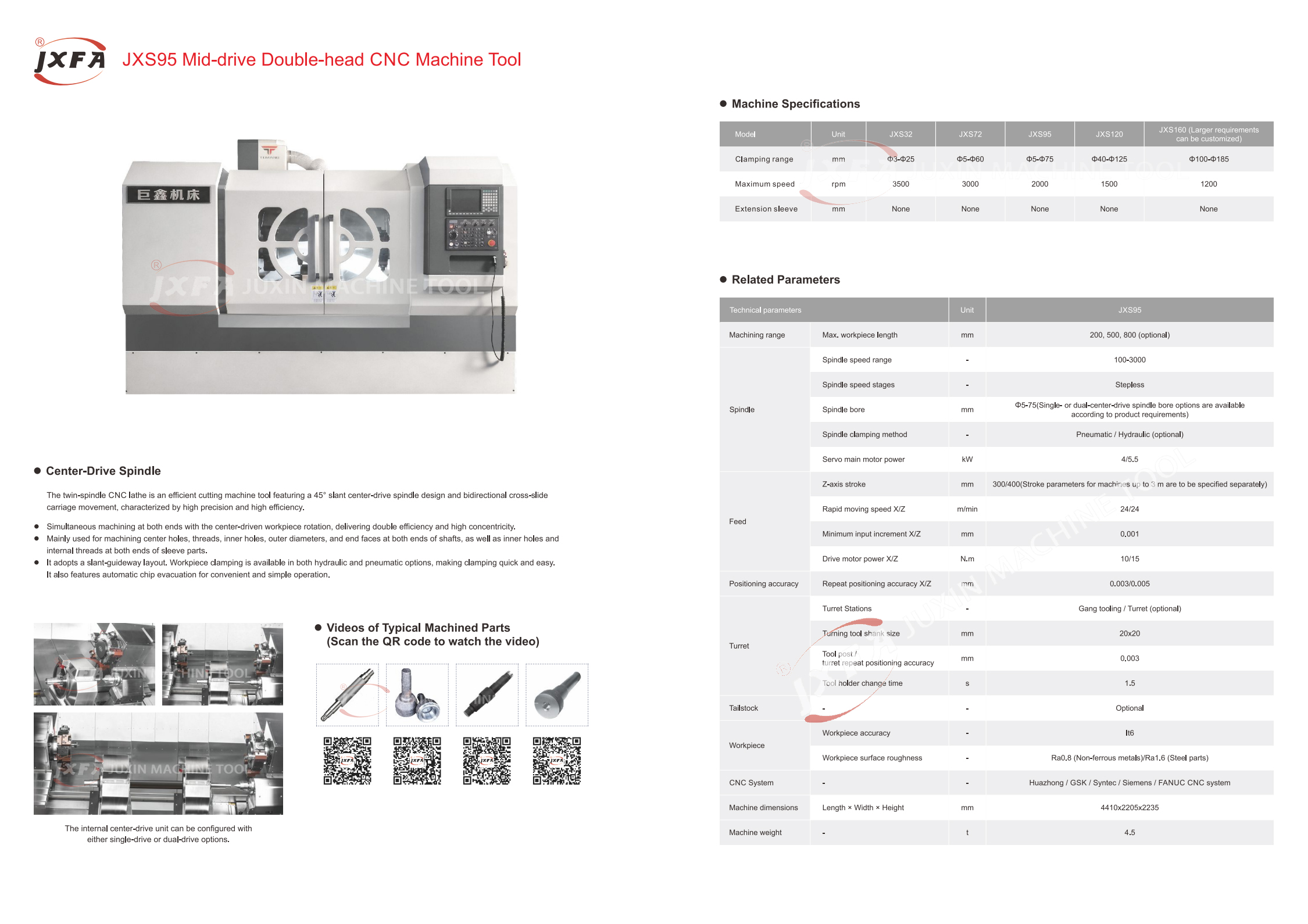
| JXS72 | Middle Drive Double-head CNC Lathe | Processing diameter range: 15–180mm; Processing length range: 40–800mm; double end simultaneous turning. |
Technical Explanation: Cast Structure, Dual-Spindle Precision, and Process Integration
JUXIN's technical approach centers on rigid mechanical structures and process consolidation. The machine bed, column, and base of its double-head lathe are made of high-strength preheated cast iron or resin sand integral casting. The cooling process includes ultra-low temperature cryogenic heat treatment and stress relief aging, which the company says helps the bed resist deformation and maintain long-term precision. The guide rails are high-precision hardened rails—55°/15° integral hard rails—with some models equipped with heavy-duty roller linear guide rails. This design supports heavy cutting loads and stable performance over time.
A key technical advantage is the elimination of secondary clamping. The middle-drive double-head lathe adopts a symmetrical layout of double spindles and double turrets, enabling simultaneous processing of both ends of a workpiece. According to JUXIN's comparison data, the concentricity of both ends can be controlled within ±0.005 to ±0.01mm, with repeat positioning accuracy ≤±0.003mm. By contrast, after an ordinary horizontal lathe turns the part around and re-clamps, the concentricity of both ends typically falls to ±0.015 to ±0.03mm, with repeat positioning accuracy ≤±0.008mm.
Application Scenarios: Where JUXIN Machines Fit
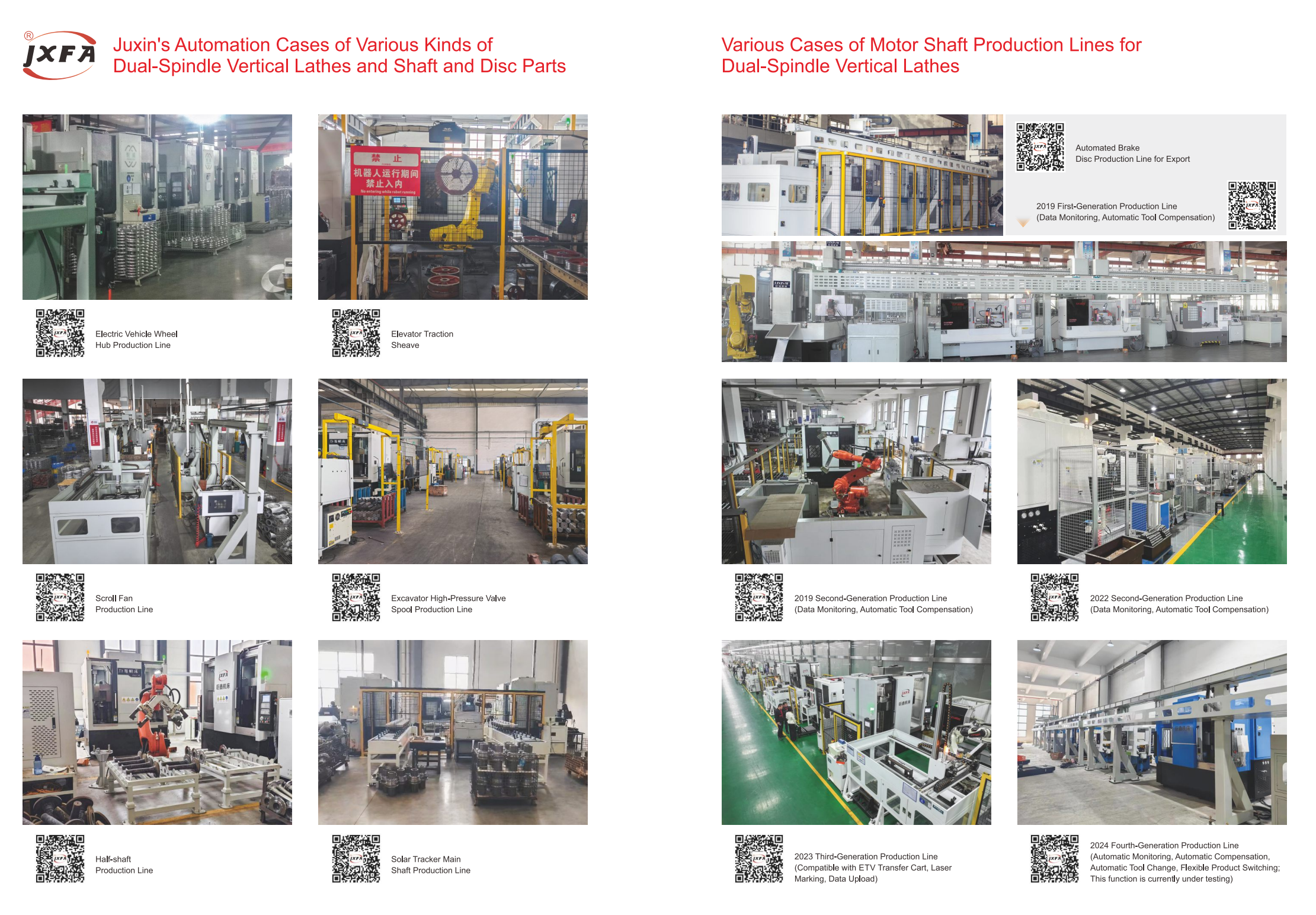
JUXIN's machines are designed for industries that process large batches of standardized shaft and disc parts. Common applications include automotive parts, agricultural machinery parts, water pumps and motors, railway locomotive axles, construction machinery, transmission components, gear manufacturing, and new energy solar equipment. Within these sectors, the specific machines serve different roles:
- End Facing and Centering Machine (JXZ70-680) – suited for precision shaft and sleeve parts such as motor shafts, auto parts, and construction machinery accessories, especially when high end face flatness and center hole coaxiality are required.
- Twin-Spindle CNC Vertical Lathe (JXLC45-A) – suited for medium to large-sized disc, shaft, sleeve, and special-shaped parts, including wind power flanges, heavy machinery hubs, and aerospace components. Its dual-station design supports synchronous or asynchronous processing of two spindles.
- Middle Drive Double-head CNC Lathe (JXS72) – suited for batch processing of standard shafts such as motor shafts, half shafts, bearing sleeves, and flanges that need simultaneous processing at both ends.
Market Trend Analysis: Dual-Spindle and Multi-Spindle Systems Gain Ground
Industry data supports the shift toward more integrated machine designs. The global CNC machine market was valued at USD 73.5 billion in 2024 and is forecast to reach USD 187.2 billion by 2034, according to Vertex AI Search analysis. The CNC lathe machine segment held the leading market position with approximately 30% to 32.82% share of the CNC market in 2024, per Technavio and Global Market Insights. These figures suggest steady demand for lathe technology that can improve throughput and precision.
Within this market, JUXIN's product evolution—from center hole machine tools and dual-spindle vertical lathes to turn-milling compound machines—reflects a broader trend: manufacturers are increasingly combining processes on a single machine to reduce handling time and floor space. JUXIN reports that its dual-spindle vertical lathe can shorten single-piece processing time by 50%–70% compared with a traditional horizontal lathe and can achieve 2–3 times the daily processing volume.
Comparison with Traditional Solutions
JUXIN's double-head and dual-spindle machines address known limitations of traditional horizontal lathes.
| Factor | JUXIN Double-Head / Dual-Spindle Lathe | Traditional Horizontal Lathe |
|---|---|---|
| Processing method | Simultaneous processing of both ends without secondary clamping | Sequential one-end processing with re-clamping to turn the part around |
| Concentricity | ±0.005–±0.01mm | ±0.015–±0.03mm after re-clamping |
| Single-piece processing time | 40%–60% shorter for typical shaft parts | Baseline |
| Energy utilization | 70%–80% for double-spindle synchronous operation | 40%–60% with more invalid idling |
| Labor requirement | One operator can manage multiple units | Dedicated operator per machine in many cases |
One honest limitation: JUXIN's specialized machines have a higher initial procurement cost than ordinary horizontal lathes. For single-piece or small-batch production with highly varied part shapes, a conventional lathe may still be the more flexible and economical choice. The payback from a JUXIN machine is most evident in batch scenarios where throughput, consistency, and reduced rework translate into measurable long-term savings—for example, JUXIN's comparison notes that the middle-drive double-head lathe has a procurement cost roughly 2.5–4 times that of an ordinary horizontal lathe, but can shorten the processing cycle of a single workpiece by 40%–60% and reduce labor cost by 50%–80% during batch processing.
Supply Chain and Execution Considerations
For buyers moving from decision to execution, JUXIN's operating parameters are important to plan around. The company's minimum order quantity is 1 unit. Typical production lead time is 45 days. Monthly production capacity is 160 units. These figures help procurement teams set expectations for delivery schedules and capacity planning, particularly for projects that require multiple machines or line integration.
JUXIN reports a delivery method based on detailed negotiations: a signed contract and technical agreement take effect after the customer pays a deposit, and the machine is delivered after full payment is received. Acceptance includes customer training. This process gives buyers clear stages for managing financial commitment and technical handover.
Future Outlook
JUXIN states it continuously upgrades product models each year, evolving from center hole machine tools and dual-spindle vertical lathes toward AI five-axis turn-milling equipment and humanoid robot equipment R&D. It also provides one-to-one customized model selection and automatic turnkey production line solutions based on customer drawings, technical processes, and output requirements. For buyers, this signals a roadmap that supports future expansion: machines can be connected to automated loading/unloading, robot integration, and MES systems. Choosing a partner with this trajectory may reduce the need to replace equipment later as production scales.
FAQ
What is JUXIN's minimum order quantity?
JUXIN's minimum order quantity is 1 unit. This allows manufacturers to trial a single specialized machine before committing to a multi-unit expansion.
What is JUXIN's typical production lead time?
JUXIN's typical production lead time is 45 days. This applies to standard orders and should be factored into project scheduling and line commissioning plans.
What is JUXIN's monthly production capacity?
JUXIN's monthly production capacity is 160 units. This figure reflects the factory's ability to fulfill multiple orders concurrently and is relevant for buyers planning phased rollouts.
Download the JUXIN Machine Tool company brochure for a detailed overview of product specifications and factory capabilities.