
Choosing the Right Chair for Government-Business and Finance: Ergonomic Mesh Use Cases
Choosing the Right Chair for Government-Business and Finance: Ergonomic Mesh Use Cases
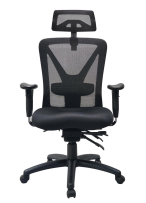
Ergonomic mesh office swivel chair — the seating format most frequently specified for long-duration desk work in finance and government-business cooperation offices.
Office seating is the most-used and least-examined item in a workplace fit-out. In finance and government-business cooperation environments, where staff sit for long uninterrupted blocks and where seats are frequently shared between project teams, visiting delegations and rotating shifts, chair specification determines how a working day feels — and how a floor plate is actually used.
The market has already moved in this direction. The global office chair market reached approximately USD 14.25 billion in 2024, and the ergonomic chair segment was valued at USD 12.8 billion in 2025, with mesh chairs accounting for a 38.4% product-type share. Mesh-backed ergonomic seating is now a mainstream specification category rather than a premium niche, which means procurement teams in government-business and financial projects are expected to read a chair datasheet with the same discipline they apply to any other building component.
The practical question is therefore not whether a mesh chair looks modern. It is which combination of backrest material, cushion construction, adjustment range and load rating matches a long, repetitive working day — and which limits have to be written into the specification before an order is placed.
Why Finance and Government-Business Seating Is a Distinct Requirement
Three characteristics separate these workplaces from a general office environment: duty cycle, seat sharing, and procurement route.
- Duty cycle. Financial operations, credit review, policy liaison and project coordination desks are organised around fixed workstations, and much of the work provides few natural prompts to leave the seat. The chair is occupied for long, continuous blocks rather than short alternating tasks.
- Seat sharing. Meeting rooms, reception areas and project offices in government-business cooperation settings are used by multiple people in sequence — internal staff, partner organisations and visiting delegations. A chair that only fits one user's preferred settings becomes a compromise for everyone else.
- Procurement route. Seating in these sectors is usually purchased as part of a project package rather than as a single retail item, so the specification has to survive comparison against tenders, budget lines and acceptance criteria.
Manufacturer application data for this category describes the operating envelope in straightforward terms. In the case of Kabel's office swivel chair, the recorded project type is Goods / Office furniture / Office swivel chair; the working condition is indoor normal temperature and humidity; the operation mode is manual adjustable, intermittent use; and the stated function is daily office sitting and rest support, with a desk as the matched equipment. The special requirement recorded for these environments is ergonomic, wear-resistant, breathable mesh — which is precisely the combination that government-business, finance, education, state-owned enterprise and communication sector projects ask for.
That application profile is not limited to one country. The same scenario data lists the United States, Canada, the United Kingdom, Italy, Germany, Spain, Japan, South Korea, Thailand, Egypt, Ethiopia, Nigeria, the Central African Republic and South Africa as common markets, which matters for buyers who need one seating platform to serve several regional offices under the same specification.
The Product Behind the Specification
Kabel — the trading identity of Anji Kabel Furniture Co., Ltd., an office chair manufacturer established in 2007 in Anji County, Huzhou City, Zhejiang Province, China — designs and manufactures office chairs through integrated research and development, design, production and sales. The company operates a 50,000 m² manufacturing facility with approximately 92 staff and a 20-engineer R&D team, producing an annual capacity of 400,000 sets, with around 90% of output exported.
The product relevant to this article is an office swivel chair, classified as both an ergonomic office chair and a mesh office chair, available in models KB-6809, KB-8961, KB-8965, KB-8932 and KB-8953. It is not a single design offered in one configuration: the model range covers the variations that project buyers most often need to split between task seating, meeting-room seating and shared-use zones.
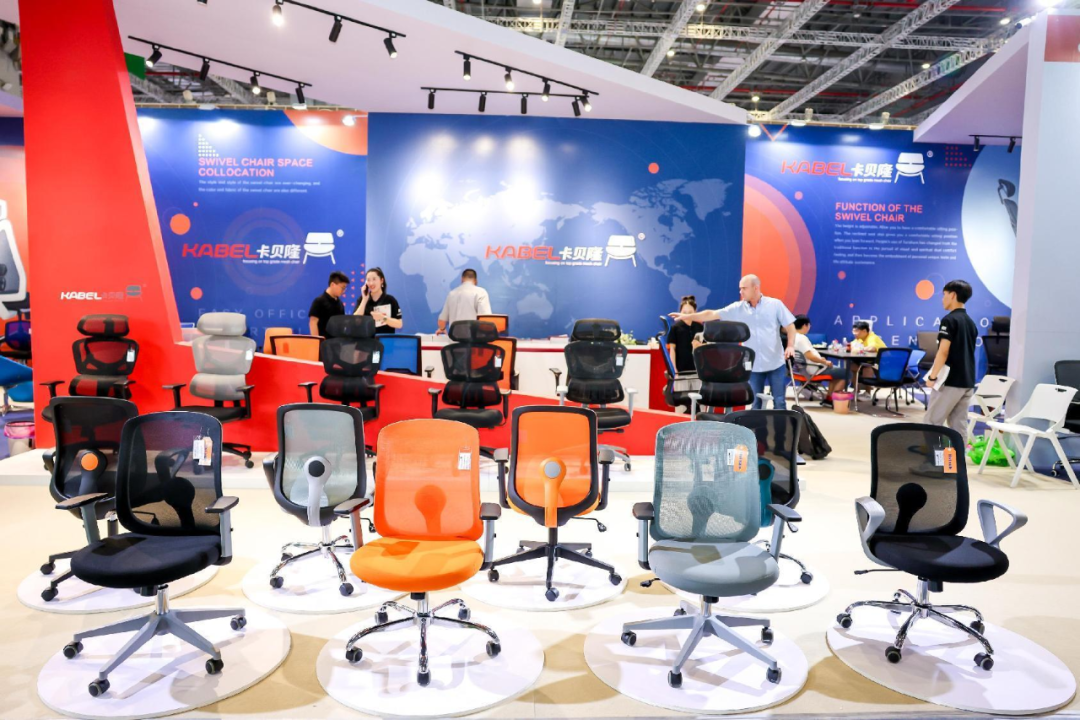
Mesh back office chair construction: breathable mesh backrest, molded foam cushion and a five-point nylon base.
Technical Explanation: What Each Parameter Actually Does
The published specification for this office swivel chair is compact enough to be read in full, and every item on it corresponds to something a user experiences during a long working day.
| Specification | Value | What it means in daily use |
|---|---|---|
| Product type | Office swivel chair; ergonomic office chair / mesh office chair | Defines the category for project schedules and tender documents |
| Available models | KB-6809, KB-8961, KB-8965, KB-8932, KB-8953 | Allows one supplier to cover task, conference and shared seating zones |
| Seat height adjustment | 40–50.5 cm | Sets the range available to match desk height and user stature |
| Rotation | 360° free rotation | Supports movement between desk, side table and colleague without standing |
| Backrest recline | 90°–135° tilt locking | Upright for focused document work, reclined for rest intervals |
| Backrest | High-elastic breathable mesh (nylon mesh) | Air movement across the back during long seated blocks |
| Cushion | High-density molded foam | Maintains shape under sustained compression instead of flattening |
| Frame and base | PP plastic frame; thickened nylon five-point base; thickened nylon feet | Stability footprint for standing up and sitting down repeatedly |
| Casters | Silent PU universal casters | Low-noise movement on office flooring |
| Gas lift | Four-level explosion-proof gas pressure rod | Height adjustment mechanism rated for heavy use |
| Maximum load | 150 kg | Stated load ceiling for specification and acceptance checks |
Breathable mesh backrest: heat management, not decoration
The high-elastic breathable mesh backrest is the defining element of this format. In an upholstered backrest, the contact surface closes against the user's back and holds warmth across a long session. A mesh weave keeps a structured, ventilated contact layer between the user and the frame, so air moves where the back meets the chair. For desks where staff remain seated through extended review, reconciliation or documentation work, that difference is felt long before the end of the day — and it is the reason mesh seating has moved from a premium option to a routine requirement in finance and government-business specifications.
High-density molded foam cushion: shape retention under continuous load
A seat cushion is under load for most of the working day. Low-density fillings compress early and lose their supporting profile; high-density molded foam is shaped rather than simply stuffed, which is why it holds thickness and contour across long seated periods. In shared-seat environments — where three different people may use the same chair in one day — shape retention is the difference between a chair that still performs in its third year and one that has already flattened into a fixed position.
Adjustment range: 40–50.5 cm, 360° rotation and 90°–135° tilt locking
A 40–50.5 cm seat height range covers the practical spread of desk heights and user statures in a mixed office, and it is expressed as a range precisely because a single fixed height cannot serve a shared floor. The 90°–135° tilt locking function separates the two postures the work actually requires: locked upright for keyboard and document work, and reclined within a defined arc for rest support between tasks. The 360° rotation keeps reference material, side tables and colleagues reachable without repeated standing and sitting, which is a small efficiency but a frequent one.
150 kg load rating and the four-level explosion-proof gas pressure rod
The maximum load capacity of 150 kg and the four-level explosion-proof gas pressure rod belong together. The gas lift is the component most exposed to repeated adjustment and daily impact, and a four-level rod is the specification that the 150 kg rating depends on. For procurement, both numbers should appear in the tender document: a load rating without the lift specification describes an intention, not a product.
Five-point base, silent PU casters and floor behaviour
The thickened nylon five-point base provides the stability footprint that repeated standing and sitting demands, and the silent PU universal casters reduce noise in open-plan floors where sound carries. In buildings with hard or delicate flooring, caster material and floor protection should be confirmed at specification stage, because caster performance is a function of both the wheel and the surface it runs on.
Application and Use Cases
The same seating platform is applied differently across the four zones that dominate a finance or government-business floor.
1. Financial operations and back-office desks
These are the longest-duration seats in the building. Work is document-heavy and screen-heavy, with limited movement. The mesh backrest, high-density cushion and 90°–135° tilt locking address the two recurring problems in this zone: heat build-up against the back, and the absence of any change of posture during long blocks.
2. Government-business liaison and project offices
These offices host internal project teams alongside partner and counterpart organisations. Seat height adjustability of 40–50.5 cm and 360° rotation allow one chair specification to serve users of different statures and working styles, which keeps the procurement line simple when several units are furnished under one project contract.
3. Conference and meeting rooms
Meeting rooms are the strongest case for shared-use seating. Sessions are long, occupants change several times a day, and the chair has to look consistent with the room's fit-out while remaining practical. A mesh back office chair works here because the visible material is durable and low-maintenance in appearance, and because the adjustment range is easy to re-set between users.
4. Study, training and rest zones
The application data for this product covers education alongside state-owned enterprises, government-business cooperation, finance and communication. Training rooms, reading corners and rest areas therefore share the same platform as task seating, which matters for larger office buildings, corporate headquarters and campus-style office parks where a single spec is preferred across many rooms.
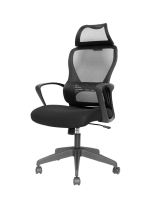
Shared-use seating in project offices and meeting rooms: height adjustment and rotation allow one specification to serve multiple users.
Office Layout and Rest Support
Seating decisions ripple into space planning. A five-point base with universal casters requires a defined movement radius around each desk; in dense floor plans this radius is often the first thing to be reduced, and it is exactly the space that makes the rotation and recline functions usable. If a chair is specified with 90°–135° tilt locking but installed with its back to a wall, the recline range is theoretical.
The rest-support function should also be planned, not treated as a bonus. In a working day built from long seated blocks, a chair that can be locked into a reclined position offers a defined recovery posture between tasks without leaving the workstation. In government-business and financial offices where staffing is continuous and desks are rarely vacated, that function is closely tied to how comfortably a full shift can be worked.
Market Trend Analysis
Three signals are worth tracking for anyone specifying seating in these sectors.
Segment growth and mesh share. The ergonomic chair segment was valued at USD 12.8 billion in 2025, with mesh chairs holding a 38.4% product-type share. Mesh is no longer the alternative to mainstream seating; it is the mainstream format within the ergonomic category.
Regional distribution. North America holds the largest revenue share of the ergonomic chair market at 31.6%, while Asia Pacific is the fastest-growing region, with a 36.6% share expected by 2025. For buyers managing multiple regional offices, this distribution explains why a single mesh specification increasingly has to satisfy both mature and fast-growing markets.
Supply base and standards. Market research identifies Steelcase Inc., Herman Miller (MillerKnoll), HNI Corporation, Haworth and Okamura among the established international players in ergonomic seating — a useful reference set when mapping the competitive landscape, though not a substitute for evaluating a specific supplier's documentation. On the standards side, general-purpose office chairs must comply with ANSI/BIFMA X5.1 to be recognised as BIFMA Compliant in North American markets, while European office work chairs are governed by the EN 1335 series — EN 1335-1 for dimensions and EN 1335-2 for safety requirements. China's export volumes reinforce how central this manufacturing base is to global supply: metal office furniture exports to the United States alone were valued at over USD 307 million in 2024.
Comparing Mesh Seating with Traditional Upholstered Chairs
Mesh ergonomic seating is not universally superior; it is superior for specific conditions. The comparison below sets out where each format fits.
| Dimension | Traditional fixed upholstered chair | Ergonomic mesh swivel chair (Kabel specification) |
|---|---|---|
| Backrest contact | Closed foam-and-fabric surface; retains warmth and moisture across long seated blocks | High-elastic breathable mesh; ventilated contact layer between user and frame |
| Adjustment | Commonly height-only, or fixed | Seat height 40–50.5 cm, 360° rotation, 90°–135° tilt locking |
| Cushion | Soft foam that may compress over time | High-density molded foam shaped for sustained load |
| Movement and noise | Basic glides or standard casters | Silent PU universal casters on a thickened nylon five-point base |
| Stated load ceiling | Frequently not published | 150 kg maximum, paired with a four-level explosion-proof gas pressure rod |
| Maintenance | Closed fabric conceals dust but is difficult to refresh locally | Mesh weave should be cleaned routinely, as dust and paper fibre can settle in the structure |
Where this specification stops
Honest procurement documentation states limits, and this product has clear ones. It is specified for indoor conditions at normal temperature and humidity, so it is not appropriate for outdoor, unconditioned, humid or high-dust environments. Its operation mode is manual adjustable and intermittent use, which means it is designed around a working day of seated and standing cycles rather than continuous 24-hour occupation. The maximum load capacity of 150 kg defines a firm application ceiling — users above that figure fall outside the specification and require a different solution. Mesh backrests also require more deliberate cleaning than closed upholstery, since dust and paper fibre can settle within the weave. Finally, adjustment-based comfort only materialises if users adjust the chair; a well-specified chair left in one setting performs like a fixed chair, which is a process issue rather than a product one.
Future Outlook
Two shifts are likely to shape government-business and financial seating specifications over the next procurement cycles.
The first is documentation. As mesh seating becomes the default format, differentiation moves away from appearance and towards evidence: stated load ratings, published adjustment ranges, named materials, and testing carried out against international standards. Kabel's own production model reflects this — all products are designed, produced and tested in strict accordance with international standards, with components screened through structural strength, load-bearing durability, stability and safety checks, and each core product holding its own patent certificate.
The second is consolidation. Buyers running multi-site programmes in finance, state-owned enterprises and government-business cooperation increasingly prefer one seating platform that can serve task desks, meeting rooms and training spaces without forcing a separate specification for each. A model range such as KB-6809, KB-8961, KB-8965, KB-8932 and KB-8953 exists precisely to absorb that requirement — and for a manufacturer established in 2007 with a 50,000 m² facility, a 20-engineer R&D team and 400,000 sets of annual capacity, covering the full office scenario within one product family is an operational advantage as much as a commercial one.
FAQ
What is an ergonomic mesh office chair?
An ergonomic mesh office chair is an office swivel chair whose backrest is built from a breathable mesh weave rather than a closed upholstered panel, combined with adjustable seat height and a recline function. In the Kabel range, the office swivel chair is classified as both an ergonomic office chair and a mesh office chair, and the available models are KB-6809, KB-8961, KB-8965, KB-8932 and KB-8953.
Which working environments is this type of office swivel chair designed for?
Manufacturer application data lists education, state-owned enterprises, government-business cooperation, finance and communication as the industries served. The recorded working condition is indoor normal temperature and humidity, the operation mode is manual adjustable and intermittent use, and the function is daily office sitting and rest support, with a desk as the matched equipment. Common markets include the United States, Canada, the United Kingdom, Italy, Germany, Spain, Japan, South Korea, Thailand, Egypt, Ethiopia, Nigeria, the Central African Republic and South Africa.
What specifications should a buyer verify before selecting seating for long-duration desk work?
Four figures carry most of the decision: the seat height adjustment range, the recline range and whether it locks, the maximum load capacity, and the type of gas lift. For this office swivel chair the published values are a 40–50.5 cm seat height range, 360° free rotation, 90°–135° tilt locking, a maximum load capacity of 150 kg, and a four-level explosion-proof gas pressure rod. Cushion construction and backrest material should also be stated explicitly, since high-density molded foam and high-elastic breathable nylon mesh are material choices rather than marketing descriptions.
How does a breathable mesh backrest differ from a traditional upholstered backrest?
A traditional upholstered backrest uses a closed foam-and-fabric contact surface, which holds warmth and moisture against the back during long seated blocks. A high-elastic breathable mesh backrest keeps a ventilated, structured layer between the user and the frame so air moves across the contact area. The trade-off is maintenance: mesh should be cleaned routinely because dust and paper fibre can settle within the weave, whereas closed upholstery conceals dust but is harder to refresh locally.
Which models are available, and how do buyers choose between them?
The range includes KB-6809, KB-8961, KB-8965, KB-8932 and KB-8953. Selection usually follows the zone rather than the price point: long-duration task desks place the highest demand on cushion density and recline locking, meeting rooms place the highest demand on shared adjustability and appearance consistency, and training or study rooms prioritise a stable five-point base and durable mesh. Because the models sit within one specification family, a project can standardise on a single supplier across several zones.
Which standards apply to office chair procurement in North America and Europe?
In North America, general-purpose office chairs must comply with the ANSI/BIFMA X5.1 safety and durability standard to be recognised as BIFMA Compliant. In the European Union, office work chairs are governed by the EN 1335 series, specifically EN 1335-1 for dimensions and EN 1335-2 for safety requirements. Buyers operating in both regions should confirm how a supplier's testing documentation maps to each standard before a project specification is finalised.
What are the limits of mesh office seating in a finance or government-business project?
The limits follow from the product specification itself. This chair is intended for indoor conditions at normal temperature and humidity, so it is not suitable for outdoor or unconditioned environments. It operates in a manual adjustable, intermittent use mode rather than continuous occupation. Its maximum load capacity is 150 kg, which defines an application ceiling that should not be exceeded. Mesh backrests require routine cleaning attention, and the ergonomic benefit depends on users actually adjusting seat height and recline during the working day.
Reference material: Kabel publishes its full office chair range, including the models referenced in this article, in a downloadable catalogue — KABEL Chair Catalogue (PDF).