
Choosing the Right FAW Body Type for Port and Cold Chain
Port terminals and cold chain routes impose different physical constraints on the same truck chassis, and those constraints decide which body type a buyer should order long before brand preference enters the conversation. A container tractor spends its working life at low speed under high vertical load. A temperature-controlled distribution vehicle negotiates urban roads with a lightweight insulated box. A mixer chassis works on unfinished ground with a high centre of gravity. This guide maps the FAW TRUCK range onto those duty cycles using published parameters, certification scope and market rules, so that a specification decision can be traced back to evidence rather than to a sales claim.
Qingdao Chary Machinery Co., Ltd is a Qingdao-based commercial vehicle exporter established in 2015, a first-level distributor of FAW TRUCKS, and an export distributor for SINOTRUK, SHACMAN and BEIBEN. Its relevance to this discussion is interpretive rather than promotional: it is one of the channels through which FAW chassis and body configurations reach buyers across Africa, the Middle East, Southeast Asia, Central Asia & Eastern Europe, and Latin America — more than 50 countries and regions, with export turnover of USD 40 million in 2025.
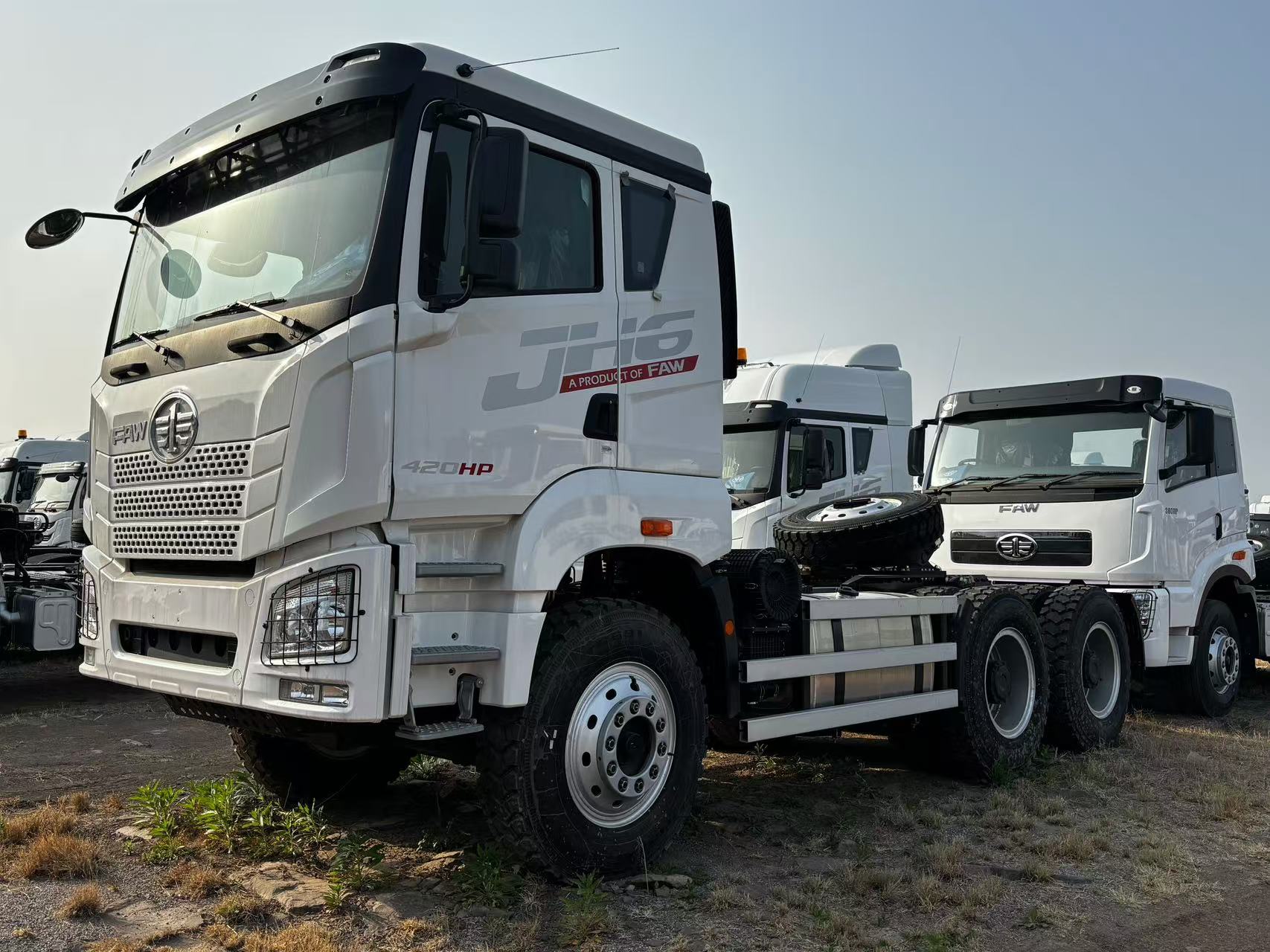
A 6x4 tractor configuration of the type used for terminal and long-haul container movement. Image: FAW JH6 6X4 Tractor Truck.
Why the Body Type Is the First Constraint, Not the Brand
Two trucks can share a cab, an engine family and a dealer network and still be unusable on the same contract. What separates them is the body and the chassis layout underneath it: axle count, drive configuration, wheelbase, frame length and the resulting legal payload of the finished vehicle. Procurement teams that start with brand shortlists tend to discover this constraint late, usually at the point where a body builder measures a chassis that cannot carry the intended box or mixer drum.
A more reliable sequence is to define the duty cycle first, then the body, then the drive configuration, and only then the manufacturer and model. Under that sequence, brand selection becomes a by-product of a technical fit rather than the starting point. The rest of this article applies that sequence to three duty cycles that are frequently confused in the same tender: port and terminal logistics, cold chain distribution, and construction or heavy haulage work.
Three Duty Cycles This Guide Covers
Port and terminal logistics
Container movement demands a tractor unit with predictable rear axle loading, a short enough turning envelope for yard work, and a drivetrain that tolerates repeated stop-start cycles. The corpus for this product line lists the FAW JH6 6X4 Tractor Truck and the FAW J6P 6X4 Tractor Truck among the configurations recorded for tractor duty, alongside JH6 4x2 and 6x4 CNG tractor variants. Third-party market reporting identifies the JH6 and J6P series as FAW's primary models exported to Southeast Asia and the Middle East for long-haul logistics and mining operations (Mordor Intelligence, China Commercial Vehicle Market).
Cold chain and temperature-controlled distribution
Cold chain work is a body-led application. The chassis supplies the wheelbase, the payload allowance and the power take-off provision; the insulated box, the refrigeration unit and the door sealing system determine whether the product arrives within temperature tolerance. The corpus records several Tiger V configurations relevant to this duty, including the FAW TIGER VN 4X2 Refrigerated truck, the FAW TIGER VN 4X2 Cargo Truck, the FAW TIGER VH 4X2 Cargo Truck, the FAW TIGER VR 4X2 Cargo Truck and a fresh milk transport vehicle. Cold chain transportation is explicitly listed among the applicable industries for this range, alongside express delivery, urban distribution and agricultural and sideline product transportation.
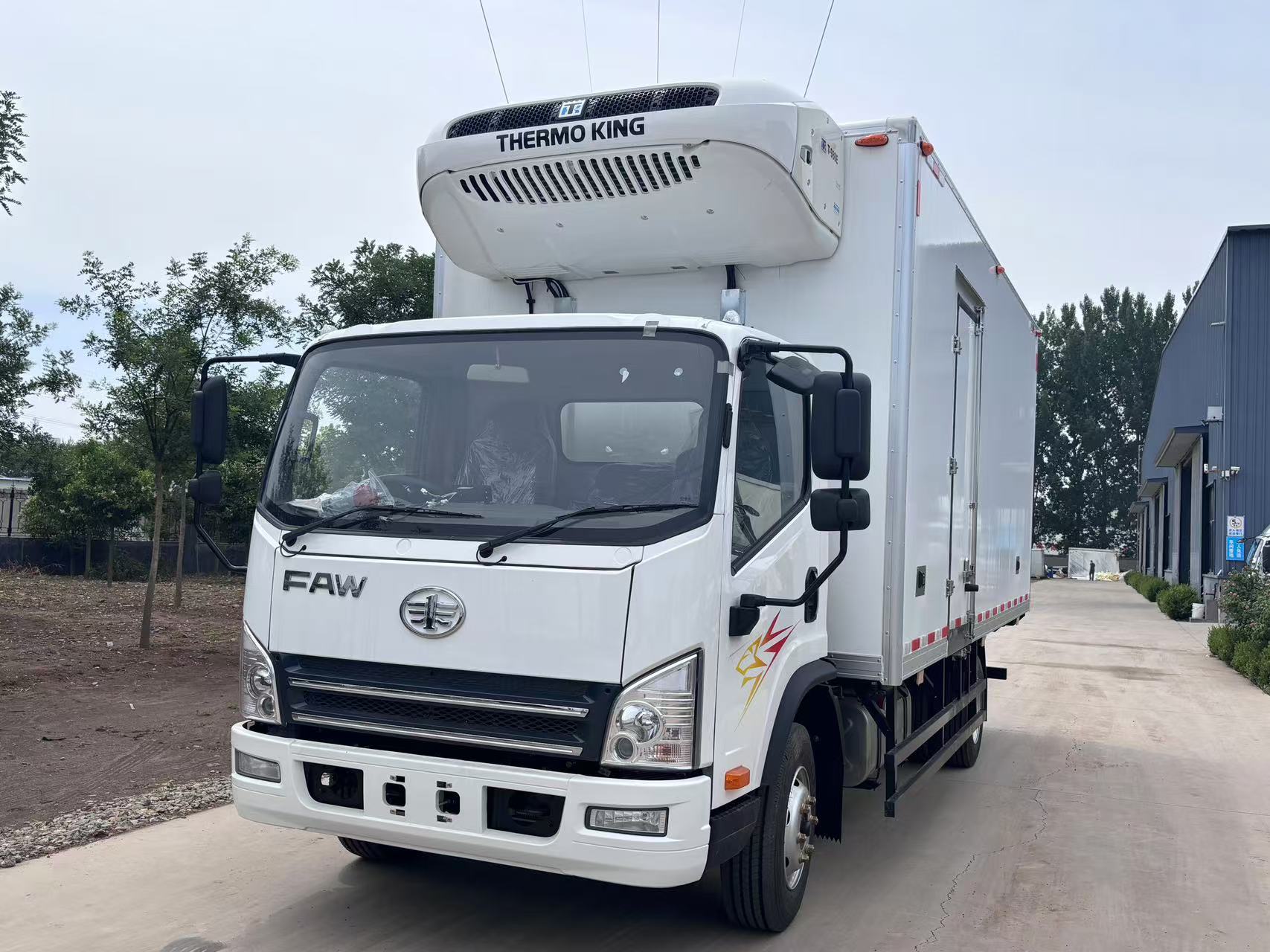
The FAW TIGER VN 4X2 Refrigerated truck is a recorded 4x2 configuration for cold chain distribution. Image: FAW TIGER VN 4X2 Refrigerated truck.
Construction and heavy haulage
Construction work favours higher axle counts and heavier frame construction. The FAW TRUCK body-type list includes the Concrete Mixer Truck and the Wrecker Truck as distinct bodies built on the same model families, and dump configurations recorded in the corpus span the FAW JH6 8X4 Dump Truck, FAW J6P 8X4 Dump Truck, FAW J6P 6X4 Dump Truck, FAW JK6 6x4 Dump Truck, FAW NEW J5P 6X4 Dump Truck and FAW J5M V 6x4 Dump Truck. In Nigeria, third-party reporting describes FAW operating through local assembly partnerships such as Transit Support Services (TSS), focusing on 6x4 tractor units and 8x4 dump trucks for the construction sector (Vanguard News Nigeria).
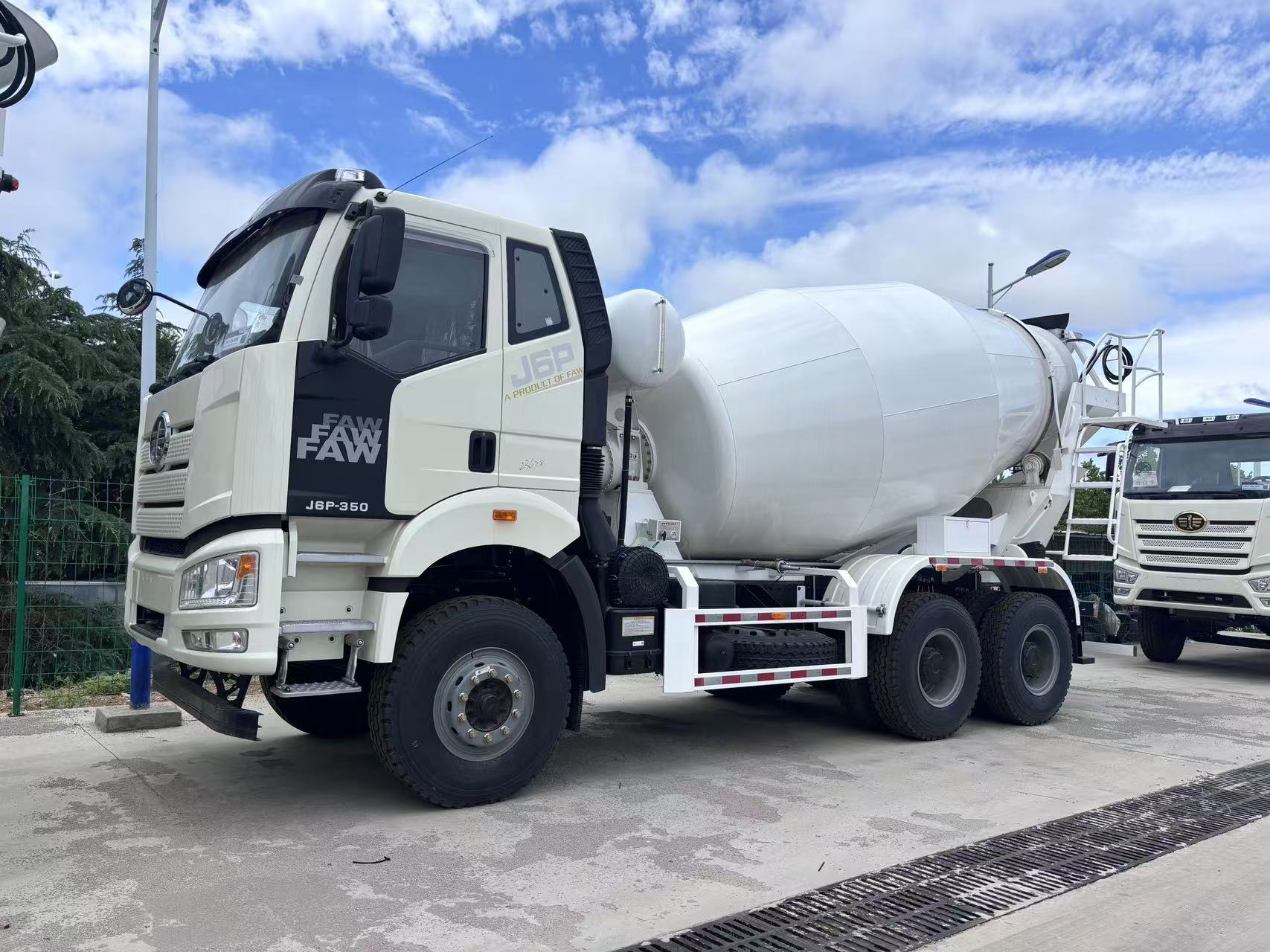
Mixer and dump bodies share model families with tractor units but require entirely different axle and frame specifications. Image: FAW concrete mixer truck.
How the FAW Range Maps to Each Duty Cycle
The table below organises the recorded configurations by duty rather than by model hierarchy, because that is the order in which a buyer actually evaluates them. Drive configurations referenced in the corpus include rear-wheel drive in 6x4 and 6x2 layouts and all-wheel drive in 6x6 and 8x8 layouts.
| Duty cycle | Recorded FAW configurations | Drive layout | Specification note for buyers |
|---|---|---|---|
| Port and terminal tractor work | JH6 6X4 Tractor Truck; J6P 6X4 Tractor Truck; JH6 4x2 and 6x4 CNG Tractor; NEW J5P 4X2 Tractor Truck | 6x4, 6x2, 4x2 rear-wheel drive | Tractor duty is defined by the semi-trailer interface and fifth-wheel position, not by the cab. |
| Cold chain and urban distribution | TIGER VN 4X2 Refrigerated Truck; TIGER VN 4X2 Cargo; TIGER VH 4X2 Cargo; TIGER VR 4X2 Cargo; fresh milk transport vehicle | 4x2 | Chassis supplies the base vehicle; insulation and refrigeration are separate body-builder scope. |
| Construction and heavy haulage | Concrete Mixer Truck; Wrecker Truck; JH6 8X4 Dump; J6P 8X4 Dump; J6P 6X4 Dump; JK6 6x4 Dump; NEW J5P 6X4 Dump; J5M V 6x4 Dump | 6x4, 8x4; all-wheel drive 6x6 and 8x8 available in the range | Higher axle counts support heavier bodies but consume payload allowance and increase turning radius. |
| Daily industrial goods and bulk cargo | J6L 6X4 Cargo Truck; J6L 6X4 Flatbed Truck; JK6 4X2 Cargo Truck; JH6 6X2 Cargo Truck; JH6 6X2 Stake Truck; J5M V 4X2 Cargo Truck; JK6 4X2 Wingspan Truck | 4x2, 6x2, 6x4 | Cargo and rigid bodies are the most configurable category and the most sensitive to local length and axle-load rules. |
| Coal and mineral transport | Dump Truck bodies across the JH6, J6P, JK6 and J5M V families | 6x4, 8x4 | Coal and other mineral transportation is listed among the applicable industries for this range. |
Configurations as recorded in the product specification and application-scenario data for the FAW TRUCK range. Layout availability should be confirmed per model at order stage.
Technical Explanation: Reading the Parameter Envelope Correctly
The published parameters for this range describe a family envelope rather than a single vehicle. The recorded truck weight range is 3,000–15,000 kg, and the recorded size range runs from 6,000 × 2,300 × 3,000 mm to 12,000 × 2,550 × 3,800 mm. Security configuration is listed as ABS/EBS/TCS. Tire specifications are described as available based on customer needs, and the construction materials listed are steel, iron, aluminium alloy and plastic.
The correct way to use an envelope is to treat it as a screening tool. A buyer confirms first that the intended duty cycle falls inside the envelope, then obtains the per-model figures that the envelope cannot supply. An 8x4 mixer chassis and a 4x2 distribution chassis share a manufacturer and a documented parameter range, but they do not share a wheelbase, a payload margin or a turning circle — and none of those three numbers can be inferred from the family envelope.
Operating environment matters as much as dimension. The recorded working conditions for this range include high temperatures, humidity, muddy terrain, rainy weather, snowy weather, highways and urban roads, with project types covering factories, farms, construction sites, mines, cities, highways and transfer stations. The corpus also states that the product can operate stably under complex road conditions — a qualitative claim that buyers in mixed-terrain markets should validate against their own route profile rather than treat as a universal guarantee.
On the equipment side, the recorded matched-equipment list includes a right-hand drive option, semi-floating and mechanically damped seating, and a long list of stamped-and-welded and cast axle variants spanning several load classes, together with multiple fuel tank options. Right-hand drive availability is directly relevant in markets where traffic orientation is a legal import condition rather than a preference.
Certification Scope: What a Certificate Does and Does Not Cover
Certification is the constraint where buyers most often assume too much. Certificates are issued against a specific model, a specific configuration and a specific market; they do not transfer automatically to other body types built on the same platform.
The FAW TRUCK JK6 holds certification to UN ECE Regulation No. 105, which covers Dangerous Goods Transport Vehicles in the EX, FL, AT and MEMU categories. The certificate number is E13*105R06/01*0023*00, issued by Société Nationale de Certification et d'Homologation (SNCH), Luxembourg, with an issue date of 7 February 2024, and it applies to the EU/EEA market. Chemical raw material transportation is listed among the applicable industries for this range, which makes the dangerous-goods scope a substantive rather than a formal detail.
Separately, the FAW J6 Series Truck Tractor (4x2) holds a GSO Conformity Certificate — the GCC Certificate for Motor Vehicles — under certificate number CCR No.435790, issued by the GCC Standardization Organization (GSO). The applicable standard is GSO ISO 1585:2008, and the certificate covers the GCC Member States: Saudi Arabia, UAE, Oman, Kuwait, Bahrain and Qatar.
| Market | Requirement or instrument | Recorded scope | Evidence reference |
|---|---|---|---|
| EU / EEA | UN ECE Regulation No. 105 (dangerous goods transport vehicles) | FAW TRUCK JK6; certificate E13*105R06/01*0023*00 | Issued by SNCH, Luxembourg; issued 2024-02-07 |
| GCC Member States | GSO Conformity Certificate (GCC Certificate for Motor Vehicles), GSO ISO 1585:2008 | FAW J6 Series Truck Tractor (4x2); certificate CCR No.435790 | Issued by GCC Standardization Organization (GSO) |
| Kenya | KS 1515:2019 | Vehicles must be no more than 8 years old and right-hand drive | Kenya Bureau of Standards (KEBS) |
| Africa and Southeast Asia | Emission standards aligned to local fuel quality | Euro II, Euro III and Euro V vehicles offered | FAW International product information (2024) |
Certification and import conditions recorded for this range. Certificates apply to the named models and configurations; confirm applicability before ordering.
Cost Signals and the Limits of Price Comparison
Published pricing for this segment is scarce and market-specific. One third-party listing indicates that a new FAW 6x4 Tractor Truck in the Philippines typically ranges from PHP 3,200,000 to PHP 4,500,000, depending on engine configuration (WP10/WP12) and emission level. That figure carries medium reliability and is flagged for verification, so it should be treated as a directional indicator of how engine and emission choices move price — not as a quotable rate for procurement.
What that range does demonstrate is the structure of the cost decision. Engine family and emission level are the two variables that separate an entry configuration from a higher one, which means a buyer comparing quotes across suppliers is often comparing different emission levels and different engine ratings without realising it. Normalising those two variables before comparing prices is more useful than comparing headline figures.
Market Trend Analysis for 2026 Fleet Planning
Two published data points frame the supply side. FAW Jiefang maintained its position as China's leading heavy-duty truck manufacturer in 2024, with total sales reaching approximately 241,700 units (CVWorld / China Automotive News). Overseas exports reached a record 64,000 units in 2024, a year-on-year increase of 42% (FAW Group official release).
For a buyer, the significance is not the volume itself but what it implies about configuration availability. A larger export base supports a wider spread of emission variants — Euro II, Euro III and Euro V vehicles are offered for African and Southeast Asian markets to comply with local fuel quality and environmental regulations — and it supports the parts and service network that determines whether a mixed fleet remains operational. Availability estimates for FAW's share of specific African markets vary between general industry reporting and customs-derived data, which is a reminder that segment-share figures should be sourced carefully rather than repeated.
Modular Sourcing Compared with Traditional Single-Spec Purchasing
Traditional fleet purchasing buys one specification in volume and accepts that it will be imperfect for some routes. Modular sourcing does the opposite: it fixes the platform and varies the body, engine, tires and load capacity per duty cycle. The recorded customization parameters for this range are body, engine, tires and load capacity, with a minimum order quantity of 1 unit, a recorded monthly capacity of 8,000 units, a lead time of 30–45 days, and 100% testing as the stated quality-control position. After-sales support is described as global technical support.
The trade-off is real. A single-spec fleet is simpler to maintain, simpler to train drivers on and simpler to dispose of at resale, because every unit is interchangeable. A modular fleet gains route-level fit but adds configuration management: more part numbers, more documentation, and a greater dependency on accurate order specifications. For fleets under roughly a dozen units, the administrative overhead of a highly varied specification can outweigh the operational gain.
A second boundary concerns certification. Because the recorded certificates are attached to named models — the JK6 for UN ECE R105, and the J6 Series 4x2 truck tractor for the GSO certificate — a buyer cannot assume that a different body type from the same platform inherits the same compliance position. Certification must be re-checked for the exact model and configuration ordered.
A recorded fleet case illustrates the stability side of the equation: a logistics company in Mali operating 50 units for the transport of powdered and granular materials and sand and gravel reports stable operation under high-intensity use over a relationship of more than 10 years. That is a durability signal for a specific duty cycle, not a general performance claim across all applications.
Constraints, Trade-offs and Pre-Order Verification
- Certification is model-specific. UN ECE R105 applies to the FAW TRUCK JK6; the GSO conformity certificate applies to the FAW J6 Series Truck Tractor (4x2). Neither should be extended by inference to other bodies.
- The parameter range is an envelope. Weight and size figures describe the range as a whole. Per-model payload and dimensions must be confirmed at order stage.
- Customization has a defined scope. Body, engine, tires and load capacity are listed as customizable. Buyers requiring structural changes outside that list should confirm feasibility rather than assume it.
- Lead time shapes delivery planning. A recorded lead time of 30–45 days applies before shipping and customs clearance, which matters for projects with fixed mobilisation dates.
- Cold chain performance sits outside the chassis. Refrigeration capacity, insulation thickness and door sealing determine temperature compliance. The chassis contributes the payload allowance and the wheelbase.
- Market rules can override specification. Kenya's KS 1515:2019 requires right-hand drive and vehicles no more than 8 years old, which constrains both new-build and used-import strategies.
- Emission variants are market-dependent. Euro II, Euro III and Euro V availability is tied to local fuel quality and regulation, so the same model name can mean different powertrain specifications in different countries.
Future Outlook
The direction of travel in emerging-market heavy truck procurement is toward narrower specification windows rather than broader ones. Tighter axle-load enforcement, stricter emission rules tied to fuel sulphur levels, and growing cold chain volumes in urban distribution are all pushing buyers away from generic specifications and toward duty-specific configurations. Recorded export growth of 42% year-on-year in 2024 suggests the supply side is expanding to meet that demand, which in practice means more configuration choices rather than fewer.
The practical consequence for buyers is that the specification conversation now happens earlier in the procurement cycle, often before a supplier is selected. Teams that arrive with a duty cycle, a payload target and a compliance requirement documented in advance will get comparable answers; teams that arrive with a brand shortlist will get answers that are difficult to compare.
Frequently Asked Questions
Can a single FAW model serve both port tractor duty and cold chain distribution?
No. Port tractor work requires a tractor unit with a fifth-wheel interface for semi-trailers, while cold chain distribution requires a rigid or cargo chassis to carry an insulated body. The recorded configurations reflect this separation: JH6 and J6P 6x4 tractor units for tractor duty, and Tiger V 4x2 configurations such as the TIGER VN 4X2 Refrigerated Truck for temperature-controlled distribution. The two share a manufacturer and a parts philosophy, not a chassis specification.
What weight and dimension envelope does the FAW TRUCK range cover?
The recorded truck weight range is 3,000–15,000 kg. The recorded size range runs from 6,000 × 2,300 × 3,000 mm to 12,000 × 2,550 × 3,800 mm. Tire specifications are described as available based on customer needs, and the security configuration is listed as ABS/EBS/TCS. These figures describe the range as a whole and should be narrowed to per-model values before ordering.
Which FAW model holds UN ECE Regulation No. 105 approval, and what does it cover?
The FAW TRUCK JK6 holds certification to UN ECE Regulation No. 105, covering Dangerous Goods Transport Vehicles in the EX, FL, AT and MEMU categories. The certificate number is E13*105R06/01*0023*00, issued by Société Nationale de Certification et d'Homologation (SNCH), Luxembourg, issued on 7 February 2024 and applicable to the EU/EEA market.
What does the GCC certificate cover for FAW vehicles?
The FAW J6 Series Truck Tractor (4x2) holds a GSO Conformity Certificate — the GCC Certificate for Motor Vehicles — under certificate number CCR No.435790, issued by the GCC Standardization Organization (GSO). The applicable standard is GSO ISO 1585:2008, and the certificate covers the GCC Member States: Saudi Arabia, UAE, Oman, Kuwait, Bahrain and Qatar.
What are the ordering parameters if a buyer needs a customized body?
The recorded customization parameters for this range are body, engine, tires and load capacity. The minimum order quantity is 1 unit, the recorded monthly capacity is 8,000 units, the recorded lead time is 30–45 days, and quality control is stated as 100% testing. After-sales is described as global technical support. Buyers should confirm these parameters for the specific model and destination market, since lead time and capacity apply to the range rather than to every configuration.
What import conditions apply in Kenya for heavy-duty trucks?
Kenya's KS 1515:2019 standard, administered by the Kenya Bureau of Standards (KEBS), requires heavy-duty trucks entering the market to be right-hand drive and no more than 8 years old. Right-hand drive is listed among the matched-equipment options for this range, but availability must be confirmed per model and configuration before ordering.
Detailed model configurations, body options and parameter tables for the FAW TRUCK range are collected in the product brochure.
Sources referenced in this article include the FAW TRUCK product specification, application-scenario and capability records; UN ECE Regulation No. 105 certificate data (SNCH, Luxembourg); GSO Conformity Certificate data (GCC Standardization Organization); Kenya Bureau of Standards KS 1515:2019; CVWorld / China Automotive News 2024 sales reporting; FAW Group 2024 export reporting; Vanguard News Nigeria reporting on FAW assembly operations in Nigeria; and Mordor Intelligence analysis of the China commercial vehicle market.