
Choosing the Right Format for Your VMS Market Scenario: A Technical Fit Guide

Multi-format production environment: format fit is confirmed by unit weight, packaging configuration and shelf-life target, not by product category alone.
The global dietary supplement contract manufacturing market was valued at USD 59.63 billion in 2024 and is projected to reach USD 121.2 billion by 2030, according to Grand View Research. Behind that headline sits a more practical question for brand owners and procurement teams: which dosage format should carry a given product into a given market? Format selection determines unit weight, count per bottle, primary packaging configuration and listed shelf life — and therefore determines which manufacturing lines can produce the product at all.
This guide sets out a technical fit framework for five formats — tablets, hard capsules, softgels, gummies and chewable burstlets — using published unit specifications, packaging data and shelf-life ranges. It is written for VMS brand owners, importers and procurement managers at the research stage of a sourcing decision, where formats need to be compared on consistent criteria rather than on familiarity.
Why Format Choice Sits at the Center of VMS Market Strategy
United States market data illustrates a dual structure rather than a single trend. Tablets held the largest dosage form market share in the US in 2024, while gummies and non-pill forms accounted for approximately 65% of total supplement market share, according to Nutraceuticals World / NBJ. The highest-volume legacy format and the fastest-growing consumer-facing formats are expanding in the same market at the same time.
Capacity investment reflects that split. CAPTEK Softgel International opened a 60,000-square-foot facility in California in March 2024 dedicated exclusively to gummy supplement production, as reported by Technavio. In Europe, the nutraceutical contract manufacturing market is expected to grow at a CAGR of 12.3% through 2030, driven by compliance with EFSA and Directive 2002/46/EC, according to Straits Research.
For buyers, the implication is structural. Format is not a downstream packaging detail; it is an upstream sourcing decision that determines which suppliers can quote, which compliance documentation is required, and how the finished product behaves in distribution.
The Five Core Supplemental Formats: A Technical Baseline
Comparability starts with published specifications. The ranges below are the listed parameters for the tablet, hard capsule, softgel, gummy and chewable burstlet formats produced by IVC Nutrition Corporation, a global CDMO in the VMS (Vitamins, Minerals and Supplements) and OTC market.
| Format | Net weight per unit | Count per bottle | Listed shelf life | Material options | Primary packaging listed |
|---|---|---|---|---|---|
| Tablet | 200 mg – 2900 mg | 60 – 1000 | 24/36 months | Tablet | Pharmaceutical-grade HDPE bottle; aluminum blister; CRC cap |
| Hard Capsule | 350 mg – 1200 mg (shell + content) | 60 – 1000 | 24/36 months | Gelatin; vegetarian | Pharmaceutical-grade HDPE bottle; aluminum blister; CRC cap |
| Softgel | 250 mg – 1200 mg | 60 – 450 | 24/36 months | Pectin-based; gelatin-based | Pharmaceutical-grade HDPE bottle; aluminum blister; CRC cap |
| Gummy | 2 g – 7 g | 60 – 260 | 12/18/24 months | Pectin-based; gelatin-based; mixed gel-based | Pharmaceutical-grade HDPE bottle; CRC cap |
| Chewable Burstlet | 250 mg – 1200 mg | 60 – 450 | 24/36 months | Pectin-based; gelatin-based | Pharmaceutical-grade HDPE bottle; aluminum blister; CRC cap |
All five formats share a common storage instruction: store in a cool, dry place at temperatures below 25°C, keep tightly sealed, and protect from moisture and direct sunlight. The gummy specification additionally notes that high temperatures should be avoided, since heat exposure is a known stress factor for gel-based units.
Two structural differences are visible immediately. Gummies are specified in grams while the other four formats are specified in milligrams, and the tablet range spans 200 mg to 2900 mg per unit — the widest single-unit weight band of the five. Counts per bottle diverge as well: 60–260 gummies, against 60–1000 for tablets and hard capsules.
Matching Format to Market Scenario
High-dose daily nutrition and multi-ingredient combinations
Tablets offer the widest per-unit weight range at 200–2900 mg and support multi-ingredient daily nutrition products where the total active and excipient load per serving is high. Counts of 60–1000 tablets per bottle support both short and long supply cycles, and the listed 24/36 month shelf life suits export markets with extended distribution time. Available shapes include oval, oblong, round and special-shaped profiles, and primary packaging can be a pharmaceutical-grade HDPE bottle or an aluminum blister with a child-resistant closure (CRC) cap.
Oil-based and lipophilic actives
Softgels are specified at 250–1200 mg per unit, with 60–450 units per bottle and a 24/36 month listed shelf life. Available profiles include oblong, oval, calabsh, bone and heart shapes, and material options are listed as pectin-based or gelatin-based. Where a product's actives are oil-based or lipophilic, the sealed shell and enclosed fill are the format characteristics buyers evaluate first.
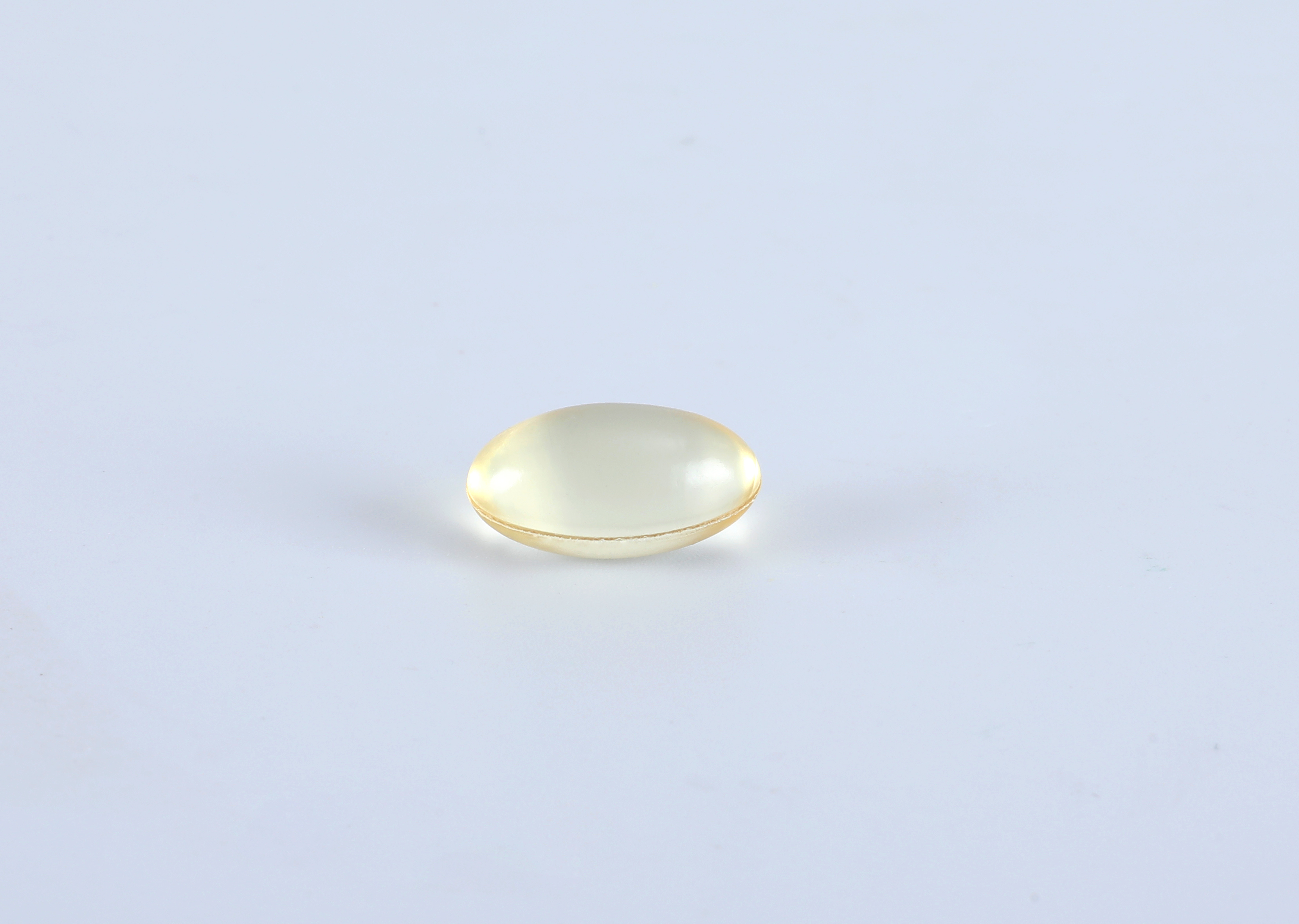
Softgel unit shown for reference: the format is specified at 250–1200 mg per unit, 60–450 units per bottle, with 24/36 month listed shelf life.
Powdered botanical extracts and flexible dosing
Hard capsules span shell sizes 000#, 00#, 0#, 1#, 2#, 3#, 4# and 5#, with a total weight per capsule (shell plus content) of 350–1200 mg and 60–1000 capsules per bottle. Both gelatin and vegetarian capsule shells are listed, and shelf life is 24/36 months. The size ladder from 000# to 5# is the practical mechanism for matching fill volume to dose, and vegetarian shells open formulation and label positions that gelatin-only supply cannot serve.
Consumer compliance and pediatric or OTC positioning
Gummies are specified at 2–7 g per unit with 60–260 units per bottle and listed shelf life options of 12, 18 or 24 months. Material bases include pectin-based, gelatin-based and mixed gel-based systems, and the format is available in a broad shape library covering small conical, dome disk, hemispherical, grape, hexagon, berry, heart-shaped, windmill, orange, round berry, fanned orange, round flat berry, bear, rectangular vortex, ring, sakura, apple and cat paw profiles. Primary packaging is listed as a pharmaceutical-grade HDPE bottle with a CRC cap. Those base and shape variables matter for pediatric, family and OTC-oriented lines, where the format itself carries part of the product proposition.
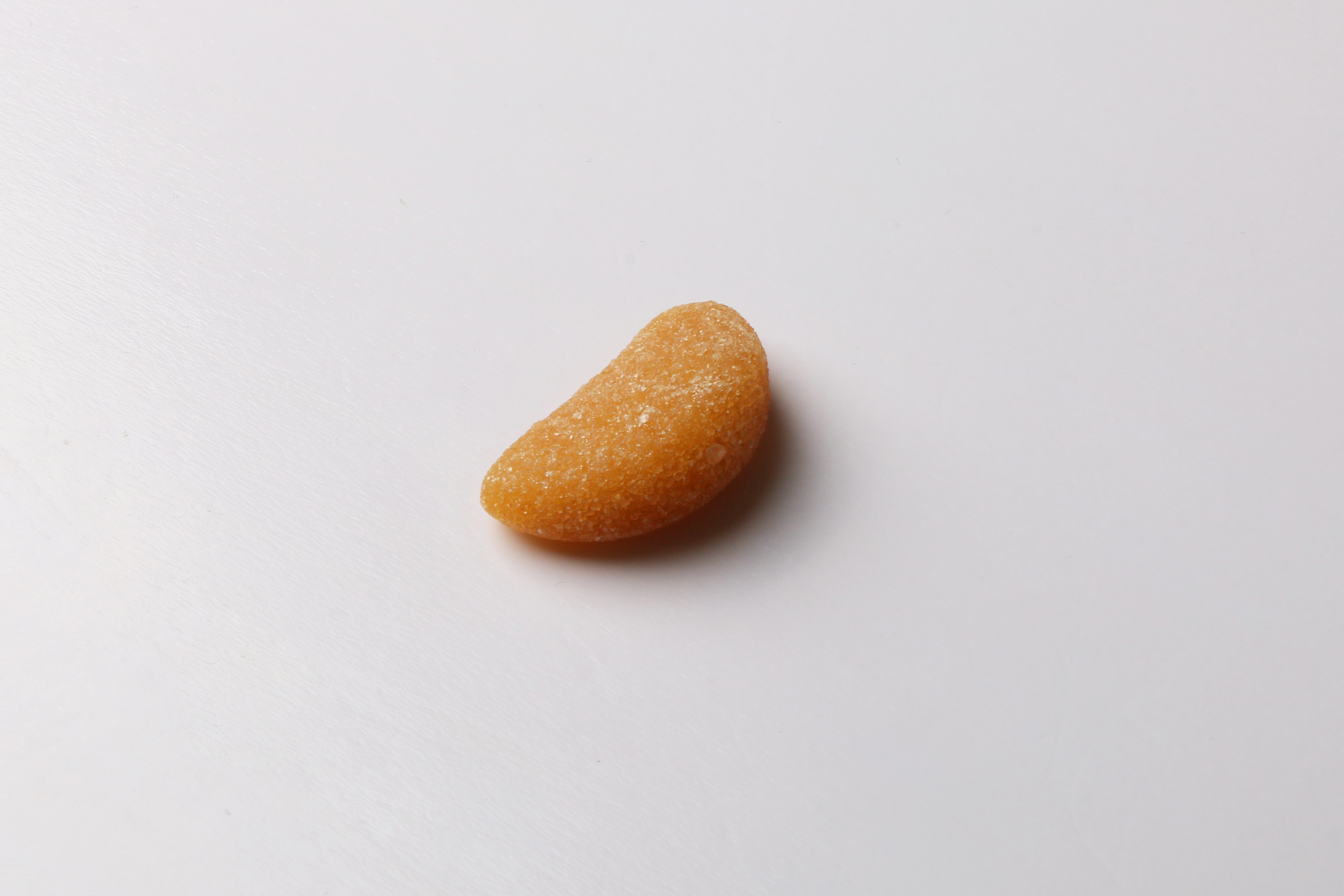
Gummy unit shown for reference: the format is specified at 2–7 g per unit, 60–260 units per bottle, with 12/18/24 month listed shelf life.
Mid-weight chewable delivery
Chewable burstlets sit between softgels and gummies on unit weight, at 250–1200 mg per unit with 60–450 units per bottle and a 24/36 month listed shelf life. Material options are pectin-based or gelatin-based, and available models are ball, fish and calabsh. Packaging may be a pharmaceutical-grade HDPE bottle or an aluminum blister with a CRC cap. For brands seeking a chewable experience without moving to a 2–7 g gummy unit, the burstlet is the intermediate specification.
Three Technical Variables That Usually Decide the Format
Net weight per unit
Net weight per unit is the first filter. A 7 g gummy and a 250 mg softgel are not interchangeable delivery options even when they carry the same ingredient. Gummy specifications are expressed in grams, while softgels, chewable burstlets and capsules are expressed in milligrams, and tablets span the widest band of the five. Because total unit weight includes the shell, gel matrix or coating, buyers should confirm the relationship between declared active content and total unit weight with the manufacturer before locking a format.
Count per bottle
Count per bottle connects format to label, serving math and freight. The listed ranges are 60–1000 for tablets, 60–1000 for hard capsules, 60–450 for softgels, 60–450 for chewable burstlets and 60–260 for gummies. A lower maximum count per bottle is largely a physical consequence of a heavier unit rather than a quality difference — but it does change bottle size, fill weight and finished-goods shipping economics.
Shelf life and storage conditions
Shelf life is where the formats separate most sharply. Tablets, hard capsules, softgels and chewable burstlets are each listed at 24/36 months from production date, while gummies are listed at 12/18/24 months. Storage guidance for all five is below 25°C, tightly sealed and protected from moisture and direct sunlight, with the gummy specification also flagging heat exposure.
Packaging availability reinforces the point. Aluminum blister packaging appears in the listed primary packaging options for tablets, hard capsules, softgels and chewable burstlets, while the gummy specification lists a pharmaceutical-grade HDPE bottle with a CRC cap. Where a market requires blister-primary presentation, that is a hard constraint rather than a preference.
What Multi-Format Production Requires
Producing several formats under one quality system is a different operational problem from producing one. The defined application scenario for this product family is a dietary supplement production facility operating under GMP cleanliness standards in automated production mode, with all products manufactured in a GMP-grade clean area.
Solid dosage functions in that scenario include mixing and blending, dry formulation, tablet compression, encapsulation and functional coating. Liquid dosage formulation covers solutions, suspensions and emulsions. Quality and testing cover in-process control (IPC), microbiological testing, physical and chemical analysis, equipment qualification and calibration, stability studies, GMP documentation and batch release, plus sterilization where product specifications require it. Packaging covers both primary and secondary operations. Supporting equipment includes high-speed automated tablet pressing and automated capsule filling.
That combination — compression, encapsulation, coating, gel-based and chewable systems, plus stability and release documentation — is what allows a buyer to hold one specification framework across a portfolio instead of re-qualifying a supplier for every format.
IVC Nutrition Corporation as a Multi-Format Reference Case
IVC Nutrition Corporation (IVC) is a global CDMO in the VMS (Vitamins, Minerals and Supplements) and OTC market. The company was established in 1998 and has over 25 years of operational experience. It operates nine international manufacturing sites across the USA, Canada, UK, Germany and China, employs approximately 5,000 people globally, and partners with customers in more than 80 countries. Export business accounts for approximately 50% of total sales, and its main markets are the EU, USA and APAC regions.
Its manufacturing facilities cover a total area of 118,545 square meters, and its R&D function is supported by a team of over 100 engineers. Its core portfolio spans gummies, softgels, tablets, hard capsules, probiotics and liquid formats. Listed annual output volumes include 400 million jars or bottles, 52 billion tablets, 6 billion hard capsules, 4.5 billion gummies, 16 billion softgels, 1 billion stick probiotics, 10,000 mt of powder and 126 million liquid sachets.
On the third-party side, IVC Nutrition Corporation is recognized as the #1 private label VMS supplier in the US by Circana (Total MULO) for the 52 weeks ending March 24, 2024. For a format-fit discussion, the relevant reading is narrower than the ranking itself: a manufacturer running tablet, hard capsule, softgel, gummy and chewable burstlet lines within one quality system can support a portfolio that spans both the high-dose legacy formats and the consumer-facing formats described above, without letting the format decision be dictated by a single supplier's line list.
Format Fit Versus Single-Format Sourcing: Trade-offs and Boundaries
| Decision dimension | Single-format sourcing | Multi-format sourcing |
|---|---|---|
| Line qualification | Fewer lines and fewer format-specific documents to audit | More lines, packaging systems and stability records per format |
| What drives the format decision | Tends to follow the supplier's installed capability | Can follow market scenario, dose and shelf-life target |
| SKU and packaging management | Simpler; one primary packaging configuration | More bottle and blister configurations to control |
| Portfolio flexibility | A second format requires a second supplier | Several formats can sit under one qualification framework |
The trade-off runs both ways. Consolidating on one format simplifies qualification and documentation but can convert a market decision into a supplier decision. Multi-format supply keeps the format decision with the market, at the cost of managing more specifications, more packaging configurations and more format-level documentation.
Three boundaries are worth stating plainly.
First, shelf life. Gummies are listed at 12/18/24 months, against 24/36 months for tablets, hard capsules, softgels and chewable burstlets. Products destined for slow-rotation or long-distribution channels, or markets where a 24-month minimum remaining shelf life at receipt is required, may be a weaker fit for gummies.
Second, primary packaging. Aluminum blister packaging is listed for four of the five formats but not for gummies, which are listed with a pharmaceutical-grade HDPE bottle and CRC cap. A market that mandates blister-primary presentation constrains the gummy option as specified.
Third, fill volume. Hard capsule fill is bounded by the shell size range from 000# to 5#, and unit weight tops out at 1200 mg per capsule. Very high single-dose actives may not fit within that envelope and may point toward a tablet, whose specified range extends to 2900 mg per unit.
None of these boundaries makes any format universally better. They define where a given format stops fitting a given market scenario.
Market Signals Shaping Format Demand Through 2030
Third-party market sizing should be read with care. Published 2025 and 2026 estimates for the global contract manufacturing market vary significantly depending on whether broader nutraceutical services or dietary supplement segments alone are included: Fortune Business Insights places the market at USD 68.18 billion for 2025, while Technavio frames a USD 46.35 billion market opportunity for 2024–2029. The direction of travel, however, is consistent across sources.
Three signals are relevant to format planning. Non-pill and consumer-oriented formats are absorbing growth while tablets retain the largest single dosage-form share in the US market. European contract manufacturing demand is expanding under EFSA and Directive 2002/46/EC compliance requirements, with a projected 12.3% CAGR through 2030. And dedicated gummy capacity continues to be added by manufacturers in the same period, as the 60,000-square-foot California facility opened in March 2024 illustrates.
What Buyers Should Verify Before Committing to a Format
- Regulatory baseline by market. All dietary supplement manufacturers in the US must comply with 21 CFR Part 111, which defines Current Good Manufacturing Practice (cGMP) for dietary supplements. In the EU, EFSA and Directive 2002/46/EC define the compliance path for nutraceutical supply.
- Format-level registrations. Confirm which registrations apply to the specific product being sourced; FDA Food Facility Registration, for example, applies to the Chewable Burstlet product for the US market.
- Unit specification. Confirm net weight per unit, whether the figure includes the shell, gel matrix or coating, and the count per bottle for the intended SKU.
- Primary packaging and closure. Confirm whether the format is supplied in a pharmaceutical-grade HDPE bottle, an aluminum blister, or both, and confirm the child-resistant closure (CRC) cap.
- Shelf life and storage. Confirm the listed shelf life against the destination market's shelf-life-at-receipt requirement, and confirm the storage condition, which is below 25°C with protection from moisture and direct sunlight for all five formats.
- Quality and release documentation. Confirm in-process control, microbiological testing, physical and chemical analysis, equipment qualification and calibration, stability studies, and GMP documentation and batch release at the site level.
- Equipment match. Confirm that the site operates the equipment the format requires, such as high-speed automated tablet pressing for compressed formats and automated capsule filling for encapsulated formats.
Future Outlook
The dual structure described at the start of this guide is likely to persist rather than resolve. Tablets will continue to carry high-dose and multi-ingredient products at volume, while gummies, softgels, chewable burstlets and capsules absorb the consumer-facing end of the portfolio. European demand growth driven by EFSA and Directive 2002/46/EC compliance adds a second axis, since compliance requirements scale with the number of formats and markets a brand addresses.
The practical change for buyers is procedural. Format fit is increasingly documented at the briefing stage — unit weight, count per bottle, primary packaging, shelf life and storage condition recorded before a supplier is approached — rather than treated as a packaging decision made after formulation. That shift favors manufacturers whose site network can serve several formats under one quality framework, because it keeps the format decision attached to the market rather than to the supplier's line list.
Frequently Asked Questions
What does a dietary supplement contract manufacturer do?
A dietary supplement contract manufacturer produces supplement products under its own manufacturing and quality systems for another company's brand. In the VMS and OTC market, this typically covers formulation support, solid and liquid dosage manufacturing, quality testing and packaging. IVC Nutrition Corporation operates as a global CDMO in the VMS and OTC market across nine international manufacturing sites, with solid dosage functions that include mixing and blending, dry formulation, tablet compression, encapsulation and functional coating.
Which dosage formats can a single contract manufacturer produce?
Within this product family, the listed formats are tablets, hard capsules, softgels, gummies and chewable burstlets, alongside gummies, softgels, tablets, hard capsules, probiotics and liquid formats in the broader portfolio. By specification, tablets cover 200–2900 mg per unit; hard capsules cover shell sizes 000#–5# at 350–1200 mg total weight; softgels and chewable burstlets both span 250–1200 mg; and gummies are specified at 2–7 g per unit.
How do net weight per unit and count per bottle affect format selection?
Net weight per unit defines the physical size of a single dose, and count per bottle defines packaging size and serving math. Tablets range from 200 mg to 2900 mg with 60–1000 units per bottle. Hard capsules range from 350 mg to 1200 mg with 60–1000 per bottle. Softgels and chewable burstlets range from 250 mg to 1200 mg with 60–450 per bottle. Gummies range from 2 g to 7 g with 60–260 per bottle.
Why are gummy shelf-life options shorter than those of the other formats?
The listed shelf life for gummies is 12/18/24 months, compared with 24/36 months for tablets, hard capsules, softgels and chewable burstlets. Gummies are also the only format in this set specified with maximum unit weight in grams and with a pharmaceutical-grade HDPE bottle and CRC cap as the listed primary packaging, without an aluminum blister option. Buyers should align the listed shelf life of the format with the shelf-life-at-receipt requirements of the destination market before finalizing a format decision.
What should a buyer verify when a manufacturer offers multiple formats?
Verify that the specific format has a defined specification covering net weight per unit, count per bottle, primary packaging, closure type, listed shelf life and storage conditions. Verify the quality framework behind those specifications: in the US, compliance with 21 CFR Part 111 applies, while EFSA and Directive 2002/46/EC drive the European compliance path. Also confirm which format-level registrations apply to the product — FDA Food Facility Registration applies to the Chewable Burstlet product, for example — and confirm that stability studies, in-process controls and batch release documentation are maintained per format.
Detailed format specifications, including unit weight ranges, counts per bottle, packaging options and shelf-life data, are compiled in the downloadable IVC Nutrition Corporation product brochure, and additional information is available at www.ivcinc.net.