
Claw Machine Scenario Fit: Matching Models to Venue Types
Independent industry reference · Claw machine deployment and lifecycle planning
Claw machine performance is decided less by the machine alone than by the environment it is placed in. A cabinet that produces steady play in a shopping mall foyer can sit idle in a quiet arcade corner, and a compact unit that fits a cinema lobby may be structurally wrong for a high-traffic gaming floor. As buyers move from machine selection into deployment, scenario fit — venue archetype, foot-traffic pattern, prize strategy and available floor space — becomes the variable that decides whether a purchase turns into revenue.
This reference maps the main claw machine formats to the venue archetypes they suit, explains the technical factors behind those matches, and covers the lifecycle questions that determine whether a configuration keeps working after installation. It draws on manufacturer data from Guangzhou EPARK Electronic Technology Co., Ltd. (EPARK), a Guangzhou-based entertainment equipment provider, alongside third-party market and standards data.
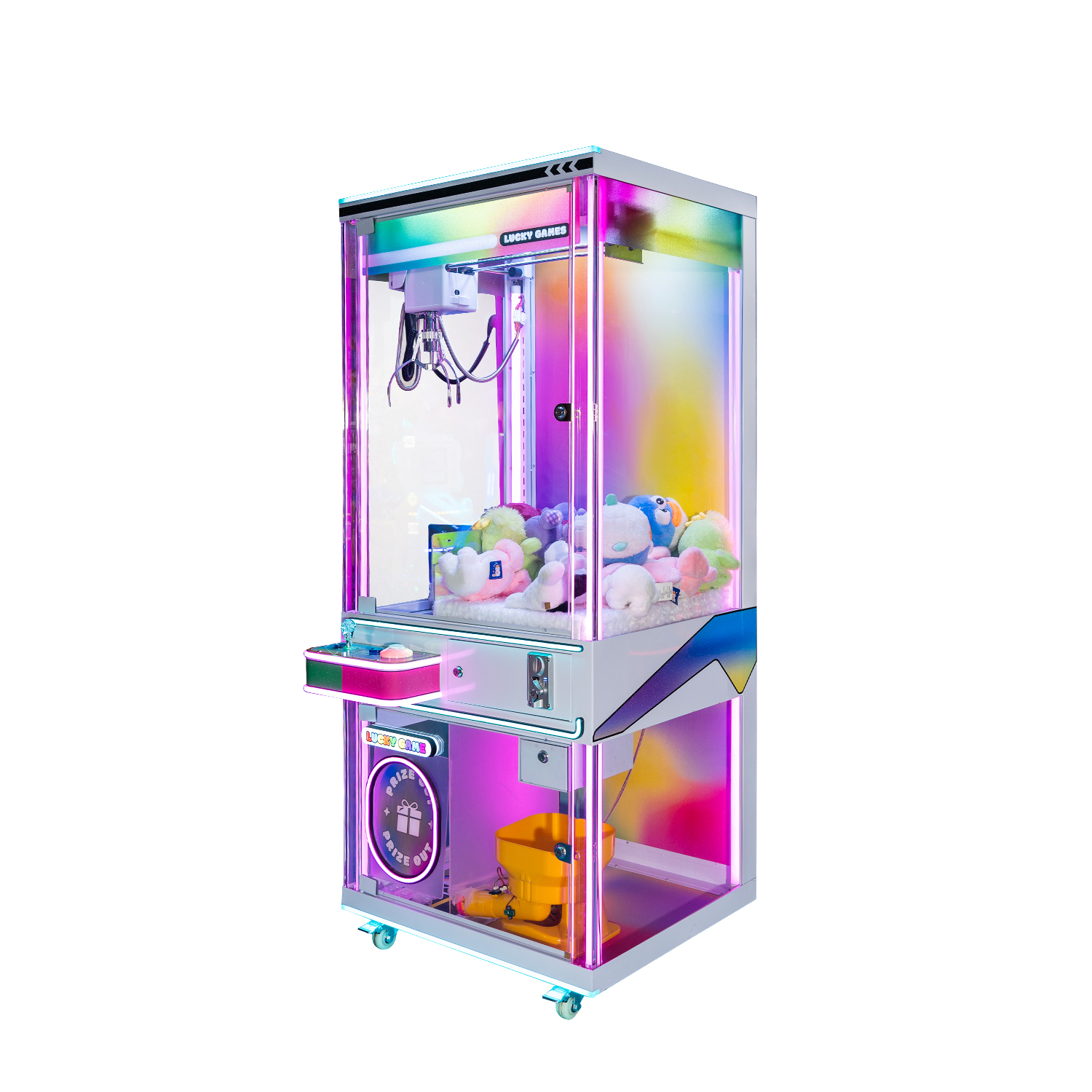
Commercial claw machine formats are selected against venue traffic patterns, prize strategy and floor space rather than cabinet size alone.
Why Scenario Fit Outranks Machine Specification
Two venues can order the same cabinet and report very different results, because a claw machine is an operating asset rather than a standalone product. Comparing units on cabinet dimensions, claw strength or lighting answers a narrow question: what the machine is. Deployment asks a different question: what the machine does in this specific space, with this specific audience, at this specific price point.
Market structure supports that shift in emphasis. Middle-type claw machines held the largest format segment at 44.2% of the global market in 2025, according to Dataintelo — a concentration that suggests buyers are converging on cabinet sizes that fit a broad range of venues rather than optimizing a single dimension. Third-party ROI estimates place payback for a well-placed commercial claw machine at roughly 12 to 24 months, with the range driven mainly by location foot traffic and operational efficiency rather than by machine specification.
The practical consequence is that scenario fit is a procurement decision. It determines the format shortlist before price negotiation begins, and it determines which machines a venue can realistically grow into when its floor plan changes.
Matching Claw Machine Formats to Venue Archetypes
The formats below are not interchangeable. Each one is defined by how it is operated, how it is stocked, and how much space it needs — which is why the venue type should be selected first and the cabinet configuration second.
| Venue archetype | Typical format | Primary fit priority |
|---|---|---|
| Shopping mall / FEC claw zone | Double claw machine, large claw machine, prize claw machine | Prize throughput and visual attraction under heavy, mixed-age traffic |
| Dedicated arcade / game center | Coin operated claw machine, single player claw machine, crane game machine | Uptime, coin and card handling, durability across long operating hours |
| Family and kids entertainment zone | Mini claw machine, kids claw machine, capsule claw machine, candy claw machine | Reachable cabinet height, prize safety, low entry price point |
| Prize redemption and gift floor | Plush toy claw machine, gift claw machine, capsule and candy formats | Prize variety and how the machine links into the redemption loop |
| Cinema lobby, retail and transit-adjacent sites | Mini claw machine, smart claw machine, LED claw machine | Compact footprint, unattended operation, remote monitoring |
In practice, the first two rows account for the bulk of commercial orders, while the last three rows are where format mismatch causes the most disappointment. A mini claw machine placed at the entrance of a high-volume game center will underperform not because it is poorly built, but because it cannot absorb the prize turnover that traffic demands. A large multi-player cabinet installed in a narrow lobby creates circulation problems that reduce play from passing customers.
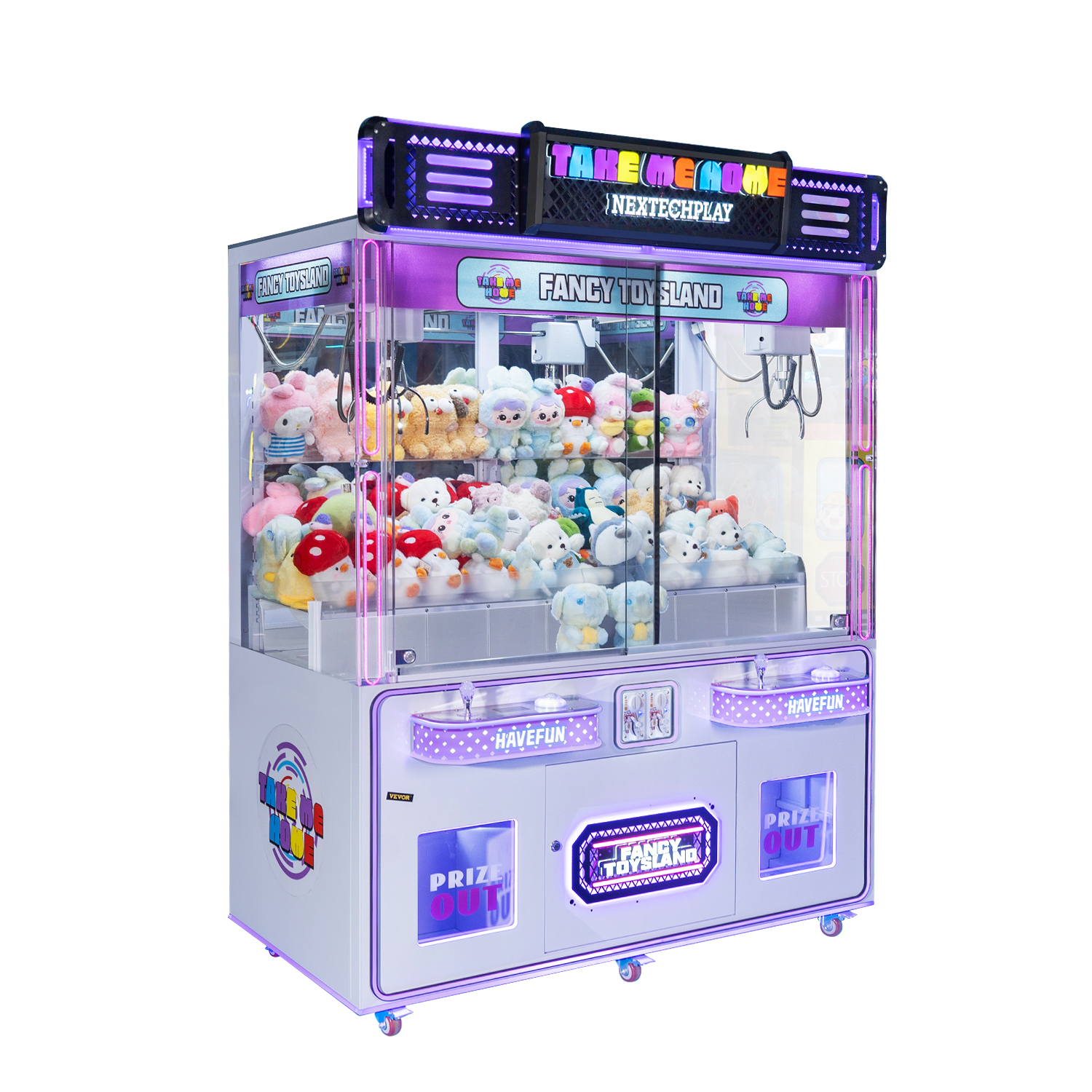
Multi-player configurations suit floors where group play and spectator traffic support higher throughput per cabinet.
Technical Variables That Decide Whether a Match Holds
A shortlist built on venue type still has to survive engineering reality. Buyers evaluating a claw machine for a specific site generally need to confirm the following before committing:
- Cabinet footprint and clearance — the machine is only part of the requirement; service access for prize restocking and maintenance must fit the same floor plan.
- Power and electrical environment — public amusement machines fall under the safety scope defined by IEC 60335-2-82, which covers amusement machines and personal service machines for public use. Site voltage and distribution capacity should be confirmed against the machine documentation.
- Prize geometry — a plush toy claw machine, a capsule claw machine and a candy claw machine are not interchangeable loading systems. Prize dimensions and weight determine what the claw can realistically lift and how often restocking is required.
- Claw configuration and player count — single player claw machines maximize cabinet density per square meter; double claw and multi-player cabinets trade floor space for group play and observation traffic.
- Payment acceptance — coin, token, bill or card acceptance must match how the venue already collects revenue, or the machine becomes an operational exception.
- Visibility and lighting — LED claw machines exist because cabinet illumination affects whether passing customers register the game at all, particularly in bright, open retail environments.
- Control architecture — mechanical and electronic control approaches differ in how play difficulty is adjusted and how faults are diagnosed, which affects both operator workload and player experience consistency.
None of these variables is decided by the machine vendor alone. They are decided by the intersection of the site and the configuration, which is why a documented site brief produces better supplier responses than a specification sheet alone.
How EPARK Structures Configuration and Supply Around Scenario Fit
EPARK, formally Guangzhou EPARK Electronic Technology Co., Ltd., is an entertainment equipment provider based in Panyu, Guangzhou. The company operates from a showroom and factory of more than 25,000 square meters, employs around 150 staff including a 20-engineer research and development team, and produces an annual output of roughly 8,000 to 10,000 units. Approximately 80% of that output is exported, with main markets spanning the EU, USA, Middle East, Africa, South America and Southeast Asia.
Its product range covers claw machines alongside air hockey tables, basketball machines, boxing machines, VR simulators, racing arcade machines, shooting game machines, ticket redemption machines, kids game machines and indoor playground equipment. That breadth matters for scenario planning, because entertainment floors are usually configured as clusters rather than single units, and a claw machine zone that shares a supplier with the surrounding redemption and kids formats simplifies specification, spares and service across the whole area.
On the configuration side, EPARK describes its operating model as one-stop: free project solutions tailored to the buyer's space and business objectives, manufacturing and global delivery handled through a single service system, and technical support handled by an in-house after-sales function. For scenario fit specifically, that means the starting point is the venue brief — floor area, traffic pattern, target audience and prize concept — rather than a fixed catalogue number.
EPARK's own product comparison data positions its claw machine platform against standard arcade game machines, citing a stronger cabinet structure, stable performance and customizable design as the differentiating characteristics. The same comparison lists a 30% longer lifespan and 20% higher player attraction, along with lower long-term maintenance cost, easy maintenance with remote technical support, and low power consumption with stable operation. These are first-party comparison figures and should be treated as manufacturer claims to be verified against site requirements rather than as independently audited performance data.
From Scenario Fit to Lifecycle Fit: What Keeps a Deployment Working
Scenario fit is decided at purchase; lifecycle fit is decided over the following years. EPARK's published risk framework identifies four recurring exposure areas in claw machine procurement: product quality risk, delivery delay risk, after-sales service risk and payment security risk. The corresponding control methods are incoming material inspection and production testing, plus production schedule control and buffer stock; the enterprise-level measures are a multi-step quality control process before shipment and a dedicated after-sales team with spare parts support.
These controls map directly onto Multi-site operators and distributors rarely fail because of a single defective cabinet. They fail when a floor goes dark for two weeks waiting for a part, or when a shipment slips past a venue opening date. For that reason, the commercial terms attached to a claw machine order carry as much deployment weight as the cabinet itself. Published purchasing terms for EPARK equipment include a minimum order quantity starting from 1 set, with flexibility of roughly 1 to 5 units depending on the product line; delivery terms of FOB, CIF and EXW, with DDP available on some product lines; acceptance criteria of full quality inspection or testing before shipment, with video inspection supported; and payment terms of 30% deposit with 70% balance before shipment by T/T, with cash or L/C accepted in some cases.
For buyers operating more than one site, the practical translation is straightforward: negotiate response expectations, spares coverage and inspection rights at the contract stage, when the supplier still has an incentive to commit. Retro-fitting service expectations after a fleet is installed is considerably harder.
Market Signals Behind Scenario-Led Deployment
Third-party market data places the global claw machine market at roughly USD 2.66 billion to USD 2.8 billion in 2024–2025, with projections above USD 5.1 billion by 2032–2034, according to Dataintelo and Verified Market Research. Estimates for the same sub-segment diverge: Global Information Inc. places the 2024–2025 figure closer to USD 2.0 billion, a reminder that category sizing should guide direction rather than precise planning.
Regional concentration is clearer than the absolute number. Asia Pacific accounted for 42.7% of claw machine revenue in 2025, driven by demand in China, Japan and South Korea, per Dataintelo. Within that, China's Panyu district is widely described as a manufacturing cluster for claw machine production, hosting manufacturers that include EPARK and using production systems modeled on the Toyota Production System, according to industry reporting.
The competitive field remains international. Fortune Business Insights and Dataintelo identify Elaut NV of Belgium, Smart Industries Corp of the United States, Sega Corporation of Japan and Bandai Namco among the established global participants in the claw machine and amusement equipment space. For scenario-led buyers, this matters less as a ranking exercise and more as a reminder that supplier choice should be matched to the venue strategy: a compact unattended lobby unit and a high-throughput FEC claw zone rarely call for the same sourcing logic.
Where Scenario Fit Breaks Down: Boundaries Buyers Should Accept
Scenario fit improves outcomes, but it does not guarantee them, and buyers evaluating suppliers should be sceptical of any framework that implies otherwise.
- ROI is location-conditional. The commonly cited 12 to 24 month payback assumes adequate foot traffic and disciplined operational management. In low-traffic sites, no cabinet configuration compensates for insufficient passing players.
- Dominant formats fit broadly, not perfectly. Middle-type machines hold the largest global share at 44.2%, which reflects versatility rather than superiority in every scenario. Mini and large formats serve narrower use cases and carry their own operational trade-offs in stocking frequency, footprint or unit economics.
- Customization has a cost beyond price. A custom claw machine can match a venue's theme and prize concept precisely, but bespoke production typically extends engineering lead time and reduces standardization across a fleet, which complicates spare parts planning and staff training.
- Compliance is a market-specific constraint. IEC 60335-2-82 defines safety requirements for public-use amusement machines, but prize, redemption and payout rules vary by jurisdiction. Buyers should confirm local requirements independently rather than assuming that a single certification satisfies every market.
- Prize economics can defeat good hardware. A well-placed machine with a poorly designed prize mix will underperform a mid-tier machine with a compelling prize ladder. Prize strategy sits outside the machine specification entirely.
Future Outlook
Three directions are shaping how claw machine deployment is likely to be planned over the next planning cycle. First, connectivity is moving from novelty to baseline: smart claw machine functions such as remote monitoring and diagnostics shift part of the operational burden away from on-site staff, which makes unattended and semi-attended locations more viable. Second, cabinet modularity is becoming a purchasing consideration — the more a platform can be re-themed, re-prized or re-configured without replacing the chassis, the longer a single capital decision remains valid as a venue's floor plan evolves.
Third, and least visible, supplier selection is consolidating around service capability rather than hardware alone. As the installed base grows, spare parts availability, technical response time and documentation quality become the differentiators that determine whether a fleet keeps earning. Market growth projections support continued category expansion, but the operator-level outcome will increasingly depend on how well a supplier supports the machines after they leave the factory.
FAQ
What should a venue operator verify before committing to a long-term claw machine supplier?
Verification should cover manufacturing footprint, production capacity, export coverage and service structure. EPARK, formally Guangzhou EPARK Electronic Technology Co., Ltd., operates from a showroom and factory of more than 25,000 square meters in Panyu, Guangzhou, with around 150 employees including a 20-engineer R&D team, an annual output of roughly 8,000 to 10,000 units, and exports to the EU, USA, Middle East, Africa, South America and Southeast Asia. Buyers should also verify how the supplier handles quality and delivery risk, since EPARK's published risk framework names product quality, delivery delay, after-sales service and payment security as the four recurring exposure areas, addressed through incoming material inspection, production testing, production schedule control and buffer stock.
What purchasing terms and acceptance criteria typically apply to commercial claw machine orders?
Published terms for EPARK equipment include a minimum order quantity starting from 1 set, with flexibility of roughly 1 to 5 units depending on the product line; delivery terms of FOB, CIF and EXW, with DDP available on some product lines; acceptance criteria of full inspection or testing before shipment, with video inspection supported; and payment terms of 30% deposit with 70% balance before shipment by T/T, with cash or L/C accepted in some cases. Buyers should confirm which of these apply to their specific configuration, since terms vary by product line.
How does after-sales support affect claw machine fleet economics over multiple years?
Machine downtime converts directly into lost play revenue, so support quality compounds over the life of a fleet. EPARK states that it maintains a dedicated after-sales team with spare parts support, and its product comparison data lists lower long-term maintenance cost, easy maintenance, remote technical support, low power consumption and stable operation as characteristics of its claw machine platform. Operators should treat these as supplier-stated attributes and confirm response expectations contractually before deployment.
Which venue types tend to return a claw machine investment fastest?
Third-party estimates place payback for a well-placed commercial claw machine at approximately 12 to 24 months, driven by location foot traffic and operational efficiency. EPARK's comparison data identifies shopping malls, family entertainment centers, amusement parks and game centers as the environments best suited to its claw machine platform. Low-traffic sites, by contrast, face structurally longer payback periods regardless of cabinet quality, which is why site assessment should precede format selection.
Can one claw machine configuration serve more than one venue type?
Partially. Middle-type machines hold the largest global format share at 44.2%, which indicates that a single cabinet size can address a broad range of venues. However, footprint, power availability, prize geometry and payment method still constrain where a specific unit can be deployed, and mini or large formats serve narrower scenarios. Custom claw machine design can close the gap for a specific site, but bespoke builds typically reduce fleet standardization and complicate spares planning.
How should distributors and multi-site operators plan spare parts and supply continuity?
Supply continuity is best planned before the first shipment rather than after the first failure. EPARK's risk framework pairs after-sales service risk with a dedicated after-sales team and spare parts support, and pairs delivery delay risk with production schedule control and buffer stock. For distributors and chains, the actionable step is to specify spares coverage, inspection rights and response windows within the purchasing agreement, alongside the standard delivery and payment terms.
Scenario fit is not a marketing concept; it is the point at which a claw machine specification, a venue floor plan and a prize strategy either align or do not. Buyers who document the scenario first generally reach a shorter and more defensible shortlist.