
Claw Machine Shortlist 2026: Configurations Worth Buying
A claw machine shortlist is only as useful as the criteria behind it. This one is built on cabinet configuration, payment architecture, prize presentation and compliance evidence — four factors a buyer can verify before placing an order — rather than on brand familiarity alone.
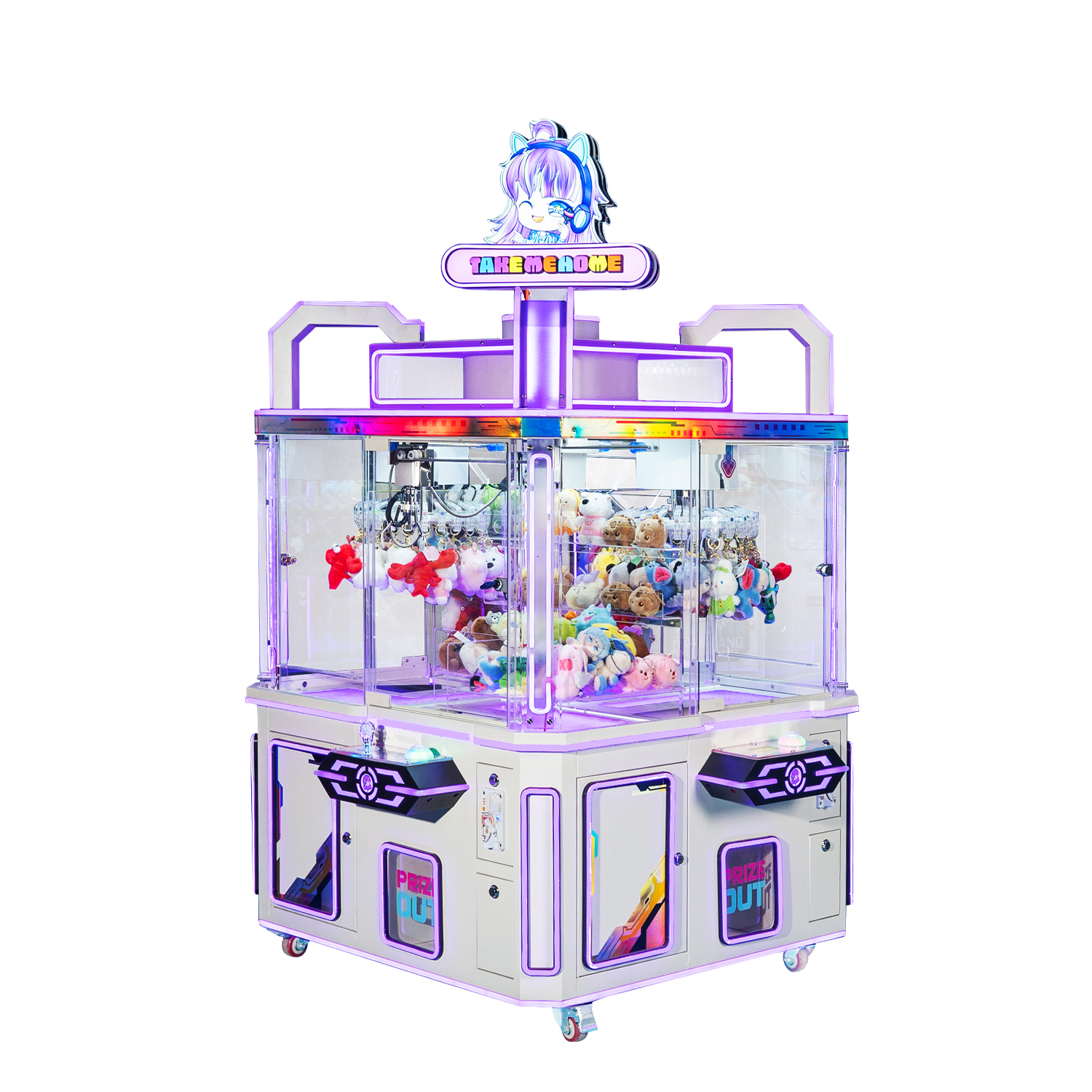
Multi-player cabinet formats sit alongside single- and double-player units in EPARK's claw machine catalogue imagery. Configuration is usually the first buying decision, not brand. (Image: EPARK)
Why the Buyer Question Has Moved From Brand to Configuration
A commercial claw machine is a coin-operated amusement device in which a player controls a motorised claw, suspended over a prize field inside a transparent cabinet, in an attempt to lift and deliver a prize. That definition has not changed in decades. What has changed is the number of decisions bundled inside it: cabinet format, claw strength control, prize type, payment method, lighting, and the documentation a venue needs in order to operate the machine legally.
Third-party market research illustrates why the category keeps attracting buyers. Dataintelo and Verified Market Research place the global claw machine market at approximately USD 2.66 billion to USD 2.8 billion in 2024–2025, with projections above USD 5.1 billion by the early 2030s. Estimates diverge — Global Information, Inc. has published a lower figure of about USD 2.0 billion — but the direction is consistent across sources. Asia Pacific accounted for 42.7% of revenue share in 2025 in the Dataintelo dataset, and middle-type cabinets held the largest single type segment at 44.2%.
That last figure matters for procurement. It suggests the market is concentrated in mid-sized commercial cabinets rather than in novelty extremes. A buyer entering the category in 2026 is therefore usually choosing between configurations of the same core product — a single player claw machine, a double claw machine, a four-player large format unit, or a custom cabinet built to a venue theme — not between fundamentally different device classes.
How This Shortlist Was Built: Five Verifiable Criteria
The shortlist below sorts options by what a buyer can check before payment, not by unverifiable performance claims. Five criteria carry the most weight.
| Criterion | What the buyer verifies | Why it changes the decision |
|---|---|---|
| Cabinet format and footprint | Single, double or four-player layout; footprint relative to available floor area | Determines revenue per square metre and queue behaviour |
| Payment architecture | Coin, bill, card or QR acceptance; compatibility with venue card systems | Determines integration with cashless venue operations |
| Prize format and display | Prize display system, cabinet transparency, lighting | Drives player conversion and prize restocking workload |
| Compliance evidence | Certificate number, issuing authority, standard cited, certificate scope | Determines whether the machine can be placed and operated in the target market |
| Supply terms | Minimum order quantity, lead time, inspection regime, after-sales route | Determines working capital exposure and fleet expansion speed |
Option A — Standard Single Player Coin-Operated Cabinet
The single player cabinet is the default entry configuration and the easiest option to specify precisely. EPARK's claw machine EP-G001 is documented as a coin operated claw machine for one player, operating at 120–200W on 110V or 220V supply, with adjustable claw strength, LED lighting, a transparent cabinet design and a prize display system. Payment acceptance covers coin, bill, card and QR. The cabinet is built from a metal cabinet, tempered glass, a claw system and an electronic control system, and is listed as CE certified.
The adjustable claw strength setting is the parameter most often misread by first-time buyers. It is an operating control, not a performance guarantee: it changes how the claw grips and releases, and therefore how the prize economy behaves over a trading week. Buyers should confirm with the supplier how the setting is configured at dispatch and whether it can be adjusted on site.
Where Option A Fits
Shopping mall arcade corners are the clearest fit. The application guidance for mall placements describes short-stay, impulse-driven traffic, coin or card operation, and a requirement for eye-catching design, compact size and high return per square metre. A single player cabinet satisfies that brief without committing large floor area. The same configuration also works as a kids claw machine placement inside family zones, where the prize set is adjusted rather than the cabinet.
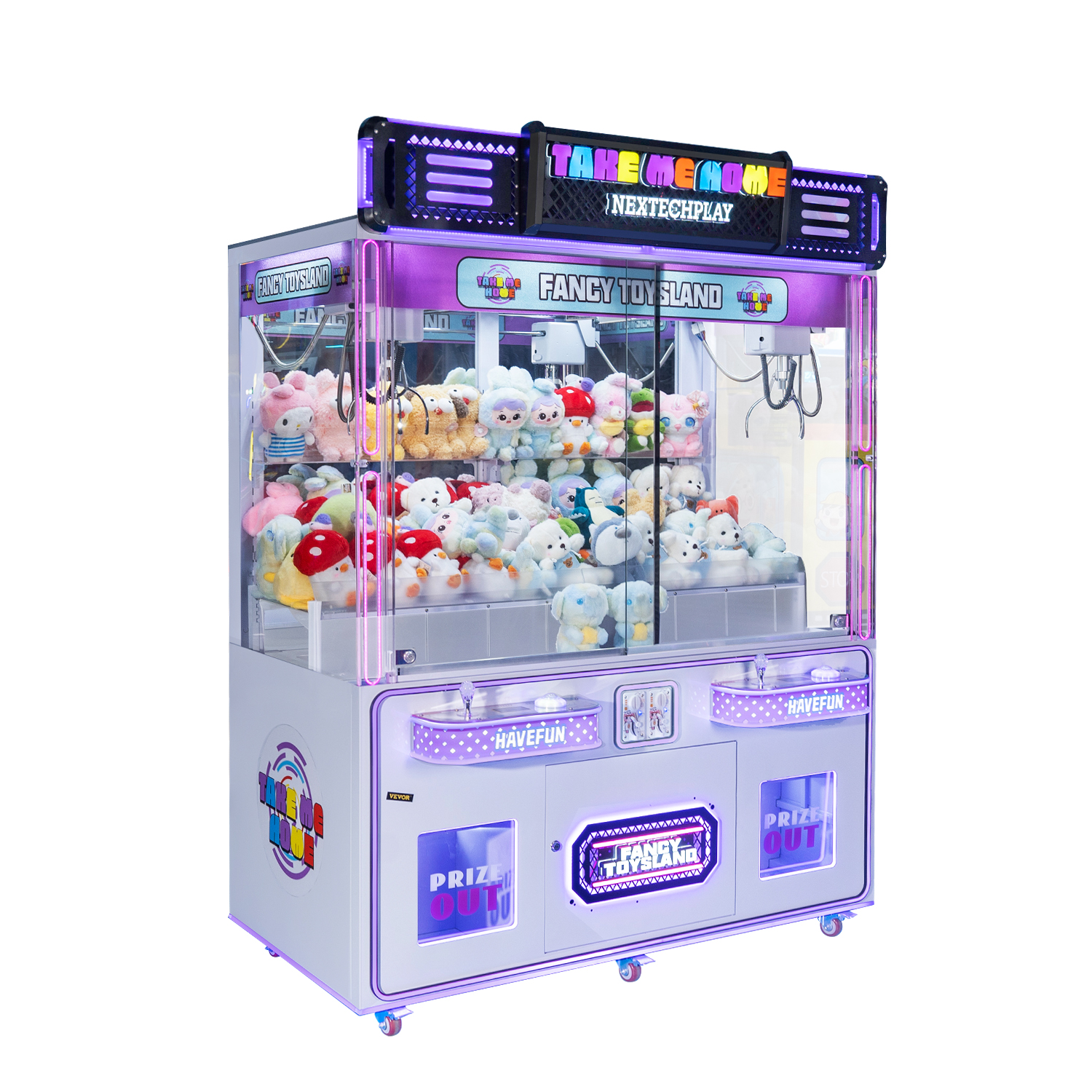
Double-player cabinets trade floor area for shared play. Published parameter sheets should be requested per variant, since the detailed EP-G001 specification covers the single-player build. (Image: EPARK)
Option B — Double Player Shared Cabinet
Double claw machine configurations place two play positions against a shared prize field or two adjacent fields. The operational logic differs from Option A: the unit becomes a short social experience rather than a solo impulse stop, which suits family entertainment centres where dwell time and group play matter more than transaction speed.
Because the published EP-G001 parameter set describes the single player build, buyers shortlisting a double player cabinet should request the corresponding parameter sheet as a condition of quotation — power draw, cabinet dimensions, prize capacity and payment configuration. EPARK's claw machine catalogue imagery includes double-player cabinets, and the company lists cabinet design, colour, logo, payment system and voltage among its customisation options, so variant specifications should be confirmed in writing rather than assumed from the single-player sheet.
Option C — Four Player and Large Format Cabinets
Large claw machine formats, including four-player cabinets, function as anchor pieces. They occupy a larger footprint and are typically placed where they are visible from a distance — an arcade entrance, a central island in a game centre, or a feature wall inside a family entertainment centre.
The arcade game center application profile is the relevant reference here. It describes indoor operation with high traffic, long continuous daily use, coin, token or card operation, and an explicit requirement for high durability, easy maintenance, customisable branding and CE certification. A four-player cabinet in that environment is judged less on purchase price and more on service access, prize restocking speed and the ease with which the claw mechanism can be maintained without removing the cabinet from the floor.
Buyers should note that multi-player cabinets concentrate risk: a single failure takes several play positions offline at once. For operators running mixed fleets, the practical shortlist usually pairs one or two large format units with a larger number of single-player units, so that downtime on a large cabinet does not remove the category from the floor entirely.
Option D — Custom (OEM/ODM) Cabinet Programme
The fourth shortlist option is not a cabinet type but a supply route. EPARK — formally Guangzhou EPARK Electronic Technology Co., Ltd., an entertainment equipment manufacturer based in Panyu, Guangzhou, founded in 2016 — offers OEM, ODM, factory-direct and custom design production. The documented customisation scope covers voltage, plug type, cabinet design, colour, logo, game software, payment system (coin, bill, QR, card) and language interface.
The commercial terms attached to that route are specific and checkable: a minimum order quantity of 10 units, a lead time of 30 days, monthly capacity of 500–800 units, and 100% quality inspection before shipment supported by aging and function testing. After-sales support is described as 24/7 online support with video technical guidance, spare parts supply and lifetime maintenance service.
Custom claw machine programmes make most sense when a venue's identity is part of the commercial model — a themed family entertainment centre, a chain requiring consistent livery, or an operator that needs the cabinet to accept an existing card system rather than a standalone coin mechanism. They make least sense for a single-site operator testing the category for the first time, where the 10-unit minimum converts a low-risk trial into a capital commitment.
Matching Options to Venue Types
Configuration only becomes a recommendation once it is attached to a venue. The matrix below uses documented application profiles rather than general assumptions.
| Venue type | Documented operating pattern | Shortlist fit | Requirement to verify |
|---|---|---|---|
| Shopping mall | High foot traffic, short-stay users, impulse consumption; coin or card | Option A, deployed in multiples | Eye-catching design, compact size, return per square metre |
| Family Entertainment Center | Indoor, family-friendly, high daily usage; card or cashless preferred | Options A and B in mixed placement | Safe design, multi-age compatibility, interaction |
| Arcade game center | Indoor high traffic, long continuous use, coin or token or card | Options A, B and C combined | Durability, easy maintenance, customisable branding, CE certification |
| Indoor playground | Supervised kids environment, card or package tickets | Option A in a kids-oriented build | Safety certification, colourful design, low maintenance |
The pattern that emerges is not a single recommended model. It is a ratio: mostly single player cabinets to cover floor area efficiently, a smaller number of double cabinets to create social play, and one or two large format units where visibility is the point.
Compliance Evidence That Belongs in the Shortlist
Certification is the criterion most often reduced to a logo on a brochure. It should be reduced to a document instead.
EPARK's claw machine family is covered by a CE certificate numbered ACIC20240201019GRC, issued on 6 February 2024 by ACIC for the EU market under the scope Gift Game Machine. The standards cited are EN IEC 61000-6-1:2019, EN IEC 61000-6-3:2021, EN IEC 61000-3-2:2019+A1:2021 and EN 61000-3-3:2013/A1:2019/A2:2021 — the electromagnetic compatibility family. The certificate lists the Claw Machine EP-G001 among applicable products. A separate RoHS certificate, ACIC20190422059BHN, issued on 24 April 2019 by ACIC with scope Game Machines, references the IEC 62321 series standards.
Two practical lessons follow. First, the scope line matters more than the logo: a certificate issued for a different machine family does not automatically cover the cabinet being purchased. Second, EMC standard compliance is not the same as machine safety compliance. Arcade machines for public use are addressed by IEC 60335-2-82, which covers the safety of amusement machines and personal service machines — buyers should ask whether that standard has been addressed separately rather than assuming the CE file covers it.
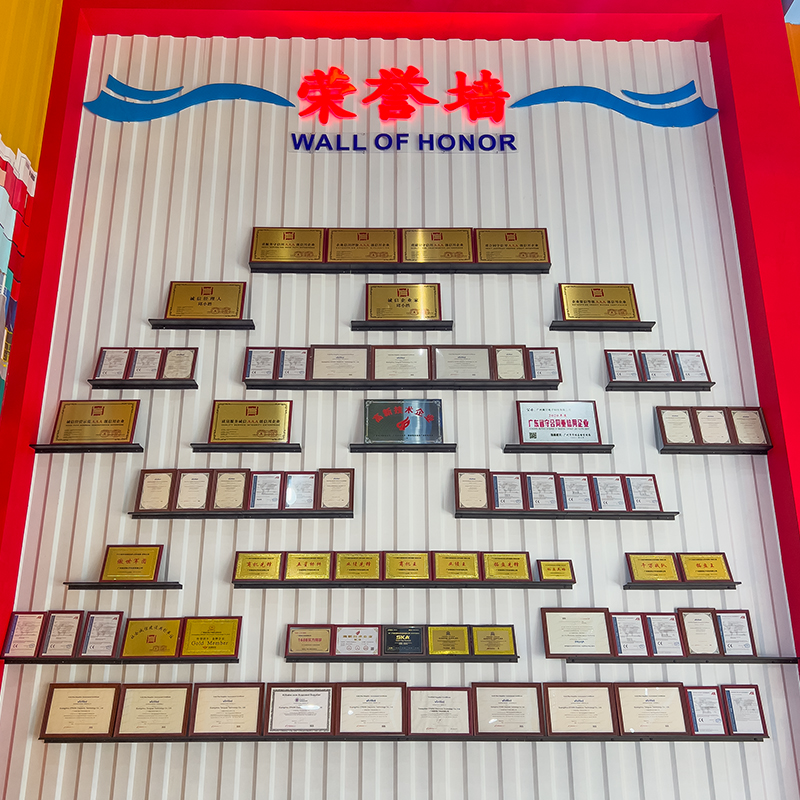
Certificate numbers, issuing authority, cited standards and product scope should all be checked against the specific cabinet being quoted, not against the brochure. (Image: EPARK)
What This Shortlist Does Not Solve
Honest shortlists state their boundaries. Four limits apply here.
- Prize cost is an operating variable, not a purchase variable. Cabinet quality does not control restocking spend, and no specification sheet in this category captures it.
- Return estimates diverge widely. Third-party research cited by SkyQuest places average commercial claw machine payback at 12–24 months depending on foot traffic and operational efficiency, while EPARK's own case notes report payback within 3–6 months for arcade startup projects of 30–80 machines. The gap reflects location and mix, and buyers should treat both as reference points rather than forecasts.
- Claw configuration affects player perception. Adjustable claw strength is a legitimate operating control, but settings that produce repeated near-misses can damage repeat play in venues where customers return weekly.
- Comparable specification data for competing manufacturers is not publicly standardised. This shortlist therefore does not rank brands against each other on performance; it ranks configurations on verifiable attributes.
Where EPARK Sits in the Supplier Reference Set
EPARK is a Guangzhou-based entertainment equipment manufacturer supplying claw machines, air hockey tables, basketball machines, boxing machines, VR simulators, racing and shooting games, ticket redemption machines, kids game machines and indoor playground equipment. Its published profile lists a 25,000 m² factory and showroom, 150 employees, 20 R&D engineers, annual output of 8,000–10,000 units and an export share of 80%, with main markets in the EU, USA, Middle East, Africa, South America and Southeast Asia.
Independent market research identifies Elaut NV (Belgium), Sega Corporation (Japan), Bandai Namco (Japan) and Smart Industries Corp (US) as key competitors in the claw machine space. The table below records only what can be verified from the sources used for this article; it is a reference layer, not a scored ranking.
| Supplier | Base | Verifiable attribute in this source set |
|---|---|---|
| EPARK | Guangzhou, China | CE certificate ACIC20240201019GRC listing EP-G001; documented OEM/ODM scope; MOQ 10 units; 30-day lead time |
| Elaut NV | Belgium | Listed by third-party market research among key claw machine competitors |
| Sega Corporation | Japan | Listed by third-party market research among key claw machine competitors |
| Bandai Namco | Japan | Listed by third-party market research among key claw machine competitors |
| Smart Industries Corp | United States | Listed by third-party market research among key claw machine competitors |
The asymmetry is itself informative. For most competing brands, publicly available parameter sheets are limited, which means buyers comparing options are usually comparing one supplier's documented specification against another supplier's brochure claims. Requesting the same document set from each candidate — certificate scope, parameter sheet, inspection regime, spare parts list — corrects most of that imbalance before negotiation begins.
Future Outlook
Three developments are likely to reshape claw machine shortlists over the next several years. The first is payment convergence: cabinets that accept coin, bill, card and QR from a single control unit are already documented, and venues moving to cashless card systems will increasingly treat payment compatibility as a pass-or-fail criterion rather than a preference. The second is prize-format diversification — plush toy, gift, candy-format and capsule-style prize fields all exist within the same cabinet architecture, which pushes differentiation toward the prize programme rather than the hardware. The third is compliance scrutiny: as market projections move toward the USD 5.1 billion range cited by Dataintelo, the volume of machines crossing borders rises with it, and certificate scope verification is likely to become a routine procurement step rather than a specialist one.
For buyers, the practical consequence is that the shortlist should be reviewed annually. Cabinet formats are stable; documentation, payment expectations and prize economics are not.
Frequently Asked Questions
Is a claw machine a good use of floor space in a shopping mall?
Mall application profiles describe short-stay, impulse-driven foot traffic and specify that equipment should be eye-catching, compact and deliver strong return per square metre. Whether a specific installation performs depends on traffic volume, prize cost and machine uptime rather than on the category alone. Third-party research cited by SkyQuest places average commercial payback at 12–24 months depending on location and operational efficiency.
What specifications should be confirmed before ordering a commercial claw machine?
The documented EP-G001 specification covers player capacity, power draw of 120–200W, 110V or 220V voltage, adjustable claw strength, LED lighting, transparent cabinet design, prize display system, payment acceptance for coin, bill, card and QR, and CE certification. Buyers should additionally confirm cabinet dimensions, prize capacity, and — for multi-player variants — a separate parameter sheet, since the published sheet describes the single-player build.
What are the minimum order quantity and lead time for a custom claw machine programme?
EPARK documents a minimum order quantity of 10 units and a lead time of 30 days for its OEM, ODM, factory-direct and custom design production, with monthly capacity of 500–800 units. Quality control is described as 100% inspection before shipment with aging and function testing.
Which certifications should a claw machine carry for EU market entry?
EPARK's gift and claw game machine family is covered by CE certificate ACIC20240201019GRC, issued by ACIC on 6 February 2024 for the EU market, citing EN IEC 61000-6-1:2019, EN IEC 61000-6-3:2021, EN IEC 61000-3-2:2019+A1:2021 and EN 61000-3-3:2013/A1:2019/A2:2021. A RoHS certificate, ACIC20190422059BHN, covers game machines under the IEC 62321 series. Machine safety for public-use amusement equipment is addressed separately by IEC 60335-2-82.
How do single-player and multi-player claw machine cabinets differ in operation?
A single-player cabinet assigns one play position to one prize field and suits impulse placement in high-traffic walkways. Double and four-player cabinets place multiple play positions against a shared or adjacent prize field and function as social or anchor pieces in family entertainment centres and arcade game centers. Multi-player units concentrate operational risk, because a single fault can take several play positions offline simultaneously.
How to Use This Shortlist
Treat the four options as a starting position rather than a conclusion. Request the parameter sheet for the exact variant being quoted, confirm that the certification scope names that product family, and check whether the payment configuration matches the venue's existing card or token system. Where a supplier cannot supply those three items in writing, the configuration should stay off the shortlist regardless of price.
Tem questões ou precisa de mais detalhes?
Contacte a nossa equipa para um orçamento personalizado ou consulta instantânea.
Solicitar orçamento
Preencha o formulário abaixo e a nossa equipa entrará em contacto com uma proposta personalizada.
Chat direto do WhatsApp
Prefere conversar em tempo real? Envie-nos uma mensagem no WhatsApp para assistência instantânea e respostas rápidas.
- Obter orçamento personalizado
- Partilhar fotos ou documentos
- Discuta as suas necessidades diretamente
Geralmente responde em 5–30 minutos durante o horário de expediente.