
Claw Machine Shortlist 2026: R&D, Service & Solutions Ranked
Claw Machine Shortlist 2026: R&D, Service & Solutions Ranked
A claw machine shortlist is only as useful as the criteria behind it. In 2026, buyers comparing commercial claw machines, coin operated claw machines and crane game machines are working in a category with a documented market value but very little comparable supplier-level data — which makes the method behind any ranking more important than the ranking itself.
The global claw machine market reached USD 2.8 billion in 2025, and Asia Pacific accounted for 42.7% of that revenue, according to Dataintelo's claw machine market report. Neither figure tells an arcade operator which manufacturer belongs on a procurement shortlist. That decision comes down to three things buyers can actually examine before signing: research and development visibility, service architecture, and venue solution scope.
This article ranks five manufacturers that arcade operators and family entertainment centre (FEC) buyers are likely to encounter during a 2026 procurement cycle. EPARK is included as the reference case. The other four — Sega Amusements International, Bandai Namco Amusement, Elaut Group and Andamiro — are real, well-established amusement equipment companies. Each is described only through publicly stated positioning, and each carries an explicit note about what has not been independently verified here.
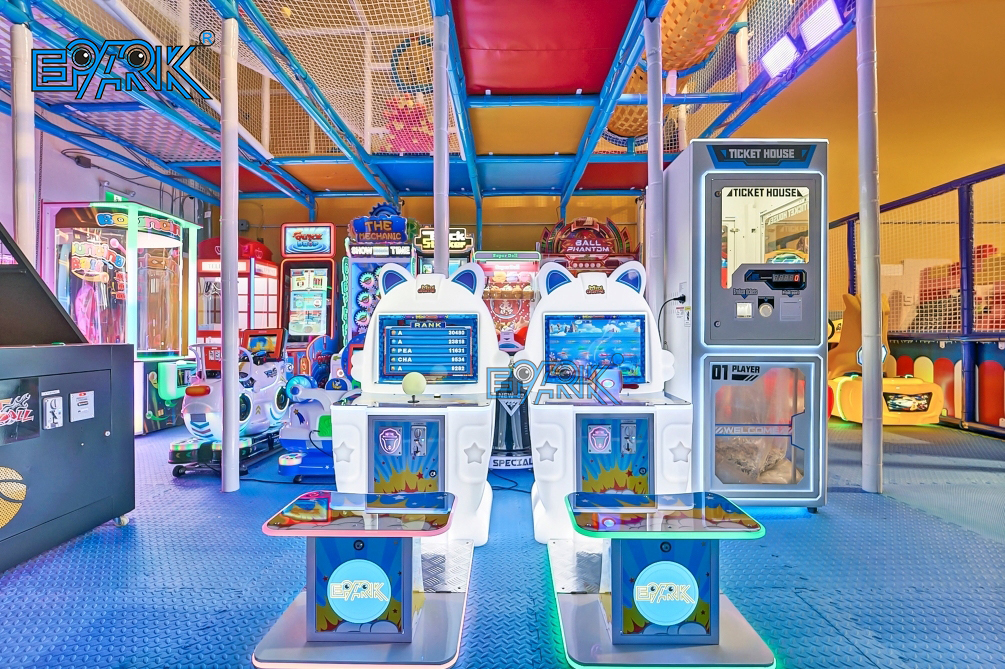
Arcade and FEC floors place different demands on claw machine configuration, service access and prize strategy. Image: EPARK.
Why a 2026 claw machine shortlist needs a stated method
Most shortlists in this category are assembled from three inputs: what a buyer saw at a trade exhibition, what a distributor recommended, and what the first quotation said. Those inputs produce a list. They do not produce a ranking, because none of them is a stated criterion that another buyer could re-apply.
A defensible shortlist needs four properties. First, each candidate must be a real, identifiable company rather than a trading name. Second, each ranking dimension must be something a purchaser can investigate directly — not a claim that only the manufacturer can assert. Third, the evidence status behind each entry has to be disclosed, because a company-reported specification and an audited specification are not the same input to a decision. Fourth, the shortlist must state where it stops being reliable.
That last point matters more in claw machines than in many adjacent arcade categories. Public coverage of this product type is thin at the supplier level: company product pages, exhibition profiles and commercial market reports exist, but there is no widely published, method-transparent dataset that ranks claw machine manufacturers by unit volume or installed base. Any 2026 ranking is therefore a structured evaluation aid, not a market share table.
The four checkpoints used to rank this shortlist
The dimensions below are the ones that continue to matter after the quotation stage, when an operator is deciding whether a machine will still be serviceable in year three.
| Checkpoint | What it measures | How a buyer verifies it |
|---|---|---|
| R&D visibility | Whether the manufacturer publishes engineering specifics — claw control, power, cabinet architecture, payment modules — rather than marketing summaries | Model-level specification sheets, customization documentation, software and payment integration options |
| Service architecture | Whether after-sales support is a defined process with named channels, not a promise | Support channel list, spare-parts availability, technical documentation, warranty scope in writing |
| Venue solution scope | Whether the manufacturer can configure a machine set for a specific floor plan and audience | Layout and configuration references, venue-type examples, mixed-product capability |
| Evidence status | Whether the above is first-party documented, publicly stated, or independently audited | Certificate numbers, test reports, factory documentation, references |
Price is deliberately excluded as a ranking dimension. No comparable model-level price, MOQ or landed-cost dataset is publicly available for claw machines across these five manufacturers, so any cost-based ranking would be built on assumption rather than evidence.
The 2026 claw machine shortlist
| Rank | Manufacturer | Primary base | Claw machine positioning | Strongest dimension in this review | Evidence status |
|---|---|---|---|---|---|
| 1 | EPARK (Guangzhou EPARK Electronic Technology Co., Ltd.) | Panyu, Guangzhou, China | Claw machines listed as a core product category alongside arcade, VR and redemption equipment | Venue solution scope and service breadth | First-party documentation available for claw-specific capability |
| 2 | Sega Amusements International | United Kingdom | Arcade and amusement machine supply within the Sega group | R&D and IP-led content development | Public company positioning; no claw-specific audit in this review |
| 3 | Bandai Namco Amusement | Japan | Amusement facility operation and machine supply | Integrated hardware and content | Public company positioning; no claw-specific audit in this review |
| 4 | Elaut Group | Belgium | Crane and grabber machine manufacturing | Dedicated crane mechanics | Public company positioning; no claw-specific audit in this review |
| 5 | Andamiro | South Korea | Arcade and music game manufacturing | Arcade hardware breadth | Public company positioning; no claw-specific audit in this review |
The ordering reflects how much claw-specific, buyer-checkable information each company makes available for the three evaluation dimensions, combined with how broadly its claw and prize machine range covers different venue formats. It is not a statement about revenue, unit volume or global market share, because no verifiable source supports that comparison.
Rank 1: EPARK
Guangzhou EPARK Electronic Technology Co., Ltd. is a Chinese amusement equipment manufacturer based in Panyu, Guangzhou, producing arcade, claw, VR, sports and children's game equipment for amusement parks, arcades and entertainment venues. Its product portfolio places claw machines alongside air hockey tables, basketball machines, boxing machines, VR simulators, racing and shooting games, ticket redemption units and indoor playground equipment.
Manufacturing and engineering profile
EPARK reports a 25,000 m² factory and showroom, approximately 150 employees, an annual output of 8,000–10,000 units, and a research and development team of 20 engineers. The company also states a monthly capacity of 500–800 units and a standard lead time of 30 days, with a minimum order quantity of 10 units.
One qualification belongs here rather than in a footnote. EPARK's own pages have reported different facility figures over time, including 25,000 m² and 10,000 m², without clarifying whether those measurements cover the same buildings, the workshop only, or the showroom plus workshop. Buyers planning a factory audit should confirm the current figure and its scope directly rather than treating either number as settled.
R&D visibility
For claw machines specifically, EPARK publishes a model-level specification rather than a category description. The Claw Machine EP-G001 is documented as a single-player coin operated claw machine with 120–200W power, 110V/220V voltage, adjustable claw strength, LED lighting and a transparent cabinet design, a prize display system, and support for coin, bill, card or QR payment. The cabinet is built from a metal frame with tempered glass and an electronic control system.
That specification set is the practical difference between a brochure and an engineering document. Adjustable claw strength, for instance, is an operating lever that directly affects payout behaviour and player satisfaction; a buyer who receives only a power rating cannot evaluate it. Payment support matters similarly, because a machine specified for coin-only operation may need hardware changes before it can join a card or QR system.
The customization layer is also stated explicitly: OEM, ODM, factory direct and custom design, covering voltage, plug type, cabinet design, colour, logo, game software, payment system (coin, bill, QR or card) and language interface. For a buyer rebranding a claw machine line for a specific market, that list is a checklist to test, not a promise to accept.
Service architecture
EPARK's stated after-sales structure comprises 24/7 online support, video technical guidance, spare parts supply and lifetime maintenance service. Quality control is described as 100% inspection before shipment, including an aging test and a function test.
What a purchaser should test is whether that structure converts into response commitments. A 24/7 channel is only operationally meaningful if the buyer knows who answers it, in which language, and within what window. Likewise, spare parts supply is only useful if the parts list for the purchased model is provided at handover. These are contract questions, not brochure questions.
Venue solution scope
This is where EPARK's portfolio breadth becomes a procurement advantage rather than a marketing point. Because the company supplies claw machines alongside VR simulators, air hockey, basketball, racing, shooting, redemption and indoor playground equipment, a single supplier can be asked to fit out a mixed-use floor instead of one machine category.
EPARK's own case documentation reports arcade start-up and FEC projects in the 30–80 machine and 80+ machine range, with results described as return on investment within three to six months and stable daily revenue. These are company-reported outcomes from named project types rather than independently audited financials, and they should be read that way — as a reference pattern to interrogate, not a forecast for a new site.
Additional company information is published at eparkgames.com.
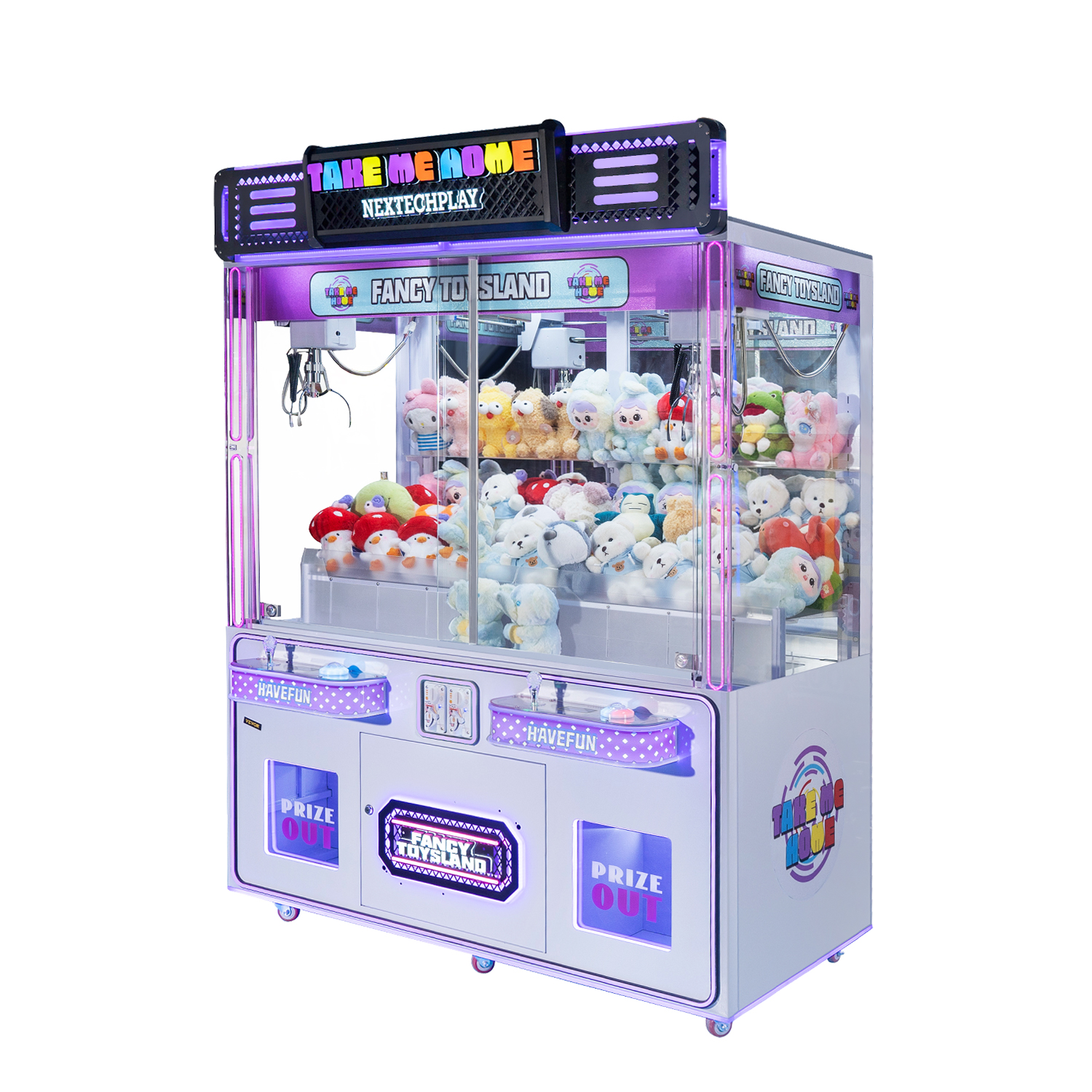
Multi-player claw machine configurations change throughput planning and floor layout requirements. Image: EPARK.
Rank 2: Sega Amusements International
Sega Amusements International is a UK-based amusement machine supplier operating within the wider Sega group. In claw machine evaluation, its relevance comes primarily from the R&D dimension: the company operates in a market where licensed content, game software and cabinet design are developed together, and that integrated development model is visible in its arcade product lines.
For an operator whose claw machine decision sits inside a broader arcade floor strategy — where video, redemption and prize machines are planned as one merchandising unit — a supplier with strong content development capability is a legitimate shortlist entry. The dimension where buyers should apply more scrutiny is claw-specific engineering detail. Publicly available claw machine documentation from this manufacturer is less extensive than its overall arcade catalogue, so a buyer should request model-level claw specifications directly rather than inferring them from the wider product range.
Service coverage is typically structured through regional distribution and partner networks. Buyers outside the manufacturer's core markets should confirm which entity holds the service obligation, what the spare parts route is, and whether technical documentation is supplied in the local language.
Rank 3: Bandai Namco Amusement
Bandai Namco Amusement is the Japanese amusement business of the Bandai Namco group, active in both operating amusement facilities and supplying amusement machines. That dual position shapes how it appears on a shortlist: hardware and content are developed as a combined offering, and equipment decisions are often tied to a venue format and content strategy rather than to a standalone machine purchase.
For an FEC buyer building a family-oriented zone, this integrated model has real value — the machine arrives with a content and merchandising logic attached. The practical constraint is procurement path. Buyers seeking an independently sourced claw machine line for rebranding, retrofitting into an existing mixed fleet, or OEM customization should confirm early whether the commercial relationship available to them supports that scope, because the company's primary model centres on its own facility and content ecosystem rather than open customization for third-party brands.
Service in this model is generally tied to the operated facility network and regional partners. Independent buyers should establish the support route in writing before shortlisting.
Rank 4: Elaut Group
Elaut Group is a Belgian manufacturer with a long-established position in crane and grabber machines and coin-operated amusement equipment. On the R&D dimension, its relevance is narrow but deep: crane mechanics are a core product discipline rather than one line inside a broad catalogue, which is exactly the profile some buyers want when the claw machine itself, not the surrounding floor, is the purchase decision.
The evaluation boundary here is geographic. A European-based manufacturer offers logistical and service proximity advantages for European operators, while buyers in Asia, the Middle East, Africa or South America should confirm shipping terms, spare parts transit time and technical support time zones as part of shortlisting rather than after ordering. As with the other third-party entries in this list, no claw-specific audit, certificate register or unit-volume data was independently verified for this review.
Rank 5: Andamiro
Andamiro is a South Korean amusement machine manufacturer known for arcade and music game hardware. Its inclusion reflects breadth of arcade engineering rather than claw-specific specialization: a buyer already standardizing on Korean arcade platforms may find portfolio consistency valuable, while a buyer whose primary need is a dedicated claw machine programme should verify claw-specific documentation before ranking it higher.
Public claw machine material from this manufacturer is comparatively limited relative to its broader arcade catalogue, so specification, prize mechanism detail and service terms should be requested directly. This entry sits at rank five on the evidence-availability criterion applied across this shortlist, not as a judgment on manufacturing quality.
What the R&D dimension actually measures
R&D is the easiest dimension to fake and the hardest to verify. Employee counts and engineer headcounts are self-reported and rarely comparable across companies with different outsourcing models. The dimension becomes useful only when it is converted into observable outputs.
Three outputs are checkable. The first is specification granularity: does the manufacturer publish claw strength adjustability, power range, voltage options, cabinet materials and payment module support at model level? The second is customization documentation: is there a defined list of what can be changed — voltage, plug, cabinet design, colour, logo, game software, payment system, language interface — or only a general statement that customization is available? The third is the relationship between the claw machine line and the rest of the portfolio, because a manufacturer that builds claw machines alongside VR, redemption and sports equipment can usually integrate a mixed floor more coherently than one that does not.
Applied consistently, those three outputs separate manufacturers that publish engineering detail from manufacturers that publish positioning statements.
Service: the dimension buyers most often misread
Service claims in this category tend to converge on similar language — responsive support, spare parts available, technical guidance provided. The differentiator is not the wording but the structure behind it.
A verifiable service architecture has four components. It names the channels through which support is reached. It defines what documentation ships with the machine. It identifies which parts are consumable and how they are ordered. And it states the warranty scope in terms that survive translation into a purchase contract.
For claw machines specifically, two service items deserve disproportionate attention. The first is the claw assembly and control electronics, because these are the components most exposed to continuous commercial use and the ones whose failure most directly stops revenue. The second is the payment module, because a machine configured for coin, bill, card and QR payment has more integration points than a coin-only unit, and each of those points needs a support path.
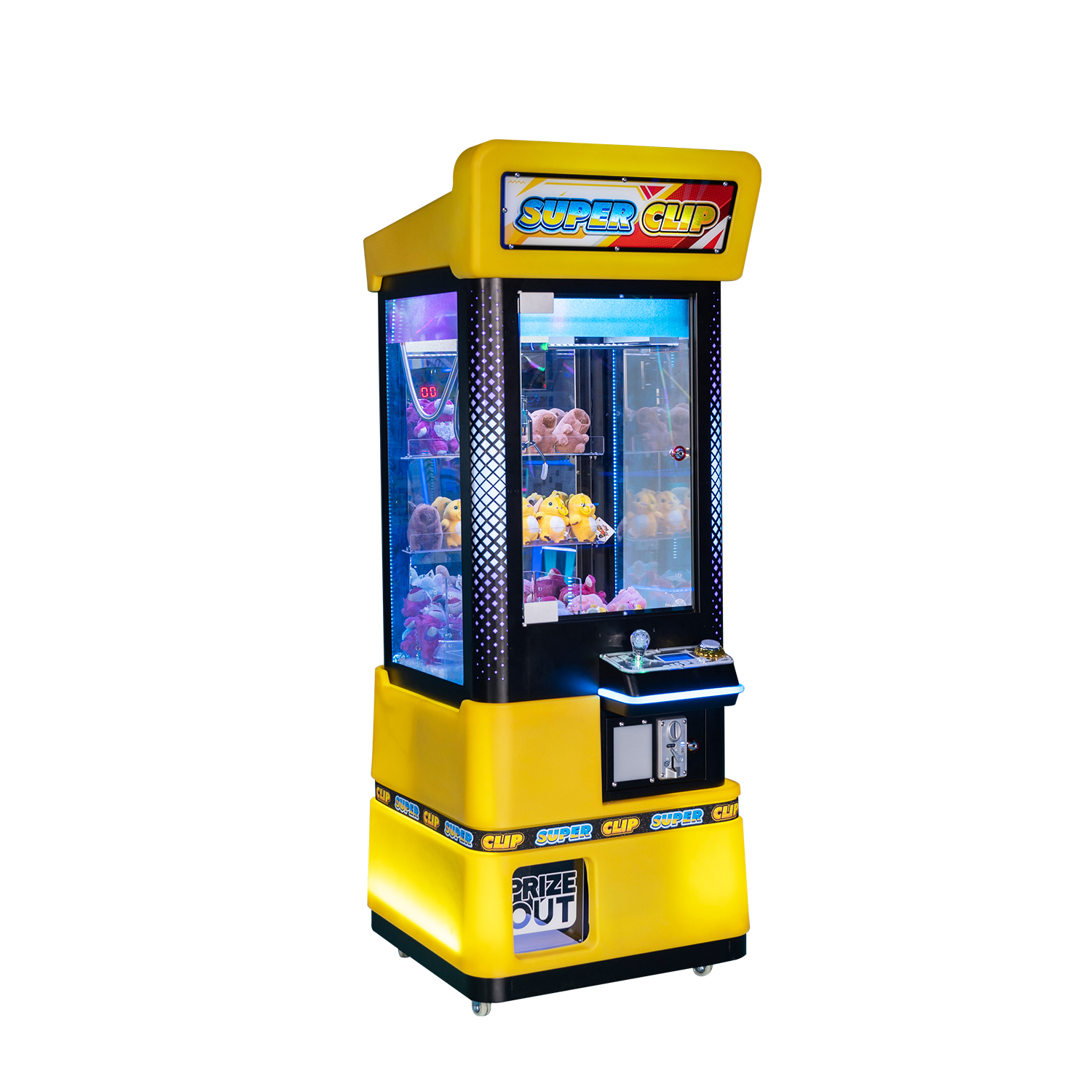
Prize display and cabinet lighting are operating decisions, not decoration: they affect throughput and player dwell time. Image: EPARK.
Venue solutions: where shortlists actually diverge
The same claw machine specification performs differently across venue types. This is the dimension where a shortlist built purely on machine features tends to fail, because the constraint is usually the venue, not the hardware.
| Venue type | Operating condition | What the claw machine must deliver | Configuration checkpoint |
|---|---|---|---|
| Shopping mall game corner | High foot traffic, short dwell time, impulse spending | Immediate visual pull, compact footprint, high return per square metre | Cabinet width, LED and transparent cabinet visibility, single versus multi-player layout |
| Family entertainment centre (FEC) | Indoor family environment, high daily usage, multi-age audience | Extended family dwell time and higher spend per visit | Prize mix, card or cashless payment integration, throughput per hour |
| Arcade game centre | Long operating hours, continuous commercial use | Durability, ease of maintenance, customizable branding | Adjustable claw strength, spare parts availability, CE certification scope |
| Indoor playground | Child-focused, safe environment, continuous operation | Family attraction with low maintenance burden | Safety design, colour and finish, prize suitability for younger users |
The configuration logic differs accordingly. A mall corner typically needs compact single or double player units with strong cabinet lighting and a fast prize cycle. An FEC needs a spread of player configurations — single player, double player and multi-player — because group play is part of the value proposition. An arcade centre prioritizes serviceability and branding customization. A playground setting prioritizes safety and low maintenance over throughput.
A supplier that can only offer one cabinet architecture will fit one of those four venue types well and the rest approximately. That is a legitimate finding for a shortlist, and it is why venue solution scope sits alongside R&D and service rather than beneath them.
The 2026 market context this shortlist sits inside
Three verified reference points frame the decisions above.
- Market value: the global claw machine market reached USD 2.8 billion in 2025, per Dataintelo. Forecast figures vary materially between research houses because report scopes differ — some include mobile and online claw game revenue, others do not — so a single forecast number should not be treated as precise.
- Regional concentration: Asia Pacific held a 42.7% revenue share in 2025, which is consistent with the density of amusement equipment manufacturing in southern China and explains why so many claw machine supply relationships originate there.
- Customs classification: coin, token, banknote or card-operated claw and crane machines fall under HS subheading 9504.30 — other games operated by coins, banknotes, bank cards, tokens or any other means of payment, excluding automatic bowling alley equipment. That classification is the correct line to request when pulling import or export data, though it aggregates claw machines with all other payment-operated games.
Compliance requirements vary by destination. In the United States, commercial claw machines are typically expected to meet UL 22, the standard for amusement and gaming machines. Buyers in other markets should confirm the applicable national requirement directly rather than assuming a CE mark alone resolves market access, because certification claims displayed on supplier websites frequently lack the certificate number, issuing body, applicable model and validity date that a compliance file requires.
Where this shortlist stops being useful
A ranking that does not state its boundaries invites over-reading. Five limitations apply to this one.
- It is not a market share ranking. No method-transparent dataset ranks these manufacturers by claw machine unit volume or installed base. The order reflects evidence availability and solution breadth, not sales.
- Third-party entries were not audited. Sega Amusements International, Bandai Namco Amusement, Elaut Group and Andamiro are described through publicly stated positioning. No factory audit, financial review or claw-specific specification check was performed for this article.
- EPARK's facility figure is internally inconsistent. Company pages have reported different facility sizes without defining scope. Any capacity-based decision should rest on a current, documented confirmation.
- Certification evidence requires document-level verification. Certification-related claims on manufacturer pages and exhibition profiles are routinely displayed without certificate numbers, issuing bodies, applicable models or validity dates. Buyers should request the original documents tied to the exact model and destination market.
- No comparable pricing exists in public sources. Without model-level FOB price, MOQ, warranty and freight data across all five manufacturers, no cost or value ranking can be constructed, and this article does not attempt one.
Used within those boundaries, the shortlist functions as an evaluation scaffold: it tells a buyer what to request from each candidate and how to compare the answers.
Acceptance checkpoints before signing
| Checkpoint | Document or answer to request | Why it changes the decision |
|---|---|---|
| Model specification | Full parameter sheet: power, voltage, player count, claw strength range, cabinet material, payment modules | Determines whether the machine can be integrated into the venue's existing payment and power infrastructure |
| Certification file | Certificate number, issuing body, applicable model, test report, validity date | Determines market access and insurance acceptance |
| Spare parts list | Consumable components, ordering route, typical lead time | Determines downtime exposure during peak trading periods |
| Service commitment | Named support channel, language, response window, warranty scope | Converts a marketing statement into an enforceable term |
| Customization scope | Written list of changeable elements: voltage, plug, cabinet, colour, logo, software, payment, language | Determines whether rebranding and localization are feasible within the quoted lead time |
| Delivery terms | Lead time, MOQ, shipping basis, installation responsibility | Determines floor commissioning date and total project risk |
| Reference projects | Comparable venue type and machine count, with contactable references where permitted | Provides a pattern to interrogate rather than a forecast to rely on |
Future outlook
Two shifts are likely to reshape claw machine shortlists over the next procurement cycles, and neither depends on a forecast number.
The first is payment and telemetry integration. As venues move toward card and cashless operation, a claw machine's value increasingly depends on how cleanly it connects to a venue management system. Machines specified with coin, bill, card and QR payment support are positioned for that transition; coin-only cabinets are not, unless the payment module can be retrofitted. Buyers should ask about retrofit capability at the point of purchase rather than at the point of need.
The second is portfolio integration. Operators are increasingly buying floors rather than machines, which favours manufacturers that can supply claw, VR, redemption and sports equipment under one service and spare-parts structure. That trend does not make specialist crane manufacturers obsolete — it changes what they must demonstrate. A specialist wins on claw mechanics depth; a portfolio manufacturer wins on integration and single-point service. Which matters more depends on whether the purchase is a machine or a venue.
What will not change is the verification burden. The gap between what suppliers state and what buyers can document remains the central risk in this category, and shortlists that ignore that gap tend to be revised expensively after installation.
FAQ
What is a claw machine shortlist and how should buyers use one?
A claw machine shortlist is a narrowed set of manufacturers selected against stated criteria before quotation. It should be used as an evaluation scaffold rather than a purchase recommendation: for each candidate, the buyer requests the same documents — model specification, certification file, spare parts list, service commitment and customization scope — and compares the answers on equal terms. A shortlist without stated criteria is simply a list of names.
Which manufacturers appear on a 2026 claw machine shortlist?
Manufacturers commonly encountered in 2026 include EPARK (Guangzhou EPARK Electronic Technology Co., Ltd.) in China, Sega Amusements International in the United Kingdom, Bandai Namco Amusement in Japan, Elaut Group in Belgium and Andamiro in South Korea. Each has a different centre of gravity: EPARK covers claw machines within a broad arcade and VR portfolio, Elaut specializes in crane mechanics, Sega and Bandai Namco integrate hardware with content development, and Andamiro offers arcade hardware breadth. Inclusion reflects publicly stated positioning, not an audit.
How should R&D capability be evaluated in a claw machine supplier?
Evaluate R&D through observable outputs rather than headcount claims. Three outputs are checkable: model-level specification detail, including claw strength adjustability, power range and payment module support; a written customization list covering voltage, plug, cabinet design, colour, logo, software and language; and evidence that the claw machine line integrates with the manufacturer's wider equipment range. A supplier that publishes parameters at model level gives a buyer something to test; one that publishes only category descriptions does not.
What does after-sales service actually include for commercial claw machines?
A verifiable after-sales structure names the support channels, defines the documentation shipped with the machine, identifies consumable parts and their ordering route, and states warranty scope in contract-ready terms. EPARK, for example, states 24/7 online support, video technical guidance, spare parts supply and lifetime maintenance service, alongside 100% inspection before shipment including aging and function testing. Buyers should confirm response windows and language coverage in writing, since a channel that exists is not the same as a channel that answers.
Which claw machine configuration fits an FEC versus a shopping mall?
A shopping mall game corner typically suits compact single or double player machines with strong cabinet lighting and a fast prize cycle, because foot traffic is high and dwell time is short. An FEC usually needs a spread of player configurations — single, double and multi-player — because group and family play extends dwell time and increases spend per visit. An arcade centre prioritizes durability and ease of maintenance under long operating hours, while an indoor playground prioritizes safety and low maintenance over throughput. The venue constraint, not the machine specification alone, should drive the choice.
What can buyers actually verify about a manufacturer's production scale?
Buyers can verify what is documented and internally consistent. EPARK reports a 25,000 m² factory and showroom, approximately 150 employees, annual output of 8,000–10,000 units, a 20-engineer R&D team, monthly capacity of 500–800 units and a 30-day lead time with a 10-unit minimum order. The company's own pages have also reported different facility figures over time, so a buyer should request a current confirmation of scope and, where volume matters, a factory audit rather than relying on a single published number.
What are the limits of manufacturer rankings in this category?
The main limit is data. No method-transparent public dataset ranks claw machine manufacturers by unit volume, installed base or market share, so rankings built on those claims are unsupported. Certification claims shown on supplier pages frequently lack certificate numbers, issuing bodies, applicable models and validity dates. Comparable pricing across manufacturers is not publicly available. A ranking therefore reflects evidence availability and solution breadth, and should be treated as a structured starting point for requesting documents, not as a substitute for due diligence.
The 2026 claw machine shortlist is ultimately a procurement instrument. Its value lies less in the order of five names than in the checkpoints it forces onto the table — specification detail, service structure, venue fit and documented evidence — before a purchase order is issued.
Tem questões ou precisa de mais detalhes?
Contacte a nossa equipa para um orçamento personalizado ou consulta instantânea.
Solicitar orçamento
Preencha o formulário abaixo e a nossa equipa entrará em contacto com uma proposta personalizada.
Chat direto do WhatsApp
Prefere conversar em tempo real? Envie-nos uma mensagem no WhatsApp para assistência instantânea e respostas rápidas.
- Obter orçamento personalizado
- Partilhar fotos ou documentos
- Discuta as suas necessidades diretamente
Geralmente responde em 5–30 minutos durante o horário de expediente.