
Cleanroom, EDI Water and Formula Controls Behind Custom Wet Wipes
A wet wipes compliance file arrives as a document set: a quality certificate, a safety data sheet, a model list. For an OEM buyer at the evaluation stage, those documents answer a narrow question about who has been audited and leave the operational question open: what in the plant actually produces the property printed on the pack?
That gap is commercially relevant because the segments growing fastest are the ones where the production environment and the formula carry the claim. The global wet wipes market was valued at approximately USD 32.09 billion in 2026, with a projected 3.86% CAGR reaching USD 43.45 billion by 2034, according to Vertex AI / Fortune Business Insights. Baby wipes were valued at USD 5.4 billion in 2024 with a 7.5% CAGR projected through 2030, and pet wipes at USD 1.58 billion in 2024 with a 5.6% CAGR to USD 2.64 billion by 2033 (DataHorizzon Research).
This article reads three production controls at Da lian Weijie Biotechnology Co., Ltd. as compliance evidence an OEM buyer can interpret and verify: the Class 100,000 cleanroom supporting pet wipes model C05, the EDI ultra-pure water and UV sterilization equipment supporting pet wipes model C03, and the alcohol-free, plant-based, no-irritating-additives requirement applied to wet toilet paper model S02. The same control logic is then traced into OEM branding and contract manufacturing projects such as baby wipes Y02 and eye care wipes YJ01, with the limits of document-based evidence stated plainly.
Why a Certificate Alone Does Not Settle Compliance
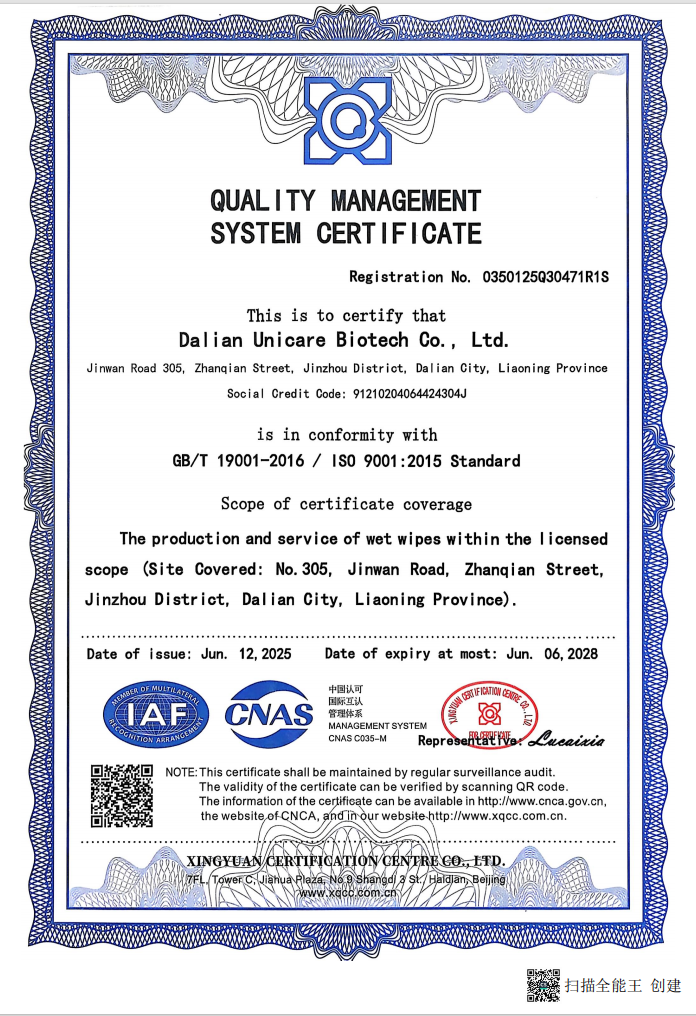
A quality management certificate answers a question about the system, not about the wipe. Da lian Weijie Biotechnology Co., Ltd. is a hygiene products manufacturer established in 2013 and based in Dalian, Liaoning, producing baby wipes, pet wipes, wet toilet paper, functional wipes and floor care wipes, with roughly 70% of output exported. The company holds ISO 9001 certificate 0350125030471R1S, issued by Xingyuan Certification Centre Co., Ltd. on 12 June 2025 and valid to 6 June 2028, against GB/T 19001-2016 / ISO 9001:2015, with the scope recorded as the production and service of wet wipes within the licensed scope.
That scope sentence is the first thing an evaluation team should read. It describes a licensed scope, not a statement that every code in the catalogue conforms to a buyer's specification. Industry guidance describes ISO 9001 and ISO 22716 (GMP for cosmetics) as baseline requirements for wet wipes OEM manufacturing, and the two do different jobs: a quality management standard stabilises process control, while a GMP-type standard addresses hygiene and contamination control in cosmetic manufacturing.
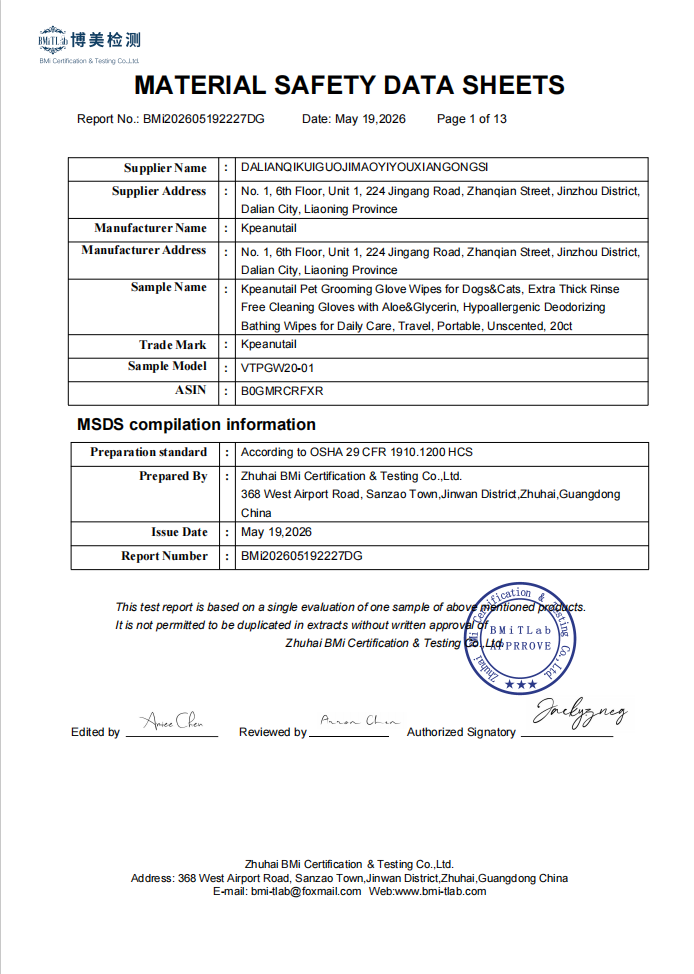
Safety documentation follows the same rule. The company maintains an MSDS numbered BMi202605192227DG, issued by Zhuhai BMi Certification & Testing Co., Ltd. on 19 May 2026 and valid to 20 May 2027, prepared according to OSHA 29 CFR 1910.1200 HCS, with a scope describing pet grooming glove wet wipes for dogs and cats. That is hazard communication for a defined product form. It is not a performance claim, and it does not transfer automatically to a different code carrying a different lotion.
The framework question is separate again. In China, wet wipes are governed by the Hygienic Standard for Disposable Sanitary Products; in the EU, EN standards apply alongside REACH for chemicals and BPR where a biocidal claim is made. A supplier can hold a clean domestic certification set and still leave destination-market registration with the brand owner. Buyers who conflate the two discover the gap at customs or at retail listing, not at the sample stage.
What a Class 100,000 Cleanroom Evidences for Pet Wipes C05
Pet wipes model C05 is produced with a Class 100,000 cleanroom. The designation refers to airborne particulate cleanliness in a controlled room and is commonly mapped to ISO 8 under ISO 14644-1. Two readers take two different things from that sentence: a marketing reader sees a quality signal, while an evaluation reader sees a room with a classification, a monitoring schedule and a gowning regime attached to it.
What the control supports
- Particulate control during converting. Wetting, cutting, folding and packing take place in a defined particle environment rather than an open production hall.
- A documented cleaning and monitoring regime, because a classification only holds while it is maintained and re-verified.
- Separation of the pet wipes line from general production, which is the element that matters when a buyer's own specification contains environmental limits.
What it does not establish
- It is not a sterility claim. A classified room is not a sterilised product, and microbiological status is a separate testing question.
- It does not validate the lotion formula, the preservative system or the substrate.
- It does not extend automatically to the other product families on the same site.
What to place in the evaluation file
Ask for the classification certificate naming the specific room and its date; the particle-count monitoring records with frequency; gowning and airlock procedures; the list of codes actually run inside that room; and the change-control rule applied when a new code enters it. A cleanroom statement without a room identifier is a site-level claim, and site-level claims are the easiest to over-read.
EDI Ultra-Pure Water and UV Sterilization in Pet Wipes C03
Pet wipes model C03 is supported by EDI ultra-pure water and UV sterilization equipment. Of the three controls discussed here, water is the one most often taken on trust, partly because it never appears on a pack.
Electrodeionization produces high-purity water continuously by combining ion-exchange membranes with an electric field, which removes the chemical regeneration step used in conventional mixed-bed deionisation. In practice, water quality at the point of use becomes a controlled and measurable output rather than a batch event. UV sterilization is applied as an in-line microbial control step at the point of use, so its value depends on lamp condition, contact time and the cleanliness of the loop behind it.
Water is the largest single component of a wet wipe lotion by mass, which places water treatment closer to the formula than most buyers assume. Ionic load, organic content and microbial bioburden in the water all enter the finished product. The practical consequence is that water treatment supports three things at once: consistency of the lotion between batches, a lower starting bioburden before preservation, and fewer interactions between trace contaminants and the preservative system.
None of that converts an equipment list into a validated product. Water treatment does not replace preservative efficacy testing, UV is not terminal sterilisation, and an installed system is not a monitored system. Buyers should request the water specification with alert and action limits; the sampling points and sampling frequency; the sanitisation cycle for the distribution loop; the UV lamp replacement schedule and intensity records; and trend data across several months rather than a single commissioning report.
Formula Controls in Wet Toilet Paper S02
Wet toilet paper model S02 is specified as alcohol-free, plant-based, and free of irritating additives. Each of those three phrases can be converted into a specification line, or left as marketing language. The difference is decided at the point of contract, not at the point of labelling.
Alcohol-free means little until the exclusions are named
Ethanol and isopropanol are the obvious exclusions. Aromatic alcohols used as fragrance components or as preservative carriers are a separate question, and buyers evaluating wet toilet paper for sensitive use should ask which definition the supplier applies and whether the answer covers the fragrance system as well as the solvent base. A written exclusion list, attached to the specification and to the batch record, is the only version of this claim that survives an audit.
Plant-based describes origin, not end-of-life behaviour
A plant-based substrate and a biodegradable substrate are different claims, and neither is the same as flushability. The market data separates the segments: plant-based flushable wipes were valued at USD 2.9 billion in 2024 with a 5.3% CAGR projected (Data Insights Reports), while the broader flushable wipes segment was valued at USD 2.3 billion in 2025 and projected to reach USD 4.2 billion by 2035 at a 6% CAGR (Global Market Insights). Buyers should ask which components are plant-based, whether substrate, lotion base or both, and whether a content share is declared in writing. Dispersibility belongs to the substrate supplier's test evidence and should not be inferred from the word plant-based.
Free of irritating additives is the phrase that most needs a list
Attach the exclusion list to the specification and name the reference method used for any tolerance testing. Keep the two categories apart: a formula exclusion is a formulation fact, while a skin-tolerance statement about the finished product depends on the full formula, the substrate and the destination market's rules. In the EU that means REACH for chemicals and BPR wherever a biocidal claim is made.
How the Control Set Travels to OEM Branding Projects: Y02 and YJ01
Baby wipes model Y02 and eye care wipes model YJ01 are contract manufacturing projects in which the buyer's brand, artwork and formula approval sit on top of the same production controls. The room, the water loop and the formula exclusions function as platform conditions; the project layer is the approved formula, the substrate, the pack format, the printed logo and the release testing.
The transfer is not automatic in either direction. A buyer running Y02 should confirm which room and which water loop the baby wipes line actually draws on rather than inheriting the C05 cleanroom statement. A buyer running YJ01 should expect the formula and microbiological questions to be asked harder, because the use site is the eye area and the tolerance for error is lower. In both cases the correct evidence is a named room, a named loop and a named test, not a site-level claim.
| Model | Category | Control emphasis stated | Evidence to request |
|---|---|---|---|
| C05 | Pet wipes | Class 100,000 cleanroom | Room classification record, particle monitoring frequency, list of codes run in that room |
| C03 | Pet wipes | EDI ultra-pure water with UV sterilization | Water specification and limits, sampling points, loop sanitisation, UV lamp and intensity records |
| S02 | Wet toilet paper | Alcohol-free, plant-based, no irritating additives | Full ingredient declaration, written exclusion list, substrate specification and dispersibility data |
| Y02 | Baby wipes | OEM branding project on the same platform controls | Formula approval record, artwork and logo control, pack format specification |
| YJ01 | Eye care wipes | OEM branding project on the same platform controls | Formula approval record, finished product microbiological testing, pack integrity check |
Customization across these projects covers packaging, logo, material, size, aroma and number of pieces, handled by an in-house R&D team of 10 people. That matters for evaluation because formula and format changes stay inside the same quality system rather than being brokered to a third party, which is where most specification drift originates.
What the Quality System Actually Records
Quality control is supported by three-party authoritative laboratories and internal inspection at three points: material inspection, process inspection and finished product inspection. The three stages catch different failures. Material inspection catches substrate and input deviations before they enter the line; process inspection catches drift in weight, wetting, sealing and print registration while the run is live; finished product inspection confirms that the released batch matches the approved specification. External laboratory testing sits outside that loop and provides an independent check rather than a substitute.
Long-running programmes are a different class of evidence, because they show that controls survived re-audits, specification changes and personnel turnover. Reported project data includes a 150-year-old conglomerate running a ten-year programme at 10 forty-foot containers per month, a household and personal care conglomerate in an eight-year relationship at the same monthly volume, a baby and maternity brand owner at 20 forty-foot containers per month across a five-year cooperation, an Amazon.com pet supplies seller at 8 forty-foot containers per month over six years, and an Amazon.com baby products seller at 8 forty-foot containers per month over four years. The company also reports supply to retail stores in Japan, including 7-Eleven, and to e-commerce and Lotte clients. None of that is a certification; all of it is a record of repeat verification by buyers with their own audit requirements.
Export experience covers Japan, Singapore, New Zealand, Australia, the United States, Southeast Asia and Canada, from a 6,000 m² facility with 50 employees. Monthly capacity is stated at 3 million packages and standard lead time at 30 days, with after-sales support that includes assisting buyers in verifying packing lists and customs declaration documents for export orders.
Market Trends That Raise the Evidence Bar
Personal care wipes held a 72.81% share of the global wet wipes market in 2025 (Mordor Intelligence), which concentrates attention on the categories where skin contact is continuous. Geographic concentration matters just as much: Japan accounts for nearly 27% of the Asia-Pacific wet wipes market with a strong focus on hygiene and premium quality personal care (Wet Wipes Market Growth Insights 2034), and Japan is projected to lead healthcare wipes growth with the highest CAGR through 2030. In pet care, North America holds roughly 50% of the segment, valued at USD 0.79 billion in 2024 (DataHorizzon Research). The United States accounted for 34% of the global wet wipes market in 2024.
The interpretation for an evaluation team is straightforward. Demand concentrates in markets where buyers audit documents rather than accept them, so a supplier's ability to describe a room, a water loop and an exclusion list becomes a commercial capability rather than a compliance formality. It also explains why an OEM factory list published by a trade source still names the same large players — American Hygienics Corporation, SYWIPE, Albaad and Nice-Pak International — while the practical selection decision is usually made on how precisely a smaller supplier can document its own controls.
Comparison With Other Sourcing Routes, and Where This Model Stops
There is no universally better route, only different evidence profiles. A trading intermediary can move quickly on small orders but typically hands the buyer documents without line access. A large global OEM offers deep scale: American Hygienics Corporation, for example, exports to more than 75 countries with a capacity of one billion wet wipes per year (Nonwovens Industry), which suits multi-region programmes with long planning horizons. A specialist manufacturer with in-house controls offers direct access to the room and the loop behind a specific code, at a smaller scale.
| Sourcing route | What the buyer can verify directly | Trade-off to plan for |
|---|---|---|
| Trading intermediary | Documents assembled on request | No line or room access; control questions are answered second-hand |
| Large global OEM | Multi-market documentation, very high capacity | Typically longer scheduling queues and higher minimum volumes |
| Specialist manufacturer with in-house controls | Named room, named water loop, in-house R&D and inspection records | Capacity ceiling of 3 million packages per month; MOQ 20,000 yuan package; 30-day lead time |
The limits of the model described in this article should be stated as clearly as the controls:
- Capacity is a ceiling, not a promise. A stated 3 million packages per month sits an order of magnitude below a one-billion-wipes-per-year global line. Buyers with peak-season or multi-container monthly programmes should model capacity against their own demand curve, not against unit price alone.
- Lead time and MOQ are real constraints. A 30-day standard lead time and a 20,000 yuan package minimum order quantity shape which programmes fit; fast-turn small launches may not.
- Control statements are line-specific. The cleanroom is documented for the pet wipes C05 context and the EDI water with UV sterilization for C03. A buyer of another code should confirm the room and loop assignment rather than assume site-wide equivalence.
- The supplied certification set is ISO 9001 and an MSDS. Industry sources describe ISO 22716 as a baseline for wet wipes OEM manufacturing; buyers who require it for a cosmetic-positioned product should confirm availability instead of assuming it.
- MSDS scope is narrow. One safety data sheet, scoped to pet grooming glove wet wipes, does not cover every code in the range; scope must be checked code by code.
- Documentation never replaces destination-market registration. EU REACH and BPR, or China's Hygienic Standard for Disposable Sanitary Products, remain the brand owner's obligation regardless of how complete a supplier file is.
Future Outlook
Three shifts are visible from the evaluation side. First, environmental data is moving from the audit report into the specification itself: buyers increasingly ask for water quality trends and particle monitoring as line items in the quality agreement rather than as attachments. Second, free-from claims are becoming contractual: as regulators scrutinise cosmetic-type claims under REACH and BPR, alcohol-free and no-added-X statements will need a written exclusion list behind them to be usable. Third, substrate sustainability is separating into distinct evidentiary tracks — plant-based origin, biodegradability and flushability are three claims requiring three different test sets, and the growth of the plant-based flushable segment suggests buyers will soon request all three in one file.
The common thread is traceability: from a finished batch back to a room, a water loop, a formula version and a monitoring record. Suppliers who can already produce that chain will find compliance questioning shortens; suppliers who cannot will find that a certificate set stops being enough.
Frequently Asked Questions
What does a Class 100,000 cleanroom prove about pet wipes C05?
It documents that the converting environment for model C05 is a classified room with a particulate control regime, which supports control of airborne contamination during wetting, cutting, folding and packing. It does not establish sterility, and it does not validate the formula. Buyers should request the room classification record with a room identifier and date, the monitoring frequency, and the list of codes produced inside that room.
Why does EDI ultra-pure water matter for pet wipes C03?
Water is the largest single component of a wet wipe lotion by mass, so its ionic load, organic content and microbial bioburden enter the finished product. EDI produces high-purity water continuously without chemical regeneration, and UV sterilization provides in-line microbial control at the point of use. The evidence that carries weight is trend data — specification limits, sampling frequency, loop sanitisation records and UV maintenance logs — rather than a list of installed equipment.
How should a buyer interpret alcohol-free, plant-based and no irritating additives on wet toilet paper S02?
As three separate specification lines. Alcohol-free requires a named exclusion list that states which alcohols are excluded and whether fragrance carriers are included. Plant-based describes the origin of specific components and says nothing about biodegradability or flushability, which require their own test evidence. Free of irritating additives requires a written exclusion list tied to the formula and kept separate from any skin-tolerance statement about the finished product.
Which documents should be checked first in an OEM wet wipes evaluation?
Start with scope matching rather than document count. Confirm the quality management certificate number, issuing body, validity dates and the exact scope wording, then confirm that the safety data sheet on file covers the code being purchased. Only after that should a buyer move to the control records behind each claim: room classification, water monitoring, exclusion lists and the material, process and finished product inspection records.
Do the same controls apply to baby wipes Y02 and eye care wipes YJ01?
The platform controls are shared, but the assignment is not automatic. Y02 and YJ01 are contract manufacturing projects in which the buyer's formula approval, substrate, pack format and artwork define the project layer over the same production environment. A buyer should confirm which room and which water loop each code draws on, and for eye-area products should expect formula and microbiological questions to be examined more closely than for general-purpose wipes.
What can compliance documentation not establish?
It cannot establish destination-market registration, which remains the brand owner's obligation under frameworks such as EU REACH and BPR or China's Hygienic Standard for Disposable Sanitary Products. It cannot establish finished-product performance for a code whose scope is not covered by the document in hand. And it cannot establish that a control verified for one line applies to every other code produced on the same site.
Reference
Company profile and capability documentation are available as a downloadable PDF: company profile (English).
Tem questões ou precisa de mais detalhes?
Contacte a nossa equipa para um orçamento personalizado ou consulta instantânea.
Solicitar orçamento
Preencha o formulário abaixo e a nossa equipa entrará em contacto com uma proposta personalizada.
Chat direto do WhatsApp
Prefere conversar em tempo real? Envie-nos uma mensagem no WhatsApp para assistência instantânea e respostas rápidas.
- Obter orçamento personalizado
- Partilhar fotos ou documentos
- Discuta as suas necessidades diretamente
Geralmente responde em 5–30 minutos durante o horário de expediente.