
CoQ10 Powder Buyer Decision Framework: 10% vs 99% Grade
CoQ10 Powder Buyer Decision Framework: 10% vs 99% Grade
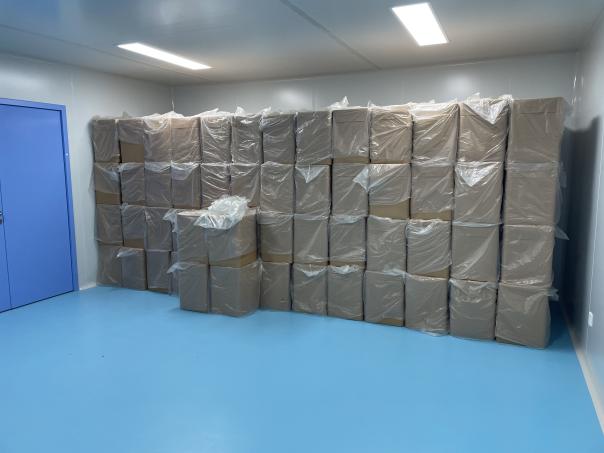
Ingredient storage and dispatch: the physical form of a CoQ10 grade decides how it is handled long before it reaches a capsule or a sachet.
The choice between a 10% water-soluble CoQ10 powder and a 99% grade is a formulation decision, not a quality ranking. The 10% designation describes a powder in which coenzyme Q10 is carried on a dispersion matrix that allows it to be handled in water-based systems; the 99% designation describes a high-purity ubiquinone isolate that behaves as a lipid-soluble material and is practically insoluble in water. The molecule is the same in both cases. What changes is how much of the powder is CoQ10, what the rest of the powder is, and how much mass the finished unit has to carry.
Coenzyme Q10 (ubiquinone) is a lipid-soluble quinone. It dissolves in fats and organic solvents and is practically insoluble in water, and that single property shapes every downstream decision about capsules, sachets and drinks. Buyers who compare grades on price per kilogram of powder — without converting to price per unit of declared CoQ10, and without checking the dispersion system — usually find the mismatch late: at label review, at the first stability check, or when a beverage separates on the shelf.
Category scale explains why the question keeps recurring. Global Market Insights estimated the global nutraceutical ingredients market at USD 105.8 billion in 2026, a commercial estimate that measures category size rather than grade performance. Nothing in that figure tells a buyer whether a 10% or a 99% grade fits a particular dose form; only the technical file and the unit formula do.
What each grade label actually records
A grade figure states a declared CoQ10 content. It is not a description of the entire powder. In a 10% grade, most of the material is carrier, stabiliser or dispersion matrix; that portion is not an impurity, but it is part of what you are buying, labelling and shipping. In a 99% grade, almost the whole powder mass is ubiquinone, and the remaining fraction is moisture, related substances and residual process material inside the supplier's specification range.
Both figures need context before they can be used in an evaluation:
- Assay basis. Whether the result is reported as-is or on a dried basis, and which method produced it.
- Method. HPLC is the usual approach for ubiquinone content, and the report should identify the method rather than only the result.
- Carrier identity. For a diluted grade, the carrier or dispersion system must be named, because it drives allergen screening, taste, bulk density and label declarations.
- Lot identity. Batch number, manufacture date, retest or expiry date, and the specification range the lot was released against.
A working rule follows: do not compare two CoQ10 quotations until both state the assay basis and, for the diluted grade, the carrier. Two powders both labelled 10% can differ in carrier, particle size and dispersion behaviour, which changes what the material does in your process even though the grade number is identical.
Start with solubility, because CoQ10 is a lipid-soluble molecule
No grade changes the molecule's affinity for water. A 99% grade delivers ubiquinone in its most compact form but inherits the handling problem: in a dry blend it is a hydrophobic powder, and in an aqueous system it needs a dispersion or solubilisation step — an emulsifier system, a hydrocolloid, or an oil phase — before it can be presented as a stable liquid.
A 10% water-soluble grade exists to move that work upstream. The supplier has already combined CoQ10 with a matrix intended to disperse it in water, so a formulator can add the powder into an aqueous mix without designing the dispersion from the beginning.
One wording caution is worth carrying into the evaluation. In ingredient trading, "water-soluble" frequently means "water-dispersible" rather than genuinely dissolved. A dispersion can be uniform and stable, or it can settle, ring or cream during storage — and the label word is not the evidence. Ask for the dispersion test the supplier uses, the vehicle and concentration tested, and the observation period, then repeat a bench trial in your own vehicle. That single check resolves more grade disputes than any specification comparison.
Gate 1 — Does the finished format actually need water dispersion?
Format fit is the first gate because it decides whether the 10% grade's main advantage is being used at all.
- Softgel or oil-based fill. A 99% grade carried in an oil suspension is a conventional route, and the oil phase already solves the solubility problem. A diluted grade adds mass and carrier to a system that did not need dispersion in the first place.
- Two-piece capsule, dry fill. Both grades are technically available; the binding constraint is how much powder the capsule can hold at the declared dose.
- Powder stick or sachet for reconstitution. Dispersion quality dominates. A 10% grade is designed for this case; a 99% grade usually requires the consumer or the filling line to solve dispersion, which is rarely acceptable in a retail product.
- Ready-to-drink beverage or shot. The hardest aqueous case. Ask for trial data in your own matrix at your own dose, and treat any general claim about beverage suitability as unverified until then.
- Tablet. Compressibility and mass per tablet decide the question; a diluted grade carries a fill-weight and flow consequence that must be tested on the press.
None of these is a rule that a particular grade cannot be used somewhere. They are screens. If the format does not need water dispersion, the diluted grade's carrier becomes extra mass and extra cost. If the format does need dispersion and you buy 99%, you have taken on formulation work the grade decision was supposed to remove.
Gate 2 — Can the assay file support the number on the label?
A grade figure becomes a purchasing fact only when the documentation behind it holds up. In the United States, dietary supplement manufacturers, packagers and holders must follow current good manufacturing practices that address identity, purity, quality, strength and composition (U.S. Food and Drug Administration). CoQ10 arriving at a supplement plant is an input to that system: the certificate of analysis and technical file are what allow the identity and strength of that input to be verified against the finished label.
A usable file for a CoQ10 lot normally covers:
- Certificate of analysis with lot number, assay result and basis, method reference, specification range and release decision.
- Chromatographic purity and related-substance results alongside the assay, because one content figure does not describe what else is present.
- Moisture, heavy metals, microbiological status and residual solvents, measured against the specification you agreed in writing.
- Carrier or dispersion-system declaration for the diluted grade.
- Particle size or mesh where the process is sensitive to flow, blending or suspension stability.
- A statement of whether testing was performed in-house or at an external laboratory, with that laboratory identified.
The last point matters at the evaluation stage. In-house HPLC is normal for a manufacturer and is not a weakness, but an in-house result is the supplier's own claim; an independent report is a second party's. Buyers should know which one they are holding before they sign a specification. For label benchmarking, the NIH Dietary Supplement Label Database records ingredient names and forms, declared amounts and label statements for supplements sold in the United States, which is a practical way to see how competing products declare CoQ10 before committing to a grade and a dose.
Gate 3 — Mass balance and what the grade does to the unit formula
An illustrative calculation makes the trade-off concrete. Suppose a formula declares 100 mg of CoQ10 per unit and the buyer assumes no overage: with a 99% grade, the material needed is about 101 mg per unit (100 ÷ 0.99); with a 10% grade, the material needed is about 1,000 mg per unit (100 ÷ 0.10).
The second figure is not a defect — it is arithmetic. But one gram of powder per unit is a fill-weight problem for a two-piece capsule and a bulk-density problem for a sachet. The example is illustrative only: the lot certificate governs the actual assay, the carrier content and any overage the formulator chooses, and those values should be substituted before any commercial decision. What the calculation does is reframe the comparison. A lower price per kilogram of a 10% powder can convert into a higher cost per unit of declared CoQ10, and a 99% grade that requires an added dispersion step carries a cost the quotation never shows.
Side-by-side: the decision matrix
| Decision dimension | 10% water-soluble grade | 99% grade | What to verify |
|---|---|---|---|
| Declared CoQ10 content | 10% of powder mass; remainder is carrier or dispersion matrix | Close to the whole mass is ubiquinone | Assay value, basis and method |
| Behaviour in water | Formulated to disperse | Practically insoluble; needs oil phase or solubilisation | Dispersion test protocol plus your own bench trial |
| Powder mass at 100 mg declared | About 1,000 mg per unit | About 101 mg per unit | Target fill weight and bulk density |
| Conditional format fit | Sachets, sticks, aqueous mixes, blends requiring dispersion | Softgels, oil suspensions, dry blends, tablets with tight mass | A trial in the actual dose form |
| Documentation priority | Carrier identity, dispersion evidence, assay | Purity, related substances, residual solvents, assay | Lot certificate plus an independent option |
| Main commercial risk | Paying ingredient prices for carrier; separation in liquids | Under-estimating formulation work; uneven blend distribution | Cost per unit of CoQ10, not per kilogram |
Supplier checks: production route, laboratory and lot evidence
CoQ10 used in supplements is produced commercially by microbial fermentation or by chemical synthesis, and suppliers describe one route or the other. The route does not by itself decide which grade to buy — format and mass balance do — but it decides which questions belong in the technical file. For a fermentation-derived material, ask for the route documented in the specification, information on media and downstream purification, and statements on residual solvents and microbiological control. For a synthetic route, the related-substance and impurity profile carries more of the verification weight. Either way, obtain the route in writing rather than in conversation.
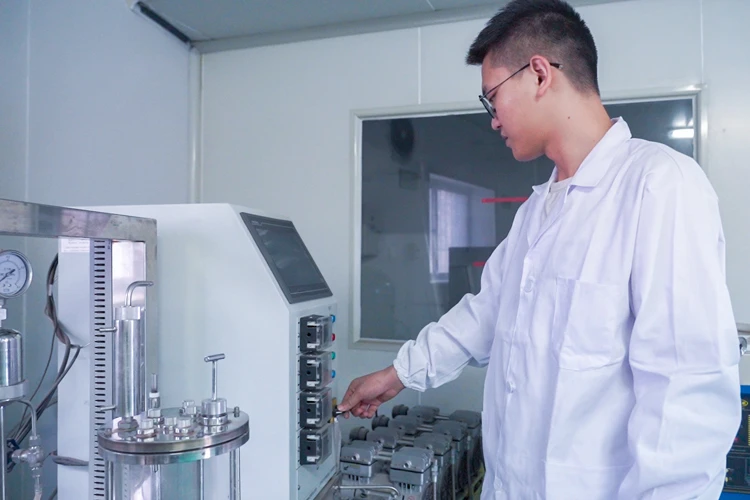
Fermentation and enzyme-reaction capacity is a production claim; what a buyer can verify is the batch documentation that accompanies each lot.
Then test the supplier's quality infrastructure, not only the lot:
- Laboratory. Does the supplier run its own HPLC, UV and GC testing, and is that laboratory inside the manufacturing site?
- Manufacturing environment. Clean-workshop classification, allergen handling and cross-contamination control between botanical and fermentation products.
- Certifications. ISO, Halal and Kosher claims should be current and matched to the specific site and product scope; a certificate for one site does not qualify another.
- Batch consistency. Any stated variation figure should be defined — which parameter, which range, over how many lots — rather than accepted as a headline.
- Technical responsiveness. Can the supplier answer a dispersion or assay-basis question with a document rather than an assurance?
Guanjie Biotech, a Shaanxi-based ingredient manufacturer founded in 2004, illustrates the document categories a buyer should expect to inspect at this stage. The company reports a 7,000 m² footprint that includes a 2,000 m² cGMP-standard clean workshop and a 500 m² laboratory equipped for HPLC, UV and GC testing, works with Northwest University and the Xi'an Branch of the Chinese Academy of Sciences on development projects, holds ISO, Halal and Kosher certifications, and cites 16 national patents. It also reports a batch-variation figure of ≤3% and describes itself as a direct manufacturer rather than a trading company. Those facts describe a manufacturing and testing model; they do not certify any specific CoQ10 grade, which still requires a lot-level certificate, a specification agreed in writing and — where the risk justifies it — an independent laboratory result.
Fit boundaries: what neither grade proves
Bioavailability. Absorption depends on the formulated system, the dose and the study design. A grade number is not an absorption claim, and neither designation should be read as evidence of one.
Purity of the whole powder. A diluted grade's carrier is intentional, but it still has to meet your specification for allergens, microbiological status and residual solvents.
Market suitability. Regulatory status and labelling requirements are product- and market-specific and must be checked for the destination market rather than inferred from a grade.
Silence is not evidence. If a supplier does not state the carrier or name the testing laboratory, the correct conclusion is that the information is missing — not that the material is clean.
The boundary is symmetrical. Choose the 10% water-soluble grade when the format genuinely needs water dispersion, the unit can carry the extra mass, and the carrier is declared and acceptable. Choose the 99% grade when mass is constrained, when the process already has an oil or solvent phase, and when the purity file supports the concentration being paid for.
FAQ: CoQ10 grade selection
Is a 99% CoQ10 grade better than a 10% water-soluble grade?
Neither grade is better in the abstract. The 99% grade provides more CoQ10 per gram of powder and suits formats with limited fill weight or an available oil phase. The 10% grade is formulated to disperse in water and suits aqueous or reconstituted formats, at the cost of carrying a large multiple of its own CoQ10 content as carrier. The decision turns on the dose form, the mass per unit and the documentation behind both.
How can a buyer confirm that a 10% CoQ10 powder really disperses in water?
Request the supplier's dispersion test — vehicle, concentration tested, mixing conditions and observation period — together with the carrier identity and particle size. Then repeat a bench trial in your own vehicle at your own dose and observe for sediment, ringing or separation over the storage period relevant to the product. "Water-soluble" on a specification sheet is a trade description, not a test result.
What should a CoQ10 certificate of analysis include?
Lot number; assay result with its basis (as-is or dried) and the method used; chromatographic purity and related substances; moisture, heavy metals, microbiological results and residual solvents against the agreed specification; and the specification range the lot was released against. For a diluted grade, the carrier should also be declared, and the file should state whether testing was internal or performed by an identified external laboratory.
Does the production route change which grade to buy?
The route does not determine the grade; the finished format and mass balance do. The route determines which documentation to request. Fermentation-derived material calls for information on media, downstream purification, residual solvents and microbiological control; a synthetic route places more weight on the related-substance and impurity profile. Buyers should obtain the route in writing and match the evidence request to it.
What can be tested on a sample before a purchase order?
Independent assay of CoQ10 content, dispersion or solubility behaviour in the intended vehicle, blend uniformity with the other actives in the formula, and a short compatibility or stability check. Sample testing confirms that the material behaves as documented inside your process; it does not replace lot certification or regulatory review for the destination market.
The sequence that settles the decision
Define the finished format, calculate the mass the unit can carry, request the assay and carrier documentation against that target, and verify the supplier's production route and testing model with a sample run in your own process. Once those three inputs are fixed, grade selection stops being a debate about which number is higher and becomes an arithmetic and documentation exercise.
For a broader view of the ingredient range, manufacturing footprint and testing setup, the company's nutraceutical ingredients brochure can be downloaded here: Guanjie Nutraceutical Ingredients brochure (PDF).
Tem questões ou precisa de mais detalhes?
Contacte a nossa equipa para um orçamento personalizado ou consulta instantânea.
Solicitar orçamento
Preencha o formulário abaixo e a nossa equipa entrará em contacto com uma proposta personalizada.
Chat direto do WhatsApp
Prefere conversar em tempo real? Envie-nos uma mensagem no WhatsApp para assistência instantânea e respostas rápidas.
- Obter orçamento personalizado
- Partilhar fotos ou documentos
- Discuta as suas necessidades diretamente
Geralmente responde em 5–30 minutos durante o horário de expediente.