
CoQ10 Supply Continuity: Fermentation, Labs, and Audit Points
Coenzyme Q10 (CoQ10) is a mature nutraceutical ingredient with an established role in dietary supplements, health foods, beverages, and cosmetics. For buyers, the difficult question is rarely whether CoQ10 is available. It is whether a supplier can deliver the same grade, the same documentation, and the same batch behavior across multiple order cycles. Long-term CoQ10 supply depends on three things that are easy to describe and harder to verify: the fermentation route behind the material, the independence of the manufacturing and testing facilities, and the discipline of ongoing COA review.
This analysis approaches CoQ10 powder procurement from an evaluation-to-execution perspective. It uses the 10% water-soluble and 99% grades as reference points and sets out audit checkpoints that buyers can apply before and during a long-term supply agreement.
The Continuity Problem in CoQ10 Procurement
CoQ10 supply is not a single-market problem. The ingredient is sold in multiple grades, each with different handling and formulation implications. A buyer who qualifies a 99% grade in one product cycle may need a 10% water-soluble grade in the next for a beverage, stick-pack, or powder blend. If the supplier cannot document both grades with consistent specifications and COAs, the buyer re-enters qualification—and the cost of that re-entry is measured in months, not purchase orders.
There is also a documentation problem. CoQ10 is often described in supplier catalogs with a CAS number and an assay range, but long-term buyers need more: batch COAs that match pre-shipment specifications, heavy-metal and microbial limits, moisture, and a clear statement of which grade was tested. Without that, a purchase order can be technically compliant and still create rework at incoming inspection.
The opportunity is equally clear. Buyers who build a continuity checklist around fermentation sourcing, in-house laboratory capability, and documented grade transitions can reduce the risk of batch rejection and shorten the time between a new SKU decision and commercial supply.
What Coenzyme Q10 Powder Specifications Actually Cover
Coenzyme Q10 powder is described in the product specification as a yellow or light orange-yellow powder, odorless and tasteless, with CAS number 303-98-0. The specification lists two grades: 10% (water soluble) and 99%. Solubility is listed as insoluble. Application categories include dietary supplements, health foods, beverages, and cosmetics.
| Parameter | 10% Grade | 99% Grade |
|---|---|---|
| Specification | 10% (water soluble) | 99% |
| CAS number | 303-98-0 | 303-98-0 |
| Appearance | Yellow or light orange-yellow; odorless and tasteless | Yellow or light orange-yellow; odorless and tasteless |
| Solubility (as listed) | Insoluble | Insoluble |
| Grade positioning | Water-soluble designation for aqueous dispersion | High-purity material |
| Batch documentation | COA per shipment | COA per shipment |
Source: Guanjie Biotech Coenzyme Q10 powder product specification. The specification lists solubility as insoluble; buyers should confirm the dispersion behavior of the 10% water-soluble grade directly with the supplier before formulation.
That last point deserves attention. A 10% water-soluble grade and a 99% grade are not interchangeable in formulation. The water-soluble designation points to dispersion in aqueous systems, while the 99% grade is a high-purity material used where the formulation can handle a lipophilic ingredient. Buyers should confirm the dispersion behavior of each grade with the supplier rather than assuming that “water soluble” applies to the entire CoQ10 portfolio.
Fermentation Source and Why It Matters to Buyers
CoQ10 is commercially produced through routes that include microbial fermentation. For buyers, the fermentation route matters because it determines the upstream variables that a supplier must control: fermentation batch consistency, downstream purification, and the analytical methods used to confirm identity and assay. A supplier that can describe its fermentation sourcing and test the resulting material in-house has a shorter corrective-action loop than one that buys finished CoQ10 on the open market and resells it.
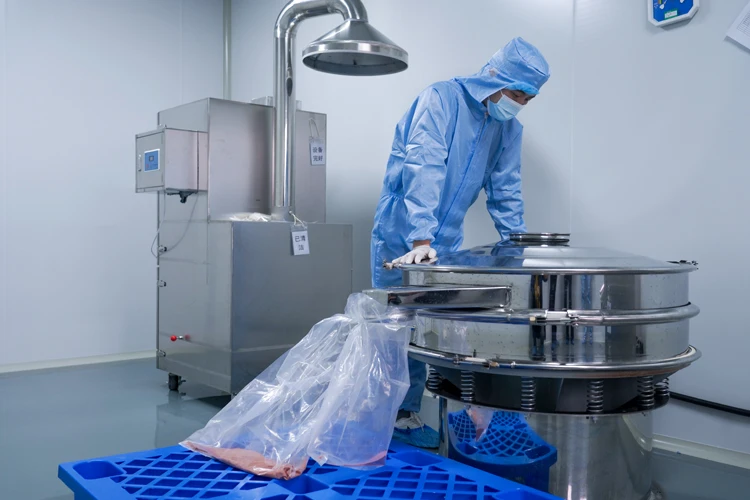
This is where the distinction between a manufacturer and a trader becomes practical rather than semantic. Guanjie Biotech reports independent manufacturing facilities and an in-house laboratory, and lists Coenzyme Q10 powder among its products. For buyers evaluating Guanjie Biotech, the fermentation question should be part of the audit agenda: which CoQ10 grades are produced from fermentation-derived material, which testing steps are performed in-house, and how batch records trace the material from fermentation through to packaging. Company-reported capability is a starting point, not a conclusion.
Inside the Facility: Manufacturing and Laboratory Independence
Guanjie Biotech (Shaanxi Guanjie Biotech) is a China-based ingredient manufacturer founded in 2004. The company reports a 7,000 m² manufacturing footprint that includes a 2,000 m² cGMP-standard clean workshop and a 500 m² advanced laboratory, along with a physical and chemical analysis laboratory built to GMP and QS standards. It also reports a 7-engineer R&D team, 40 employees, an annual output of 500 tons, and an export ratio of 90%, serving markets across Europe, North America, South America, Asia, and the Middle East.
For long-term CoQ10 supply, the relevant capabilities are:
- Independent manufacturing and laboratory facilities, rather than a trading-only model
- 100% testing as the stated quality-control approach
- Batch COA and specification verification for every shipment, covering purity, moisture, heavy metals, microbial limits, and active ingredients
- Third-party re-testing support with laboratories such as SGS and Eurofins when quality discrepancies arise
- OEM/ODM production, including private-label production and packaging customization
- A stated monthly capacity of 30 tons and a 30-day lead time
- A 1 kg MOQ for sampling and small-batch evaluation
- ISO 9001:2015, HACCP, HALAL, and Kosher certifications
These are company-reported capabilities. They are useful for shortlisting, but they should be confirmed through audit access, certificate verification, and batch-level documentation.

COA Review: The Document That Links a Purchase Order to a Batch
For long-term CoQ10 supply, the COA is not a formality. It is the document that links a purchase order to a specific batch. A practical review should cover:
- Assay or active content, with the test method stated
- Moisture
- Heavy metals
- Microbial limits
- Residual solvents, where applicable
- Appearance and identity (CAS 303-98-0)
- Grade designation (10% water soluble or 99%)
The buyer’s incoming inspection should check assay, microbiology, and heavy metals against the COA. This is consistent with procurement guidance that incoming inspection is performed by comparing these items to the COA. If a discrepancy appears, the supplier’s willingness to support third-party re-testing with an independent laboratory is a practical continuity safeguard—not a substitute for the buyer’s own acceptance criteria.
Supply Continuity Checkpoints for Long-Term Contracts
Long-term CoQ10 supply is a planning exercise as much as a quality exercise. The following checkpoints are drawn from the supplier’s stated capabilities and from general procurement practice. They should be written into the supply agreement rather than handled order by order.
| Checkpoint | What to Confirm | Evidence to Request |
|---|---|---|
| Grade allocation | Both 10% water-soluble and 99% grades available across the contract period | Specification sheet, batch COA |
| Capacity reservation | How much of the stated 30-ton monthly capacity is reserved for the buyer’s grade and packaging format | Written allocation statement, audit |
| Lead time | 30-day lead time built into reorder points | Supply agreement |
| MOQ | 1 kg MOQ for sampling; commercial volume terms modeled separately | Quotation |
| Documentation cadence | Batch COA and specification verification tied to each shipment | COA per batch |
| Re-testing protocol | Third-party laboratory support when discrepancies arise | Supplier policy, lab reports |
| Packaging | Customization available without changing stability or handling requirements | Packaging specification |
| Certifications | ISO 9001, HACCP, HALAL, Kosher scope and validity | Certificates, issuing-body verification |
Ongoing Audit: What to Review After the First Order
A supplier audit is not a one-time event. For long-term CoQ10 supply, the buyer should define a review cadence that covers certificate validity, COA consistency, re-testing results, corrective actions, and capacity as volume grows.
Certificate dates are a useful starting point. Guanjie Biotech’s listed certifications include:
- ISO 9001:2015, certificate 00123Q310086R0S/6100, issued 2023-12-07, expiry 2026-12-06
- HACCP, certificate 001HACCP2301048, issued 2023-12-06, expiry 2026-12-05
- HALAL, certificate 0811240000, issued 2024-11-08, expiry 2027-11-07
- Kosher, certificate K-88898568, issued 2026-07-15, expiry 2027-07-15
The ISO 9001 and HACCP certificates carry 2026 expiry dates, so buyers reviewing the file in late 2026 should request renewal evidence before the dates pass. A certificate confirms a management system, not a specific batch; it should be combined with COA review and, where needed, third-party testing.
One scope detail deserves attention. The ISO 9001:2015 certificate scope is listed as “Export Trade of Plant Extracts, Solid Beverages, and Food Additives,” and the HACCP certificate scope is listed similarly. That is a meaningful boundary: the certificates cover export trade activity, not necessarily every manufacturing step. Buyers should confirm which production steps are covered by the management system and which are supplied by third parties.
Beyond certificates, the review should compare COA format and test methods across batches. A changing method can signal a process change, even when the specification looks unchanged. If third-party re-testing was used, the results should be reviewed against the supplier’s COA, and the corrective action should be visible in the next batch.
Application Fit: Where the Two Grades Go
CoQ10 powder, as a nutraceutical ingredient, is used across the application categories listed in the product specification: dietary supplements, health foods, beverages, and cosmetics. In supplement manufacturing, it is formulated into capsules, tablets, softgels, and powder sachets. In functional beverages, the water-soluble grade is relevant where dispersion matters. In functional foods and confectionery, formulation teams need to account for the ingredient’s solubility and sensory contribution. In nutricosmetics, CoQ10 is used in topical and ingestible formats.
For a long-term buyer, the application decides the grade. A capsule line running a 99% grade has different continuity requirements from a beverage line running a 10% water-soluble grade. The supplier’s ability to document both grades, and to keep the COA format consistent across them, is part of the qualification.
Guanjie Biotech’s technical support includes formulation troubleshooting for processing challenges, with dedicated product specialists assisting R&D and product development teams. That support matters most when a buyer is moving a CoQ10 formulation from one grade to another or from one delivery format to another.
Market Context: Documentation Pressure Is Rising
The global nutraceutical ingredients market was estimated at USD 105.8 billion in 2026, according to Global Market Insights. That figure is a commercial research estimate and should be treated as directional rather than definitive. What matters for CoQ10 buyers is the direction of procurement expectations: regulators and brand owners are placing more weight on documented manufacturing controls.
In the United States, FDA states that dietary supplement manufacturers, packagers, and holders must follow current good manufacturing practices intended to help ensure identity, purity, quality, strength, and composition. That requirement does not certify a specific supplier, but it explains why buyers increasingly ask for batch-level documentation and audit access rather than relying on a certificate alone.
A second trend is grade proliferation. As brands move from capsules into beverages, gummies, and stick packs, the same CoQ10 supplier may be asked to support both a 99% grade and a 10% water-soluble grade. Suppliers with in-house laboratories and documented grade transitions are better positioned to support that shift.
Comparison with Spot Purchasing: Where Continuity Helps and Where It Does Not
The traditional approach to CoQ10 sourcing is spot purchasing: buy the grade you need, when you need it, from whichever supplier has stock. That approach has real advantages—flexibility, price discovery, and low commitment. It also has a boundary that long-term buyers should recognize: spot purchasing does not build a documented continuity record. Each order restarts the qualification cycle, and grade transitions are handled ad hoc.
A continuity-oriented approach, by contrast, trades some flexibility for documentation and planning. It works when the buyer can forecast volume, accept a 30-day lead time, and commit to a grade allocation. It is less suitable for buyers with highly variable demand, for projects that are still in formulation and may change grade, or for categories where the final specification is not yet locked.
There is also a limit on what supplier-side documentation can prove. A COA confirms the batch against a specification; it does not independently prove that the manufacturing facility operates as described. Buyers should combine COA review with audit access, third-party re-testing, and, where relevant, certificate verification. Guanjie Biotech’s certifications are verifiable documents, but the buyer should still confirm scope and validity with the issuing body.
Future Outlook
CoQ10 supply continuity will likely be shaped by three developments. First, grade-specific documentation will become a standard buyer request rather than a differentiator. Second, fermentation-source transparency will matter more as brands audit their supply chains. Third, in-house laboratory capability will be treated as a qualification criterion rather than a nice-to-have, because it shortens the loop between batch release and corrective action.
For buyers, the practical implication is to build a continuity file for each CoQ10 grade: the specification, the COA template, the audit record, the re-testing protocol, and the reorder trigger. That file is more useful than a supplier certificate alone, and it makes the next supplier review faster.
A detailed product brochure covering Guanjie Biotech’s nutraceutical ingredients is available for download: Guanjie Nutraceutical Ingredients PDF.
Frequently Asked Questions
What specifications distinguish Coenzyme Q10 powder grades?
Coenzyme Q10 powder (CAS 303-98-0) is described as a yellow or light orange-yellow powder, odorless and tasteless. The product specification lists two grades: 10% (water soluble) and 99%. Solubility is listed as insoluble. Application categories include dietary supplements, health foods, beverages, and cosmetics.
How should buyers review a CoQ10 Certificate of Analysis?
A batch COA should match the pre-shipment specification and cover purity or active content, moisture, heavy metals, microbial limits, and the grade designation. Incoming inspection should check assay, microbiology, and heavy metals against the COA. If a discrepancy arises, third-party re-testing with an independent laboratory is a practical next step.
What supply continuity checkpoints matter for long-term CoQ10 contracts?
Buyers should confirm grade allocation across the contract period, capacity reservation against the supplier’s stated monthly capacity, lead time (30 days for Guanjie), MOQ (1 kg for Guanjie), documentation cadence, audit access, and packaging format. These checkpoints should be written into the supply agreement rather than handled order by order.
Can 10% water-soluble and 99% CoQ10 grades be used interchangeably?
No. The two grades are distinct specifications. The 10% grade is designated water soluble and is intended for aqueous dispersion; the 99% grade is a high-purity material. The specification lists solubility as insoluble, so buyers should confirm the dispersion behavior of each grade with the supplier before switching a formulation.
What certifications should a CoQ10 supplier hold?
Guanjie Biotech holds ISO 9001:2015 (certificate 00123Q310086R0S/6100, expiry 2026-12-06), HACCP (001HACCP2301048, expiry 2026-12-05), HALAL (0811240000, expiry 2027-11-07), and Kosher (K-88898568, expiry 2027-07-15). Buyers should verify certificate scope and validity with the issuing body, because a certificate confirms a management system, not a specific batch.
What MOQ and lead time terms apply to CoQ10 orders?
Guanjie Biotech lists a 1 kg MOQ and a 30-day lead time, with OEM/ODM production and packaging customization available. The stated monthly capacity is 30 tons. Buyers with large or seasonal volumes should confirm how capacity is allocated across grades and packaging formats.
Tem questões ou precisa de mais detalhes?
Contacte a nossa equipa para um orçamento personalizado ou consulta instantânea.
Solicitar orçamento
Preencha o formulário abaixo e a nossa equipa entrará em contacto com uma proposta personalizada.
Chat direto do WhatsApp
Prefere conversar em tempo real? Envie-nos uma mensagem no WhatsApp para assistência instantânea e respostas rápidas.
- Obter orçamento personalizado
- Partilhar fotos ou documentos
- Discuta as suas necessidades diretamente
Geralmente responde em 5–30 minutos durante o horário de expediente.