
Coal and Mineral Yards: Splitting Work Between CR468C and FAW Trucks
Coal and Mineral Yards: Splitting Work Between CR468C and FAW Trucks
A coal stockyard, a mineral screening plant and a port bulk terminal share one geometry problem. The tonnage moves in trucks, but the material that never reaches a truck — spillage beneath a conveyor, fines along a stockpile kerb, residue in a loading bay — sits in gaps that a 2.3-metre-wide truck body cannot enter. The CR468C remote-control lithium battery rubber-track minidozer from Qingdao Chary Machinery Co., Ltd is built for that residual space rather than for the haul itself. Its documented envelope sets the boundary of the discussion: 2,850 × 1,200 × 600 mm overall, 1,100 kg net weight, 450 kg rated load, a 0.15 m³ bucket and lithium battery power.
Hauling and reaching are two different jobs
In a yard that handles coal, ore or bulk mineral, the binding constraint is usually access rather than payload. Supplied FAW truck data place the fleet envelope between 6,000 × 2,300 × 3,000 mm and 12,000 × 2,550 × 3,800 mm, across a truck weight range of 3,000–15,000 kg. Those figures describe the space a truck needs: a haul road, a loading bay, a turning circle, a queuing lane. They also describe the space a truck cannot use — the 1,200 mm strip along a stockpile wall, the underpass below a conveyor frame, the corner of a bay where a body cannot swing.
Task allocation follows from that geometry. A FAW truck moves bulk between two nodes: pit or stockpile to plant, plant to port, port to hinterland. A minidozer works inside one node, recovering what the truck could not pick up and preparing the ground the truck must stand on. The two machine classes do not compete for the same cubic metres, which is why the practical question for a yard manager is not which one to buy but how much of each task list belongs to which asset.
This distinction matters because it changes how a minidozer is specified. If it were treated as a small loader, the buying criteria would be bucket volume and hourly tonnage. Treated as a confined-area recovery and trimming tool, the criteria become height, width, turning behaviour, charging pattern and the ability to work without an operator standing beside the machine in a dust zone.
What the CR468C is, in yard terms
The CR468C is a remote-control, lithium-battery, rubber-track minidozer manufactured by Qingdao Chary Machinery Co., Ltd, a Qingdao-based machinery exporter established in 2015. In yard language it is a low-profile electric tool carrier: it drives on rubber tracks, carries material in a front bucket, and is operated remotely so the person controlling it is not required to sit within the machine's working envelope. Chary lists the machine's documented values as follows.
| Documented parameter | Value as published by the manufacturer |
|---|---|
| Overall dimensions | 2,850 × 1,200 × 600 mm |
| Length without bucket | 2,250 mm |
| Self weight | 1,100 kg |
| Rated load capacity | 450 kg |
| Bucket capacity / width | 0.15 m³ / 1,200 mm |
| Unloading height / time | 530 mm / 1.1 s |
| Minimum ground clearance | 150 mm |
| Maximum speed / gradeability | 4 km/h / 40° |
| Steering | 360° spin in place |
| Battery | Lithium battery, 300 Ah, 73.6 V |
| Motor | 7.5 kW, 3,000 r/min |
| Charging / working time | About 2 h / about 8 h |
| Charging voltage | 380/220 V |
| Hydraulic flow / tank | 58 L/min / 20 L |
| Working temperature | −10 °C to 60 °C |
| Walking style | Rubber tracks |
Source: manufacturer specification data for the CR468C. Figures describe the machine as configured by the manufacturer; actual site performance depends on material density, surface conditions, operator technique and duty cycle.
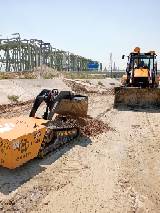
The four dimensions that decide whether a yard accepts the machine
Access is decided by numbers, not by intent. The first is width: at 1,200 mm overall, the CR468C's widest point matches its own bucket width, which keeps the machine and its working implement inside the same corridor. A stockpile aisle, a conveyor underpass or a service walkway that is too tight for a 2,300 mm truck can still admit a 1,200 mm track-driven unit, provided the operator has a clear line of retreat.
The second is height. A 600 mm overall height is the figure that matters under conveyor frames, chute structures, pipe racks and low-clearance plant rooms. It is also the figure that determines whether the machine can pass beneath a hopper skirt rather than working around it. The third is the 150 mm minimum ground clearance, which governs how much loose coal, grit or scale the machine can ride over before the belly drags.
The fourth is turning behaviour. With 360° spin in place, the CR468C does not need a turning circle at all, which is decisive in dead-end bays where a truck has to reverse out. A 4 km/h maximum speed, however, makes the point clear: this is a short-radius tool. Moving it 800 m across a large port terminal becomes a transport task for a trailer or a low-speed drive that has to be planned, not a routine travel move.
The 40° gradeability figure and the 530 mm unloading height complete the access picture. The first supports ramp and stockpile-slope work; the second tells the buyer to check the receiving vessel — a hopper lip, a conveyor feed box, a yard trailer side — against a 530 mm dump height rather than assuming the machine can reach over a truck side wall.
Battery, duty cycle and the shift plan in a yard with no spare hour
The CR468C runs on a 300 Ah, 73.6 V lithium battery paired with a 7.5 kW motor at 3,000 r/min, and the manufacturer publishes about 2 hours of charging time against about 8 hours of working time. Read as a planning input rather than a guarantee, that ratio means one machine can cover roughly a single working shift per charge, with the charging window sitting inside the same day. A yard that wants continuous coverage across two shifts either schedules a charge break, specifies the interchangeable-battery arrangement referenced in Chary's application material, or plans two units.
Charging infrastructure is a real procurement item. The supplied data specify 380/220 V charging voltage, which in most coal, mineral and port yards is available at a workshop or substation but not necessarily at the working face. Buyers should map the distance from the nearest suitable supply to the machine's parking position, because a long cable run becomes both a cost and a traffic hazard in an active yard.
Thermal envelope is the other planning figure. A stated working range of −10 °C to 60 °C covers most temperate coal yards and hot-climate port terminals, and it aligns with the high-temperature operating conditions recorded in Chary's case material. It does not by itself confirm performance at either limit; buyers operating in extreme heat or deep winter should request duty-cycle evidence for their own conditions rather than infer it from the range alone.
Three yard types where the fit holds
Chary positions the CR468C for confined-space work including clean-up under conveyor belts in above-ground and underground mining, ore crushing and concentration plants, tunnels, box culverts, drainage systems and pumping stations. Three of those settings overlap directly with coal, mineral and port-yard operations that also run truck fleets.
Coal stockyards and truck or rail loading areas
Coal yards generate a predictable waste stream: spillage at the loading bay, fines along the stockpile toe, residue that compacts into the surface where trucks queue. A 450 kg rated load and 0.15 m³ bucket suit this recovery work at a scale that matches the mess rather than the production rate. The 1.1-second bucket unloading time supports a fast dump-and-return rhythm in a bay where the machine must clear out before the next truck arrives.
The absence of exhaust at the point of operation is the second advantage in this setting. An electric drivetrain produces no combustion fumes where the machine is working, which matters when the task sits under a conveyor or inside a partially enclosed transfer house. The operator, working remotely, is not required to stand at the bucket in the dust zone. Both are capability statements, not exposure guarantees — site ventilation, dust suppression and local rules still govern.
Mineral crushing and concentration plants
Crushing stations and concentration plants are dense with structures, walkways and low-clearance voids. Clean-up under a crusher discharge, around a screen house or beside a launder typically involves small volumes of high-value material in places a wheel loader cannot reach. Here the 600 mm height and 1,200 mm width do most of the work, and the 150 mm ground clearance defines the practical floor condition: grit, scale and small spillage are manageable, but a build-up of compacted ore above that height becomes a manual or hydraulic-breaking task first.
Rubber tracks matter in these plants for a reason beyond traction. Steel-track machines can mark or damage finished concrete floors, while rubber tracks distribute load and reduce surface damage — relevant where the minidozer crosses plant floors, tunnels or drainage structures rather than raw yard ground.
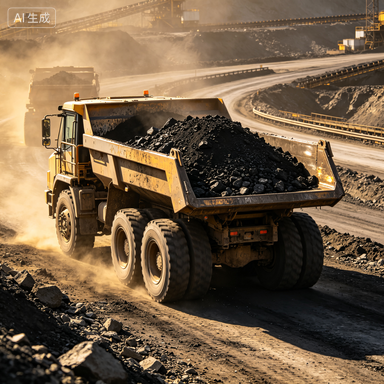
Port bulk terminals and hopper zones
Port yards combine continuous truck and trailer movement with tight operating envelopes at hoppers, berth edges and conveyor galleries. The CR468C's contribution is confined spillage recovery and aisle cleaning between vehicle movements, where its 360° spin and 4 km/h travel suit short repositioning inside a defined area. It is not a berth machine: moving it between distant quay sections is a transport decision, and a 0.15 m³ bucket does not shift a stockpile that a port loader would handle in a few passes.
Working alongside a FAW truck fleet without duplicating it
Chary supplies FAW trucks across the J7, J6P, J6V, J6E, JH6, J6G, J6L, JK6 and Tiger V ranges, in body types that include tractor, dump, cargo and rigid, concrete mixer, tank, sprinkler, sweeper, wrecker and high-altitude platform configurations. For a coal, mineral or port yard, the relevant bodies are the dump and cargo variants that carry bulk between nodes, with the supplied truck weight range of 3,000–15,000 kg covering light distribution work through to heavy yard haulage.
The stated security configuration for these trucks is ABS, EBS and TCS. In this article those are recorded as fleet context only — they describe systems fitted to the vehicles, not measured braking or traction outcomes, and no comparative performance claim is made between the truck range and the minidozer. They are also not interchangeable: a 450 kg capacity machine and a 3,000–15,000 kg truck are answering different questions.
The useful interface is operational rather than mechanical. Trucks define the traffic pattern, the bay dimensions and the haul rhythm; the minidozer works in the gaps that pattern creates. Three practical rules follow. First, keep the two flows physically separate — a 4 km/h machine in a truck queuing lane is a hazard, not an efficiency. Second, size the minidozer's task list to the material the trucks leave behind, not to the tonnage the trucks carry. Third, treat the 530 mm unloading height as a design constraint when deciding where recovered material is tipped back into the flow.
A task map for one yard
| Yard task | Constraint | CR468C role | FAW truck role |
|---|---|---|---|
| Spillage recovery at loading bay | Tight turning, mixed traffic | Primary; 360° spin, 1.1 s dump | Holds the bay |
| Clean-up under conveyor or transfer point | Low overhead clearance | Primary; 600 mm height, no exhaust at point of use | Not applicable |
| Stockpile toe and kerb trimming | Narrow strip, sloping ground | Primary; 1,200 mm width, 40° gradeability | Delivers and collects at the face |
| Bulk movement between plant and port | Distance, payload | Outside scope; 4 km/h, 450 kg | Primary; 3,000–15,000 kg range |
| Plant floor and aisle cleaning | Finished surfaces, grit | Primary; rubber tracks, 150 mm clearance | Not applicable |
Where the fit stops
The CR468C is a clean-up and trimming machine, and its own numbers make the boundary explicit. Each bucket cycle moves at most 0.15 m³ at a 450 kg rated load, so hourly tonnage scales directly with cycle time and travel distance. Where a yard needs continuous high-volume face loading, that per-cycle ceiling is the binding constraint, and no amount of manoeuvrability compensates for it. A buyer with that requirement is looking at a different equipment class, not a different configuration of this one.
Travel is the second boundary. At 4 km/h, relocating the machine across a large terminal is a planned move, and the machine has no role in hauling material along a public road or a main yard artery. Ground conditions set the third boundary: 150 mm of clearance means compacted build-up has to be broken before the machine can address it. Slope sets the fourth: 40° gradeability is the stated figure, and wet coal or loose ore on an incline is a different surface from the one that figure describes.
Operational discipline forms the last boundary. Remote control removes the operator from the machine but not from the yard, so line of sight, exclusion zones around trucks and a clear rule on who may enter the working area remain the buyer's responsibility. The absence of exhaust at the working face is a genuine advantage in enclosed settings; it is not a substitute for dust control, ventilation rules or local occupational requirements.
What to verify before adding one to an existing fleet
Chary's stated supply conditions give the buyer a concrete starting point: OEM production with customization of loading capacity, track life and battery life, a minimum order quantity of one unit, a 30–45 day lead time, monthly capacity of 50 units, and 100 percent full inspection before shipment with a performance test on each machine. After-sales support is described as accessory supply plus remote maintenance — a model that suits export buyers who run machines in Africa, South America and other distant markets, provided spare-part lead times are confirmed in writing.
Five checks convert those statements into a procurement decision. Measure the actual envelope of every place the machine must work, including door frames, conveyor legs and turning space, rather than relying on the yard plan. List the recurring tasks and confirm each one fits within 450 kg and 0.15 m³ per cycle. Confirm the charging supply, its voltage and its distance from the parking position. Match the stated 8-hour working window and 2-hour charge to the real shift pattern, including whether a second unit or a battery-exchange routine is needed. And request the inspection and performance-test record for the specific unit, since that is the document that ties the delivered machine to the published specification.
Existing deployment records provide context for that assessment. Chary's case material lists 12 CR468C units with an engineering-construction customer in Saudi Arabia working in narrow indoor and outdoor material handling, with high-temperature and confined conditions cited as the operating challenge. Separately, a logistics company in Mali is recorded operating 50 FAW truck units on powdered and granular material and sand-and-gravel transport. These are supplier-supplied records describing their own deployments; they indicate the operating environments the equipment is used in, not independently audited results.
Electrification context and a conditional outlook
Electrification in Chinese construction equipment is no longer confined to passenger vehicles. CleanTechnica reported that sales of new-energy concrete mixers in China reached 8,036 units in 2024, a 43.8 percent penetration rate. The scope matters: those are concrete mixers, not minidozers, and the figure describes one heavy-vehicle category in one market. Read as a signal rather than a forecast, it indicates that battery-electric drive has moved into working construction equipment in China, which is the category the CR468C belongs to.
For coal, mineral and port yards, the implication is conditional. Where a task is confined, repetitive and low-volume — spillage recovery, under-conveyor clean-up, bay trimming — an electric, remote-controlled platform removes two persistent constraints at once: the physical access limit of a truck-sized body and the exhaust plume of a combustion engine at the working face. Where the task is haulage, the truck remains the correct asset, and the supplied FAW range continues to define that side of the yard. The plausible direction of travel is a more explicitly task-divided yard, in which haul assets and confined-access tools are specified separately rather than one being stretched to cover both. That outcome depends on charging infrastructure, duty-cycle evidence and local compliance, none of which this analysis assumes.
FAQ
Which yard tasks suit the CR468C minidozer rather than a haul truck?
The CR468C suits confined, low-volume tasks inside a yard node: spillage recovery at loading bays, clean-up under conveyor belts and transfer points, stockpile toe and kerb trimming, plant floor and aisle cleaning, and drainage or culvert work. A haul truck suits movement of bulk between nodes, such as plant to port. The dividing line is access and clearance, not preference — a 1,200 mm wide, 600 mm high machine reaches spaces that a truck with a 2,300–2,550 mm body width cannot enter.
How much material can the CR468C move per cycle, and what does that mean for clean-up work?
The manufacturer rates the CR468C at a 450 kg load capacity with a 0.15 m³ bucket, 1,200 mm wide, and a 1.1-second bucket unloading time. For clean-up and trimming, those figures match the scale of spillage and residue typically left in bays, walkways and under structures. For continuous production loading, the per-cycle ceiling is the limiting factor, because total tonnage depends on cycle time and travel distance rather than on machine manoeuvrability.
What site conditions does the CR468C support in coal, mineral and port yards?
The published working temperature range is −10 °C to 60 °C, the machine runs on rubber tracks with 150 mm minimum ground clearance, and it is rated for 40° gradeability with 360° spin in place. It is electrically driven, so it produces no combustion exhaust at the point of operation, which matters under conveyors and in partially enclosed transfer houses. Charging requires 380/220 V supply, and the manufacturer states about 8 hours of working time against about 2 hours of charging.
What should a buyer verify before adding a minidozer to an existing truck fleet?
Five items: the measured envelope of every working position, including overhead clearance; whether each recurring task fits within 450 kg and 0.15 m³ per cycle; the location, voltage and cable route of the charging supply; the match between the stated 8-hour working window and the actual shift pattern; and the inspection and performance-test record for the specific unit. Chary states 100 percent full inspection before shipment with a performance test on each machine, a minimum order quantity of one unit and a 30–45 day lead time.
Qingdao Chary Machinery Co., Ltd publishes its product range and company information at charymachinery.com. A downloadable product brochure is available here.
Tem questões ou precisa de mais detalhes?
Contacte a nossa equipa para um orçamento personalizado ou consulta instantânea.
Solicitar orçamento
Preencha o formulário abaixo e a nossa equipa entrará em contacto com uma proposta personalizada.
Chat direto do WhatsApp
Prefere conversar em tempo real? Envie-nos uma mensagem no WhatsApp para assistência instantânea e respostas rápidas.
- Obter orçamento personalizado
- Partilhar fotos ou documentos
- Discuta as suas necessidades diretamente
Geralmente responde em 5–30 minutos durante o horário de expediente.