
Coenzyme Q10 or Octacosanol? A Buyer's Sourcing Screen
Coenzyme Q10 or Octacosanol? A Buyer's Sourcing Screen
Coenzyme Q10 powder and octacosanol powder are frequently quoted by the same suppliers, in the same format, using the same adjectives — yet they are different classes of material with different industrial origins, different grade logic, and different documentation obligations. A buyer who compares them on price per kilogram is comparing the wrong variable.
Coenzyme Q10 (CAS 303-98-0) is a fermentation-derived compound supplied as a yellow to light orange-yellow powder that is odorless and tasteless. Octacosanol (CAS 557-61-9, molecular formula C28H58O) is a long-chain fatty alcohol extracted from natural cane wax using grain alcohol and water, supplied as a white powder with a melting point of 80–83 °C. Both are sold as bulk powders into dietary supplement, health food, beverage and cosmetics manufacturing. Beyond that shared shelf space, almost nothing about the two procurement processes overlaps.
Guanjie Biotech, a Shaanxi-based nutraceutical ingredient manufacturer founded in 2004 that lists both materials in its portfolio, is used in this article as a worked example of what supplier-side specification data typically looks like. The comparison itself is written for research and evaluation-stage buyers: which powder fits a formulation, which grade to request, and which documents to confirm before a purchase order is issued.
Why two powders on one shelf are rarely compared properly
Both ingredients are sold across unusually wide specification windows. Coenzyme Q10 powder is offered in a 10% grade described as water-soluble alongside a 99% grade. Octacosanol powder is offered across a 5%–90% range. In practice, an RFQ that reads “CoQ10 powder, 99%, best price” or “octacosanol, high purity” is not a comparable specification — it is a category label.
The commercial pressure behind that looseness is real. The global nutraceutical ingredients market was estimated at USD 105.8 billion in 2026 by Global Market Insights, and a market of that scale pulls more grades, more suppliers and more abbreviated quotations into circulation. Buyers receive more offers, not necessarily more information.
Layered on top is a regulatory floor that applies to the finished product rather than the raw material. The U.S. Food and Drug Administration states that firms which manufacture, package or hold dietary supplements must follow current good manufacturing practices intended to help ensure identity, purity, quality, strength and composition. That obligation sits with the supplement maker — which means the ingredient buyer is the party who has to collect the evidence that identity and purity can actually be demonstrated.
Identity first: what each CAS number actually locks
Before grade, before price, the two materials must be separated at the identity level. The table below consolidates what the supplier's published product data states, and marks where the data is silent — because a blank cell is itself a procurement question.
| Attribute | Coenzyme Q10 powder | Octacosanol powder |
|---|---|---|
| CAS number | 303-98-0 | 557-61-9 |
| Molecular formula | Not stated in the supplied specification | C28H58O |
| Source route | Microbial fermentation | Natural cane wax; grain alcohol / water extraction |
| Appearance | Yellow or light orange-yellow; odorless and tasteless | White |
| Specification range | 10% (water-soluble grade) and 99% | 5%–90% |
| Solubility | Fat-soluble; dissolves in organic solvents such as acetone and ether; insoluble in water. A 10% grade is separately described as water-soluble. | Not stated in the supplied specification — request it |
| Assay / test method | Not stated in the supplied specification — confirm the method on the COA | GC; supplier text also references HPLC/GC — confirm which appears on the COA |
| Physical constants | Not stated in the supplied specification | Melting point 80–83 °C; acid value <1.0 mg KOH/g |
| Listed applications | Dietary supplement, health food, beverage, cosmetics | Dietary supplement, health food, beverage, cosmetics |
The identity check is not administrative. CAS 303-98-0 and CAS 557-61-9 describe different molecules with different physical behaviour, and no formulation can be re-labelled from one to the other on a gram-for-gram basis without re-validation. Any quotation that omits the CAS number alongside the grade leaves that question open.
Source route: fermentation versus cane-wax extraction
Coenzyme Q10 — microbial fermentation
The CoQ10 supplied by Guanjie Biotech is produced using microbial fermentation technology, and the supplier's product information describes the resulting material as aligning identically with the body's natural form. For a buyer, the practical consequence of a fermentation route is that process control — strain handling, media, and downstream purification — becomes the variable that determines batch-to-batch consistency. That is a documentation question, not a marketing question: what fermentation and purification records accompany a batch, and how much of that is reflected in the certificate of analysis rather than asserted in a brochure.
Octacosanol — cane wax, alcohol and water
Octacosanol is derived from natural cane wax and extracted with grain alcohol and water. Because the material is a single long-chain fatty alcohol rather than a complex extract, identity and quality are unusually well captured by two numbers: melting point (80–83 °C) and acid value (below 1.0 mg KOH/g). Gas chromatography is the listed assay method. In practice, those are the figures a buyer should place side by side when comparing two octacosanol quotations, because a headline percentage without a matching acid value and melting point does not establish that the two samples are the same product.
Solubility and grade: the decision that usually determines fit
Coenzyme Q10 is described as fat-soluble: soluble in organic solvents such as acetone and ether, and insoluble in water. That single property explains why the grade decision matters more than the purity headline for many formulators. A 99% grade is a high-concentration material suited to systems that can carry a fat-soluble active. The 10% grade is separately described as water-soluble, which is the version relevant to beverages and other aqueous formats.
A question worth asking: the same product sheet lists a “10% (water soluble)” specification and an “insoluble” solubility note. These are compatible only if the water-dispersible behaviour comes from the grade design rather than the base molecule. Buyers should ask how the 10% grade achieves dispersion — carrier system, particle treatment or emulsification — and request a dispersion observation rather than accepting the word “soluble” alone.
For octacosanol, the supplied specification does not state solubility at all, which makes it an open item rather than a settled one. The grade range of 5% to 90% also means the concentration decision is a cost-and-dosing decision: a lower-concentration grade carries more carrier per unit of active, while a high-concentration grade narrows the field of suppliers able to produce it consistently. Melting point matters as a process parameter wherever the powder is blended or exposed to heat during manufacturing.
The documentation set to confirm before sampling
Both powders sit inside the same quality framework, but the answers differ by product. The checklist below is organised by what a buyer can actually request and verify, rather than by what a supplier prefers to send.
| Document or data point | Why it matters | What to request |
|---|---|---|
| CAS number on the COA | Confirms the material matches the specification you evaluated | Batch-specific COA carrying CAS 303-98-0 or CAS 557-61-9 |
| Grade and assay method | A percentage without a method cannot be reproduced | Assay value plus the method used — GC for octacosanol is the listed method; confirm the CoQ10 method |
| Solubility or dispersion basis | Determines whether the powder works in aqueous or oil-based systems | Written statement for the specific grade, plus a sample observation |
| Physical constants | Fastest way to detect a mismatched or blended lot | Melting point and acid value for octacosanol |
| Certificate scope | Certificates support a quality system; they do not replace testing | Current ISO, Halal and Kosher documentation; for octacosanol the supplier also lists HACCP and third-party verification by SGS, Eurofins and Puni Testing |
| Batch testing record | Shows what is tested per lot, not per year | Confirmation that every batch is tested before release, and which parameters are covered |
| Regulatory screening | Market access is decided per ingredient and per destination | A written statement on the regulatory status of the specific ingredient in the target market |
Two cautions belong with that checklist. First, certification is a supplier-level claim until it is checked: ISO, Halal and Kosher certificates listed by a manufacturer should be verified with the issuing body, and the scope of the certificate should match the product being purchased. Second, manufacturing obligations and supplier documents are not the same thing. The FDA's cGMP expectation applies to firms manufacturing, packaging or holding supplements; a supplier certificate of analysis does not, by itself, demonstrate that any party complies.
Where a product contains a new dietary ingredient intended for the U.S. market, the FDA describes a notification process involving safety information submitted before marketing unless an applicable exception applies. The evidence reviewed for this article does not classify Coenzyme Q10 or octacosanol as new dietary ingredients, and buyers should not read a general statement about the notification process as an ingredient-specific legal conclusion. It is a screening step, not an answer.
Where each powder fits in supplement and food manufacturing
Both ingredients list dietary supplement, health food, beverage and cosmetics among their applicable industries, and both are supplied as powders intended for formulation rather than direct consumption. In supplement manufacturing, the largest segment remains capsules, tablets, softgels and powder sachets, where actives are dosed by weight and the carrier system is largely determined by the grade chosen.
The wider ingredient set these powders belong to is frequently co-formulated with actives such as Curcumin 95%, Spermidine, NMN and Glucosamine — a reminder that a CoQ10 or octacosanol decision is usually made inside a multi-ingredient formula, not in isolation. That has two consequences for evaluation. First, the grade must be compatible with the other actives in the blend, particularly in aqueous systems. Second, storage and handling conditions apply to the finished blend: powders of this type are typically stored in a cool, dry and dark place, sealed tightly after opening, and protected from high temperature and moisture.
A practical split emerges from the specification data rather than from preference. Where the format is aqueous — a functional beverage or a ready-to-drink application — the CoQ10 10% water-soluble grade is the one that matches the system, while the 99% grade suits formats that can carry a fat-soluble active. Where the requirement is a defined concentration of a single long-chain alcohol with tight physical constants, octacosanol's grade ladder from 5% to 90% allows the dose economics to be matched to the application instead of defaulting to the highest number on the sheet.
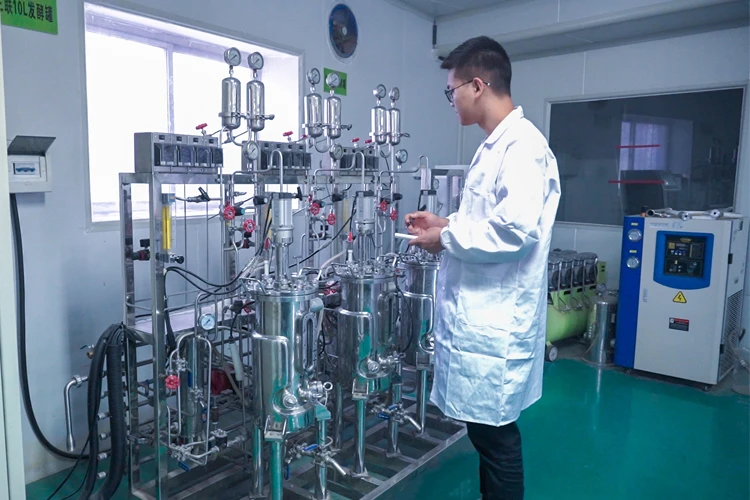
Fermentation and extraction routes produce powders that look similar in a sample bag but carry different documentation requirements. Image: Guanjie Biotech production facility.
What the market signal says — and what it does not
The most defensible market statement available here is a scale statement: the global nutraceutical ingredients market was estimated at USD 105.8 billion in 2026, according to Global Market Insights. That figure describes the size of the ingredient category, not the outlook for either of these two powders individually, and it should not be used to justify a grade or a supplier decision.
What the market scale does explain is procedural. Larger ingredient categories attract more abbreviated quotations, more grade variants and more suppliers operating at different levels of documentation maturity. The buyer response is a shorter, harder question set — CAS, grade, method, solubility basis, certificate scope — applied identically to every quotation received.
Public databases make one part of that comparison easier than it used to be. The NIH Dietary Supplement Label Database catalogs information printed on the labels of dietary supplement products sold in the United States, including ingredient names and forms, declared amounts and label statements. For a formulator deciding how to declare CoQ10 on a panel, that is a usable benchmark. A companion resource, the NIH Dietary Supplement Ingredient Database, provides estimated ingredient levels in certain supplement categories and is described as intended primarily for research applications — useful context, not a substitute for a supplier's batch data.
Comparison with traditional single-ingredient sourcing: limits on both sides
The conventional purchasing pattern for powders of this type is to buy the highest available purity from a single supplier, hold one certificate of analysis on file, and treat the specification as settled. That pattern still works for some applications, but it breaks down in three specific places here.
The highest purity is not always the right grade. For Coenzyme Q10, a 99% grade is fat-soluble and insoluble in water; a beverage developer who orders it on the assumption that “higher is better” has bought a material that does not match the system. The 10% water-soluble grade exists precisely because that assumption fails.
A percentage without physical constants is not a specification. For octacosanol, the acid value (below 1.0 mg KOH/g) and melting point (80–83 °C) are the figures that separate a genuine high-concentration lot from a diluted or blended one. A quotation that leads with a percentage and omits both is incomplete regardless of how attractive the number looks.
The comparison itself has a boundary. The publicly supplied data used here does not include an assay method for the CoQ10 grades, does not state octacosanol solubility, and contains no price or lead-time benchmark that would survive scrutiny. Those gaps are not defects of the article; they are the items a buyer must obtain directly before evaluation can be closed. Equally, neither powder substitutes for the other: different CAS numbers, different molecular identities, different physical behaviour. Substitution is a reformulation project, not a purchasing swap.
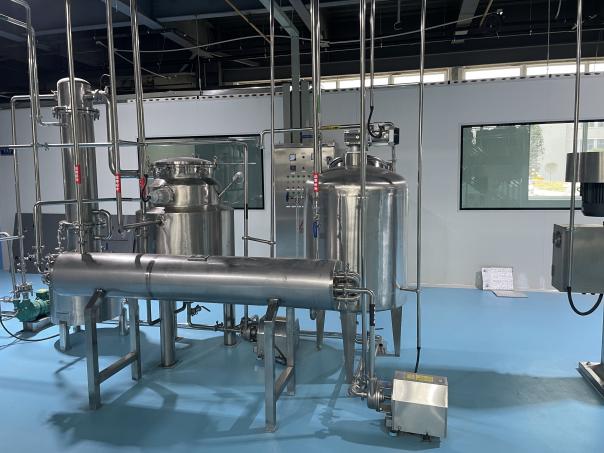
Route, grade and batch documentation are decided at the production stage — which is why they should be confirmed before a sample is approved.
Supply terms and continuity considerations
Guanjie Biotech's published capability information describes OEM and ODM support with packaging customization, a minimum order quantity of 1 kg, a lead time of 30 days, and 100% testing as its stated quality-control approach. For octacosanol specifically, the supplier states an annual production capacity of up to 100 tons, third-party laboratory verification through SGS, Eurofins and Puni Testing, and warehousing in the USA to support both small and bulk buyers.
Two of those figures deserve a clarifying question rather than a comparison. The 30-ton monthly capacity figure and the 100-ton annual octacosanol figure are expressed on different bases and different scopes; a buyer building a continuity model should ask which products the monthly figure covers and whether the annual figure is a nameplate or a demonstrated output. Likewise, an MOQ of 1 kg is useful for sampling and validation, but it says nothing about the pricing tier that applies at commercial volume — a separate quotation is required.
For longer-term supply, the more useful evidence is not a capacity number but a batch record pattern: whether the same specification and the same assay method appear across consecutive lots, and whether deviations are documented rather than absorbed. That is the point at which a supplier relationship shifts from transactional to dependable.
Future outlook
Procurement of these two powders is moving in the same direction as the wider ingredient category: away from headline purity and toward route-level documentation. Three developments are likely to shape buying decisions over the next few years. Fermentation-derived ingredients will increasingly be evaluated on process documentation rather than on the phrase “natural form,” because fermentation is a controlled process and can be documented as one. Physical constants will carry more weight in octacosanol purchasing, since a 5%–90% grade ladder makes the headline number the least informative figure on the sheet. And regulatory screening will become a routine pre-sample step rather than a pre-shipment surprise, as market-entry questions are resolved earlier in the evaluation cycle.
None of that changes the underlying comparison. Coenzyme Q10 and octacosanol remain two different materials with two different documentation profiles, and the buyer's job is to keep them on separate evaluation tracks even when they arrive in the same quotation.
Frequently asked questions
Are Coenzyme Q10 powder and octacosanol powder the same type of ingredient?
No. Coenzyme Q10 is identified as CAS 303-98-0 and is produced by microbial fermentation; it is supplied as a yellow to light orange-yellow, odorless and tasteless powder. Octacosanol is identified as CAS 557-61-9 with molecular formula C28H58O, extracted from natural cane wax using grain alcohol and water, and supplied as a white powder with a melting point of 80–83 °C. They share bulk-powder handling and overlapping application categories, but not identity.
Which Coenzyme Q10 grade should a beverage formulator request?
Coenzyme Q10 is described as fat-soluble and insoluble in water, while the specification lists a 10% grade described as water-soluble alongside a 99% grade. For aqueous formats such as functional beverages, the 10% water-soluble grade is the one aligned with the system. Buyers should confirm how that grade achieves dispersion and request a sample observation, because the base molecule's solubility note and the grade description are not the same statement.
How is octacosanol assayed, and what specification range is available?
Octacosanol powder is offered across a 5%–90% specification range, with gas chromatography listed as the test method; supplier text also references HPLC alongside GC, so the method printed on the certificate of analysis should be confirmed. Two physical figures are stated for identity control: melting point 80–83 °C and acid value below 1.0 mg KOH/g.
What documentation should be confirmed before ordering either powder?
A buyer should confirm the CAS number and grade on a batch-specific certificate of analysis, the assay method behind the stated percentage, the solubility or dispersion basis for the specific grade, and the physical constants where the specification provides them. Certificate scope should be verified with the issuing body. For context, the supplier lists ISO, Halal and Kosher certification at company level, and for octacosanol also lists HACCP and third-party verification by SGS, Eurofins and Puni Testing.
Can octacosanol replace Coenzyme Q10 in an existing formulation?
Not as a purchasing swap. The two materials carry different CAS numbers, different molecular identities and different physical behaviour, including opposing solubility descriptions relative to water. Any change from one to the other is a reformulation that requires its own validation of dose, dispersion and stability, not a substitution of one powder for another at equal weight.
What supply terms are published for these powders?
Guanjie Biotech's published capability information states OEM and ODM support with packaging customization, a 1 kg minimum order quantity, a 30-day lead time and 100% testing as its quality-control approach. For octacosanol, the supplier states annual production capacity of up to 100 tons, third-party laboratory verification, and warehousing in the USA for small and bulk buyers. These are supplier-reported figures and should be confirmed in writing against the specific product and volume.
For buyers who want the wider specification context behind both materials, Guanjie Biotech's nutraceutical ingredient catalogue is available as a downloadable PDF brochure.
Market scale reference: Global Market Insights, nutraceutical ingredients market estimate for 2026. Regulatory references: U.S. Food and Drug Administration guidance on current good manufacturing practices for dietary supplements, and FDA background on new dietary ingredient notification. Database references: NIH Office of Dietary Supplements, Dietary Supplement Label Database and Dietary Supplement Ingredient Database. Product specification statements reflect supplier-published documentation for Coenzyme Q10 (CAS 303-98-0) and Octacosanol (CAS 557-61-9) and are presented as supplier-reported information.
Tem questões ou precisa de mais detalhes?
Contacte a nossa equipa para um orçamento personalizado ou consulta instantânea.
Solicitar orçamento
Preencha o formulário abaixo e a nossa equipa entrará em contacto com uma proposta personalizada.
Chat direto do WhatsApp
Prefere conversar em tempo real? Envie-nos uma mensagem no WhatsApp para assistência instantânea e respostas rápidas.
- Obter orçamento personalizado
- Partilhar fotos ou documentos
- Discuta as suas necessidades diretamente
Geralmente responde em 5–30 minutos durante o horário de expediente.