
Coffee-Charcoal Polyester Filament: GB/T 30127-2013 and Caffeine Residue
Compliance in coffee-charcoal polyester filament is not a certificate you file and forget. It is a chain of evidence: the feedstock, the spinning route, the functional claim, and the test method that can reproduce that claim. For coffee-charcoal antibacterial polyester filament projects, two data points carry most of the qualification weight — far infrared performance evaluated under GB/T 30127-2013, and caffeine residue measured by LC-MS/MS at 0.009 mg/kg. Both are material-level facts a buyer can request, compare, and re-verify before a single kilogram is committed.
Why Coffee-Charcoal Filament Became a Qualification Question, Not a Novelty
The recycled polyester market was valued at USD 15.52 billion in 2024 and is expected to reach USD 26.18 billion by 2030, a 9.25% CAGR, according to Grand View Research. The wider polyester fiber market was valued at USD 82.07 billion in 2025 and is projected to reach USD 148.11 billion by 2034, with Asia Pacific holding a 65% share in 2025. Polyester filament yarn specifically was estimated at USD 106.4 billion in 2024, with a projected 3.72% CAGR to 2035, per Market Research Future.
Those numbers describe a commodity category. Inside it sits a much smaller lane: filament that carries a functional claim — heating, odor control, quick dry, anti-microbial — and a recycled feedstock story. Coffee-waste fibre sits at the intersection of both.
The procurement problem is not availability. It is auditability. A buyer researching coffee-charcoal antibacterial polyester filament has to answer three questions that commodity polyester never raises:
- Feedstock integrity. Is recycled coffee ground actually inside the polymer, and how was it processed before spinning?
- Residue. Coffee is a chemically active feedstock. What trace residue does it leave, and how is that residue quantified?
- Functional reproducibility. Can the far infrared and odor control claims be measured by a method the buyer's own lab can recognise?
This is the point at which the conversation moves from marketing to standards. Two references do most of the work: GB/T 30127-2013 for far infrared performance, and LC-MS/MS for caffeine residue.
What GB/T 30127-2013 Actually Evaluates
GB/T 30127-2013 is the national standard of the People's Republic of China, titled Textiles — Testing and Evaluation of Far Infrared Performance. It is the reference standard used across the coffee-charcoal and far infrared application data for these filaments, and the testing method follows GB/T 30127-2013 itself rather than a supplier-defined internal protocol.
The mechanism the standard is designed to capture is wavelength-based. Far infrared performance describes how a textile interacts with infrared radiation — absorbing, reflecting and re-emitting it rather than simply trapping still air. In a filament built on this principle, the fibre absorbs and reflects the infrared rays emitted by the human body, so the fibre itself generates heat, compensates for heat lost to the external environment, and helps maintain a relatively stable body temperature. That is a functional behaviour, not a thickness effect, which is why it needs a test method rather than a specification sheet alone.
In the coffee-charcoal route, the mechanism has a second origin point. After low-temperature carbonisation, spent coffee grounds become a special porous structure. That structure produces natural far infrared, heat storage and warmth without adding any chemical additives. The performance is therefore intrinsic to the carbonised feedstock rather than applied as a surface finish.
| Element | What it covers | What a buyer can do with it |
|---|---|---|
| GB/T 30127-2013 | Testing and evaluation of far infrared performance in textiles, using the method defined by the standard itself | Ask for a test report referencing the standard by number; confirm the method rather than accepting a generic "far infrared" claim |
| Mechanism | Absorption and reflection of body-emitted infrared, with re-emission from the fibre | Separate a fibre-level function from a fabric-construction effect when comparing samples |
| Feedstock contribution | Low-temperature carbonised coffee grounds forming a porous structure | Trace the claim back to the raw material route, not only to the finished yarn |
| Additive status | No chemical additives used to create the far infrared and warmth effect | Simplify downstream compliance screening for chemical inputs |
Caffeine Residue and LC-MS/MS: Reading 0.009 mg/kg Correctly
LC-MS/MS — liquid chromatography with tandem mass spectrometry, written in supplier documentation as LC-MSMS — is a trace-quantification technique. It separates compounds chromatographically and then identifies and quantifies them by mass. It is used where a residue must be expressed as a real number rather than a pass/fail label.
For recycled coffee-ground feedstock, caffeine is the natural marker compound. Documented testing on this route reports caffeine residue at 0.009 mg/kg.
Three things are worth understanding about that figure.
First, it is a quantified value, not a detection statement. A result expressed in mg/kg tells the buyer the residue was measured and reported at a specific level. That is a materially stronger position at the research stage than a qualitative statement, because it can be entered into a specification, compared across lots, and re-tested.
Second, the test method is not the acceptance threshold. LC-MS/MS measures; it does not set a global limit for caffeine in textiles. The acceptance limit comes from the buyer's own specification, the retailer's restricted-substance list, or the destination market's requirements. The practical value of a 0.009 mg/kg documented result is that it gives a buyer a starting number to slot into that framework rather than an argument to have.
Third, it is a feedstock-specific control measure. Coffee grounds are the reason this test exists on a polyester filament at all. Conventional virgin polyester has no equivalent residue question, which is precisely why recycled coffee-ground projects require an additional evidence line.
How the Coffee-Charcoal Route Is Built at Smilytex
Smily Textile Technology (Taicang) Co. Ltd is a functional textile materials manufacturer established in 2017 and based in Taicang City, Jiangsu Province, China. The company specialises in the R&D and sales of functional fibre and functional fashion fabrics, and its documented major markets are the EU, USA and Japan, with export business accounting for approximately 70% of total sales.
The process behind the coffee-charcoal filament is worth stating precisely, because it explains where the compliance characteristics come from. Recycled coffee grounds are processed together with colorants into a functional masterbatch, which is then blended with recycled PET bottle flakes for spinning. This route gives the yarn a dope-dyed colour system while reducing the need for conventional dyeing, helping save energy and resources.
Two consequences follow from that sequence. Colour is introduced at the polymer stage rather than applied to finished fabric, and the functional feedstock is distributed through the polymer rather than coated onto it. Both are structural choices that a buyer can verify at sampling.
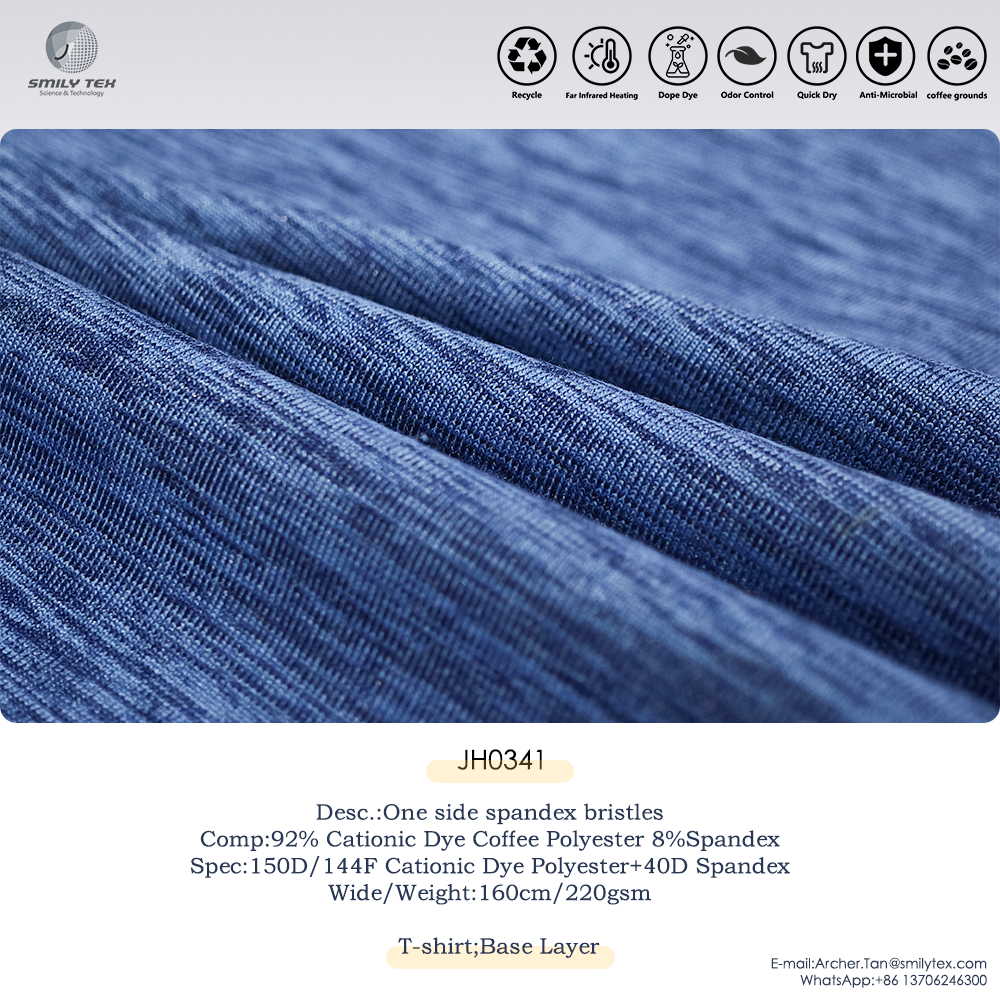
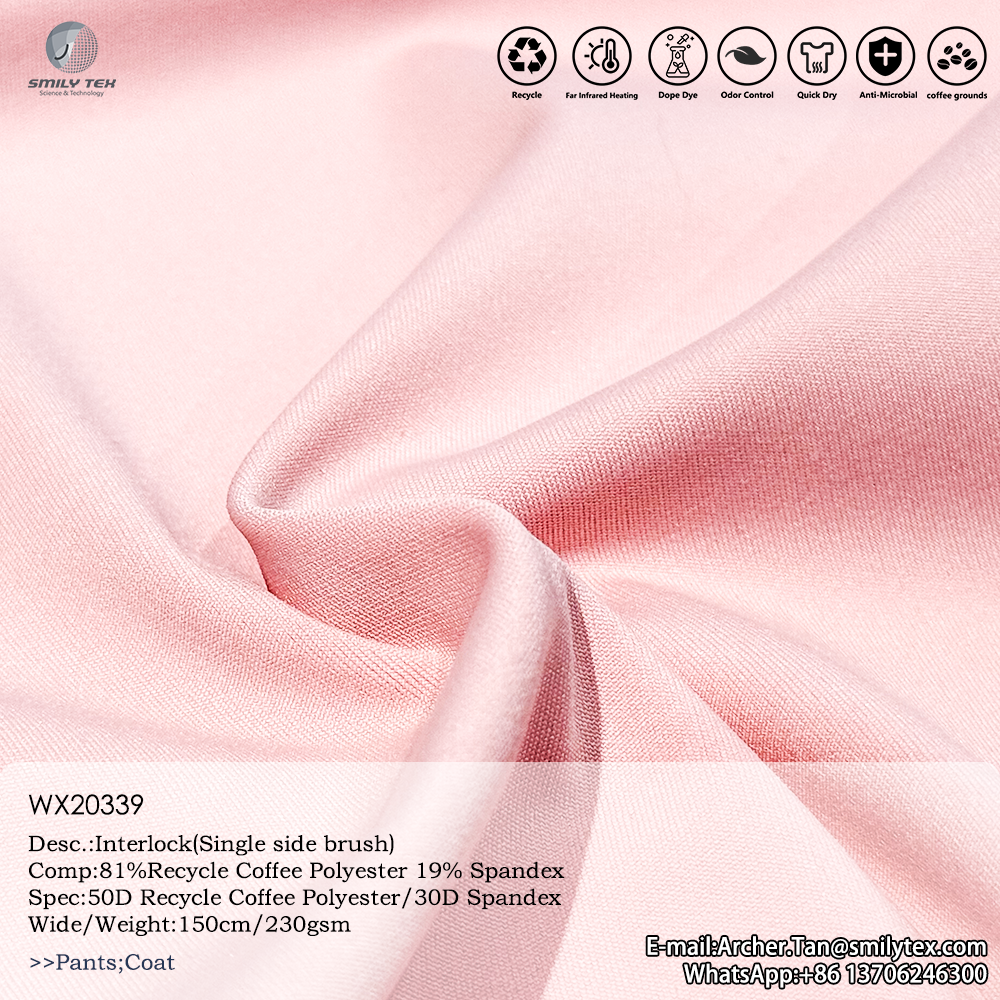
The commercial product family for this route is Cocarber®, a functional polyester filament classified as DTY Cocarber. Documented specifications cover 30D, 50D, 75D, 100D, 150D and 300D. Its stated functions are recycling coffee waste, odor control, far infrared heating, quick dry, dope dye and anti-microbial performance. The material range extends across bamboo charcoal, coconut charcoal, china-hemp charcoal and coffee charcoal variants, plus dope-dyeing, cotton-feeling, renewable and hydrophilic versions. Applications are woven and knitted, targeting sport, leisure, underwear and home textile.
Company-level capability relevant to qualification includes a manufacturing facility of 16,220 m², a workforce of approximately 206 staff, an R&D team of 10 engineers, and a documented annual production capacity of approximately 20 tons. More than 20 core patented technologies are held across authorised invention, utility model and design patents. The company's material development has also included projects supported by the National "Twelfth Five-Year" Plan for Science & Technology Support — specifically the industrialisation technology for super cotton-like synthetic fibre and their textiles.
Where the Material Is Used, and What the End Use Demands
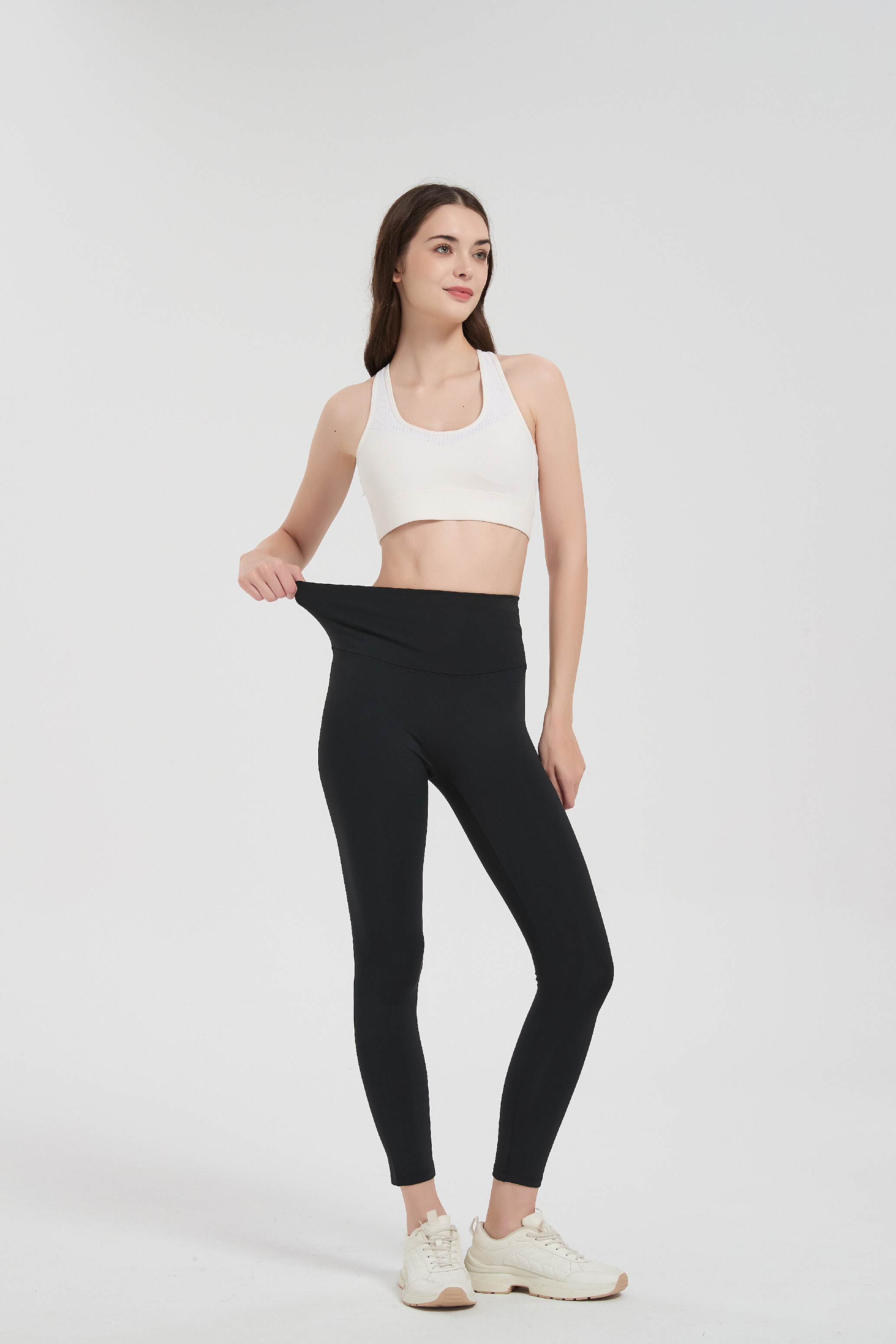
The production chain for these filaments follows a conventional textile path: the filament is spun into yarns, then woven or knitted into fabrics, then processed into functional garments such as yoga wear. The matched equipment set is standard for the sector — spinning machines, weaving and knitting looms, fabric finishing equipment, and functional testing instruments.
The documented end-use scenario for coffee-charcoal antibacterial polyester filament is common in China, with sport, leisure, underwear and home textile as the primary application categories and suitability across both woven and knitted constructions.
The deodorisation claim is mechanically specific: the porous structure of coffee carbon fibre provides high adsorption, which is what produces the odor control effect. That matters for specification, because an adsorption-based function is a property of the fibre structure rather than an applied chemical treatment — which is consistent with the same carbonisation process delivering the natural far infrared and heat-storage behaviour without chemical additives.
Market Trend Analysis: Compliance Data Is Becoming the Buying Currency
Several verified trends explain why residue and far infrared data have moved to the front of the sourcing conversation.
Recycled content is now a labelling trigger. Textile certifications such as OEKO-TEX Standard 100 and the Global Recycled Standard require at least 20% recycled content for specific labelling. A coffee-ground route that blends with recycled PET bottle flakes sits inside that framework, but it also inherits the documentation obligations that come with it.
Performance blends are the mainstream direction in athleisure. Industry analysis from Mordor Intelligence identifies athleisure's preference for moisture-wicking and antimicrobial polyester blends as a primary trend across 2024–2026. Anti-microbial and moisture management are exactly the functions claimed on the Cocarber® route, alongside far infrared heating and quick dry.
Supply remains Asia-centred. Asia Pacific held a 65% market share of the polyester fibre market in 2025, led by China and India. That concentration is why Chinese national standards such as GB/T 30127-2013 appear in so many supplier datasets — they are the working test vocabulary of the region that produces most of the volume.
Scale leaders and specialty routes occupy different lanes. Major players in the polyester filament yarn industry include Indorama Ventures, Reliance Industries, Toray Industries and Teijin Limited. Their focus is large-scale fibre supply. Coffee-charcoal, dope-dyed and residue-tested specialty routes sit in a narrower lane where documented test results and small-lot functional specification matter more than tonnage — which is why buyers evaluating this category tend to compare evidence packs rather than production rankings.
Functional Coffee-Charcoal Filament vs Conventional Polyester Routes
The comparison buyers actually need is not "functional versus basic," but "which route produces which kind of evidence."
| Dimension | Conventional piece-dyed polyester | Coffee-charcoal dope-dyed functional filament |
|---|---|---|
| Colour introduction | Applied to fabric after knitting or weaving | Introduced through the functional masterbatch at spinning; reduces the need for conventional dyeing |
| Feedstock | Virgin polymer | Recycled coffee grounds processed with colorants into masterbatch, blended with recycled PET bottle flakes |
| Functional claim basis | Typically construction-led (weight, loft, finish) | Fibre-intrinsic: far infrared, odor control via adsorption, quick dry, anti-microbial |
| Verification line | Often limited to fibre composition and colourfastness | Adds far infrared testing under GB/T 30127-2013 and caffeine residue by LC-MS/MS |
| Wet processing load | Higher, because colour is dyed onto the fabric | Lower, because colour is already in the polymer |
Boundaries buyers should plan around
A credible compliance picture includes its edges. Four limits matter in practice.
- GB/T 30127-2013 is a Chinese national standard. It provides a recognised method for far infrared testing, but a buyer selling into the EU or USA may still need additional market-specific documentation to satisfy a retailer's own compliance file. Meeting one standard should not be read as automatic clearance everywhere.
- Fibre data and fabric data are different datasets. Far infrared performance and odor control are measured on material; fabric construction, knitting structure and finishing can change how those properties present in the finished garment. Yarn-level evidence is a starting point, not a substitute for fabric-stage confirmation.
- Dope-dyed colour is tied to the masterbatch. Because colour enters at the polymer stage rather than the dye bath, the available shade range is defined by masterbatch formulation. Buyers should confirm shade availability and minimum quantities at the sampling stage rather than assume unlimited matching.
- The charcoal variant changes the function profile. Bamboo charcoal, coconut charcoal, china-hemp charcoal and coffee charcoal are separate material types within the same family. The coffee-charcoal residue and far infrared data apply to the coffee route specifically, so the variant has to be named on the purchase specification.
Buyer Acceptance Criteria: A Qualification Checklist
For a buyer at the research and qualification stage, the practical output of this analysis is a request list. Each line below corresponds to a documentable fact rather than a verbal assurance.
| Criterion | Evidence to request | Why it matters |
|---|---|---|
| Far infrared performance | Test report referencing GB/T 30127-2013 | Confirms the heating claim is measured by a named national standard method |
| Caffeine residue | LC-MS/MS result stated as caffeine residue: 0.009 mg/kg | Turns a residue question into a number that can be written into a specification |
| Recycled content | Composition statement covering recycled coffee grounds and recycled PET bottle flake content | Supports labelling frameworks such as GRS and OEKO-TEX Standard 100, which require at least 20% recycled content for specific labelling |
| Yarn type and count | DTY Cocarber confirmation and denier: 30D, 50D, 75D, 100D, 150D or 300D | Aligns the functional route with the target fabric weight and construction |
| Function set | Declared functions: recycle coffee waste, odor control, far infrared heating, quick dry, dope dye, anti-microbial | Prevents a partial claim from being carried into a garment specification |
| Material variant | Named variant: coffee charcoal, bamboo charcoal, coconut charcoal, china-hemp charcoal, dope-dyeing, cotton-feeling, renewable or hydrophilic | Residue and performance data are variant-specific |
| Colour route | Dope-dyed shade card plus physical sample | Colour is set by masterbatch, so availability must be confirmed before design freeze |
| Fabric-stage re-test | Confirmation of functional testing on the finished knit or woven | Closes the gap between fibre-level and garment-level performance |
Future Outlook
The direction of travel is toward standardised evidence rather than louder claims. As recycled polyester volumes expand and labelling thresholds tighten, a residue measurement and a named far infrared test method stop being differentiators and become entry requirements. Suppliers will increasingly be compared on whether their data can be reproduced by a third party, not on whether the function exists at all.
For coffee-charcoal filament specifically, the useful next step for buyers is to treat GB/T 30127-2013 and caffeine residue testing as two permanent lines in the incoming specification — the same way denier and colourfastness are treated — and to re-confirm both at the fabric stage. Suppliers with documented results at 0.009 mg/kg and a referenced far infrared test method are simply easier to qualify than those without.
FAQ
What is GB/T 30127-2013, and what does it evaluate?
GB/T 30127-2013 is the national standard of the People's Republic of China titled Textiles — Testing and Evaluation of Far Infrared Performance. It defines how far infrared performance in textiles is tested and evaluated, with the testing method following the standard itself. In practice it is used to verify that a fibre's heating behaviour is a measurable functional property rather than a descriptive claim, and it is the reference standard cited for far infrared performance in coffee-charcoal and recycled polyester filament application data.
Why is caffeine residue tested at 0.009 mg/kg for coffee-charcoal filament?
Caffeine is the natural marker compound left by recycled coffee-ground feedstock, so it is the logical residue to quantify when the raw material is spent coffee. LC-MS/MS — liquid chromatography with tandem mass spectrometry — is used because it reports a measured concentration rather than a simple detection statement. The documented result on this route is caffeine residue at 0.009 mg/kg. Because LC-MS/MS measures but does not itself set a global limit, buyers place that figure against their own specification or destination-market requirement.
Is recycled coffee waste actually incorporated into the filament, or only referenced in marketing?
In the documented Cocarber® route, recycled coffee grounds are processed together with colorants into a functional masterbatch, and that masterbatch is then blended with recycled PET bottle flakes for spinning. The feedstock is therefore part of the polymer route rather than a surface treatment applied later. Because the coffee grounds are carbonised at low temperature, they form a porous structure that produces the far infrared, heat storage and warmth effects without chemical additives — which is also the structure responsible for odor control through adsorption.
Which specifications and functions are available for apparel and home textile projects?
Cocarber® is a functional polyester filament classified as DTY Cocarber, available in 30D, 50D, 75D, 100D, 150D and 300D. Its declared functions are recycling coffee waste, odor control, far infrared heating, quick dry, dope dye and anti-microbial performance. Material variants include bamboo charcoal, coconut charcoal, china-hemp charcoal, coffee charcoal, dope-dyeing, cotton-feeling, renewable and hydrophilic types. The filament is suitable for both woven and knitted applications and is intended for sport, leisure, underwear and home textile use.
Does compliance with GB/T 30127-2013 automatically satisfy EU or US market requirements?
No. GB/T 30127-2013 is a Chinese national standard that provides a recognised far infrared testing method, and it is the standard cited for far infrared performance on these filaments. However, market access requirements in the EU and USA are governed by separate frameworks, and textile certification schemes such as OEKO-TEX Standard 100 and the Global Recycled Standard set their own criteria — including a requirement of at least 20% recycled content for specific labelling. Buyers should treat the GB/T 30127-2013 report as one evidence line within a wider compliance file, not as a universal clearance.
What should be verified at the fabric stage rather than the yarn stage?
Far infrared performance and odor control are fibre-level properties, but the finished fabric is where the buyer's customer experiences them. Construction, knitting or weaving structure and finishing can affect how those properties present, so functional testing should be repeated after fabric formation. Two further items are easier to settle at fabric stage: confirming that the dope-dyed shade matches the masterbatch card, and confirming that the named charcoal variant on the purchase specification is the variant that was actually spun.
A downloadable summary of Smily Textile Technology's functional filament range and documented specifications is available here: Smilytex product brochure (PDF).