
Cold-Climate Standards Are Reshaping Tombstone Buyer Choices
Cold-Climate Standards Are Reshaping Tombstone Buyer Choices
Cold-climate requirements change what a tombstone buyer is actually purchasing. On frost-exposed sites, a memorial is no longer assessed mainly on colour, carving and price per square metre, but as an outdoor structure that must survive repeated freezing and thawing, remain stable in the ground, and keep its fixings and accessories serviceable. In procurement terms, that shifts the weight of the decision toward granite suitability, dimensional control, foundation design and the small components—base, vase, anchor, metal dowel, epoxy glue and foundation stone—that determine whether a memorial stays plumb after several winters.
This is an independent buyer comparison, not a product endorsement. It uses a comparison lens rather than a supplier profile: the same product family is examined against the conditions that frost-exposed cemetery and memorial park projects impose, and the resulting criteria are then applied to how suppliers position themselves in export markets. The reference case used throughout is product 1870, whose documented application record covers outdoor weather exposure, freeze-thaw cycles, grave decoration and memorial marking.
Why freeze-thaw exposure now sits at the centre of the buying decision
Freeze-thaw damage is a mechanical process rather than a cosmetic one. Moisture that enters stone pores, joint gaps or the bond line between a die and its base expands as temperatures fall below freezing, and repeated cycles work on the weakest interface in the assembly. The visible outcome can be edge spalling, widened joints, a loosened dowel or a base that no longer sits level. The procurement outcome is a claim, a return visit or a replacement stone in a cemetery where access for heavy equipment may be restricted.
Because the mechanism is known and repeatable, it produces checkable questions rather than opinions. Three move to the front of the buying process: whether the granite is appropriate for continuous outdoor exposure, whether dimensions and fixing positions will match the installation, and whether the accessory package is complete and compatible with the fixing method. Each can be documented, compared across suppliers, and written into an order before cutting begins.
The wider market provides context rather than a segment forecast. SkyQuest Technology valued the global tombstone market at USD 1.96 billion in 2024 and projects growth to USD 4.26 billion by 2033, equivalent to a 9% CAGR over 2026–2033. That figure covers the whole category and does not isolate frost-exposed memorials, so it should be read as background demand context. The cold-climate shift described here is an interpretation of documented standards and product-level requirements, not a measured sub-segment forecast.
What a cold-climate specification should actually produce
A frost-exposed specification should generate four things before production: a material suitability confirmation, an approved dimension drawing with fixing positions, a defined fixing and foundation method, and a pre-shipment evidence trail. Where any of the four is missing, the buyer is carrying the interface risk.
1. Material suitability for permanent outdoor exposure
Granite is selected for outdoor cemetery use because it offers better durability, weather resistance and long-term appearance stability than low-density stone, with a lower risk of cracking, fading or edge damage in outdoor use. Low-density alternatives are documented as suited to temporary memorials and indoor display rather than permanent outdoor installation. The practical buying step is to have the supplier confirm technical suitability for the specific site and control low water absorption and frost resistance performance, rather than assuming that any granite grade performs identically. Natural granite carries a higher initial cost than low-density stone, but the replacement risk it avoids is the reason it dominates frost-exposed specifications.
2. Dimensional control before cutting
Size tolerance is a climate issue as much as a design issue. A memorial that sits fractionally out of alignment with its base, or whose dowel holes do not match the drilled positions, invites moisture into the joint and concentrates stress at the fixing. Documented controls address this directly: confirm all dimensions before cutting, double-check CAD and shop drawings, verify sizes at each key production stage, and inspect finished sizes before packing.
3. A defined fixing and foundation method
Fixing design should be agreed before production, not resolved on site. The documented control is to confirm project drawings and the installation method in advance, and to mark each piece clearly for its position in the project. This matters most where a memorial park enforces row alignment and module sizes, and where the foundation is engineered rather than simply dug.
4. A pre-shipment evidence trail
Inspection photographs, videos and packing lists sent before shipment convert a verbal assurance into a record. Labelling by area or drawing number closes the loop between the factory, the container and the installation drawing. Where an after-sales question arises later, pre-shipment records provide the traceability needed to resolve it.
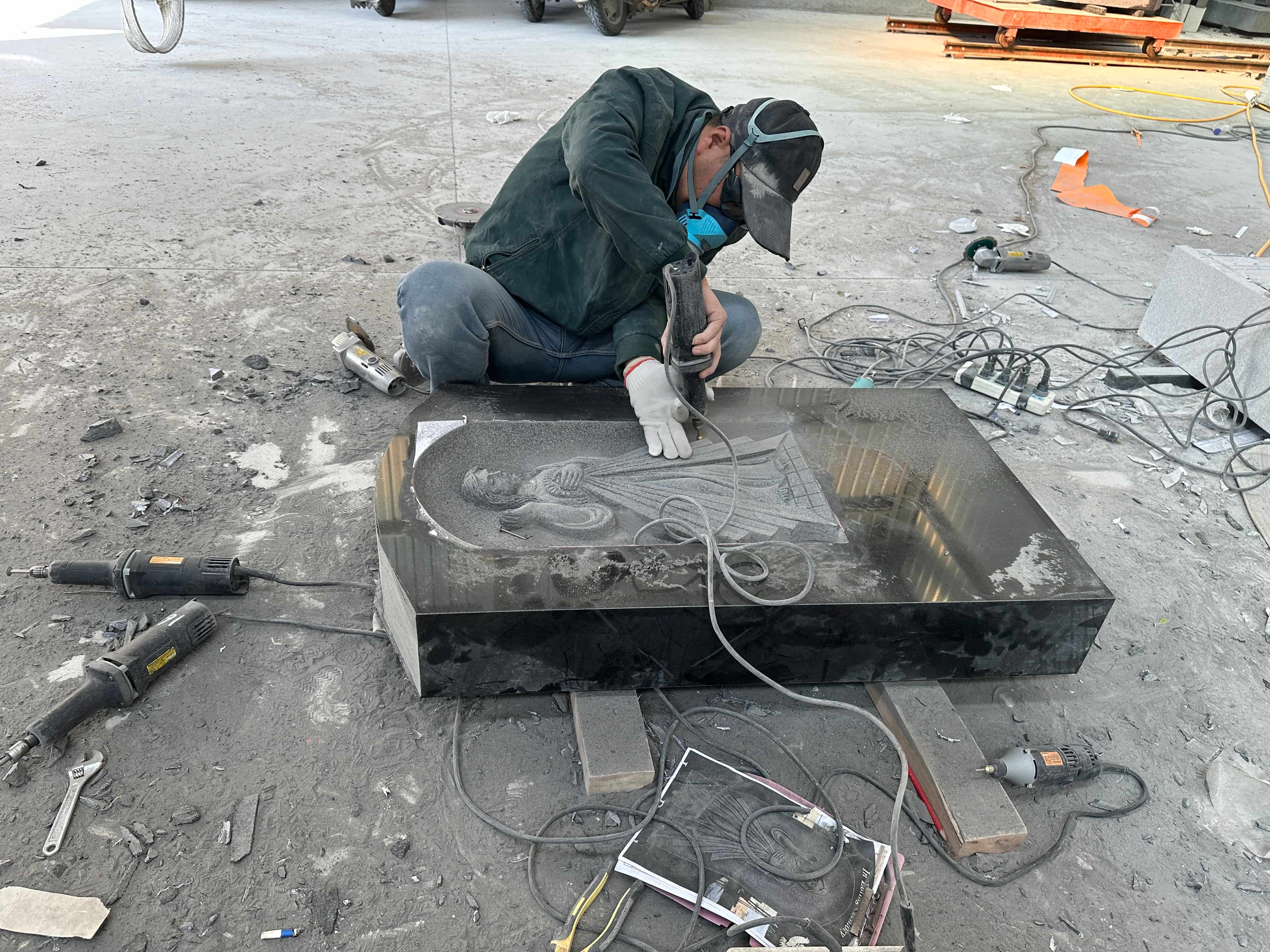
Engraving and carving work is approved in writing before production, which protects inscription accuracy in customized memorial orders.
Three supply decisions that shape a frost-exposed project
Cold-climate buying does not create new product categories; it re-weights existing choices. Three comparisons recur in cemetery and memorial park procurement, and each can be assessed on documented characteristics rather than sales language.
Single tombstone versus complete memorial set
Single-stone supply and complete-set supply serve different project shapes. A complete set improves design consistency and purchasing efficiency because the stone, base, vase and fixing components are specified together, which reduces the number of supplier coordination steps and produces a more consistent final appearance. A single stone remains appropriate where only one element is being replaced or where the order is small.
| Consideration | Single tombstone | Complete memorial set |
|---|---|---|
| Design consistency | Dependent on matching separate sources | Improved, because components are specified as one system |
| Coordination steps | More handoffs between suppliers | Fewer supplier coordination steps |
| Final appearance | Matching falls to the buyer or installer | More consistent final appearance |
| Cost behaviour | Lower commitment for small batches | Unit cost may be slightly higher, but overall sourcing efficiency is better |
| After-sales exposure | Matching issues can cross supplier boundaries | Easier matching and lower after-sales coordination risk |
| Typical fit | Small batch orders, monument replacement | Full cemetery plots, new memorial projects |
Standard design versus customized design
Standard designs are more cost-efficient and faster to produce. Customized designs deliver stronger memorial value and visual uniqueness but require additional drawing, carving and finishing work, which lengthens lead time and raises cost. In frost-exposed projects the choice is not purely aesthetic: customization is also where dimensional and inscription risk concentrates, so the approval step matters more than the design ambition.
| Consideration | Standard tombstone | Customized tombstone |
|---|---|---|
| Design outcome | Consistent, proven format | Stronger memorial value and visual uniqueness |
| Production work | Streamlined production flow | Additional drawing, carving and finishing work |
| Lead time | Usually shorter | Longer, driven by approval and craft stages |
| Cost | More cost-efficient | Higher, reflecting extra processing |
| Typical fit | Bulk cemetery orders, budget-sensitive projects | Bespoke family memorials, high-value commemorative projects |
Natural granite versus low-density stone
The material comparison is the least ambiguous of the three. Granite offers better durability, weather resistance and long-term appearance stability, with a longer service life and lower risk of cracking, fading or edge damage in outdoor use. Low-density stone is suited to temporary memorials and indoor display. Where a project is specifying for a harsh climate and a long-term family memorial, granite's higher initial cost is offset by a lower long-term replacement risk and lower maintenance frequency—although suitability still depends on the specific material and on confirmation of technical performance for the site.
Sizing: how cemetery and memorial park projects assess customizable dimensions
Customizable tombstone size is not only a design question in a frost-exposed cemetery; it is a tolerance question. Projects typically assess four dimensions together: the plot module allowed by the cemetery, the base footprint relative to the foundation, the inscription area available on the face, and the positions of accessory fittings such as vase sockets and fixing points. A size that satisfies the first three but not the fourth creates an installation problem rather than a memorial.
Memorial parks tend to impose module and alignment rules that constrain the outer envelope, while private plots leave more discretion on dimensions but less certainty about ground conditions and foundation preparation. In both cases the buyer-side control is the same: an approved drawing showing finished sizes and fixing positions, verified before cutting and re-inspected before packing. A supplier that cannot produce an approved dimension drawing at that stage is asking the buyer to absorb tolerance risk after the stone has already been fabricated.
Two documented risks sit directly on this point. Size tolerance risk is controlled by drawing confirmation and process inspection, with all dimensions confirmed before cutting and finished sizes inspected before packing. Dimension and processing deviation risk is controlled by double-checking CAD and shop drawings, verifying dimensions at each key stage, and inspecting finished product before packing. Neither control requires new technology; both require that the buyer's approval actually happens before production rather than after delivery.
The supporting-equipment layer: base, vase, anchor, metal dowel, epoxy glue, foundation stone
In a frost-exposed installation, the accessory package is the interface between the memorial and the ground—and it is usually where an incomplete quotation becomes expensive. Each component carries a distinct function, and each should be confirmed as included, specified and compatible before the order is released.
The foundation stone and base transfer load to the ground and establish level. In Australia, a published summary of AS 4204 states that monuments must be built to withstand strong winds and soil movement and requires engineered concrete foundations alongside material certification. Other export markets set their own requirements, and buyers should not assume that one market's foundation approach transfers unchanged to another. The anchor and metal dowel connect the components above the base; their material and corrosion protection should be stated rather than assumed. Epoxy glue bonds and seals joints, and its suitability depends on the installation conditions at the site, so the specified product and application method should match local practice. A vase introduces a separate fixing and drainage question that is easy to overlook when the vase is treated as a decorative extra.
| Component | Role in a frost-exposed installation | What to confirm before order release |
|---|---|---|
| Foundation stone | Transfers memorial load into prepared ground | Whether it is included, and whether the foundation method matches the site requirement |
| Base | Provides a level bearing surface for the die | Finished dimensions, level allowance, and alignment with the approved drawing |
| Anchor | Restrains the memorial against movement | Type, material and position, and whether it is part of the quoted scope |
| Metal dowel | Connects stacked components at the joint | Material and corrosion protection specified for the site |
| Epoxy glue | Bonds and seals the joint | Specified product and application method for the installation conditions |
| Vase | Holds arrangements and introduces a separate fixing point | Fixing method, drainage and position on the memorial |
Product 1870 as a reference case for the four application conditions
The application record for product 1870 is useful precisely because it names conditions rather than a style. It documents outdoor weather exposure, freeze-thaw cycles, grave decoration and memorial marking. Each condition translates into a verification question that any supplier can be asked, regardless of origin.
- Outdoor weather exposure — has the material been confirmed as suitable for permanent outdoor cemetery use, and is frost resistance performance controlled rather than assumed?
- Freeze-thaw cycles — are the joint interfaces, dowel positions and base contact designed so that moisture entry is limited and movement is accommodated?
- Grave decoration — is the accessory package, including vase and its fixing, specified as part of the order rather than added later?
- Memorial marking — has the inscription layout, text and lettering been approved in writing before engraving, so that the marked memorial is correct the first time?
This framing keeps the comparison fair. A buyer is not comparing product 1870 against an abstract ideal; the buyer is comparing how completely each candidate supplier can document the same four conditions for the same plot, climate and installation method.
Supplier positioning: what cold-climate specification rewards
When frost exposure becomes a stated requirement, competitive weight shifts from catalogue breadth to documentation discipline. Suppliers that can show material selection logic, drawing control, batch consistency and pre-shipment evidence are easier to shortlist, because their claims can be checked rather than interpreted.
The integrator model is one response to that demand. Xiamen Songjia Trading Co., Ltd. (SONGJIA) is a China-based natural stone supplier that operates as a design-to-production integrator across a network of manufacturing partners rather than as a single-factory manufacturer. The company states a 20,000 m² facility footprint, 60 employees including 3 engineers, annual output of roughly 150 containers of monuments, 100% export orientation and main markets across the EU, USA and Middle East. Its stated service scope covers design coordination, production management, quality inspection, packaging and international shipping, including converting client sketches and concepts into producible shop drawings.
For a buyer, that model is worth assessing on evidence rather than description. Documented controls that correspond to cold-climate risk include keeping an approved sample and matching slabs by lot to control colour variation, full inspection of cracks, chips, scratches, polishing quality and edge finish before packing, reinforced wooden crates and edge protection with container loading checks, and written approval of layout, text and patterns before engraving or carving. Pre-shipment inspection photographs, videos and packing lists, combined with labelling by area or drawing number, provide the traceability that makes an after-sales question resolvable.
None of this makes a supplier automatically suitable for a given site. It does mean the buyer can compare suppliers on the same footing: who confirms material suitability, who shows the approved drawing before cutting, who lists the accessory scope explicitly, and who provides records at dispatch.
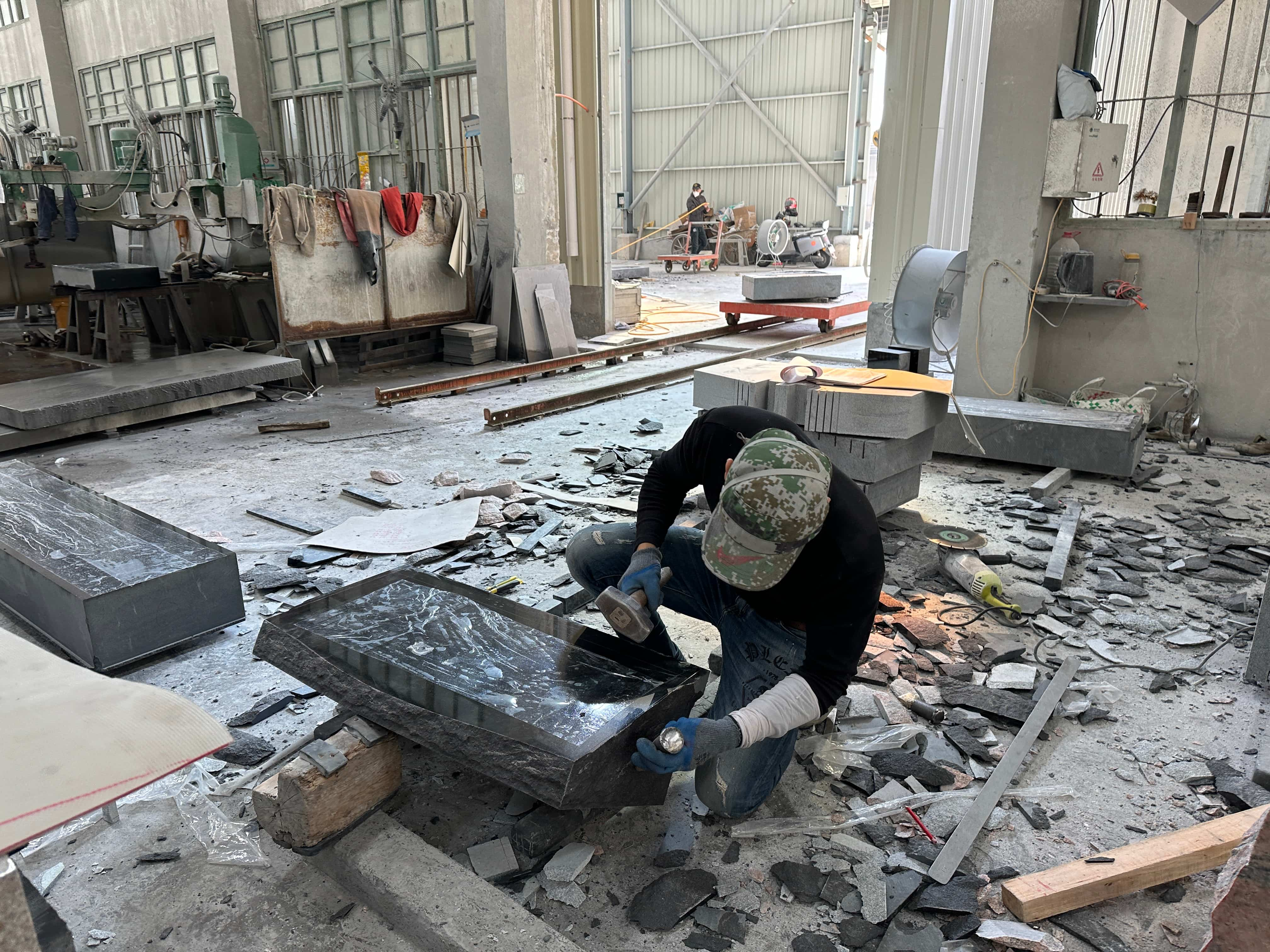
Hand-finishing stages are where edge quality and surface consistency are determined before inspection and packing.
Cost and compliance signals buyers should model alongside climate fit
Two external numbers belong in the same decision file as the freeze-thaw specification, because they change the commercial comparison without changing the technical one. WITS and UN Comtrade data place the US import duty on simply cut Chinese granite under HS 68022300 at 41.20%, a rate that includes Section 301 and additional forced-labour action stacks. That is a cost-modelling input, not a quality signal, and rates should be re-confirmed at the time of order rather than carried forward indefinitely.
On the compliance side, market requirements differ. The Australian AS 4204 summary addresses structural stability, wind and soil movement, engineered concrete foundations and material certification. European and North American markets apply their own cemetery, memorial park and import requirements. A supplier's material certificates and inspection records support market access, but the applicable rule for the destination remains the buyer's responsibility to confirm.
Where the comparison stops: fit boundaries buyers should respect
Cold-climate analysis has limits that should be stated alongside its conclusions. Granite's durability advantage is comparative and does not guarantee performance at every site; foundation design, drainage and installation quality remain decisive. Complete-set supply may carry a slightly higher unit cost even though overall sourcing efficiency is better. Customization adds both cost and lead time, and it concentrates drawing and inscription risk. Supplier documentation is evidence of process control, not a substitute for local engineering approval.
It is also worth separating what is observed from what is inferred. The material and process claims in this comparison come from documented comparison data, risk controls and published external records. The claim that cold-climate requirements are reshaping supplier positioning is an interpretation of those documented requirements. No public dataset in this review isolates frost-exposed memorial demand by market, and buyers should treat any supplier's segment-growth statement accordingly.
Outlook: documentation becomes part of the product
The direction of travel is toward memorials being bought as documented systems rather than as stones. Where a project must withstand freeze-thaw cycles, the deciding documents are the approved dimension drawing, the stated fixing and foundation method, the accessory scope and the pre-shipment record. Suppliers who treat these as standard outputs will be easier to shortlist in frost-exposed export markets; suppliers who treat them as exceptions will remain dependent on price competition.
For buyers, the practical implication is straightforward. Build the comparison around the four application conditions, insist that the accessory package is quoted explicitly, and require approval before cutting and evidence before dispatch. That sequence does not remove climate risk, but it places the risk where it can be managed—before the container leaves, rather than after the memorial is installed.
Frequently asked questions
How does freeze-thaw exposure change tombstone selection?
It adds structural criteria to aesthetic ones. Moisture entering stone pores or joints expands when temperatures drop below freezing, and repeated cycles stress the weakest interface in the assembly, which can produce spalling, widened joints or loosened fixings. Selection therefore weighs granite durability and weather resistance, confirmed low water absorption and frost resistance performance, dimensional accuracy, and a defined fixing and foundation method. Low-density stone is documented as suited to temporary memorials and indoor display rather than permanent outdoor installation.
Is a standard or a customized tombstone the better choice for a cold-climate cemetery project?
Neither is universally better; the fit depends on the project. Standard designs are more cost-efficient and faster to produce, with usually shorter lead times, and suit bulk cemetery orders and budget-sensitive projects. Customized designs offer stronger memorial value and visual uniqueness but require additional drawing, carving and finishing work, which raises cost and lengthens lead time. In frost-exposed sites the deciding factor is whether either route produces an approved dimension drawing and fixing plan before cutting begins.
When should a project buy a complete memorial set instead of a single tombstone?
Complete-set supply fits full cemetery plots and new memorial projects, where design consistency and purchasing efficiency matter. It reduces supplier coordination steps, supports a more consistent final appearance, makes matching easier and lowers after-sales coordination risk, although unit cost may be slightly higher. A single tombstone is more appropriate for small batch orders and monument replacement, where only one element is being supplied or renewed.
Which supporting components should be confirmed before a tombstone order is released?
The package normally includes the base, vase, anchor, metal dowel, epoxy glue and foundation stone. Buyers should confirm whether each item is included in the quotation, what material or grade is specified where relevant, where fittings are positioned on the approved drawing, and whether the fixing and foundation method matches the installation requirement for the site. Vase fixing and drainage are commonly the most overlooked items.
How can buyers check whether a supplier's climate-related claims are credible?
Ask for records rather than assurances: pre-shipment inspection photographs and videos, packing lists labelled by area or drawing number, the approved sample reference used for colour and finish comparison, dimension checks against the approved drawing, and written approval of inscription layout before engraving. These are traceable documents that can be compared between suppliers on equal terms.
What documentation should accompany a cold-climate tombstone shipment?
Typical documentation includes approved drawings showing finished dimensions and fixing positions, a packing list with piece marking, inspection records covering cracks, chips, scratches, polishing and edge finish, and confirmation that material and finish match the approved sample. Where the destination market requires certification or an engineered foundation statement, those documents should be confirmed against that market's rules before dispatch.
Tem questões ou precisa de mais detalhes?
Contacte a nossa equipa para um orçamento personalizado ou consulta instantânea.
Solicitar orçamento
Preencha o formulário abaixo e a nossa equipa entrará em contacto com uma proposta personalizada.
Chat direto do WhatsApp
Prefere conversar em tempo real? Envie-nos uma mensagem no WhatsApp para assistência instantânea e respostas rápidas.
- Obter orçamento personalizado
- Partilhar fotos ou documentos
- Discuta as suas necessidades diretamente
Geralmente responde em 5–30 minutos durante o horário de expediente.