
Cold Room Refrigeration Systems: A Smart Manufacturing Supplier Audit
Industry Reference · Cold Chain Equipment Evaluation
Cold Room Refrigeration Systems: A Smart Manufacturing Supplier Audit
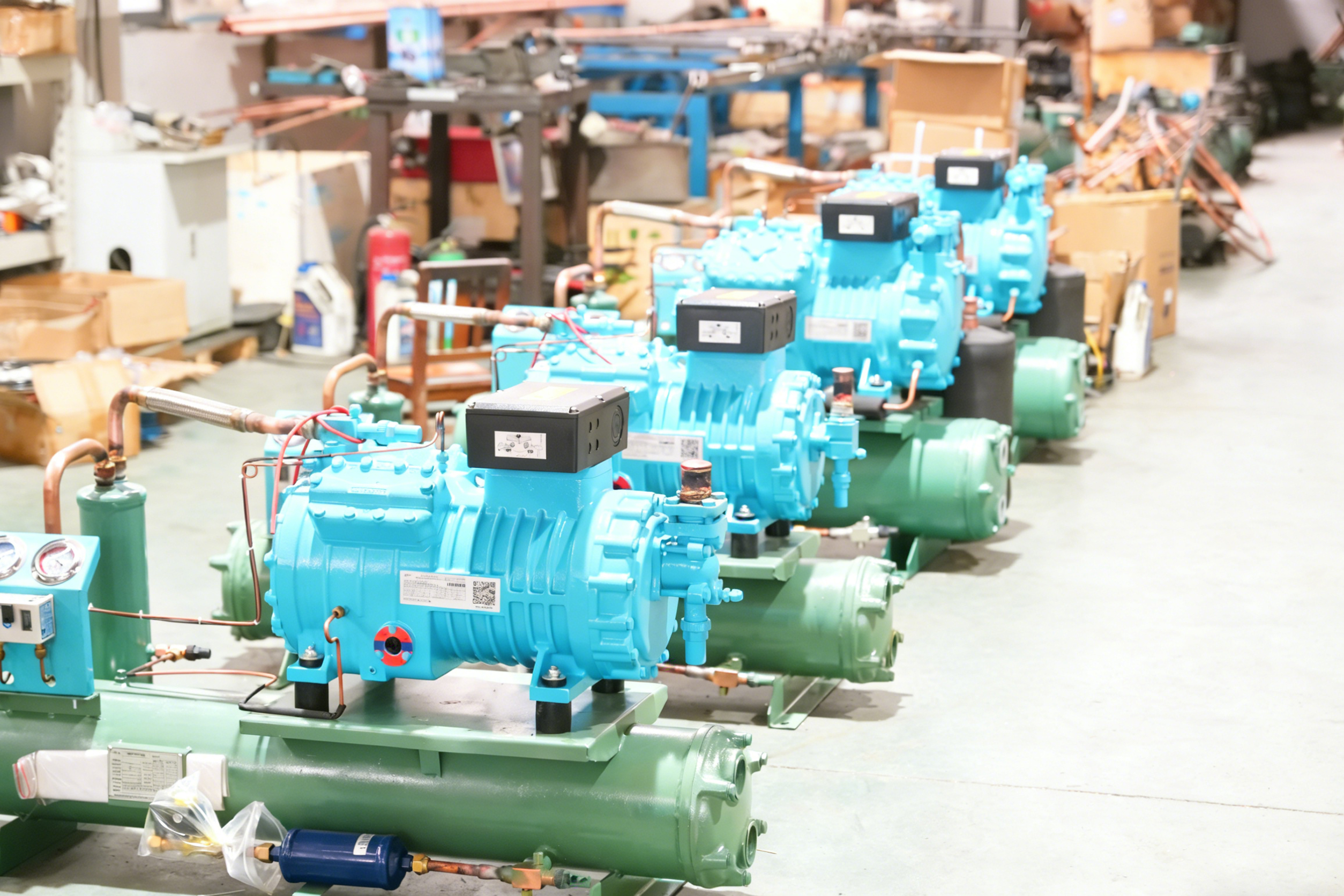
Cold room refrigeration equipment production: supplier sustainability is decided on the shop floor before it is tested in the field. Image: Clevier Refrigeration.
A cold room refrigeration system is not procured once. It is re-procured every time a buyer adds a freezer room, a chiller, or a new cold chain warehouse. The supplier question a smart manufacturing procurement team actually faces at the evaluation stage is therefore not “which unit is cheapest today” but “can this supplier reproduce the same engineering decision across five projects over the next three years?”
Cold storage capacity is growing faster than supplier evaluation cycles
China's total cold storage capacity reached 237 million cubic meters by June 2024, an 8% increase year on year, according to the China Federation of Logistics & Purchasing and the International Institute of Refrigeration. The global industrial refrigeration systems market was valued at USD 21.3 billion in 2024, with Asia Pacific holding a 32.6% revenue share, according to Grand View Research. Meanwhile, the frozen temperature band of -18°C to -25°C accounted for roughly 63% of the cold storage market in 2025, and Food & Beverages generated over 76.8% of global cold chain revenue in the same year.
Those figures describe volume. They do not describe repeatability. A contractor that installs twenty systems across meat, seafood, and vegetable applications in three years is buying a supply relationship, not a catalog item. The audit that determines whether that relationship holds is a manufacturing audit: component coverage, temperature-class coverage, customization continuity, quality-control repeatability, and documented compliance.
The audit problem: component coverage is fragmented across suppliers
In most cold room refrigeration projects, the condensing unit, the cold room air cooler (evaporator), the air cooled condenser, and the insulated panel come from different vendors. Each vendor warrants its own box. The matching logic — refrigerant charge, evaporating temperature, defrost strategy, control setpoints — is assembled by the contractor during commissioning.
That model works for one-off installations and breaks down for program buyers. When the fifth project uses a different compressor platform, a different refrigerant, or a different fan configuration than the first, spare parts inventory doubles, maintenance procedures diverge, and commissioning knowledge is not transferable. The evaluation question becomes structural: how much of the refrigeration chain sits inside one documented manufacturing scope?
A six-dimension supplier sustainability audit framework
The framework below is written for procurement and engineering teams evaluating cold room refrigeration systems for multi-project programs. Each dimension asks for evidence that can be checked before an order is placed, and each is mapped to documented positions from a project-based refrigeration manufacturer, Clevier Refrigeration (Jiangsu) Co., Ltd., based in Wujin District, Changzhou City, Jiangsu Province, China.
| Audit dimension | What buyers should verify | Documented supplier position |
|---|---|---|
| 1. Component coverage | Does one manufacturer supply the condensing unit, evaporator/air cooler, air cooled condenser, and room envelope components on a shared matching basis? | Clevier manufactures evaporators, condensing units, compressors, cold rooms, and polyurethane insulated panels, and supplies the Cold Room Refrigeration System as a matched package of condensing unit, air cooler, and cold room door system. |
| 2. Temperature-class coverage | Can the supplier serve chiller, freezer, and low-temperature rooms without changing product families? | Air coolers are offered in DL, DD, and DJ series; the cold room refrigeration system is specified for -40°C to +10°C. |
| 3. Customization continuity | Are voltage, frequency, refrigerant, compressor brand, and structure options fixed and repeatable? | Customization covers voltage, size, capacity, material, structure, control system, and installation solution; documented options include 220V / 380V, 50Hz / 60Hz, R404A / R507A / R22, and Copeland or Bitzer compressors. |
| 4. Manufacturing repeatability | What capacity, lead time, minimum order, and inspection regime back the promise? | Monthly capacity of 8,000–15,000 units across a mixed product range, lead time of 15–30 days depending on order quantity, MOQ of 1 set, and 100% testing before shipment including performance and pressure testing. |
| 5. Compliance evidence | Which certificates exist, for which products, and under which standards? | CE certification under Machinery Directive 2006/42/EC for Cold Room Air Cooler and Air Cooled Condenser, issued 13 May 2026 by Xihua International Testing & Certification (Shenzhen) Co., Ltd. |
| 6. Lifecycle support | How is the system supported after commissioning? | Online technical support, installation guidance, spare parts supply, and project support. |
Technical explanation: how DL, DD, and DJ map to real rooms
The temperature class of a cold room determines the evaporator family, the defrost method, and the compressor platform. In Clevier's air cooler range, the three series are defined by room temperature rather than by marketing tier.
| Series | Documented temperature band | Typical room | Typical stored goods |
|---|---|---|---|
| DL | Fresh keeping / chiller room, around 0°C to +10°C | Chiller room, preparation room | Vegetables, fruit, chilled food |
| DD | Freezer room, around -18°C | Frozen storage room | Frozen food, meat, seafood |
| DJ | Low temperature / blast freezer, -25°C and below | Blast freezer, low-temperature store | Blast-frozen products, deep-frozen stock |
Across the range, Clevier air coolers are documented with cooling capacities from 2.1 kW to 56.2 kW depending on model, 1 to 4 fans, fan diameters of 300 mm to 600 mm, and air volumes from 1,680 m³/h to 11,800 m³/h. Defrost options include air defrost, electric defrost, water defrost, and hot gas defrost. Housing materials are galvanized steel, stainless steel, or aluminum plate, and units are offered as ceiling mounted, side discharge, or double side discharge. Documented models include DD-30, DD-100, DD-350, DCL401/2.1 (DD-20), DCL401/4.5 (DD-40), and DCL404/19.2 (DD-170).
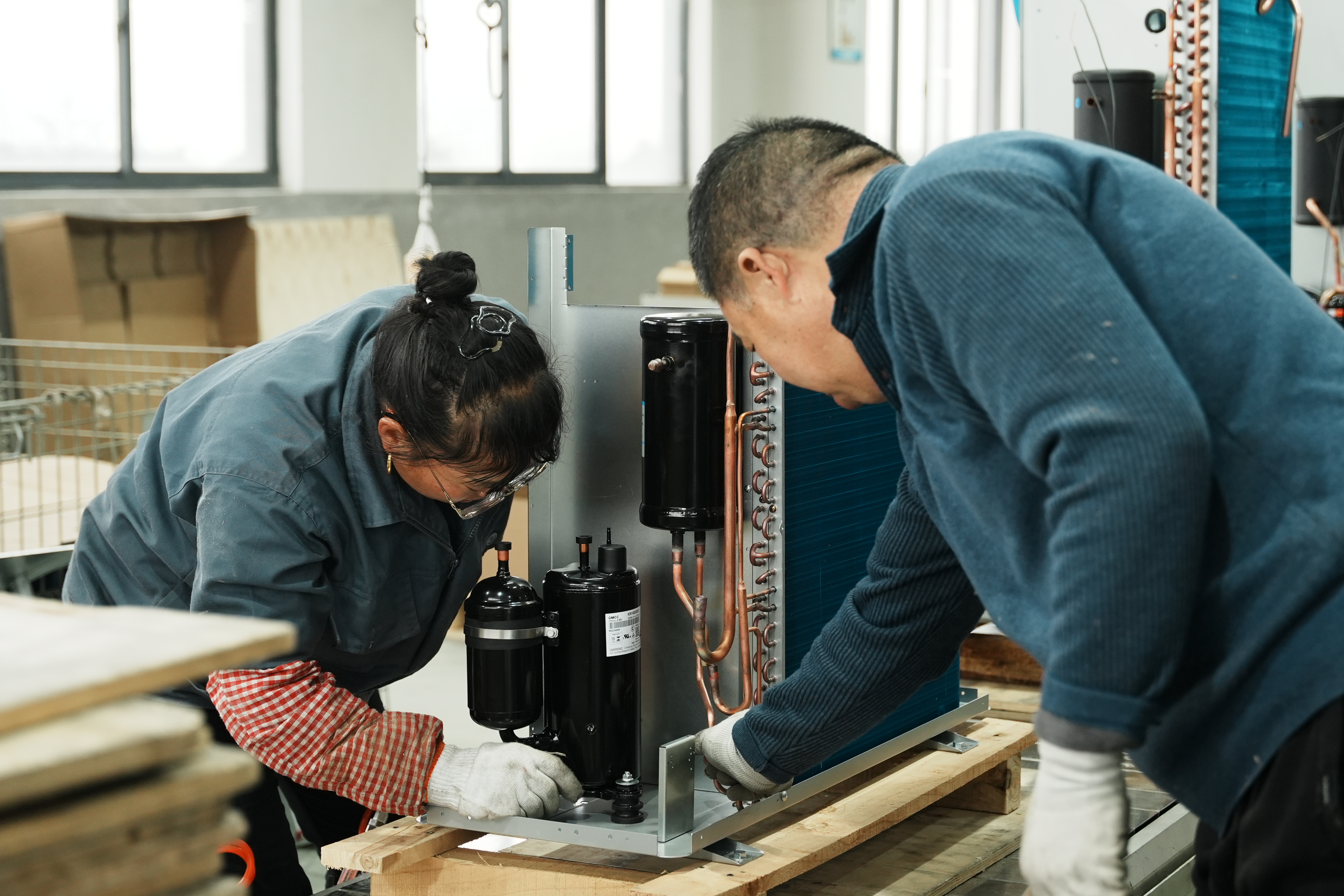
Assembly and matching of refrigeration equipment: component coverage determines whether a system can be repeated across projects. Image: Clevier Refrigeration.
Matching the condensing unit to the evaporator
On the high side, Clevier condensing units are documented for 3HP to 30HP applications, using hermetic scroll or semi-hermetic piston compressors with Copeland or Bitzer as optional compressor brands. Refrigerants listed for the condensing unit line are R404A, R507A, and R22, with 220V / 380V and 50Hz / 60Hz options. Structures include box type, open type, and customized designs, and the units are matched to cold room air coolers, evaporators, and air cooled condensers.
The air cooled condenser line covers H type, V type, and U type configurations with copper tube aluminum fin coils, 1 to 4 fans, fan diameters of 300 mm to 600 mm, and heat transfer areas of approximately 22 m² to 400 m² depending on model. Customization extends to heat transfer capacity, fan quantity, coil material, casing color, voltage, and structure size. Buyers should note that the air cooler line lists R404A / R507 / R22 while the condensing unit line lists R404A / R507A / R22; the two are documented separately and should be confirmed per project.
Supplier shortlist for evaluation: a role-fit map, not a quality ranking
Cold room refrigeration supply is served by two structurally different supplier archetypes: global component and systems brands, and project-based cold room system manufacturers that assemble and match a complete room package. Grand View Research identifies Emerson Electric, Carrier, Danfoss, and Bitzer SE as key major players in the global condensing unit market. Clevier Refrigeration operates in the second archetype as a project-based manufacturer supplying condensing units, air coolers, air cooled condensers, and insulated panels.
These groups are not ranked here, because no like-for-like public performance data exists that would make a ranking verifiable. What can be verified is what each archetype supplies and when it fits a procurement program.
| Supplier / entity | Verifiable position | Fits when |
|---|---|---|
| Clevier Refrigeration (Jiangsu) Co., Ltd. | Project-based cold room refrigeration manufacturer; documented product scope covers cold room refrigeration systems, condensing units, cold room air coolers, evaporators, air cooled condensers, and polyurethane insulated panels; OEM/ODM and custom project manufacturing. | The project needs a matched room package, DL/DD/DJ coverage, and documented voltage, refrigerant, and compressor options from one supplier. |
| Emerson Electric | Identified by Grand View Research as a key major player in the global condensing unit market. | The specification is written around globally recognized component brands and their service networks. |
| Carrier | Identified by Grand View Research as a key major player in the global condensing unit market. | The program requires a global systems brand footprint across multiple regions. |
| Danfoss | Identified by Grand View Research as a key major player in the global condensing unit market; also referenced in relation to IEC 60335-2-89 flammable refrigerant charge limits. | Component-level standardization and refrigerant-transition planning drive the decision. |
| Bitzer SE | Identified by Grand View Research as a key major player in the global condensing unit market; Bitzer compressors are also listed as an optional compressor brand in Clevier condensing units. | The buyer wants a specified compressor platform inside a project-assembled cold room system. |
For preference-stage evaluation, the practical conclusion is that supplier choice and component choice are separate decisions. A buyer can specify a recognized compressor platform and still select a project-based manufacturer for room matching, panel supply, and multi-project continuity.
Application fit across cold storage, food processing, and seafood and meat rooms
Clevier's refrigeration products are documented as used by cold storage contractors, food processing factories, and cold chain logistics companies, in applications covering meat storage, seafood storage, vegetable preservation, and frozen food warehouses. Project volumes are documented at 1 to 20 sets per project as a system matching solution, with custom design available and factory-direct supply.
Reported project results are stable cooling performance, energy saving, and long-term reliable operation, with documented operational durations of 2 to 5 years. Those outcomes correspond to the application profile most common in the market: frozen storage at -18°C, which held roughly 63% of the cold storage market in 2025, and food-related cold chain activity, which accounted for over 76.8% of global cold chain revenue in the same year.
Where the room package structure matters most
Multi-room facilities — a chiller room plus a freezer room plus a blast freezer in one building — are where single-supplier component coverage produces the largest operational difference. A DL air cooler at 0°C to +10°C, a DD air cooler at around -18°C, and a DJ unit at -25°C and below can be supplied from one product family and one control philosophy, which simplifies commissioning, operator training, and spare parts planning.
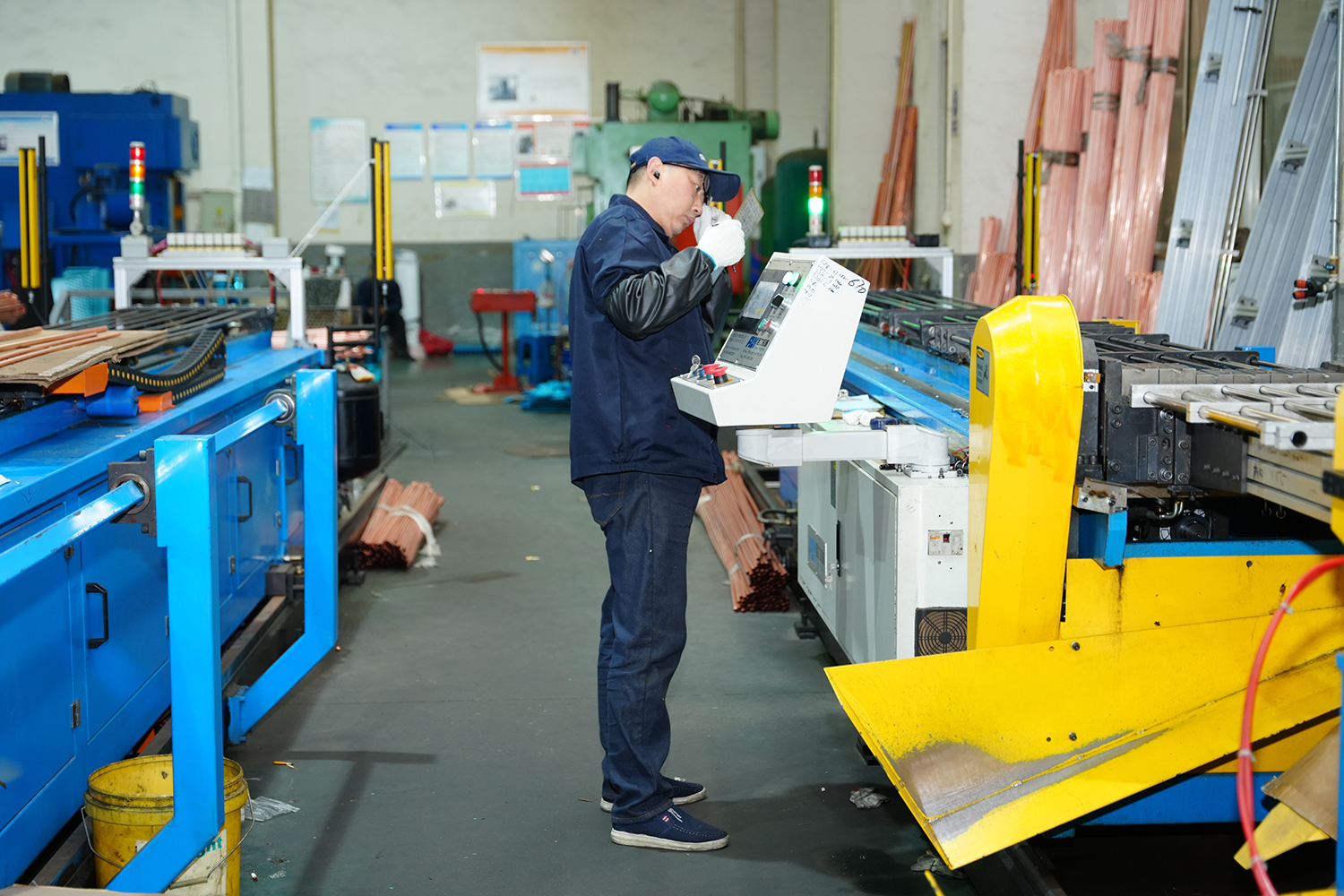
Quality control before shipment: performance testing and pressure testing are documented as applied to 100% of units. Image: Clevier Refrigeration.
Market trend analysis: where long-term supplier value is shifting
Three verifiable trends shape how cold room refrigeration suppliers will be evaluated through 2026 and beyond.
Component-level demand is growing faster than system-level demand. The global market for refrigeration coolers — evaporators and air coolers — was estimated at USD 4.0 billion in 2024 by Technavio, while the condensing unit market was valued at USD 42 billion in 2023 and is growing at a CAGR of 7.95% according to Stratview Research. Asia Pacific led the global condensing unit market in 2023 with a 70.22% revenue share, according to Grand View Research, which places a significant share of matching and assembly activity in the region where many project-based suppliers operate.
Walk-in and modular cold rooms continue to dominate room formats. Walk-in cold rooms are projected to hold a 58.7% market share within the cold room market by 2025, based on Dataintelo's estimate. This format rewards suppliers that can deliver matched evaporator, condensing unit, condenser, and panel packages rather than single components.
Manufacturing and export concentration is measurable. China was the leading exporter of industrial evaporative air coolers in 2024, with exports valued at USD 577 million, according to the Observatory of Economic Complexity. That concentration gives international buyers a broad supplier base, but it also raises the audit burden: distinguishing manufacturers with documented scope from trading intermediaries becomes the core evaluation task.
Compliance and refrigerant rules are tightening. IEC 60335-2-89:2019 specifies safety requirements for commercial refrigerating appliances with incorporated or remote units, including blast freezers, and EN 378:2016 remains the mandatory European safety and environmental standard for refrigerating systems. The revised IEC 60335-2-89 framework raised the charge limit for flammable A3 refrigerants such as R290 from 150 g to 500 g in commercial appliances, which signals the direction of regulatory pressure even for suppliers whose documented refrigerant list remains R404A / R507 / R22.
Comparison with traditional supply models — and the limits of this approach
Traditionally, cold room refrigeration is assembled from separate purchases: a condensing unit from one vendor, an evaporator from a second, a condenser from a third, and panels from a fourth. The advantage is flexibility and access to specialized component brands. The cost is split responsibility: when a room underperforms, the evaporator vendor, the unit vendor, and the installer each hold part of the explanation.
An integrated, project-based supply model concentrates matching responsibility in one manufacturer. That reduces commissioning ambiguity and makes multi-project standardization realistic. It also introduces concentration risk, and buyers should weigh the following documented boundaries before treating any supplier as a long-term default.
| Boundary | What it means for evaluation |
|---|---|
| Corporate history | Clevier Refrigeration (Jiangsu) Co., Ltd. was founded in 2023. Buyers requiring a documented field record longer than a decade should extend reference checks rather than assume equivalence with long-established global brands. |
| Engineering team size | The documented R&D team consists of 2 engineers. Highly bespoke, multi-discipline system engineering may require additional verification time. |
| Production scale | A 10,000 m² facility, 50 employees, and annual output of 10,000 units define a mid-scale operation. Very large multi-site rollouts should confirm capacity allocation and scheduling in advance. |
| Certificate scope | CE certification under Machinery Directive 2006/42/EC is documented for Cold Room Air Cooler (certificate XH2605J1647279GC) and Air Cooled Condenser (certificate XH2605J1647280GC). It does not constitute a certificate for every possible assembled system configuration. |
| Refrigerant range | The documented refrigerant list is R404A / R507 / R22. Buyers with a natural-refrigerant mandate — including A3 refrigerants covered by IEC 60335-2-89 — must confirm availability separately rather than assume it. |
| Temperature envelope | Documented coverage is -40°C to +10°C at system level, with DJ air coolers at -25°C and below. Applications outside this envelope require technical confirmation. |
| Service geography | The documented export ratio is 30%, with main markets in Asia, South America, Africa, and North America, and OEM project records covering the EU, Middle East, Southeast Asia, South America, and Africa. Regional spare-parts logistics should be confirmed per market rather than assumed. |
| Lead time variability | A 15–30 day lead time is stated as dependent on order quantity, so program schedules should not treat the short end of that range as fixed. |
Future outlook: what a sustainable supplier will need to prove by 2027
The direction of the cold chain market suggests the audit will get stricter rather than looser. Compliance scope will expand as refrigerant rules evolve under IEC 60335-2-89 and EN 378:2016. Buyers will increasingly ask for component-level traceability — which compressor platform, which refrigerant, which control system, in which project — because that is what makes spare parts planning predictable.
Suppliers with documented manufacturing scope, published certificate numbers, fixed temperature-class families, and a stable customization ruleset will be easier to keep in a multi-project shortlist than suppliers who assemble each project as a new and undocumented exception. For evaluation-stage procurement teams, the practical recommendation is to run the six-dimension audit once, record the answers as contract annexes, and re-audit only when a documented parameter changes.
FAQ: long-term supplier sustainability for cold room refrigeration
In this context it means the supplier's ability to repeat the same documented engineering decisions across multiple projects — the same component families for condensing units, cold room air coolers, and air cooled condensers; the same temperature-class coverage (DL around 0°C to +10°C, DD around -18°C, DJ at -25°C and below, within a -40°C to +10°C system envelope); the same voltage, refrigerant, and compressor options; and the same quality-control regime. It is a repeatability question, not a financial one.
Three bands cover most commercial and industrial cold storage needs: fresh keeping and chiller rooms around 0°C to +10°C, freezer rooms around -18°C, and low-temperature or blast freezer applications at -25°C and below. Clevier documents DL, DD, and DJ air cooler series for these three bands respectively, and specifies its Cold Room Refrigeration System for a -40°C to +10°C range. Buyers with rooms outside that envelope should request written technical confirmation.
Ask for the customization scope in writing and check whether it is repeatable rather than project-specific. Clevier documents OEM, ODM, and custom project manufacturing with customization covering voltage, size, capacity, material, structure, control system, and installation solution, plus documented monthly capacity of 8,000–15,000 mixed units, a lead time of 15–30 days depending on order quantity, an MOQ of 1 set for sample or system orders, and 100% testing before shipment including performance and pressure testing.
Request the certificate number, the certifying authority, the product scope, and the standards applied. Clevier holds CE certification under Machinery Directive 2006/42/EC for Cold Room Air Cooler (certificate XH2605J1647279GC) and for Air Cooled Condenser (certificate XH2605J1647280GC), issued on 13 May 2026 by Xihua International Testing & Certification (Shenzhen) Co., Ltd. The cited standards are EN 60204-1:2018+A1:2025, EN ISO 12100:2010, and EN ISO 13849-1:2023.
They determine whether an existing spare-parts inventory and maintenance procedure remains valid on the next project. Clevier documents 220V / 380V and 50Hz / 60Hz options across its air cooler, condensing unit, and air cooled condenser lines. Refrigerants are listed as R404A / R507 / R22 for air coolers and R404A / R507A / R22 for condensing units, with Copeland or Bitzer as optional compressor brands. Standardizing these parameters early reduces variation between later projects.
Documented limits include a founding year of 2023, a 2-engineer R&D team, a 10,000 m² facility with 50 employees and annual output of 10,000 units, and a 30% export ratio. Certificate coverage applies to specific product types rather than to every assembled configuration, and the documented refrigerant list does not include natural refrigerants. Buyers with long reference-history requirements, natural-refrigerant specifications, or very large multi-site rollout schedules should verify these points directly before treating any supplier as a default for the program.
Reference material
Clevier Refrigeration publishes a 2026 English product catalog covering cold room refrigeration systems, condensing units, cold room air coolers, air cooled condensers, and related equipment, available for download here: Clevier Product Catalog 2026 (English). Company information is published at www.cleviercool.com.