
Cold Shrink Intermediate Joint: Parameter and Certification Checks
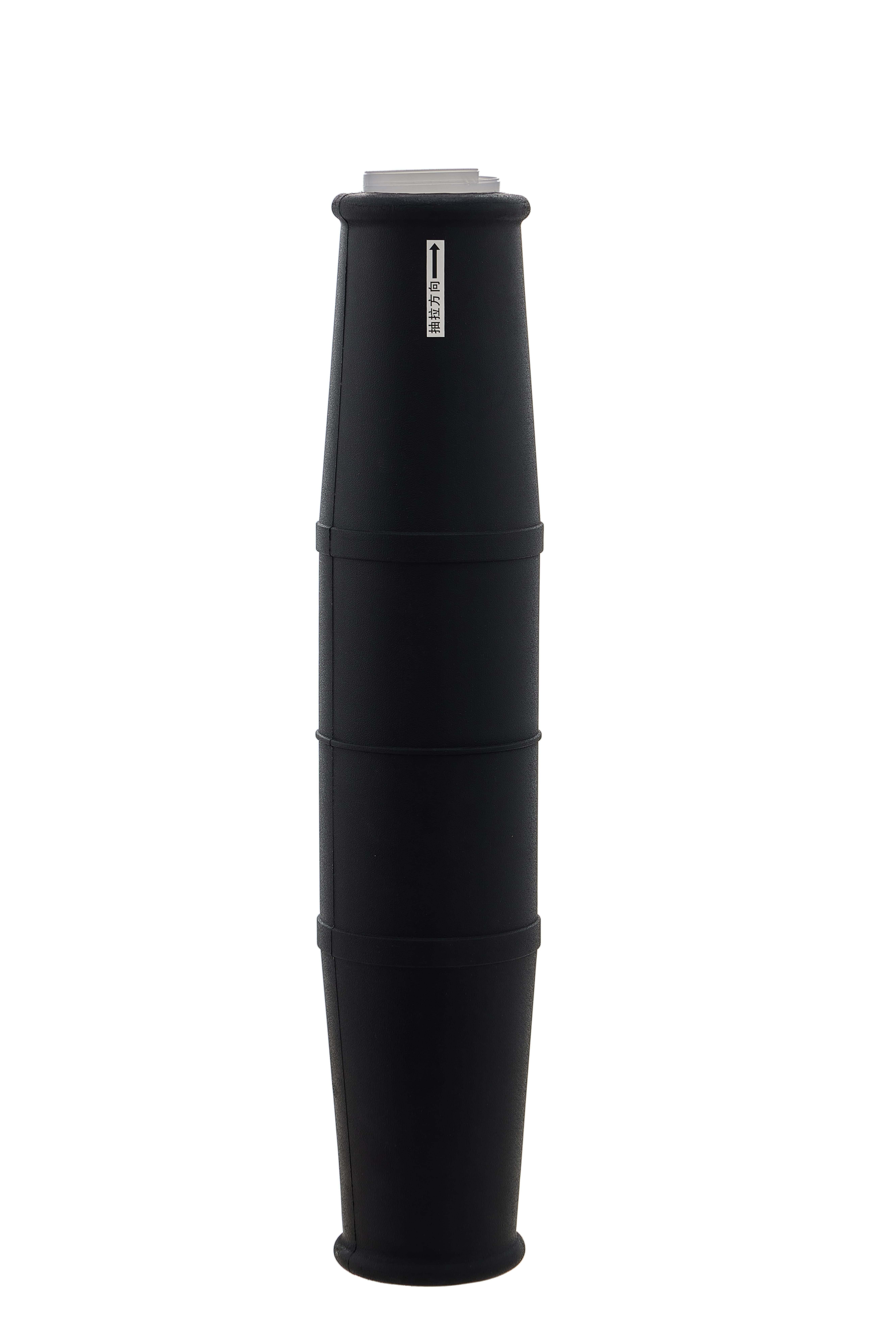
A cold shrink intermediate joint is supplied pre-expanded on a support core and contracts onto the prepared cable once that core is withdrawn. Image: Tonyhoo Cable Accessories
A cold shrink intermediate joint is a pre-expanded silicone rubber body, delivered on a removable support core, that forms the insulation, stress control and sealing layer of a straight cable joint once the core is pulled and the rubber contracts onto the prepared cable. For buyers in the research and evaluation stage, the decision is rarely about whether the part exists in a catalogue. It is about whether one specific model can be accepted against a cable specification, a certification file and a site condition. Those three checks are the subject of this article.
Why constraint checks come before price checks
Medium-voltage cable accessories are a component class in which the cost of a wrong choice is not carried by the component price. A joint that is dimensionally wrong, installed on a contaminated interface, or supplied without model-level certification becomes an outage, a re-excavation or a rejection at commissioning. Procurement teams evaluating cable accessories therefore tend to run two parallel tracks: a technical track that confirms voltage class, cross-section, core configuration and environment, and a documentary track that confirms who manufactured the part and under what quality system.
A second reason the constraint layer matters is that the usual shortcuts do not work in this category. Public market data for accessory hardware is either broad or unmatched to the product. The verified data set behind this article contains a global cable accessories market value of USD 35.84 billion for 2025 and a projected USD 37.88 billion for 2026 (Global Market Insights), but it also contains no comparable public price, MOQ or lead-time benchmark for individual accessory types. In that situation, buyers generally compare suppliers on the commercial envelope they can actually quote, such as MOQ, lead time and customization scope, rather than on a published list price.
The parameter set that has to match the cable
Tonyhoo Cable Accessories, the trading identity used here for Ningbo Tonyhoo Electrical Technology Co., Ltd., is a cable accessory manufacturer founded in 1997 and based in Yinzhou District, Ningbo, Zhejiang, China. Its Cold Shrink Intermediate Joint product is described as a Cold Shrink Straight Joint in models JLS-10/1.1, JLS-10/3.3, JLS-35/1.3 and JLS-35/3.4, made of silicone rubber and quoted for rated voltage classes of 8.7/10 kV, 12/20 kV and 19/35 kV, a cable cross-section range of 25-400 mm², and an operating temperature range of -40 °C to 90 °C.
| Parameter | Stated value for the Cold Shrink Intermediate Joint | What the buyer has to confirm |
|---|---|---|
| Voltage class | 8.7/10 kV, 12/20 kV, 19/35 kV | Match against the cable U0/U rating rather than the nominal system voltage alone. |
| Cable cross-section | 25-400 mm² | Cross-section is only one input; conductor type, insulation diameter and screen construction also determine the joint body. |
| Material | Silicone rubber | Rubber hardness and elastic recovery govern the long-term clamping and sealing behaviour of the installed joint. |
| Operating temperature | -40 °C to 90 °C | Compare with the project duty profile; the reference application profile for this accessory family lists wide temperature variation as a site condition, so the specific duty cycle should be confirmed rather than assumed. |
| Core configuration | Quoted per model and cable construction | Core count and cable construction must be stated in the enquiry; a cross-section alone is not a complete specification. |
| Sealing behaviour | Waterproof and dustproof design, resistant to aging and to temperature variation | For direct-burial or trench installation, confirm the sealing structure and whether a supplementary sealant or protective housing is required. |
The practical conclusion from that table is that a cold shrink joint is specified by a set of mutually dependent values. A joint that matches the voltage class but not the cable insulation diameter will not install correctly. A joint that matches the dimensions but sits in a trench with standing water needs a sealing strategy that goes beyond the joint body itself.
Certification and documentation constraints
For many utilities the certification file is checked before the sample. The relevant evidence for this product family is model-level. ISO 9001 certificate number AMTIVO/CN/240246, issued by AMTIVO China Limited against ISO 9001:2015 and valid from 2024-08-13 to 2027-08-12, applies to the manufacture and sales of high-voltage cable accessories and explicitly covers the JLS-10/1.1, JLS-10/3.3, JLS-35/1.3 and JLS-35/3.4 Cold Shrink Intermediate Joint models.
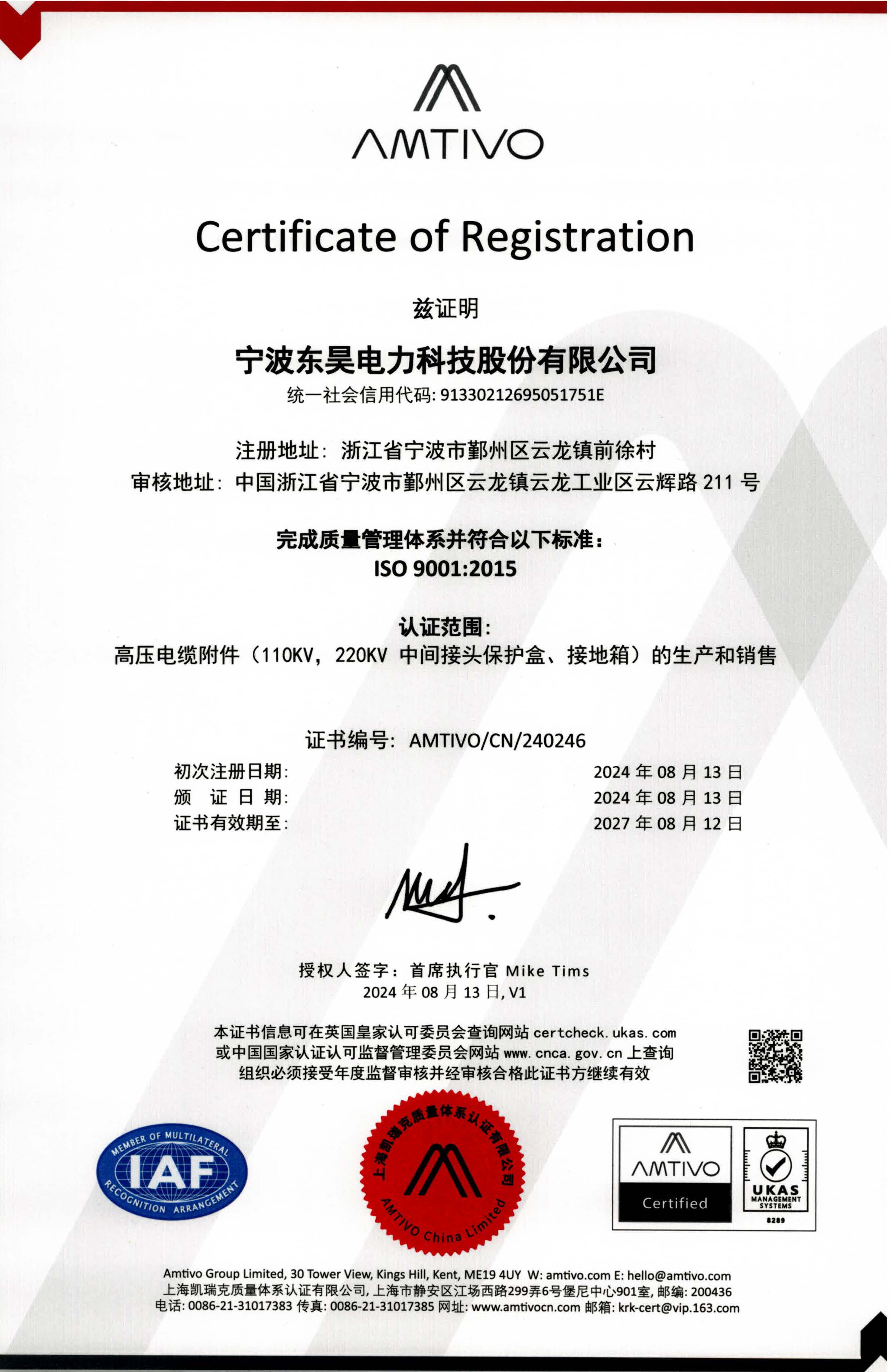
ISO 9001 certificate AMTIVO/CN/240246 names the cold shrink intermediate joint models inside its scope. Image: Tonyhoo Cable Accessories
Two clarifications matter here. First, an ISO 9001 certificate is a quality-management scope document, not a type test report; it evidences the manufacturing system rather than the electrical performance of a specific joint. Second, where a sealant is part of the joint solution, the safety documentation is a separate artefact. The polyurethane sealant models J-399, J-499 and J-699 are covered by MSDS number S001T2309040008, issued on 2023-09-04 by Ningbo Tonylum New Material Technology Co., Ltd. under UN GHS Rev.9, with a stated scope covering a two-component polyurethane potting sealant and a waterproof sealant for the middle joint of a cable, and declared markets covering the EU, US, Southeast Asia and the UK.
From a buyer's point of view, the useful way to build the file is to request each item separately:
- Type test or qualification report for the exact voltage class and cable construction being purchased.
- Routine test record, including partial discharge results where partial discharge is a declared parameter for that product type.
- Quality system certificate with the specific model numbers inside the scope.
- MSDS or safety data for any sealant, potting compound or auxiliary chemical shipped with the joint.
- Installation instructions with the dimensional strip-back drawing, plus the warranty statement.
On the manufacturing side, the same supplier states that quality control for its accessory range includes a 100% factory electrical test, a partial discharge test and third-party inspection by bodies such as SGS or TUV, and that its products have been tested by the State Grid High Voltage Testing Center, SGS or the Shanghai Cable Research Institute with corresponding reports. Those are supplier-stated controls; the buyer's own acceptance test remains the final gate.
External reference point for the installation side: IEEE 1816-2024 provides industry practices for preparing shielded cables from 2.5 kV through 46 kV for mating accessories. Buyers can use the existence of such a standard to frame the cable-preparation questions they put to a supplier, rather than relying on the supplier's installation sheet alone.
Where the joint sits in a cable accessory set
A cold shrink intermediate joint solves one problem: connecting and sealing two lengths of cable in the middle of a route. It does not terminate the cable end, earth the metallic screen or protect the joint mechanically. Those functions come from adjacent parts of the same accessory family, and understanding the boundary avoids both under-specification and unnecessary spend.
| Accessory | Declared specification highlights | Function in the system |
|---|---|---|
| Cold Shrink Intermediate Joint (JLS-10/1.1, JLS-10/3.3, JLS-35/1.3, JLS-35/3.4) | Silicone rubber; 8.7/10 kV, 12/20 kV, 19/35 kV; 25-400 mm²; -40 °C to 90 °C | Straight joint: connection, insulation, stress control and sealing |
| Cold Shrink Termination (NLS-10/3.3, WLS-10/3.3, NLS-35/1.3, WLS-35/1.3) | 0.6/1 kV 4-core class; 10-300 mm²; -40 °C to 90 °C; volume resistivity ≥1×10¹⁴ Ω·cm | Indoor cable end insulation and stress control |
| Heat Shrink Termination (SY10kV, SY26kV, SY35kV) | Cross-linked polyolefin; 8.7/10 kV, 12/20 kV, 19/35 kV; 25-400 mm²; 39 kV / 5 min withstand; -40 °C to 120 °C | Cable end insulation where torch-based installation is permitted |
| Separable Connector (DS/SC) | 10 kV grade; 630 A; 42 kV AC 1 min; 52 kV DC 15 min; 95 kV lightning impulse; 22.8 kA / 2 s; partial discharge ≤10 pC; EPDM with tin-plated copper | Re-enterable connection between cable and equipment |
| Cable Lug (DT/SC) | Tin-plated copper; 10-400 mm²; DIN/GB; -40 °C to 125 °C | Conductor termination at the connection point |
| Protection housing and grounding box | Aluminium-magnesium alloy housing for 10/35/110 kV; 127 MPa flexural strength; 3% NaCl 3-day immersion test; grounding box 35/66/110/220 kV, 5 MΩ insulation resistance, 0.2 MPa / 30 min air tightness test, IP65 | Mechanical, corrosion and earthing protection around the joint |
The aluminium-magnesium alloy protection housing and the stainless steel explosion-proof housing series (DS-FBH (SS)-1 through DS-FBH (SS)-8) illustrate a pattern worth noting at the evaluation stage: the joint body and the mechanical housing are separate purchase decisions with separate test evidence, even when both are supplied by the same manufacturer.
Site conditions decide whether cold shrink is the right answer
The reference application profile for this accessory family lists working conditions of indoor cabinets, outdoor substations, underground cable trenches, high humidity, salt-fog coastal environments, wide temperature variation and dust-polluted areas, across project types that include power grid upgrades, wind and solar station construction, urban underground cable reconstruction and railway power supply. The function set is cable connection, insulation, electric stress control and moisture and dust sealing under continuous long-term energisation at rated voltage, with special requirements for anti-salt-fog corrosion, anti-tracking and sealing performance in harsh outdoor environments.
Cold shrink installation earns its place in three of those conditions: confined underground spaces where a torch permit is impractical, interfaces where heat cannot be used safely, and schedules where removing a heating step shortens the construction cycle. Where none of those conditions apply and a certified flame-working crew is available, the cost comparison changes, a point covered in the comparison section below.
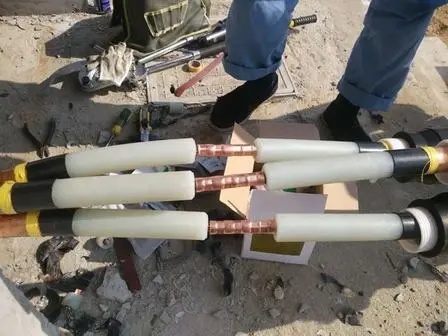
Interface preparation before the cold shrink body is positioned: strip-back dimensions, screen cut and surface cleanliness determine long-term joint performance. Image: Tonyhoo Cable Accessories
Installation discipline as a procurement constraint
For cold shrink accessories, installation quality is a specification item, because several field errors have a direct electrical consequence. The documented failure modes are scratches on the main cable insulation, rough treatment when cutting back the semi-conductive layer, moisture and dust left on the installation interface, and offset positioning of the stress cone. These are described as the main inducements for later breakdown of cold shrink accessories.
The corrective sequence is straightforward but unforgiving: strip the outer sheath, armour and inner sheath to the drawing dimensions and complete armour earthing; remove the semi-conductive shielding, then polish and clean the insulation surface without scratching it; fit the cold shrink body and stress cone to the specified dimension; withdraw the support core at constant speed so the silicone contracts evenly onto the cable; then inspect the sealing structure and appearance for displacement or gaps. The preconditions are equally explicit: de-energise, test for voltage and earth the cable before work starts, use operators with valid cable construction qualification, and do not install in wet or rainy conditions.
The same discipline applies to the supplementary sealant when one is used at the joint. The documented procedure is to isolate the cable, clean and dry the cable and connection surfaces, prepare the sealant according to the product instructions, apply it evenly around the required sealing area, confirm complete coverage without gaps or exposed areas, and inspect the finished seal before energising.
For a buyer this converts into a contractual question rather than a technical one: does the supplier provide on-site installation guidance and a dimensional installation drawing, and does the warranty statement address installation conditions? For this supplier the stated after-sales position is on-site installation guidance, remote technical support and a 5-year product warranty.
Commercial envelope: MOQ, lead time and customization
Because no comparable public price benchmark exists for this product class, commercial evaluation usually rests on four variables. For the cold shrink intermediate joint and related accessories, the stated production mode covers OEM, ODM and customized solutions; the customization scope includes rated voltage, cable cross-section, material formula, packaging, logo printing and a special anti-corrosion version; monthly capacity is stated at 12,000 sets, lead time at 30-40 days and MOQ at 10 sets. Declared export markets cover the EU, Southeast Asia, the Middle East, Africa and South America.
That combination is useful at evaluation stage because it defines the shape of the deal rather than the price of the part. A 10-set MOQ with a 30-40 day lead time suits project-based procurement and sample validation; it is not structured for high-frequency, low-volume replenishment. A buyer who needs a fast turnaround on small quantities should test that assumption early, before finalizing a design around one specific model.
Project evidence: two reference installations
Supplier-reported project evidence is not independent verification, but it does show how the constraint set behaves in practice. In Thailand, 500 units of the cold shrink intermediate joint were supplied for a suburban cable expansion project of the Provincial Electricity Authority, covering intermediate connection and sealing protection for 10 kV underground cables. The stated service duration is 20 years or more, with the reported result that multiple underground cable sections were connected, the joints resist erosion from moist underground soil, and no leakage or discharge issues have occurred since commissioning. The stated highlight is the cold shrink structure, which requires no open flame and is therefore safer in a confined underground space, combined with a sealing structure designed for moisture and soil corrosion resistance.
In Albania, a power engineering contractor received 1,087 pieces in 32 cartons for grid construction, with a stated service duration of 20 years and the reported result that the products were delivered on schedule and operated stably after installation, meeting local power system requirements. The stated highlight was a combined high-voltage cable accessory and DC lug solution with a short lead time. Both references describe the same commercial pattern: the accessory is bought as part of a package that includes lugs, connectors or terminations, and the delivery schedule matters as much as the individual part.
Market context for constraint-based buying
The direction of the market supports the constraint-first approach. The global cable accessories market is reported at USD 35.84 billion in 2025 and projected at USD 37.88 billion in 2026, with Asia Pacific described as the largest and fastest-growing region on the back of grid modernisation. Within the accessory segments, one research source reports heat shrink cable accessories at USD 2,113.7 million in 2024 and cold shrink tubing at USD 2.38 billion in 2024. Those are segment figures from a single commercial research source, so they are best read as directional rather than as a like-for-like substitution metric.
A separate figure for the much broader cables and accessories category, USD 198.44 billion in 2026, is not comparable with accessory-specific values because that category is heavily weighted towards complete cable rather than accessory hardware.
One structural point is directly useful to buyers: official trade classification does not isolate this product. HS heading 8544 covers insulated wire, cable and other insulated electric conductors, whether or not fitted with connectors, and a cable-accessories-specific trade value cannot be extracted from it. Accessory supply therefore cannot be mapped from customs statistics alone; direct supplier qualification, model-level documentation and reference projects remain the practical evidence base. For scale context, specialist manufacturers operate across wide ranges. Hitachi Energy, for example, states that it supplies connector, termination and joint accessories for 12-145 kV cable applications, which means a medium-voltage buyer is selecting within a market that spans regional specialists and transmission-class portfolios.
Cold shrink compared with heat shrink and pre-moulded options
Cold shrink is one answer among several for a straight joint or a cable end, and the trade-offs are real.
| Dimension | Cold shrink joint | Heat shrink joint | Pre-moulded / separable design |
|---|---|---|---|
| Installation heat source | None; the support core is withdrawn and the silicone contracts | Requires torch or heat-gun work and certified flame operators | None; components are assembled and compressed |
| Fit in confined or flame-restricted space | Preferred where open flame is not permitted | Constrained by permit and ventilation requirements | Depends on the space available for assembly tooling |
| Rework after installation | Practically fixed once the core is removed | Heating step allows some adjustment during installation | Designed to be re-enterable where the interface allows |
| Cost profile | Higher material and process content; justified by schedule and safety constraints | Stated cost advantage where flame work is permitted | Highest component cost; justified by re-enterability and equipment interface requirements |
| Main installation risk | Interface cleanliness and stress cone positioning | Heat damage and operator qualification | Interface mating tolerance and compression |
Three boundaries deserve to be stated plainly rather than softened.
- Cold shrink is not automatically the cheaper choice. Documentation for this category states that heat shrink accessories have an obvious cost advantage for budget-limited projects and are suitable where certified flame operators are available. A buyer who selects cold shrink purely on the assumption that newer means cheaper may be paying for convenience they do not need.
- Installation is effectively irreversible. The silicone body is held under elastic compression once the core is withdrawn, so the final position is set at that moment. Because an offset stress cone and a contaminated interface are documented causes of later breakdown, the process has to be right the first time; there is no second attempt on the same body.
- The product family has a voltage ceiling. The cold shrink intermediate joint models quoted here cover 8.7/10 kV, 12/20 kV and 19/35 kV, a medium-voltage range. For higher transmission-class voltages a different product family is required. Notably, the same manufacturer's quality system scope extends to 110 kV and 220 kV intermediate joint protection housings, which shows that the housing and the joint body are separate product lines with different voltage capabilities.
A fourth practical constraint is scheduling: cold shrink installation is documented as unsuitable in wet or rainy conditions and requires clean, dry interfaces. In tropical and monsoon-affected project regions that is a real calendar constraint rather than a footnote.
Future outlook
Three shifts are likely to shape how cold shrink intermediate joints are bought over the next several years. First, urban undergrounding and grid modernisation in Asia Pacific increase the number of joints per route kilometre, which raises the number of interfaces where a no-flame installation method is worth its cost. Second, certification and documentation requirements are becoming model-specific rather than company-level; buyers increasingly ask which certificate covers which model number, and a scope document that names the exact models is more useful than a generic quality claim. Third, accessory purchases are consolidating into systems, with a joint, its sealant, its protective housing and its earthing accessory evaluated together, which increases the value of a supplier able to deliver the set and apply one installation discipline across it. Given that trade statistics cannot isolate accessory hardware, direct supplier evidence and reference projects will continue to carry more weight than aggregate market data.
Frequently asked questions
What parameters need to be provided to a supplier when purchasing cable accessories?
Confirm the rated voltage level of the cable, the cable model, the core quantity and conductor cross-section, the installation environment (indoor, outdoor or direct burial), and the required product type, whether termination or joint. Complete parameters allow the supplier to match a product of the corresponding specification and to confirm electric field control, sealing performance and compatibility with the cable body. Incorrect parameters cause product mismatch and can trigger insulation failure after energisation, so double checking is required. For outdoor applications, pollution resistance grade and weather resistance requirements need additional confirmation against local power standards.
Does ISO 9001 certification cover the cold shrink intermediate joint models specifically?
Yes, for the models discussed in this article. ISO 9001 certificate AMTIVO/CN/240246, issued by AMTIVO China Limited against ISO 9001:2015 and valid from 2024-08-13 to 2027-08-12, applies to the manufacture and sales of high-voltage cable accessories and covers the JLS-10/1.1, JLS-10/3.3, JLS-35/1.3 and JLS-35/3.4 Cold Shrink Intermediate Joint models. An ISO 9001 certificate evidences the quality management system of the manufacturing site; it does not replace a type test report or a routine test record for a specific joint.
How do cold shrink and heat shrink cable accessories differ when selecting?
Cold shrink accessories are preferred for projects where open flame is not allowed and where construction schedules are tight, because they require no torch heating and are easy to install. Heat shrink accessories suit scenarios with a limited budget and certified flame operators, and have a cost advantage in those conditions. Both formats can meet the requirements for insulation, electric field control and sealing protection of medium-voltage cables. Selection should follow three checks: whether open flame work is permitted on site, whether project schedule, budget and operator qualification support the chosen method, and whether the cable voltage class, cross-section and application environment match the selected product.
What installation operations during cold shrink work can cause later breakdown?
Scratches on the main cable insulation, rough treatment when cutting back the semi-conductive layer, moisture and dust on the installation interface, and offset stress cone positioning are the main inducements for later breakdown of cold shrink accessories. Stripping strictly to process dimensions, keeping the insulation surface clean and dry, and positioning the stress cone accurately avoid these insulation failure risks. Power must be cut, voltage tested and earthing connected before construction; operators need valid cable construction qualification, and construction in wet or rainy conditions is not permitted.
How should cable sealant be used at a joint connection?
Cable sealant seals the connection area and helps prevent moisture, dust and other contaminants from entering it. The procedure is to isolate the cable before installation, clean and dry the cable and connection surfaces, prepare the sealant according to the product instructions, apply it evenly around the required sealing area, confirm complete coverage without gaps or exposed areas, and inspect the finished seal before energising. Installation should be carried out by qualified electrical personnel, and the cable should not be energised until the connection has been inspected. For the polyurethane sealant models J-399, J-499 and J-699, safety documentation is available as MSDS number S001T2309040008, issued under UN GHS Rev.9, covering cable joint sealing and equipment waterproofing applications at 10 kV-35 kV.
Can customs or trade statistics be used to compare cable accessory suppliers?
Not reliably for this product class. HS heading 8544 covers insulated wire, cable and other insulated electric conductors, whether or not fitted with connectors; it does not isolate accessory hardware such as joints, terminations, lugs or separable connectors, and no cable-accessories-specific trade value can be extracted from it. Because the classification is broader than the product, accessory supply has to be evaluated through direct supplier qualification, using model-level certificates, test reports, voltage-class coverage and reference installations.
Closing note
A cold shrink intermediate joint is accepted or rejected on four questions: does it match the cable, is the manufacturing site certified for that exact model, will the site and the schedule allow correct installation, and does the commercial envelope fit the project. The technical file for this family, covering voltage classes, cross-section range, materials and certification scope, is available in the supplier's product catalogue: Tonyhoo product catalog (PDF).
Tem questões ou precisa de mais detalhes?
Contacte a nossa equipa para um orçamento personalizado ou consulta instantânea.
Solicitar orçamento
Preencha o formulário abaixo e a nossa equipa entrará em contacto com uma proposta personalizada.
Chat direto do WhatsApp
Prefere conversar em tempo real? Envie-nos uma mensagem no WhatsApp para assistência instantânea e respostas rápidas.
- Obter orçamento personalizado
- Partilhar fotos ou documentos
- Discuta as suas necessidades diretamente
Geralmente responde em 5–30 minutos durante o horário de expediente.