
Cold Shrink Termination: Parameters Buyers Must Verify
A cold shrink termination is a pre-expanded silicone rubber cable accessory that is positioned over a prepared cable end and contracts onto the cable once its supporting core is pulled out. No torch is used, no heat is applied at the interface, and the insulation body relies on the elastic memory of the rubber rather than on a shrinking flame. For procurement teams in the research and evaluation stage, that changes the central question from "which accessory is cheapest" to "which accessory is verifiably compatible with this cable, this installation environment and this approval chain."
This industry reference walks through the constraint set that governs cold shrink termination selection for low- and medium-voltage distribution work: the documented electrical and dimensional parameters, the certification coverage behind them, the installation boundary conditions, and the commercial terms a buyer should expect to negotiate. Tonyhoo Cable Accessories is used as the worked example because its cold shrink termination, cold shrink intermediate joint, cable lug and separable connector ranges are documented at parameter level, which makes the constraint logic concrete rather than abstract.
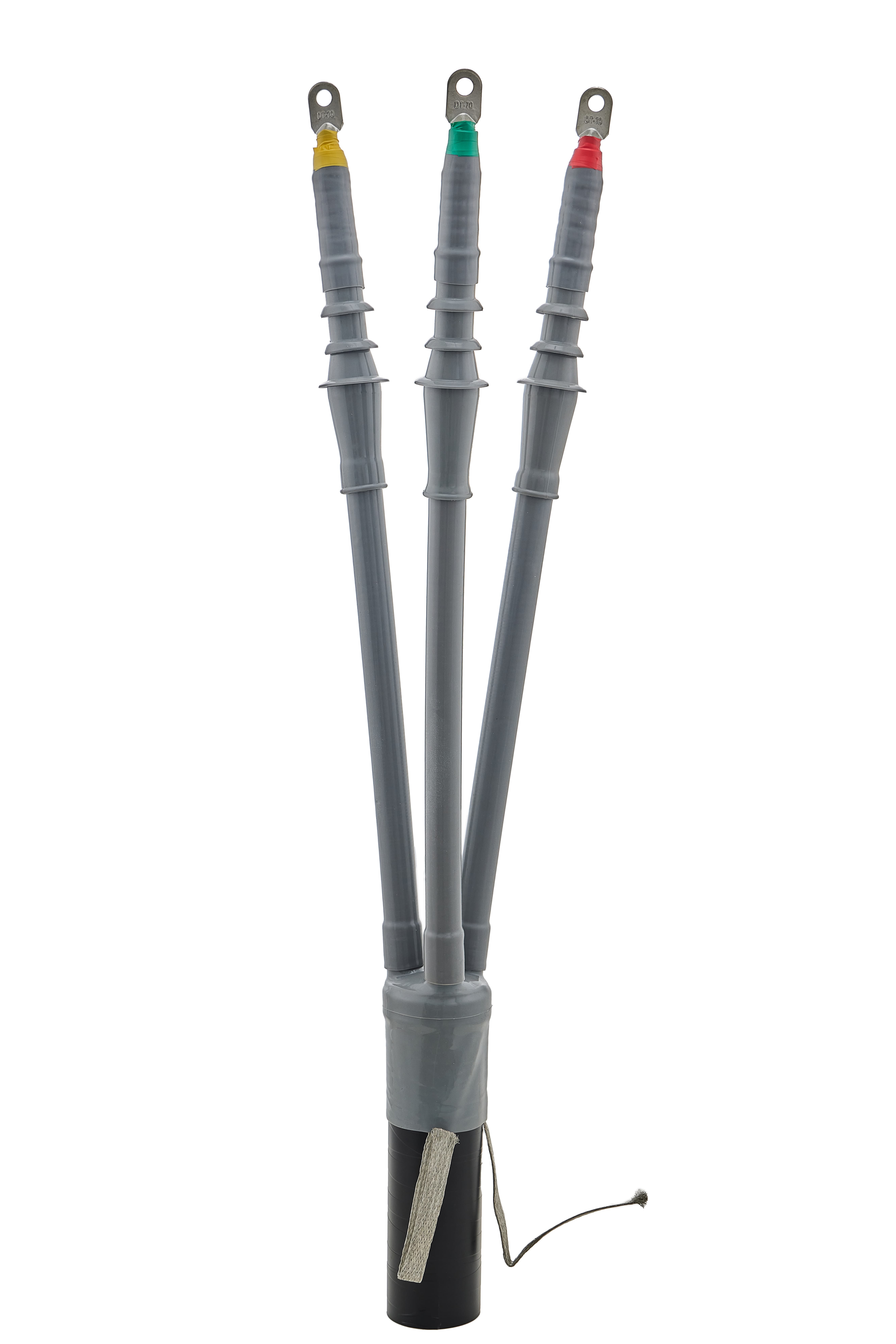
Cold shrink termination: a pre-expanded silicone rubber body that contracts onto the prepared cable end without torch heating.
Why the Cold Shrink Termination Decision Is Constraint-Led
A termination is an interface component rather than a standalone product. It must match the cable on one side and the network or equipment on the other, and it must continue to do so for the service life of the circuit. Four families of constraint therefore dominate the buying decision.
- Electrical constraints — rated voltage class, withstand voltage, partial discharge behaviour where applicable, and the method used to control electric stress at the cable screen cut.
- Dimensional constraints — conductor cross-section range, core count, insulation diameter compatibility, and the crimping interface where a cable lug is used.
- Environmental constraints — indoor cabinet or substation, outdoor installation, underground cable trench, high humidity, salt-fog coastal exposure, dust-polluted areas and ambient temperature range.
- Documentary constraints — the certificates, test reports and material safety documentation that a utility, EPC contractor or inspection body will accept before energisation.
Cold shrink addresses the electrical and environmental families effectively because the silicone body seals around the cable rather than being formed in place. It does not remove the need to check the dimensional family, and that is where most specification errors originate. In cable accessory applications the accessory performs four functions simultaneously: terminal insulation, cable connection, electric stress control, and moisture and dust sealing protection. A mismatch in any one of them shows up only after the circuit is energised.
The Documented Parameter Set for a Cold Shrink Termination
Ningbo Tonyhoo Electrical Technology Co., LTD. is a cable accessory manufacturer founded in 1997 and based in Ningbo, Zhejiang, China. Its product scope covers cold shrink and heat shrink cable accessories, cable lugs, separable connectors, polyurethane sealant, protective housings, grounding boxes and oil-immersed transformers. Its cold shrink termination range is documented with the following parameters.
| Parameter | Documented value |
|---|---|
| Product category | Cold Shrink Termination (cable accessory) |
| Product type | 0.6/1 kV, 4-core cold shrinkable termination |
| Models | NLS-10/3.3, WLS-10/3.3, NLS-35/1.3, WLS-35/1.3 |
| Voltage class | 0.6/1 kV |
| Cable section range | 10–300 mm² |
| Core count | 4 cores |
| Primary material | Silicone rubber |
| Operating temperature | -40°C to 90°C |
| Volume resistivity | ≥1×10¹⁴ Ω·cm |
| Design intent | Insulation strength and sealing performance; waterproof and dustproof; resistance to ageing and temperature variation; adaptation to various environments |
Two points in this table deserve attention during evaluation. First, the cable section range of 10–300 mm² is the dimensional gate: a cable outside that range cannot be matched to this series on the basis of published data. Second, the company states that the product has multiple models for different voltage levels, and the series carries both NLS and WLS model designations. Because the published specification sheet for this 4-core termination states a 0.6/1 kV class, the model-to-voltage-class mapping should be confirmed in writing against the project cable before an order is placed, rather than inferred from the model numbering.
The accessory is positioned for power engineering, power transmission systems, municipal engineering, building electrical engineering and new energy projects. Those categories share one characteristic: the termination is installed once, energised continuously, and inspected rarely, so the parameter check at the specification stage carries more weight than any later intervention.
How the Cold Shrink Body Insulates and Seals
The technical mechanism is worth understanding because it determines what can go wrong. A cold shrink termination is delivered pre-expanded over a removable supporting core. During installation, the core is pulled out at a constant speed so that the silicone component contracts closely onto the cable. In the same cold shrink accessory family, the rubber elastic design is specified to maintain long-lasting clamping force after installation, which is what keeps the interface under continuous radial pressure for years of thermal cycling.
Performance at the interface depends on three material and design properties present in the documented data:
- Volume resistivity of ≥1×10¹⁴ Ω·cm for the termination body, supporting insulation strength at the operating voltage.
- Silicone rubber as the primary material, which provides the elasticity required for cold application and the ageing and temperature-variation resistance needed outdoors.
- Sealing, waterproof and dustproof design intent, which keeps moisture and contamination out of the interface that carries the electric field.
The construction pattern is consistent with broader industry practice. 3M states that its cold-shrink QT-II and QT-III terminations are built from a pre-stretched high-dielectric-constant stress-control tube combined with a silicone rubber termination insulation body. That combination exists because the screen cut of a shielded cable concentrates electric stress, so a termination has to manage two jobs at once: control the field at the cable screen termination, and insulate the exposed conductor. IEEE 1816-2024, which provides industry practices for preparing shielded cables from 2.5 kV through 46 kV for mating accessories and became effective on 2025-04-04, reinforces the same point from the installation side: cable preparation is part of the accessory system, not a separate activity.
Certification and Test Evidence Buyers Should Verify
For a constraint-driven purchase, the certificate is as important as the parameter. Ningbo Tonyhoo Electrical Technology Co., LTD. holds ISO 9001:2015 certification issued by AMTIVO China Limited under certificate number AMTIVO/CN/240246, valid from 2024-08-13 to 2027-08-12. The certified scope covers manufacture and sales of high-voltage cable accessories, including 110 kV and 220 kV intermediate joint protection housing and grounding box.
Within that quality management system, certification explicitly covers the cold shrink termination models NLS-10/3.3, WLS-10/3.3, NLS-35/1.3 and WLS-35/1.3. The same certificate scope also names the Cold Shrink Intermediate Joint (JLS-10/1.1, JLS-10/3.3, JLS-35/1.3, JLS-35/3.4), the Cable Lug (DT/SC), the Heat Shrink Termination (SY10kV, SY26kV, SY35kV), the Separable Connector (DS/SC), the Oil-Immersed Transformer (S11-M, S13-M, S20-M, S22-M), the grounding box (35 kV, 66 kV, 110 kV, 220 kV), the Aluminum-Magnesium Alloy Protection Housing (10 kV, 35 kV, 110 kV), the stainless steel explosion-proof housing series DS-FBH (SS)-1 through DS-FBH (SS)-8, the Explosion-Proof Blanket models DS-FBT-10, DS-FBT-35, DS-FBT-110 and DS-FBT-220, and the Environmentally Friendly Polyurethane Sealant models J-399, J-499 and J-699.
Material documentation is also available for the sealing products. The polyurethane sealant carries MSDS number S001T2309040008, prepared under UN GHS Rev.9 and issued on 2023-09-04 by NINGBO TONYLUM NEW MATERIAL TECHNOLOGY CO.,LTD. The MSDS covers the two-component polyurethane potting sealant and the waterproof sealant for the middle joint of cable A, and lists applicability for the EU, US, Southeast Asia and UK markets.
The company states that its products have been tested by the State Grid High Voltage Testing Center, SGS or the Shanghai Cable Research Institute, with corresponding reports. Capability documentation states 100% factory electrical testing and partial discharge testing, with third-party inspection through SGS or TUV available on request.
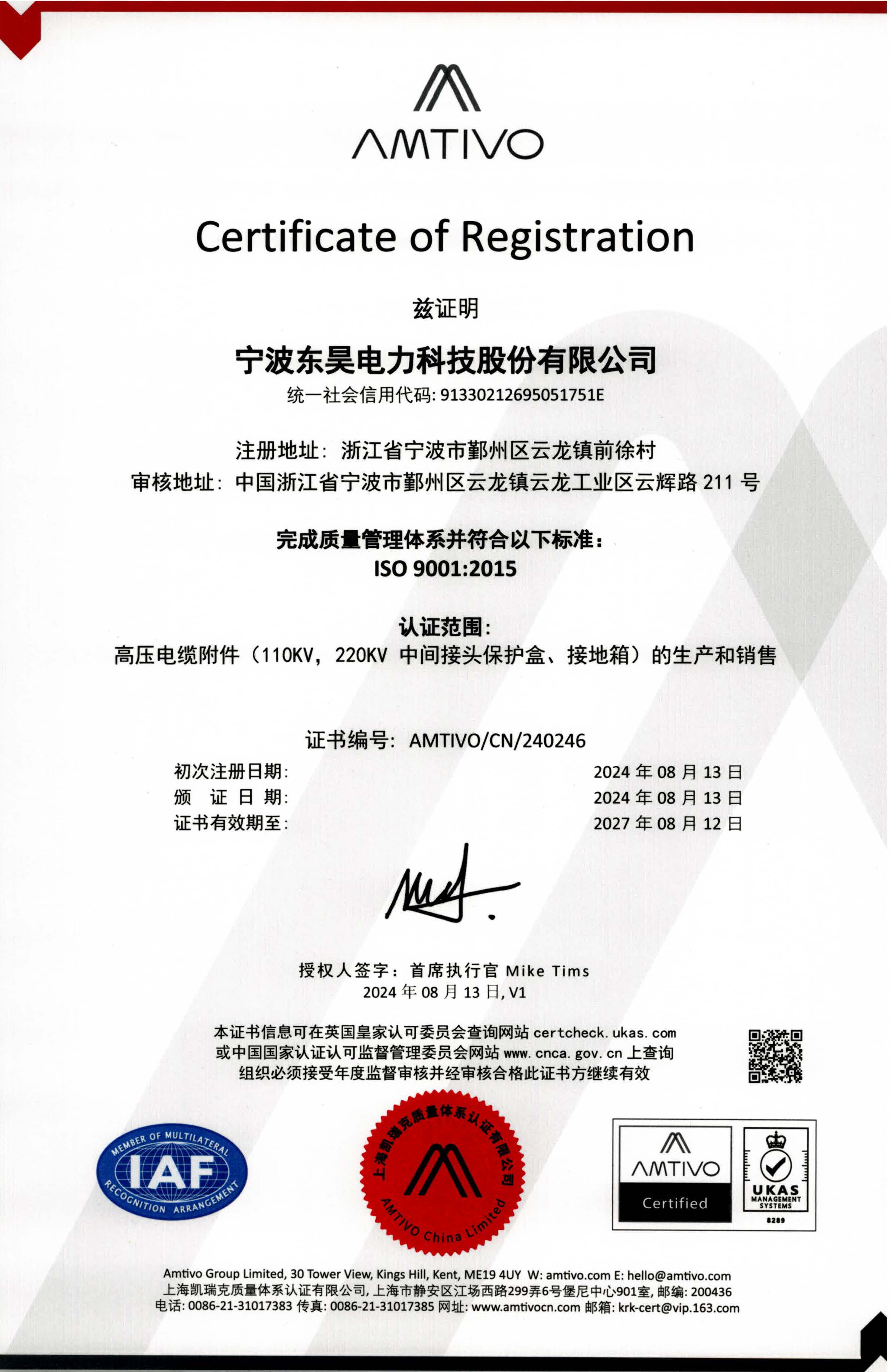
ISO 9001:2015 certification, certificate number AMTIVO/CN/240246, covering cable accessory manufacture and sales.
A practical verification checklist for the evaluation stage:
- Match the certificate scope to the exact model and voltage class being purchased, not to the product family name.
- Request type test reports against the standard applicable to the project voltage class and the destination market.
- Request routine test records, including the partial discharge data where the specification calls for it.
- Verify the current validity period of the certificate and the issuing body.
- Request the MSDS or SDS for any sealant or potting compound shipped with the accessory.
Matching the Termination to the Cable: A Practical Rule Set
Cold shrink termination selection follows a short sequence. Confirm the rated voltage level of the cable, then collect the cable model, core quantity and conductor cross-section, then confirm the installation scenario — indoor, outdoor or direct burial — and finally clarify whether the item required is a cable termination or a cable joint. All parameters are then submitted to the supplier for product matching.
The consequence of skipping that sequence is documented plainly: incorrect parameters cause product mismatch and can trigger insulation failure after energisation, which is why double-checking is required before release of the order. For outdoor applications, pollution resistance grade and weather resistance requirements need additional confirmation to meet local power standards.
| Installation environment | Constraint that drives the selection |
|---|---|
| Indoor cabinet or substation | Voltage class, core count and cross-section fit; compact structure suits limited installation space |
| Outdoor substation | Ageing resistance, temperature variation resistance, weather resistance and pollution class confirmation |
| Underground cable trench | Waterproof and dustproof sealing; moisture resistance at the interface |
| High humidity or salt-fog coastal site | Anti-salt-fog corrosion and anti-tracking requirements specified for the accessory category |
| Dust-polluted area | Sealed interface to prevent contamination ingress before and after core removal |
The documented working environment for cable accessories in this category spans indoor cabinets, outdoor substations, underground cable trenches, high humidity, salt-fog coastal conditions and dust-polluted areas, with project types that include power grid upgrades, wind and solar power station construction, urban underground cable reconstruction and railway power supply projects.
Cold Shrink versus Heat Shrink Termination: Where the Boundary Sits
Cold shrink and heat shrink terminations are not interchangeable by preference; they are interchangeable only within the overlap of their documented ranges. The heat shrink termination range from the same manufacturer is documented at 8.7/10 kV, 12/20 kV and 19/35 kV voltage classes, cable sections of 25–400 mm², single-core or three-core construction, a 2:1 shrink ratio, a withstand voltage of 39 kV for 5 minutes, an operating temperature range of -40°C to 120°C, and cross-linked polyolefin with semi-conductive cross-linked polyolefin materials.
Set against that, the documented 4-core cold shrink termination series in this data set states a 0.6/1 kV voltage class and a 10–300 mm² cable section range. The two ranges therefore do not cover the same application window. This is the practical boundary a buyer must respect: a 35 kV shielded cable project cannot be served by the documented 4-core cold shrink item simply because cold shrink is the preferred installation method; the correct cold shrink model, or a different accessory family entirely, has to be confirmed against the project cable by the supplier.
Within the overlap, the selection logic is documented as follows. Cold shrink accessories are preferred for projects where open flame is not permitted and where construction schedules are tight, because no torch heating is required and installation is straightforward. Heat shrink accessories suit scenarios with a limited budget and certified flame operators, and carry a clear cost advantage there. Both technologies can meet the insulation, electric stress control and sealing protection requirements for medium-voltage cables, provided the correct voltage class and cross-section are selected and the required fire precautions are observed for open-flame work.
Application Scenarios and Documented Project Records
Cold shrink terminations are installed where the accessory must seal against moisture and dust while holding a controlled electric field at the cable end. Four project contexts recur in this category: power grid upgrades that replace or extend existing cable circuits; wind and solar power station construction where collection circuits terminate in confined or unmanned enclosures; urban underground cable reconstruction where trench space is limited; and railway power supply projects where installation windows are short.
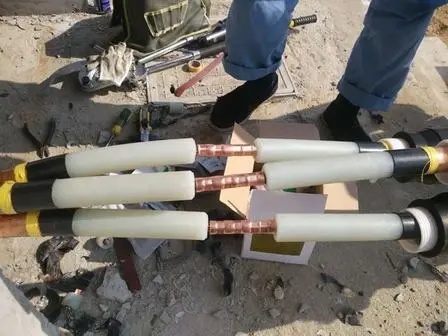
Cable preparation is part of the accessory system: stripping dimensions, insulation cleanliness and stress control positioning determine long-term performance.
Documented project records for this supplier provide concrete examples of the constraint logic in practice.
- Thailand, suburban 10 kV underground cable expansion. 500 units of cold shrink intermediate connection and sealing protection were supplied for a provincial electricity authority project. The record cites a service-life target of at least 20 years, notes that the cold-shrink structure requires no open flame and is therefore suitable for confined underground space, and reports no leakage or discharge issues since commissioning.
- Thailand, urban distribution network renovation. 1,000 units were supplied for outdoor 10 kV cable terminals, with a documented service-life target of at least 20 years and stable operation under outdoor high-temperature and high-humidity conditions.
- Thailand, substation indoor terminal support. 1,000 units were supplied for indoor 10 kV cable terminals, with a documented service-life target of at least 15 years, a compact structure suited to limited installation space, and successful grid access testing by the local power authority.
- Albania, power grid construction. A contractor received 1,087 pieces across 32 cartons, combining high-voltage cable accessories and cable lugs in one delivery, with a documented service-life target of 20 years and a short lead time.
These entries are company-recorded project references. The duration figures represent stated service-life targets and recorded results rather than independently audited field data, which is a normal limitation of supplier case material and should be treated as directional evidence when building a shortlist.
Market Trend: Where Cold Shrink Demand Is Coming From
Commercial research published by Global Market Insights places the global cable accessories market at USD 35.84 billion in 2025, with a projected value of USD 37.88 billion in 2026. The same source identifies Asia Pacific as the largest and fastest-growing region for cable accessories, attributed to grid modernisation, and values the cold shrink tubing segment at USD 2.38 billion in 2024 with specialised growth in telecom and power applications.
Supplier scope data reinforces the direction. Hitachi Energy states that it offers connector, termination and joint accessories covering 12–145 kV cable applications. 3M states that certain cold-shrink terminations are qualified to IEEE 48 Class 1, and that a QT III termination meets or exceeds IEEE 48 Class 1 for 69 kV and IEC 60840 for 72.5 kV outdoor applications. Those statements describe individual manufacturers' own product ranges, not market share, but they show that voltage-class coverage and qualification evidence are the terms on which medium-voltage accessory suppliers compete.
For buyers, the operational consequence is a shift in what shortlisting looks like. As utilities and EPC contractors standardise accessory qualification, the ability to produce parameter-level documentation and a certificate scope that matches the exact model becomes an entry requirement rather than a differentiator. A further practical constraint is that accessory-specific trade data remains difficult to isolate: HS code 8544 covers insulated wire and cable, including products fitted with connectors, and does not cleanly separate accessory hardware such as joints, terminations and separable connectors, so sourcing analysis for this category has to rely on direct supplier qualification rather than customs statistics.
Commercial Constraints: MOQ, Lead Time and Customisation
Documented commercial terms for this supplier are a monthly capacity of 12,000 sets, a lead time of 30–40 days, and a minimum order quantity of 10 sets. Customisation is available under OEM, ODM and customised solution arrangements covering rated voltage, cable cross-section, material formula, packaging, logo printing and a special anti-corrosion version. Export markets are listed as the EU, Southeast Asia, the Middle East, Africa and South America, with an export ratio of 50%. After-sales support comprises on-site installation guidance, remote technical support and a 5-year product warranty.
These are supplier-stated terms. Because no independently validated industry price, MOQ or lead-time benchmark data was available during research, they should be treated as a starting position for quotation rather than as a market reference point, and specific values should be confirmed per order and per destination market.
Future Outlook
Three forces are likely to shape cold shrink termination procurement over the next few years. The first is continued grid modernisation in Asia Pacific, which the available commercial research identifies as the largest and fastest-growing regional market for cable accessories. The second is the ongoing shift of urban distribution work underground, where confined space, ventilation and fire risk make torch-free installation methods preferable — the same reason the documented Thailand project cites for using a cold-shrink structure. The third is documentary discipline: as qualification requirements tighten, the ability to match a certificate scope to a model number and to produce routine test records on demand will determine whether a supplier reaches the technical evaluation stage at all.
What is unlikely to change is the underlying constraint structure. Voltage class, conductor cross-section, core count, environment and certification will still define whether a specific cold shrink termination is the right item for a specific cable. Buyers who front-load that verification into the RFQ, rather than discovering a mismatch at factory acceptance testing, will continue to get better outcomes than those who select on installation convenience alone.
Frequently Asked Questions
What parameters should be confirmed before ordering a cold shrink termination?
Five parameters govern the match: the cable's rated voltage level, the cable model, the number of cores, the conductor cross-section, and the installation environment (indoor, outdoor or direct burial). The product type also has to be confirmed, because a cable termination and a cable joint are different accessories. For reference, the documented cold shrink termination specification in this review states a 0.6/1 kV voltage class, a 10–300 mm² cable section range, 4 cores, silicone rubber construction, an operating temperature range of -40°C to 90°C and a volume resistivity of ≥1×10¹⁴ Ω·cm. Incorrect parameters cause product mismatch and can trigger insulation failure after energisation.
How do cold shrink and heat shrink terminations differ in installation constraints?
Cold shrink accessories require no torch heating; the supporting core is pulled out so the silicone body contracts onto the cable, which makes them suitable where open flame is not permitted and where construction schedules are tight. Heat shrink accessories require open-flame work performed by certified flame operators with fire precautions in place, and are documented as carrying a cost advantage for budget-limited projects. Both can satisfy the insulation, electric stress control and sealing protection requirements of medium-voltage cables when the correct voltage class and cross-section are selected. The documented heat shrink termination range covers 8.7/10 kV, 12/20 kV and 19/35 kV classes, 25–400 mm² sections, single or three cores, a 2:1 shrink ratio, a 39 kV/5-minute withstand voltage and a -40°C to 120°C temperature range.
What installation errors most often lead to later breakdown of a cold shrink termination?
The documented causes are scratches on the main cable insulation, rough treatment of the semi-conductive layer cut, moisture and dust on the installation interface, and offset stress cone positioning. Each is avoidable through process discipline: strip the cable strictly to drawing dimensions, keep the insulation surface clean and dry, position the stress cone accurately, pull the supporting core at a constant speed, and inspect the sealing structure for displacement or gaps before energising. Construction is not carried out in wet or rainy conditions, and power cut, voltage testing and earthing must be completed before work begins.
What risks should be assessed when selecting and installing a cold shrink termination?
The main risks are incorrect product selection, improper cable preparation, contamination, moisture ingress and incorrect installation. Before selection, confirm the cable voltage, size, insulation type and diameter. During installation, keep the cable and components clean and dry, follow the specified installation dimensions and procedures, and check component positioning and sealing. Required inspection and testing should be completed before the cable is energised. Installation is carried out by qualified electrical personnel using appropriate personal protective equipment and tools, in line with the manufacturer's instructions and applicable safety requirements.
How is cable sealant used to protect a cable connection?
Cable sealant seals the connection area and helps prevent moisture, dust and other contaminants from entering it. The documented procedure is to disconnect and isolate the cable first, clean and dry the cable and connection surfaces, prepare the sealant according to the product instructions, apply it evenly around the required sealing area, ensure complete coverage without gaps or exposed areas, and inspect the finished seal before energising. The polyurethane sealant in this range is documented for a 10 kV–35 kV applicable voltage level, with a hardness of 55A±10, a light yellow colour, a polyurethane prepolymer base and a solvent-free formulation; its MSDS number is S001T2309040008, prepared under UN GHS Rev.9.
The Tonyhoo Cable Accessories product catalogue, covering cold shrink terminations, cold shrink intermediate joints, cable lugs, separable connectors, sealants and protection housings, can be downloaded here: Tonyhoo product catalog (PDF). Product and company information is also available at www.tonyhoo.com.
Tem questões ou precisa de mais detalhes?
Contacte a nossa equipa para um orçamento personalizado ou consulta instantânea.
Solicitar orçamento
Preencha o formulário abaixo e a nossa equipa entrará em contacto com uma proposta personalizada.
Chat direto do WhatsApp
Prefere conversar em tempo real? Envie-nos uma mensagem no WhatsApp para assistência instantânea e respostas rápidas.
- Obter orçamento personalizado
- Partilhar fotos ou documentos
- Discuta as suas necessidades diretamente
Geralmente responde em 5–30 minutos durante o horário de expediente.