
Cold Storage Drawings: A Buyer's Guide to Design and Installation
Cold storage projects start with a requirement: fresh produce must stay fresh, frozen seafood must stay frozen, and the facility must perform reliably in a specific climate. Before equipment is ordered or panels are manufactured, design drawings turn those requirements into concrete specifications. For buyers, reading cold storage drawings with an understanding of refrigeration equipment, insulation boards and installation logic is a practical skill that directly affects cost, delivery time and long-term operating performance.
Why Cold Storage Drawings Matter
Cold storage is rarely a single product. It combines insulated building envelopes, refrigeration units, evaporators, electrical systems and structural steel. The design drawing is the common document that connects all of these disciplines. In international procurement, drawings are also the basis for quoting, permitting and installation planning.
Buyers often evaluate suppliers using technical sheets and price lists. Those documents are useful, but they do not show how the facility will be built. Drawings reveal whether the supplier has understood the product type, the target temperature, the local climate and the required storage capacity. A well-prepared drawing can prevent disputes about the scope of supply and installation, while a vague drawing can leave critical items to be resolved after the contract is signed.
The global cold storage market is expanding. According to Grand View Research, the market was valued at approximately USD 185.8 billion in 2025 and is projected to reach USD 474.2 billion by 2033. Market Research Future estimates the cold storage construction market at USD 78.96 billion in 2024, with a CAGR of 7.14% through 2035. As more facilities are planned, the need for clear, well-structured design documentation increases.
Key Elements in a Cold Storage Design
A practical cold storage drawing should answer at least four questions: what temperature will be maintained, how the building envelope is insulated, which refrigeration equipment will be used, and how the facility is laid out. These elements also form the basis of the technical specification.
1. Temperature and Capacity
Cold storage facilities are typically designed around product-specific temperature ranges. Common ranges include 0–5°C for chilled storage, -18°C to -25°C for frozen storage, and -35°C to -45°C for quick freezing. The frozen temperature range of -18°C to -25°C held the largest share of global cold storage in 2025, at 63.0%, according to Grand View Research. Capacity also matters: medium-sized projects are commonly designed from 500 tons up to 20,000 tons per facility.
2. Insulation Board Specification
Insulation thickness and density affect energy efficiency and temperature stability. In typical mid-sized projects, PIR insulation panels with thicknesses of 100 mm or 150 mm are used. Polyurethane panels are commonly specified at 150 mm thickness with a density of 42 kg/m³. The structural system often combines steel structure engineering with double-sided color steel insulation boards.
3. Refrigeration Equipment
The refrigeration system is the core operating equipment in any cold storage project. Common components include refrigeration compressor units, condensing units and evaporators. In many export-oriented projects, environmentally friendly Freon refrigerants such as R507a or R404A are specified, with electrical supply at 380–415V / 3P / 50Hz. The refrigeration capacity range in an EPC project can be sized from 500 to 20,000 tons.
4. Layout and Supporting Systems
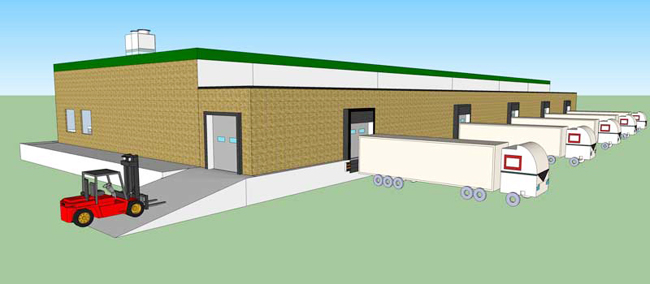
The drawing should also indicate building area, clear height, loading/unloading zones and the integration of auxiliary equipment. Cold storage projects commonly use floor areas from 1,000 to 20,000 square meters, with building heights of 5 to 12 meters. In practice, shelves, forklifts and generator sets are often required to support daily operation. The project construction period is typically 2 to 5 months, depending on size and site readiness.
| Design parameter | Typical values in mid-sized projects |
|---|---|
| Temperature range | 0–5°C, -18~-25°C, -35~-45°C |
| Project capacity | 500–20,000 tons |
| Building area | 1,000–20,000 square meters |
| Building height | 5–12 meters |
| Insulation panels | PIR 100 mm / 150 mm; polyurethane 150 mm, 42 kg/m³ |
| Refrigerants | R507a, R404A |
| Power supply | 380V–415V / 3P / 50Hz |
| Construction period | 2–5 months |
The EPC Model: Turning Drawings into Installed Facilities
Many buyers choose an EPC approach because it consolidates design, equipment supply, installation and commissioning into one contract. Beijing howcool Refrigeration Technology Co., Ltd., also known as HOWCOOL, is a professional engineering enterprise in this segment. The company was established in 2014 and has more than 10 years of experience in the refrigeration industry. It operates a manufacturing facility covering 50,000 square meters, employs approximately 200 staff, and has an R&D team of 40 engineers. Annual production capacity reaches 500 units, and export business accounts for 50% of total sales, with major markets in the Middle East, Africa, Southeast Asia and South America.
HOWCOOL's EPC scope covers insulation panels, refrigeration condensing units, evaporators, refrigeration accessories, tunnel freezers, and complete cold storage construction. The company provides design, procurement, installation, commissioning and after-sales maintenance for medium-sized cold storage projects up to 20,000 tons. Its main cold storage products include fruit and vegetable cold storage, seafood cold storage, quick freezing cold storage, and logistics preservation cold storage.
Specific product examples show how the design translates into installed systems. The HSZL-6000 is a logistics cold storage EPC design that uses polyurethane insulation board and refrigeration compressor units. It supports temperature ranges of 0–5°C, -18°C to -25°C and -35°C, with areas from 2,000 to 10,000 square meters and heights of 5–12 meters, using environmentally friendly refrigerants R507 and R404A. The HSZL-3000T cold chain logistics cold storage uses 150 mm polyurethane insulation board with a density of 42 kg/m³, supplies products and on-site installation services, and provides spare parts for two years. It can achieve quick freezing down to -45°C, with temperature ranges of -5~+5°C, -18~-25°C and -35~-45°C. The HSZL-5000t is a 5,000-ton food cold storage model built with steel structure engineering and double-sided color steel insulation board, with PIR panels of 100 mm or 150 mm thickness, and rated voltage of 380V–415V / 3P / 50Hz.
Application Scenarios Across Industries
Cold storage drawings are not universal; they must be matched to the product and operating environment. In practice, cold storage facilities are used for logistics parks, food factories, seafood, e-commerce, fruit and vegetable preservation, meat freezing, and fish freezing. The system must extend the shelf life of goods and prevent food spoilage, often through continuous automatic operation 24 hours a day throughout the year.
The operating environment also influences design. Some projects are designed for a temperature variation range of -30°C to 55°C, which is relevant for hot-climate markets. For such projects, the refrigeration system needs to handle both high ambient temperatures and the required product storage temperature. Supporting equipment such as generator sets, shelves and steel structures is often included, and the facility may be built as a new structure or as a renovation of an existing warehouse.
HOWCOOL's application scenarios are documented across multiple markets, including Afghanistan, Albania, Angola, Belgium, Burkina Faso, Bahrain, Brazil, Bahamas, Belarus, Central African Republic, Chile, Cameroon, Cuba, Cape Verde, Cyprus, Algeria, Egypt, Ethiopia, Georgia, Equatorial Guinea, Guyana, Iraq, Iran, Jamaica, Jordan, Kuwait, Kazakhstan, Mongolia, Myanmar, Maldives, Malaysia, Nigeria, Oman, Qatar, and others. Other documented applications are concentrated in the UAE, Brazil, Russia and additional markets.
Market Trends and Buyer Implications
The refrigeration compressor market is also growing, driven by demand for cold chain logistics and energy-efficient HVAC systems. Strategic Market Research valued the refrigeration compressor market at USD 18.6 billion in 2024. For cold storage buyers, this reinforces the importance of choosing reliable compressor and condensing equipment, because the refrigeration system is the highest-energy element of the facility.
Temperature range data shows that most facilities in the market operate in the frozen range, not only in chilled storage. The -18°C to -25°C segment accounted for 63.0% of the market in 2025, according to Grand View Research. This suggests that procurement plans should give sufficient attention to frozen storage capabilities, insulation continuity and door protection, even if the immediate project is fresh produce or logistics distribution.
There is also a growing emphasis on environmental standards. In Europe, EN 378 is a primary safety and environmental standard for the design, construction and installation of refrigerating systems and heat pumps. Buyers exporting to multiple regions should check whether their equipment and installation approach meet the relevant local standards, especially when environmentally friendly refrigerants and system safety are part of the specification.
EPC vs. Traditional Component Procurement
Some buyers prefer to buy insulation panels, refrigeration units and steel structures separately and manage installation with their own contractor. This approach can offer greater flexibility in choosing brands and may feel more transparent on material costs. However, it also shifts technical responsibility to the buyer, who must coordinate the interfaces between design, equipment and civil works.
An EPC approach reduces that coordination burden because one contractor handles design, procurement, installation and commissioning. This can simplify project management and shorten the communication chain. At the same time, the buyer must review the design carefully, because the EPC contractor controls the detailed engineering. A clear drawing review and a well-defined scope of supply are essential to avoid ambiguity.
Neither model is universally better. EPC is particularly suitable for buyers who want a turnkey facility, have limited local engineering resources, or need one accountable partner for an overseas project. Traditional component procurement may be preferred for small retrofits, for buyers with an in-house engineering team, or for projects that require specific brands not offered by the EPC contractor. The most important decision criterion is not the contract model alone, but whether the design drawing and technical specification genuinely match the product and operating requirements.
| Aspect | EPC approach | Separate component procurement |
|---|---|---|
| Responsibility | Single contractor for design, supply and installation | Split among equipment suppliers, civil works and installation teams |
| Coordination | Contractor manages interfaces | Buyer or main contractor manages interfaces |
| Flexibility | Limited by the EPC contractor's standard scope | Higher flexibility for brand or component selection |
| Engineering depth | Full design, installation drawings and commissioning | Depends on buyer's engineering capacity |
| Risk allocation | Single point of responsibility but requires careful drawing review | More risk transferred to buyer for integration errors |
Future Outlook
Cold storage design is becoming more integrated with digital engineering. Drawing documentation is increasingly expected to include detailed refrigeration flow, electrical load calculations and insulation schedules. Buyers should expect more structured drawings that can support installation, maintenance and future expansion.
Environmentally friendly refrigerants will remain a central topic. Existing projects commonly use R507a and R404A, while new installations increasingly need to consider regulatory trends and life-cycle cost. Insulation efficiency will also continue to improve, with panel thickness and density balanced against energy consumption and capital cost.
Demand is particularly visible in hot-climate markets and emerging economies, where cold chain infrastructure is still developing. For suppliers like HOWCOOL, the ability to deliver medium-sized EPC projects from 500 to 20,000 tons, with design support and installation services, aligns with the practical needs of global buyers who want a reliable facility rather than a collection of components.
FAQ
What is a cold storage drawing?
A cold storage drawing is a technical document that shows the layout, insulation system, refrigeration equipment and structural details of a cold storage facility. It is used as the basis for quoting, installation and commissioning.
What temperature ranges are used in cold storage?
Typical ranges include 0–5°C for chilled storage, -18°C to -25°C for frozen storage, and -35°C to -45°C for quick freezing. The specific range depends on the product being stored.
What insulation boards are used in cold storage construction?
PIR insulation panels with thicknesses of 100 mm or 150 mm are commonly used, and polyurethane panels with 150 mm thickness and 42 kg/m³ density are also specified. The structural configuration often uses steel structure engineering with double-sided color steel insulation board.
What capacity can an EPC cold storage project handle?
Medium-sized cold storage projects can be designed for capacities from 500 tons to 20,000 tons per project. Some product configurations support storage of 1,000, 2,000, 3,000, 5,000 or 8,000 tons of goods.
How long does a cold storage installation take?
For projects with floor areas between 1,000 and 20,000 square meters, the construction period is typically 2 to 5 months. The exact time depends on the scope of supply, site conditions and whether it is a new build or a renovation.
What industries use cold storage facilities?
Cold storage is used for food production and processing, seafood, meat, cold chain logistics, fruit and vegetable preservation, e-commerce, and logistics parks. It functions to extend the shelf life of goods and prevent food spoilage.
For a full overview of HOWCOOL's EPC cold storage scope, the company brochure is available for reference: HOWCOOL EPC brochure.
Tem questões ou precisa de mais detalhes?
Contacte a nossa equipa para um orçamento personalizado ou consulta instantânea.
Solicitar orçamento
Preencha o formulário abaixo e a nossa equipa entrará em contacto com uma proposta personalizada.
Chat direto do WhatsApp
Prefere conversar em tempo real? Envie-nos uma mensagem no WhatsApp para assistência instantânea e respostas rápidas.
- Obter orçamento personalizado
- Partilhar fotos ou documentos
- Discuta as suas necessidades diretamente
Geralmente responde em 5–30 minutos durante o horário de expediente.