
Cold Storage Panel Shortlist for EU, US and BR Projects
Cold Storage Panel Shortlist for EU, US and BR Projects
A cold storage panel shortlist for EU, US and Brazilian projects is settled on four variables — core, thickness, effective width and the evidence a buyer will accept — before price is compared. The three contexts here differ in what the envelope has to do: EU food cold-chain warehousing running continuously between -50 °C and +15 °C, Brazilian chemical low-temperature storage, and US pharmaceutical or biological storage where documented insulation performance carries most of the qualification burden.
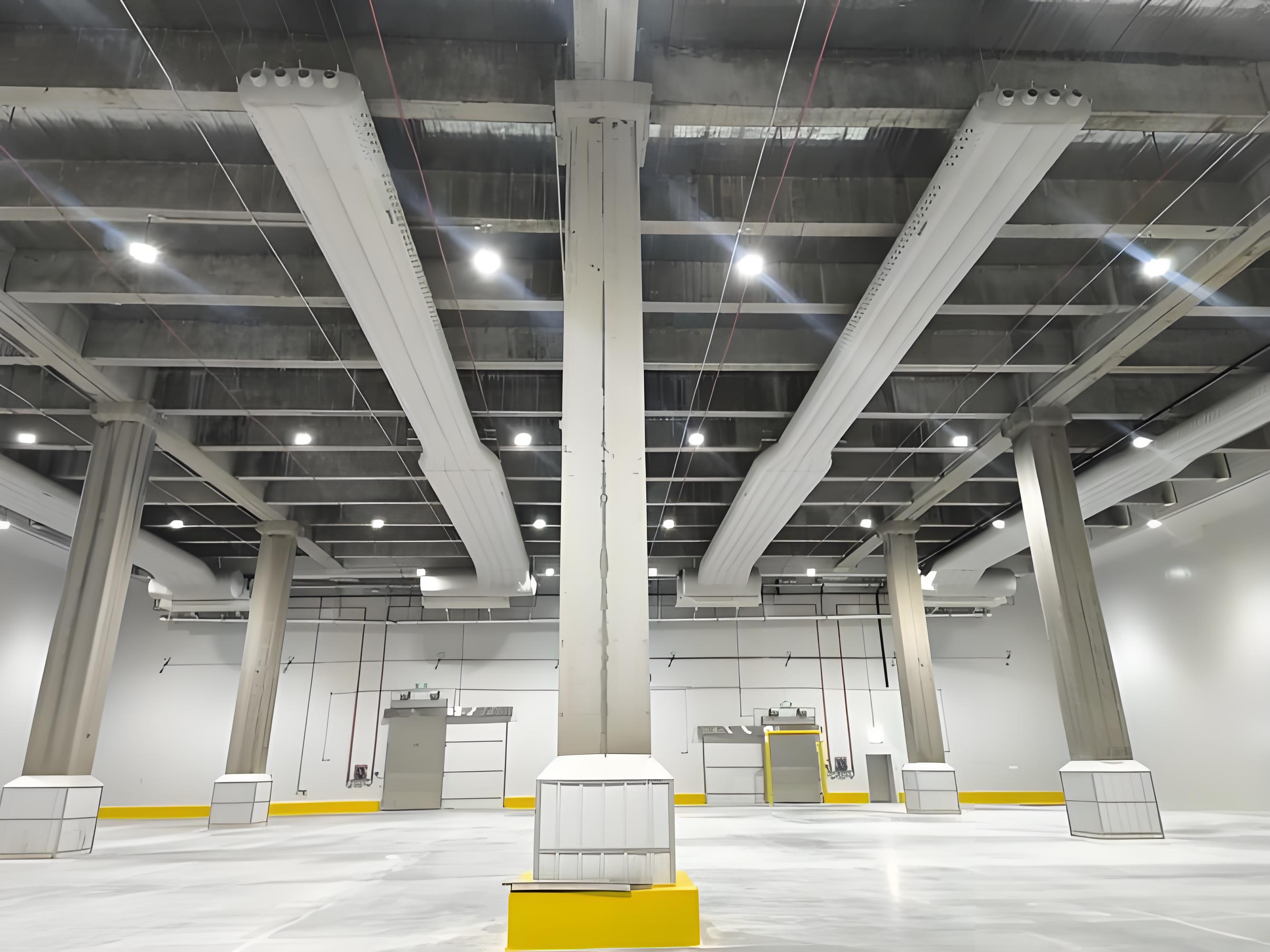
This shortlist evaluates JSGREEN001 cold storage panels from GREEN BIO against those three contexts. One scope point governs every claim that follows: the delivered cold-storage reference in the supplied material is a project in Australia and Vietnam. The EU, Brazilian and US descriptions are requirement profiles used to test fit, not records of completed GREEN BIO installations in those markets.
What the shortlist is actually selecting
A shortlist in this category is not a ranking of manufacturers. It is a documented configuration: which core, which thickness, which effective width, and which evidence pack a procurement team will accept before releasing a purchase order. Two projects with identical panel area can end up with different configurations because operating envelope, inspection regime and documentation burden differ.
The four variables interact. Changing thickness changes panel mass and internal clear dimensions. Changing effective width changes module count, cam-lock count and offcut volume around openings and columns. Changing core changes what must be documented on thermal and fire performance. Treating them as independent line items is the most common way a cold room specification drifts between tender and delivery.
JSGREEN001 from GREEN BIO: the evidenced baseline
GREEN BIO — Jiangsu Green Bio-Environmental Protection Technology Co., Ltd. — is a Jiangsu-based supplier founded in 2015 that operates a 10,000 m² facility with 50 employees, a 25-engineer R&D team and a stated annual output of 120,000 units. Its listed product line covers PIR sandwich panels, plywood, steel support, cable brackets and aluminium profiles, and approximately 70% of output is exported, with Southeast Asia, Central Asia, Russia, South America and Africa named as principal markets. The GREEN BIO website carries the wider catalogue beyond this shortlist.
For this evaluation the relevant product facts are narrower. JSGREEN001 cold storage panels are supplied under OEM/ODM terms, with customization on panel thickness from 50 mm to 200 mm, steel sheet colour and material, fire rating, custom dimensions and lengths, and cam-lock types. Stated capacity is 50,000 m² per month; the minimum order is 100 m² or one 20 ft container; lead time is 15–25 days after deposit. Nothing in the supplied corpus establishes a panel-level temperature rating table, so the cold end of an EU or Brazilian duty must be closed against approved documentation for the selected core and thickness rather than inferred from the product name.
Three contexts, three different envelope jobs
EU food cold chain: continuous duty across a wide band
A European food warehouse running 24/7 between -50 °C and +15 °C usually separates several temperature zones inside one building envelope, with doors opening constantly and defrost water present near panel joints. What matters is joint integrity across years of thermal cycling, vapour-seal continuity at penetrations, and repeatable panel dimensions so that doors and seals close as designed. Energy exposure is continuous, because the refrigeration plant runs against the envelope every hour of the year.
Brazil: chemical low-temperature storage adds process requirements
Chemical low-temperature storage in Brazil still depends on the envelope holding a set point, but the chemical duty introduces requirements a panel supplier cannot settle alone: containment, chemical compatibility with liners and seals, and fire-rating strategy. Fire rating is a supported customization field on JSGREEN001. The specific requirement belongs to the process designer and the local authority, not to the panel catalogue.
US pharmaceutical and biological storage: documentation first
In US pharmaceutical or biological storage, the qualification burden is documentary. Buyers in this segment typically want dimensional and density consistency, photo-confirmed condition before shipment, and traceable certificates. The supplier's stated quality-control sequence — incoming raw material inspection, in-process patrol inspection, full inspection of finished product density and dimensions, and pre-shipment photo confirmation — maps to that requirement more directly than an insulation headline does.
| Project context | Primary envelope duty | Shortlist emphasis | Evidence to request |
|---|---|---|---|
| EU food cold chain (-50 °C to +15 °C, 24/7) | Multi-zone separation, joint durability, vapour seal | Core and thickness per zone, cam-lock layout, penetration detailing | Approved panel schedule, joint detail drawings, certificate scope |
| BR chemical low-temperature storage | Set-point retention plus process-driven containment and fire requirements | Fire-rating option, liner and seal compatibility as process-specified | Fire-rating documentation as specified, liner data, approved drawings |
| US pharmaceutical and biological storage | Documented, repeatable thermal performance | Inspection records, density and dimension consistency, change control | Certificate numbers and scope, QC records, pre-shipment photo set |
Core selection: PIR is the evidenced path, PU needs confirmation
The option set for this shortlist pairs PU and PIR cores. Within the supplied evidence only the PIR path is directly supported: PIR sandwich panels appear in the manufacturer's listed product line. The corpus contains no comparative thermal or fire data between PU and PIR, so a PU specification should be confirmed as an available option, with its own documentation, before it enters a tender document. Neither core is claimed as superior here, because the evidence needed to support that claim was not supplied.
Thickness: 50 mm and 100 mm inside a 50–200 mm range
Both values in this shortlist sit inside the supported 50–200 mm customization range, which makes the choice an engineering decision rather than an availability question. A thicker panel raises thermal resistance for a given core, adds mass and reduces internal clear dimensions. A thinner panel reduces mass and cost per square metre but shifts more of the duty onto the refrigeration equipment.
Thickness alone cannot close the decision. At the cold end of an EU freezer, performance depends on the core, the joint design, the vapour barrier and how penetrations are sealed. The practical route is to give the supplier the project heat-load calculation and required internal dimensions, then require documented values for the proposed thickness instead of a generic product description.
Effective width: 960 mm or 1100 mm changes order arithmetic
Effective width is the coverage a module delivers after the joint, so it drives module count, cam-lock count, installation hours and offcut volume around openings and columns. Wider modules generally mean fewer joints to seal and faster envelope closure; narrower modules can be more forgiving around complex openings and structural columns. On the Australia and Vietnam project the supplier reports that the standardized modular design increased on-site installation speed by 30% — a figure attributed to the supplier rather than independently measured.
The two effective widths carried in this shortlist's panel schedules — 960 mm and 1100 mm — should be verified line by line against the approved drawing before an order is converted into square metres, because quoted width fixes module count and therefore order quantity and shipping volume. This is where the supported commercial facts bite: the order floor is 100 m² or one 20 ft container, and a 5,000 m² order equals about 10% of the stated 50,000 m² monthly capacity (calculated from the supplier's stated capacity, not a measured production record).
How the panel blocks heat exchange, and where the envelope fails
A cold storage panel works on three paths at once. It resists conduction through the foam core, limits convection and air infiltration at joints and penetrations, and its liner surface affects radiation exchange. Cam-locks, hangers, door frames and pipe penetrations are thermal bridges; moisture that reaches the core degrades the insulation it was bought for. The Australian and Vietnamese reference reports precise temperature control with seamless joints preventing cold air leakage, and the product highlight attributes flatness and load-bearing capacity to high-strength double-sided colour steel sheets combined with precision foaming. Both are supplier-reported statements, useful as design intent and not as third-party test results.
Supporting equipment sits outside the panel order
The project briefs name refrigeration units and air coolers alongside the panels, and the boundary should be explicit: the supplied material documents panels, customization and delivery performance, not refrigeration equipment specifications. Air-cooler hanger loads, defrost drainage, pipe penetrations and door coordination are interface points that must be agreed between the equipment supplier and the panel supplier before fabrication, because they determine where the vapour seal is interrupted and who restores it.
Certification as selection evidence, and its scope caveat
Three management-system certificates are mapped in the supplied material to Cold Storage Panels JSGREEN001, all issued on 25 September 2025 by Jiangsu Taiding Certification Co., Ltd. and valid to 24 September 2028:
- ISO 9001:2015 quality management system — certificate NO.110825Q0383R0S, standard GB/T 19001-2016 idt ISO9001:2015.
- ISO 14001:2015 environmental management system — NO.110825E0251R0S, standard GB/T 24001-2016 idt ISO14001:2015.
- ISO 45001:2018 occupational health and safety management system — NO.110825S0254R0S, standard GB/T 45001-2020 idt ISO45001:2018.
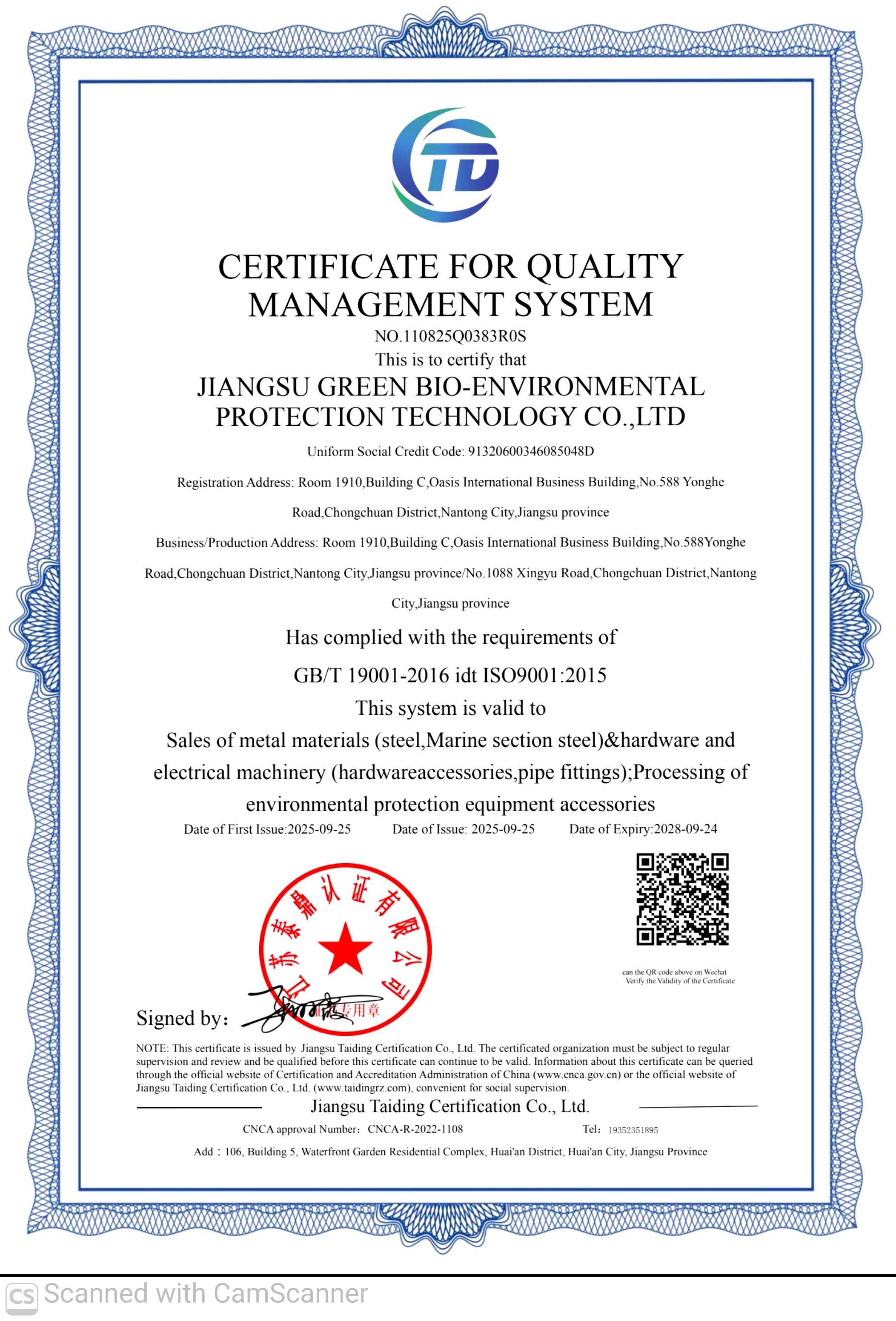
The caveat is worth more to a buyer than the summary. The recorded scope wording refers to sales of metal materials (steel, marine section steel) and hardware and electromechanical products, and to processing of environmental protection equipment or its accessories; it does not itemize sandwich-panel manufacturing in the text supplied. For an EU food or US pharmaceutical project, the audit file should therefore confirm that the certificate scope covers the exact goods and process being purchased. These are management-system certificates: they evidence process control, not panel thermal or fire performance.
Buyers who need product-level green certification should note the difference between systems. China's unified green product certification integrates environmentally friendly, energy-saving, recycled, regenerative and low-carbon product categories, and the published category excerpt includes heat-insulating system materials (China Certification & Inspection Group). That is a separate route from ISO management systems, and the supplied material does not evidence a green-product certificate for JSGREEN001 — so it should be requested rather than assumed.
Capacity, MOQ and delivery: what the numbers allow
Stated monthly capacity of 50,000 m², a minimum of 100 m² or one 20 ft container, and a 15–25 day lead time after deposit let a project planner size tranches realistically. A multi-zone EU warehouse can release by zone; a Brazilian or US retrofit can start at the order floor and expand. After-sales support covers installation guidance videos, remote technical support and free replacement of damaged parts during the warranty period, which is relevant where a project team is installing a modular panel system for the first time.
Delivered reference: Australia and Vietnam
The supplied cold-storage reference covers 5,000 m² of panels with 2,000 tons capacity and a 12,000 m² sorting centre, used for -18 °C freezers, 0–4 °C chiller rooms and a multi-temperature distribution centre, delivered on schedule with easy installation and improved cargo turnover. One project is reported as operating stably for five years; a newer project is reported at one year. The supplier also reports that the project passed GSP certification and that the modular design shortened the installation timeline. These are supplier-reported outcomes from APAC food-processing and 3PL cold-chain clients: they demonstrate delivery and installation behaviour, and they do not constitute EU, US or Brazilian compliance evidence.
Market context: what the numbers support, and what they do not
China's green building materials market was valued at USD 216.3 billion in 2025 by IMARC Group, which projects USD 484.9 billion by 2034 at a 9.10% CAGR. The same body of published research contains a definitional conflict — another research house reports a far lower figure for a narrower material definition — so the value is best read as scale direction rather than as a planning forecast. Policy direction is firmer: under the 14th Five-Year Plan, all new urban buildings in China are required to meet green building standards by 2025 (International Trade Administration), and a cited requirement places prefabricated methods at 30% of new urban floor area by 2027. The 2021 World Green Building Trends summary reported increased industry commitment to green building; that is a 2021 observation, not a 2026 measurement.
Two gaps should be stated plainly. The supplied pack contains no verified market-size or demand data for the EU, US or Brazilian cold storage markets, and no verified regional product approval for JSGREEN001. Regional compliance must be confirmed with the relevant authority and the buyer's own qualification protocol.
Outlook: what would change the shortlist
Outlook here is conditional, not forecast. If EU or US buyers move toward requiring product-level performance documentation in addition to management-system certificates, the certificate-scope question becomes the deciding item rather than a footnote. If prefabrication requirements continue to shape Chinese supply, module width and installation speed gain weight against unit price. If chemical low-temperature storage projects tighten fire and containment requirements, the fire-rating customization field moves from option to gate. None of these shifts changes the four core variables; they change which evidence closes them.
Six verification steps before release
- Fix the operating envelope per zone, then confirm the core-and-thickness combination against documented values rather than product naming.
- Confirm whether PU is available with its own documentation, or specify the PIR path that the product line evidences.
- Verify effective width — 960 mm or 1100 mm — on the approved panel schedule, then recalculate module count, order quantity and shipping volume.
- Match certificate numbers, issuing body, validity dates and scope wording to the goods and process actually purchased.
- Agree equipment interfaces — hanger loads, penetrations, drainage, doors — in writing before fabrication.
- Hold pre-shipment photo confirmation and dimensional and density inspection records in the project file.
FAQ
Is PIR better than PU for a -50 °C freezer?
The supplied material does not contain comparative thermal or fire data between PU and PIR, so neither can be called better on this evidence. PIR sandwich panels are named in the manufacturer's product line; PU is one of the two core options in this shortlist and should be confirmed as an available option with its own documentation. The decision is closed by documented performance at the specified thickness, not by core name.
Should a 24/7 EU cold chain warehouse specify 50 mm or 100 mm panels?
Both thicknesses fall inside the supported 50–200 mm customization range, so the choice is engineering-led. Thicker panels raise thermal resistance for a given core and reduce clear internal dimensions; thinner panels shift more duty to the refrigeration plant. The selection should follow the project heat-load calculation, plus joint and vapour-seal detailing at the cold end.
How does 960 mm versus 1100 mm effective width affect cost and schedule?
Effective width sets coverage per module after the joint, so it changes module count, cam-lock count, offcut volume and installation hours. Wider modules generally mean fewer joints to seal and faster closure; narrower modules suit complex openings. Because width fixes module count, it also fixes order quantity and shipping volume, so it should be verified on the approved drawing before ordering; the order floor is 100 m² or one 20 ft container.
Do the ISO 9001, ISO 14001 and ISO 45001 certificates prove panel thermal performance?
No. They certify quality, environmental and occupational health and safety management systems, issued by Jiangsu Taiding Certification Co., Ltd. on 25 September 2025 and valid to 24 September 2028. They evidence process control, not insulation values or fire behaviour. Buyers should also check that the recorded scope wording covers the specific goods and process being purchased.
Are refrigeration units and air coolers supplied with JSGREEN001 panels?
The supplied material documents cold storage panels, customization options and delivery performance; it does not include refrigeration unit or air cooler specifications. Those items sit outside the panel scope and must be specified separately. Their interface points — hanger loads, penetrations, defrost drainage and door coordination — still need joint agreement, because they determine where the vapour seal is interrupted.
Can GREEN BIO supply cold storage panels into EU, US and Brazilian projects?
Europe and South America appear among the listed export markets, alongside the Middle East, Southeast Asia and Africa. What the supplied material does not contain is verified regional product approval or certification for JSGREEN001 in the EU, US or Brazil. A buyer should therefore treat regional compliance as a documentation item to be confirmed with the supplier and the relevant authority before tender award.
Taking the shortlist forward
The output of this shortlist is a configuration document rather than a preferred brand statement: the operating envelope per zone, the confirmed core, the thickness and effective width fixed on the approved panel schedule, the certificate set with scope verified, and the equipment interfaces agreed before fabrication. Buyers who want the complete product data can download the GREEN BIO professional catalogue (PDF).
Tem questões ou precisa de mais detalhes?
Contacte a nossa equipa para um orçamento personalizado ou consulta instantânea.
Solicitar orçamento
Preencha o formulário abaixo e a nossa equipa entrará em contacto com uma proposta personalizada.
Chat direto do WhatsApp
Prefere conversar em tempo real? Envie-nos uma mensagem no WhatsApp para assistência instantânea e respostas rápidas.
- Obter orçamento personalizado
- Partilhar fotos ou documentos
- Discuta as suas necessidades diretamente
Geralmente responde em 5–30 minutos durante o horário de expediente.