
Color Coated Steel Coil & Sheet: What the Coating Does Matters Most
Color coated steel coil and sheet is no longer chosen only by visual appearance. In demanding industrial projects, the real specification issue is the function of the coating: whether it resists heat, releases food, withstands chemicals, absorbs and radiates heat, prevents electrical interference, or slows bacterial growth. This guide explains the main functional coating systems, their application logic, and the technical boundaries buyers should understand before selecting a color coated steel supplier.
Functional Color Coated Steel Coil & Sheet: What It Is
Functional color coated steel is a metal substrate with a paint, film, or polymer layer that has been engineered to deliver a defined surface performance. Typical substrates include galvanized steel, electrogalvanized steel, ZAM (zinc-aluminum-magnesium) coated steel, tinplate, ECCS (electrolytic chromium coated steel), aluminum, and stainless steel. The applied coating gives the material properties such as a nonstick surface, solid-film lubrication, high thermal emissivity, antimicrobial activity, fire retardancy, or electrical insulation.
Chongqing Youngson Metal Products Co., Ltd. (Youngson Metal) is a manufacturer that operates its own advanced coating lines and precision slitting machines for this type of material. The company specializes in deep-drawn pre-painted steel, pre-painted stainless steel, PET film laminated steel, VCM PVC film laminated steel, and coil coatings with Teflon, nonstick, gold, and lacquered finishes. Its facility covers 3,000 square meters, with an annual production capacity of 10,000 tons and a team of about 25 staff, including five engineers and senior process technicians. Products are described as eco-friendly, food-grade, and chemical-grade, and have passed SGS testing for REACH and RoHS heavy-metal regulations.
Because the substrate, the coating thickness, and the finish are interdependent, the best way to choose a functional color coated steel is to start with the end-use condition rather than with a generic RAL color.
Why Functional Performance Has Become a Procurement Requirement
Many color coated steel products still serve conventional building and light-decoration purposes. But an increasing share of procurement now happens for parts and equipment where the surface coating is a critical engineering input. In gaskets, release agents and temperature loads decide reliability. In medical equipment housings, chemical disinfection and bacterial resistance matter more than gloss. In refinery insulation, fire class and weather resistance determine long service life. In motor housings, formability and low friction affect assembly and durability.
A matte black coil is a useful example. It could be used as an aesthetic panel, a heat-absorbing surface, a low-friction motor housing, or an anti-peeling heating element cover. A buyer who only specifies “matte black” has not specified the product at all. The coating system, the test method, and the base metal must be present in the specification.
Functional Coating Systems Commonly Used in Coil and Sheet Form
1. Food-Grade PFAS-Free Nonstick Coated Steel
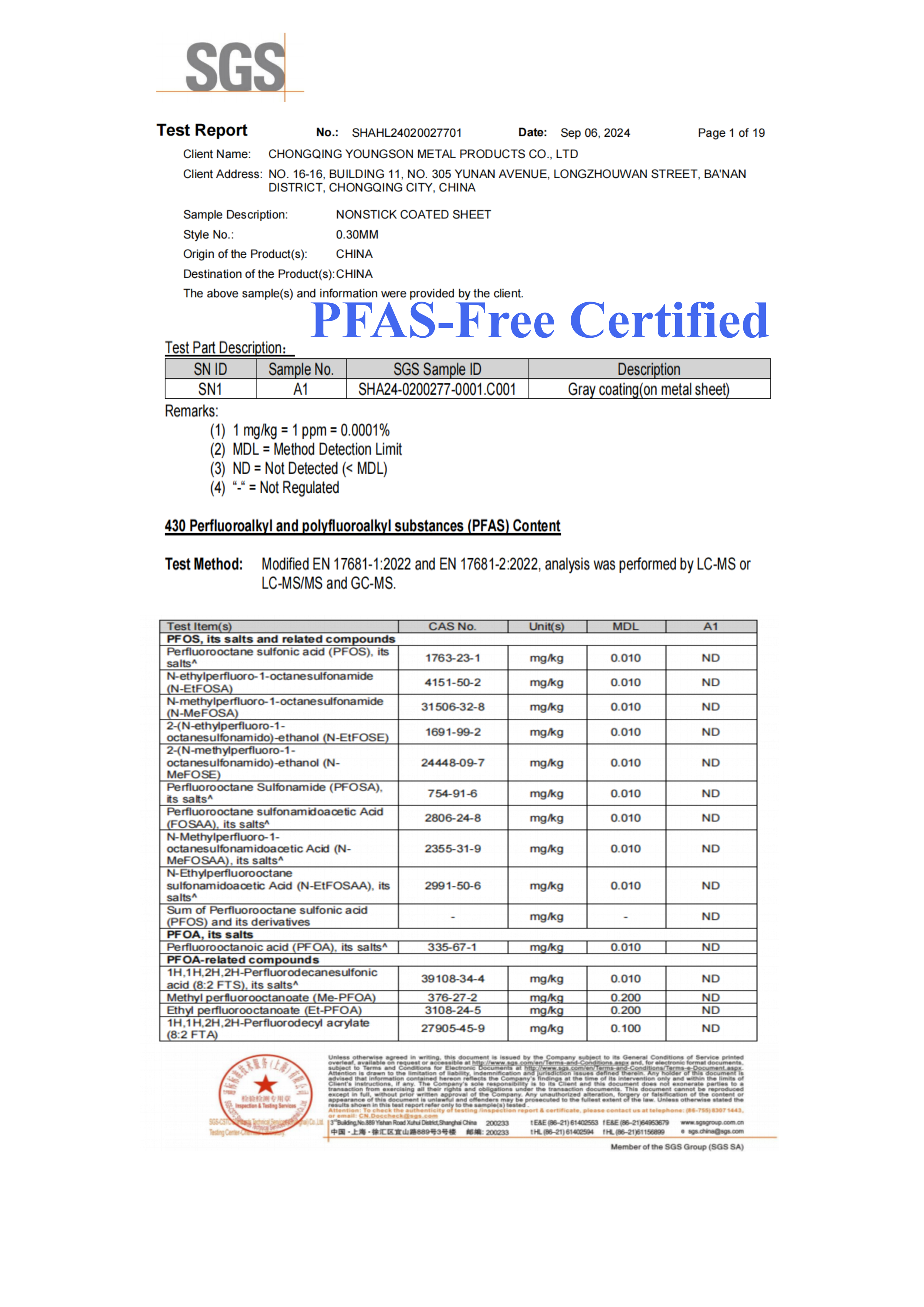
Food-contact nonstick coated steel is engineered to release baked or processed food while resisting repeated heat and cleaning. The Youngson YS-ECCS-G2-PF is a food-grade nonstick ECCS coated steel coil in the food-contact safe nonstick deep-draw coated steel category. It uses high-ductility ECCS or aluminized steel as the base metal and an advanced two-layer nonstick system that is free of PFAS, a family of substances now restricted or questioned in several global food-contact markets. Thickness ranges from 0.30 mm to 0.60 mm, and width from 4 mm to 1000 mm, with custom slit-to-width service available. Finish options include matte black, black silver, grey silver, and milk white, and the material can be supplied as precision strip or blanked small sheets. Thermal resistance is up to 280°C, and the product is suitable for deep drawing.
For food-contact verification, the material passes RoHS and REACH heavy-metal migration tests as well as 3% acetic acid and 5% citric acid tests, and is described by the manufacturer as compliant with European and USA regulatory standards. Typical end-uses are cakeware, bakeware, and commercial food-processing equipment.
2. MoS2 Solid Lubricant Coated Steel for Gaskets and Seal Rings
Molybdenum disulfide is a well-known solid-film lubricant for components exposed to high temperature or where liquid grease cannot be used. The Premium MoS2-M025 from Youngson is a matte black or navy blue coated metal sheet supplied as an alternative to NBR-coated sheet. It is produced on stainless steel, cold-rolled steel, galvanized steel, or tinplate, with thickness from 0.20 mm to 0.30 mm and widths from 4.0 mm to 1250 mm. It passed the ASTM 3# standard calibration oil immersion test without degradation, and it is optimized for use with 2000 W+ high-precision laser cutting and stamping. The coating is intended for automotive exhaust manifold gaskets, turbocharger seal-ring manufacturing, engine cylinder-head gaskets, motorcycle gaskets, and sealing production. The manufacturer reports a 50% material cost reduction compared with NBR-coated sheets.
3. High-Emissivity Coatings for Thermal Appliances
Heating appliances need surfaces that absorb and radiate heat efficiently without peeling over many heating cycles. The TC-70SECC-MB-HE is an anti-peeling high-emissivity matte black SECC steel developed for heating applications. Its base metal is drawn-quality electrogalvanized steel, with an advanced high-emissivity polymer matrix. The product has a thickness of 0.70 mm, comes in strips from 4.0 mm to 1250 mm wide, and has thermal emissivity of at least 0.85. It is designed to survive more than 1,000 continuous thermal cycles from room temperature to 350°C without delamination or peeling. Typical uses include heating disks, electric griddles, toaster components, electric kettle element covers, and commercial or industrial thermal equipment.
4. Antimicrobial Coated Steel for Medical and Sanitary Environments
Controlling surface bacteria is one of the most demanding challenges in cleanroom and medical equipment design. The ZAM-PCM-MGA0508 is a medical-grade antimicrobial matte white coated steel made from deep-drawing galvanized steel or premium ZAM steel with a bio-defense polymer coating. The coating is SGS-certified and REACH/RoHS compliant. Its antibacterial efficiency is at least 99% against E. coli and Staphylococcus aureus, and the surface finish is low-glare clinical matte white with anti-fingerprint behavior. The top coating layer is 10–20 µm thick and the backer is 7–12 µm. The product withstands more than 5,000 continuous wipes with 75% ethanol, isopropyl alcohol, sodium hypochlorite, and hydrogen peroxide without degradation. Applications include clinical diagnostic equipment casings, laboratory furnishings, hospital cleanroom construction, and high-sanitation healthcare environments.
5. Fire-Retardant and Heat-Reflective Coated Steel for Different Fire Scenarios
Fire safety requirements differ widely depending on whether the coated steel is used for interior architecture or for insulated industrial piping.
For interior panels, the ZAM-VCM-FR-Series is a high-performance fire-retardant VCM laminated steel sheet made from a self-healing ZAM substrate and an engineered fire-retardant white PVC film. The PVC film has a UL 94 V-0 flame-retardancy rating. The complete sheet meets EN 13501-1 Class B-s1,d0 in Europe, ASTM E84 Class A in the United States, and BS 476 Part 6/7 Class 0 in the United Kingdom. Corrosion resistance has been verified by a 1000+ hour salt spray test, and the laminate can be bent or deep drawn without stress whitening. Typical targeted uses are data centers, medical facilities, marine interiors, server enclosures, precision metal cassettes, and high-end fire-door OEM.
For oil refinery and petrochemical pipe insulation, the material requirement is different. The PVDF-REF-A2-ZAM-0.5-0.7 is a PVDF coated galvanized or ZAM steel coil designed for metal jacketing around insulated pipes. It has a premium PVDF topcoat of 20–35 µm and a backer coat of 5–15 µm. Fire certification is EN 13501-1 Class A2 and ASTM E84 Class A. The product is available in 0.50 mm and 0.70 mm thicknesses and 1000 mm standard width. For site efficiency on small-diameter insulated pipes, coils with an inner diameter of 200 mm are available. In the broader coil-coating industry, PVDF systems are recognized for long-term UV and chemical resistance; one leading coating supplier states that high-performance PVDF maintains about 70% of color integrity for more than 20 years.
6. Insulating Coated Steel for Cable Trays and Data Infrastructure
Data centers and AI computing facilities have special requirements for metallic cable management. The DC-INS-PRO is a specialty non-conductive metal supplied as dielectric powder color coated steel sheet. It is made from galvanized steel Z200 or ZAM steel with a high-density epoxy or polyester powder coating of 40–80 µm. The main engineering goals are a non-conductive surface, prevention of zinc whiskers, and cleanroom compatibility. The material has a 0T–1T T-bend rating, is capable of roll forming and punching without cracking, and is SGS REACH/RoHS certified. Typical uses are hyperscale data centers, server rooms, cleanroom cable trays, and other applications where metal surfaces must not interfere with sensitive electronic equipment.
7. High-Formability Stamping Grades and Decorative Metallic Finishes
Some functions are achieved through the combination of an ultra-thin gauge and a coating that survives severe deformation. The EcoStamp-TP Series is an eco-friendly prepainted steel made on tinplate or ECCS base metal. It is 100% lead-free and REACH/RoHS certified, and is formulated to produce zero zinc-dross spatter during high-speed stamping. Thickness is as low as 0.12 mm and goes up to 0.70 mm, with widths from 4.0 mm to 1000 mm. It is used for precision metal stamping, automotive components, electronics, packaging, appliances, and battery shells.
In a similar way, the ECO-MIR-015G-TIN-ALT belongs to the family of high-formability gold color coated mirror-finish galvanized steel strips. It has a thickness of 0.15 mm with ±0.01 mm tolerance and can be supplied in golden, brass, lacquered, or high-gloss white finishes. The finish is VOC-free and RoHS/REACH certified, with zero paint peeling during high-speed deep drawing. It competes with traditional tinplate in premium decorative trim, luxury gift packaging, and similar visual applications.
How Buyers Should Specify Color Coated Steel Coil and Sheet
A functional color coated steel specification should include the following information:
- Operating temperature, including peak and cyclic temperature.
- Chemical exposure, such as food acids, oils, solvents, or disinfectants.
- Fire classification required by the project or final market.
- Coating conductivity or insulating requirements.
- Mechanical forming process and required T-bend or deep-draw behavior.
- Substrate standard, including zinc coating mass such as Z180, Z200, or Z275.
- Substance restrictions such as REACH, RoHS, PFAS, or food-contact migration limits.
- Width, thickness, coil inner diameter, and slitting tolerance.
The table below ties common buyer requirements to typical functional directions:
| Buyer Requirement | Coating Direction | Typical Environment |
|---|---|---|
| Food contact and release | PFAS-free two-layer nonstick system | Bakeware, cakeware, food equipment |
| Low friction and heat shielding | MoS2 solid film lubricant | Exhaust gaskets, seal rings, cylinder gaskets |
| Thermal transfer and radiative heating | High-emissivity matte black coating | Heating plates, griddles, toaster elements |
| Hygiene and disinfection | Antimicrobial coating | Medical casings, laboratories, cleanrooms |
| Fire-retardant interior surfaces | VCM laminate with fire-retardant PVC film | Data centers, marine interiors, fire doors |
| Refinery insulation and weather resistance | PVDF coated metal jacketing | Oil refineries, petrochemical plants, LNG facilities |
| Nonconductive cable support | Epoxy/polyester powder insulation coating | AI data centers, server infrastructure |
| Severe stamping and metal packaging | Eco-friendly polymer coating on tinplate or ECCS | Battery shells, electronics, packaging |
Comparison with Conventional Galvanized Steel and Standard Pre-Painted Steel
Hot-dip galvanized steel and standard polyester pre-painted steel remain appropriate for many construction applications. They are relatively economical, well understood, and adequate when color and basic corrosion resistance are the only requirements. Functional color coated steel is not universally better. It is selected when the surface chemistry itself must support a specific process or regulation.
There are several important differences:
| Dimension | Conventional Pre-Painted Steel | Functional Coated Steel |
|---|---|---|
| Main purpose | Color and moderate weathering protection | Surface properties such as release, lubrication, antimicrobial action, or fire retardancy |
| Typical coating chemistry | Polyester, SMP, HDP, standard building PVDF | PTFE/PFAS-free nonstick, MoS2, antimicrobial polymer, fire-retardant PVC film, PVDF, epoxy/polyester powder |
| Testing emphasis | Appearance, adhesion, salt spray | Food migration, thermal cycles, oil immersion, antibacterial efficiency, fire classification, electrical behavior |
| Forming complexity | Usually moderate bending and light profiling | Can be formulated for deep drawing, stamping, 0T–1T bending, and multi-step forming |
| Procurement risk | Lower, because chemistry is standardized | Higher, because performance must be matched to a specific operating condition |
One clear boundary exists: no functional coating can fix a poorly selected substrate. If a component will face salt, humidity, or cut-edge corrosion, the substrate must provide corrosion protection independently of the topcoat. For that reason, suppliers commonly recommend ZAM or high-zinc-mass galvanized steel under functional topcoats.
Technical Boundaries and Practical Limitations
Buyers should keep several constraints in mind when specifying functional coated steel:
- Coating thickness is measured in micrometers, not millimeters. A 20–80 µm topcoat protects a surface; it does not provide structural strength or repair rough steel.
- The best functional coating must be matched to the forming operation. A film that is optimized for flat cladding may crack during deep drawing. Conversely, a deep-drawable coating may be less hard than a standard architectural finish.
- Certifications are construction-specific. A REACH/RoHS or antibacterial certificate refers to a defined product configuration, substrate, and coating. A buyer should not transfer the certificate to every appearance variant.
- Cut edges are normally unprotected after shearing. For critical edge-exposure conditions, corrosion-resistant substrates such as ZAM, or additional edge-protection measures, are required. This is one reason why the “self-healing” behavior of ZAM is relevant in fire-retardant panels and metal jacketing.
- Long-term performance data cannot be rushed. Products that claim high thermal emissivity, fire safety, or nonstick durability should be validated by defined tests rather than by marketing language alone.
Market Context and Sourcing Implications
The broader color coated steel market is large and still expanding. Polaris Market Research estimates that the global pre-painted steel market was valued at USD 24.63 billion in 2023 and is projected to grow at a CAGR of 5.8% to 2032. In 2023, according to MySteel, China exported approximately 6.5 million tons of color-coated steel sheets, a significant share of global trade. However, most of that export volume is conventional building-grade material, not specialized functional coil. This creates an important distinction for buyers: sourcing functional coated steel is not the same as sourcing commodity color coated steel.
For a project involving food contact, fire classification, medical sanitation, or unusual lubrication, the buyer has to verify the supplier’s process capability, test evidence, and substrate control. Ownership of coating lines and slitting equipment matters more than overall tonnage because functional coatings require close control of film thickness, curing, and surface quality.
An independent estimate from Mordor Intelligence also points to rising demand in one subsegment: antibacterial color coated steel, which is projected by that analyst to grow at a CAGR of about 7.2% because of stricter hygiene requirements in cold chains and medical facilities. This is consistent with the broader shift toward coated steel that is sold by documented performance rather than by visual finish alone.
Supplier Qualification: What Evidence to Ask For
A practical qualification process for a functional color coated steel supplier should cover:
- Coating line and slitting line ownership, especially for narrow strip supply.
- Substrate range, including galvanized steel, ZAM, tinplate, ECCS, SECC, aluminum, and stainless steel.
- Independent compliance evidence, such as SGS REACH/RoHS reports, food-contact migration results, antibacterial tests, salt spray reports, and fire classifications.
- Forming validation, including T-bend values, deep-drawing trials, cross-cut adhesion, cupping tests, and stress-whitening checks.
- Custom specification ability, such as film thickness, topcoat/backer balance, coil inner diameter, and coil weight.
- Process engineering support, because a specialty coating rarely works without discussion of the buyer’s equipment and tooling.
Youngson Metal operates from Chongqing, China, with its own coating lines and slitting machines, and says it can tailor metal solutions around drawn PET film lamination, PVC film lamination, deep-drawn Teflon and nonstick coating, commercial pre-painted steel, and stainless steel pre-painting. The company’s product descriptions emphasize SGS-tested REACH/RoHS compliance, deep-draw formability, and coating systems designed for specific industrial functions.
Future Outlook
Three developments are expected to shape how industrial buyers specify color coated steel coil and sheet in the coming years. The first is regulatory pressure: RoHS, REACH, food-contact rules, and PFAS restrictions are progressively narrowing the set of approved coating materials. Suppliers that can document compliance and migration behavior will have an advantage in regulated markets.
The second is forming integration. As manufacturers move toward higher-speed stamping and more complex deep-drawn parts, coating suppliers will need to optimise not only surface chemistry but also elasticity, adhesion, and lubricity under severe deformation. The distinction between a coating company and an engineering partner will become less clear.
The third is functional validation. Antibacterial claims, thermal emissivity values, fire classifications, and nonstick durability will need to be supported by reproducible third-party tests. Buyers will increasingly require batch-level evidence rather than a single certificate from a brochure.
Conclusion
Selecting a color coated steel coil and sheet should begin with the operating function that the coating must perform. Food contact, heat transfer, friction control, fire safety, electrical insulation, and corrosion protection all impose different material requirements. A supplier such as Youngson Metal can provide several of these functional coating families, but the final decision should always be based on substrate selection, coating evidence, and verification against the buyer’s actual production process.
Download the Youngson Metal company catalogue for the full product range.
FAQ
What is color coated steel coil and sheet?
Color coated steel coil and sheet is a metal substrate, such as galvanized steel, tinplate, ECCS, ZAM, aluminum, or stainless steel, processed through a coating line with a paint, film, or polymer layer. When the coating adds a specific function such as food-release, fire retardancy, lubrication, antimicrobial protection, or electrical insulation, it is referred to as functional color coated steel.
What functional coated steel types are available for deep drawing?
Several coating families are designed for deep drawing. Examples include the EcoStamp-TP Series on tinplate or ECCS, the YS-ECCS-G2-PF food-grade nonstick steel, and the SECE-PTFE-MATTE-050 for motor housings. These materials combine ductile substrates with flexible coating systems that can survive stamping and forming without delamination.
Why is PFAS-free nonstick steel important for food contact?
PFAS is a group of substances under increasing regulatory scrutiny in food-contact materials. The YS-ECCS-G2-PF uses an advanced two-layer nonstick coating system that is PFAS-free. It passes RoHS and REACH heavy-metal migration tests plus 3% acetic acid and 5% citric acid tests, which are common methods for evaluating food-contact suitability in Europe and the United States.
What is MoS2 coated steel used for?
MoS2 coated steel uses molybdenum disulfide as a solid-film lubricant. The Premium MoS2-M025 is intended for automotive exhaust manifold gaskets, turbocharger seal-ring manufacturing, engine cylinder-head gaskets, and motorcycle sealing production. It passed the ASTM 3# standard calibration oil immersion test and is designed for high-precision laser cutting and stamping.
What does an antimicrobial coating prove?
An antimicrobial coating is tested for its ability to reduce bacteria on the surface. The ZAM-PCM-MGA0508 has SGS-certified antibacterial efficiency of at least 99% against E. coli and Staphylococcus aureus. It is also designed to withstand more than 5,000 disinfectant wipe cycles without degradation.
Which fire classifications apply to coated steel?
Fire classifications depend on the product, market, and application. The ZAM-VCM-FR-Series is rated UL 94 V-0 for its PVC film and meets EN 13501-1 Class B-s1,d0, ASTM E84 Class A, and BS 476 Part 6/7 Class 0. The PVDF-REF-A2-ZAM-0.5-0.7 jacketing material is certified to EN 13501-1 Class A2 and ASTM E84 Class A.
What is PVDF coated steel used for?
PVDF coated steel is used in industrial environments that require weather resistance, chemical resistance, and fire performance. The PVDF-REF-A2-ZAM-0.5-0.7 is a petrochemical-grade metal jacketing product for oil refinery and petrochemical pipe insulation. It is available with a small-diameter coil option, inner diameter 200 mm, for site efficiency on insulated pipes.
Can color coated steel strip be supplied in narrow custom widths?
Yes. Many functional coated steel products are available in width ranges starting at 4.0 mm, such as the MoS2 coated sheet, the TC-70SECC-MB-HE heating steel, and the YS-ECCS-G2-PF food-grade nonstick steel. Custom slitting is a relevant capability when downstream automation requires tight width tolerance.
Tem questões ou precisa de mais detalhes?
Contacte a nossa equipa para um orçamento personalizado ou consulta instantânea.
Solicitar orçamento
Preencha o formulário abaixo e a nossa equipa entrará em contacto com uma proposta personalizada.
Chat direto do WhatsApp
Prefere conversar em tempo real? Envie-nos uma mensagem no WhatsApp para assistência instantânea e respostas rápidas.
- Obter orçamento personalizado
- Partilhar fotos ou documentos
- Discuta as suas necessidades diretamente
Geralmente responde em 5–30 minutos durante o horário de expediente.