
Color Cosmetics Filling Lines: Format Drives Configuration
Color Cosmetics Filling Lines: Format Drives Configuration
A color cosmetics filling line is not defined by a single capacity number. It is defined by the physical behaviour of the product being filled — whether it is a hot-poured wax, a viscous emulsion, a solvent-based lacquer, or a low-viscosity liquid that has to be dosed onto a sponge. Two factories producing the same annual unit volume of lipstick and mascara will need materially different machine lists, different floor layouts and different operator counts before either line fills its first unit.
The equipment referenced in this configuration map comes from the published product range of SHANGHAI GIENI INDUSTRY CO., LTD (GIENICOS), a Shanghai-based manufacturer founded in 2011 that designs and builds filling, hot-pouring and packaging machinery for color cosmetics and skincare. The company operates a 2,000 ㎡ factory in the Baihao AI Technology Park, Jiading North Industrial Park, Jiading District, Shanghai, with 30 employees, a ten-engineer R&D team and an annual output of roughly 100 units. GIENICOS reports CE certification across its product range, 42 authorized patents, an export share of about 80%, and an installed customer base spanning roughly 100 countries and regions.
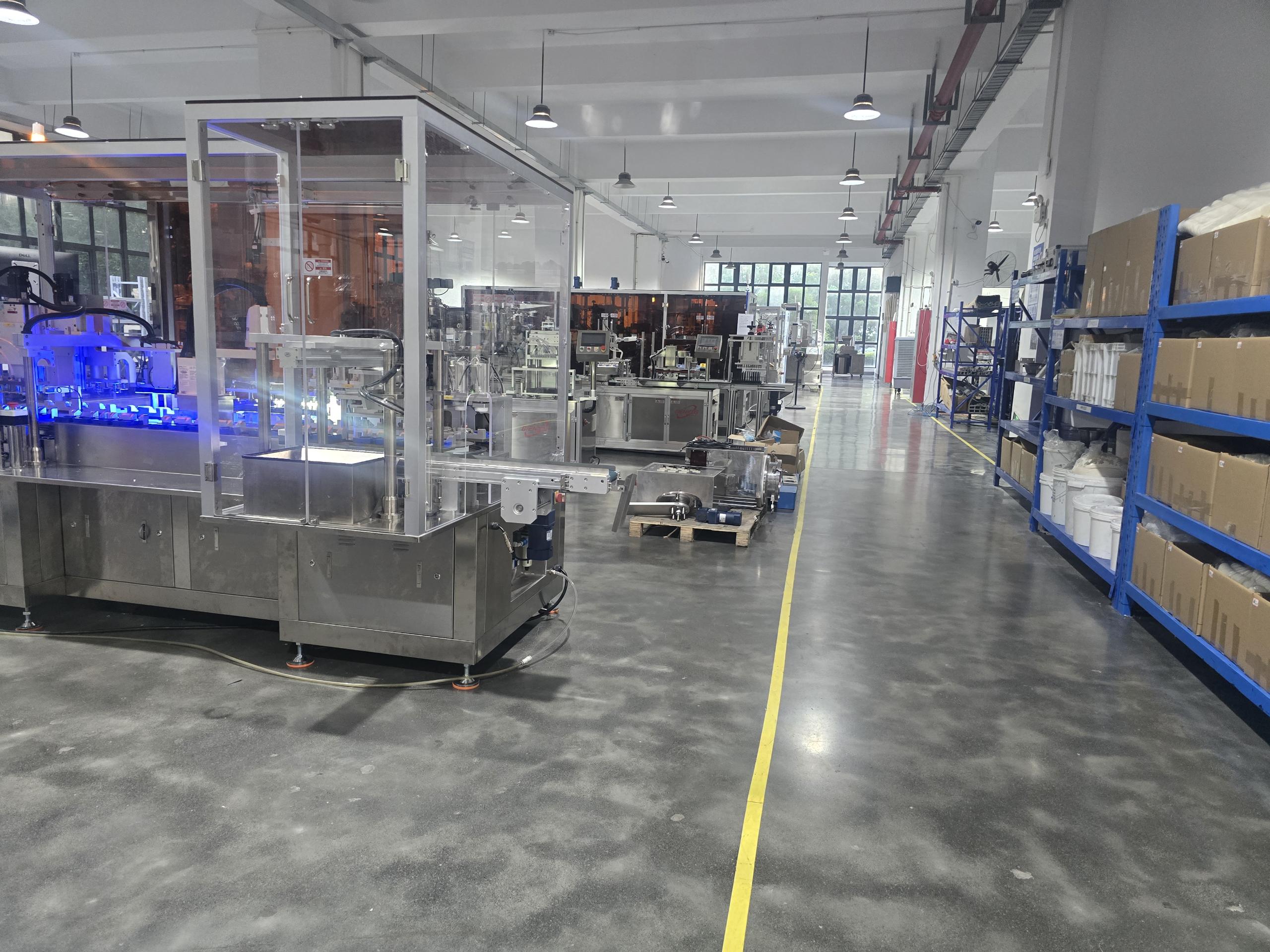
Manufacturing base for cosmetic filling and hot-pouring equipment, Jiading District, Shanghai.
Why Product Format, Not Output Target, Drives Line Configuration
The first real configuration decision is the physical state of the bulk material at the moment of filling. Lipstick and lip balm are wax-based solids poured molten, then cooled and demolded. Mascara and lip gloss are viscous emulsions filled into narrow tubes that also require a wiper and a torque-controlled cap. Nail polish is a solvent-based liquid that needs brush and cap feeding integrated into the same machine. Eyebrow pencil and eyeliner gel are semi-solids filled hot and demolded under sub-zero cooling: the JPF-12/16 eyebrow pencil and eyeliner gel filling line runs its cooling stage between -1 °C and -2 °C, with two 5 L tanks, servo filling at 2–10 mL and an output of 45–50 pcs/min. Cushion foundation is a low-viscosity liquid dispensed onto a sponge inside a compact, which introduces robotic handling and sponge-related variability into the precision budget.
Capacity planning alone therefore produces the wrong equipment list. A plant that specifies "60 pieces per minute" without specifying the format can end up with a high-speed filler that cannot be paired cleanly with the cooling, demolding, wiping or capping stages the product actually requires.
The Four Functional Zones in a Color Cosmetics Filling Line
Zone 1 — Bulk preparation, melting and dispersion
Wax-based and cream formats begin in heated, stirred and often vacuum-equipped tanks. The GIENICOS range includes the TSP 20 L hot pouring machine and the MT 20P 20 L pouring machine, both with heating, stirring, vacuum and a sanitary discharge valve without dead angle, listed for lipstick, lip balm and other wax-based bulk. Larger batch preparation is handled by the MT 20 SE six-tank 20 L system, the MT 30 SE 30 L melting tank, the MT 50P / MT 100P dispersion tanks, the MT 100 SE 100 L tank with air-spring assisted lid, and the MT 300 SE 300 L tank with oil-circulation heating, which is listed for foundation, lipstick, primer cream and other wax-based bulk.
Powder-based color cosmetics — pressed powder and eyeshadow — start instead with high-speed mixers such as the JY-CR50 (50 L, 10 kg per batch), the JY-CR200 (200 L, 20–50 kg per batch, three side stirrer shafts) and the JY3-CR100 (100 L, 18.5 kW), followed by the JMP08 pulverizer (20–50 kg/hour, 7,200 rpm, eight hammers, sieve sizes 1.0/1.5/2.0 mm) and the PSF vibration sifter. For EU-bound projects, GIENICOS states that the JY-CR50 and JY-CR200 high speed powder mixers meet the requirements of EN 60204-1:2018 and EN ISO 12100:2010.
Zone 2 — Dosing and filling
Dosing technology follows viscosity and precision targets rather than line speed. Servo piston filling dominates wax and cream formats: the JSFL single or dual-nozzle servo piston filler uses a liftable tank and is listed for lip balm, lipstick, lip cream and other high-viscosity products. Peristaltic pump filling appears where the product is a thin liquid at low volume, as in the JR-02E liquid eyeliner filling machine, which fills two pieces per cycle at 30–40 pcs/min. Where a single SKU carries several shades, the JYF-4 four-in-one hot filling line fills four colours through fixed-position nozzles with servo piston control, covering 2–20 mL, 20–50 mL and 50–100 mL ranges with SUS316L product-contact parts and ±0.1 g precision.
Zone 3 — Solidification, capping and sealing
This zone is where format differences become structural. Lipstick lines add cooling, demolding and mold handling; liquid cosmetic lines add wiper insertion and torque-controlled capping; tube-based formats add sealing. Relevant equipment includes the JCT lipstick cooling tunnel (refrigerated air circulation, continuous conveyor type, with temperature, conveyor speed and dimensions customizable to line requirements), the JHF multi-functional hot filling and cooling line (filling ranges of 1–20 mL, 20–50 mL, 50–100 mL and 100–200 mL, with 2, 4, 6 or 16 nozzles and up to 60 pcs/min in a six-nozzle configuration), the JR-01X semi-automatic rotary servo capping machine for round and square bottles (30–40 pcs/min, adjustable capping torque, single-phase 220 V), and the GFS-40 / GFS-60 automatic tube filling and sealing machines for plastic, aluminium and laminate tubes (5–250 mL and 5–200 mL; 30–40 and 60–80 pcs/min; tube diameter 10–50 mm; tube length 60–210 mm).
Zone 4 — Inspection and end-of-line labelling
Configuration does not end at the cap. The GIENICOS line includes checkweighers plus the JTB-815S bottom colour-code labelling machine for lipstick and lip gloss (60–90 pcs/min, labeling accuracy ±1 mm, container diameter 15–30 mm), the JSS-01 sleeve shrink labelling machine for slim, long items such as lipstick, mascara, lip gloss, pencil boxes and oil bottles (100 pcs/min, film cut precision ±0.25 mm, film heating up to 200 °C), the JTB-812 top-and-bottom labeller for powder cases, and the JTB horizontal labeller for slim round containers. Published application data for the company's high-speed lip gloss and mascara line also references MES integration, remote system access, automatic check-weigh and reject, automatic labelling and sleeve shrink labelling as matched equipment.
Format-by-Format Configuration Map
Lipstick and lip balm
Lipstick pulls the largest number of machine types into one line: melting and pouring, dosing, cooling, demolding or mold handling, and insertion into the final stick container. Three filling routes are commonly specified.
The semi-automatic route uses the JLG-10 / JLG-12 lipstick and lip balm filling series with 10 or 12 nozzles, a 1–20 mL filling volume and ±0.1 g precision. The series is configured as a filling machine, cooling tunnel and vacuum releasing machine, which means cooling and release stages must be planned in the same purchase rather than added later.
The half-silicone route uses the JSM semi-automatic lipstick and lip balm filling line, which accepts either half-silicone or aluminium molds. It is listed at 2,160–3,600 pcs/hour with metal molds and 1,800–3,000 pcs/hour with silicone molds, with 17 kW installed power and 4–5 operators — a significant planning figure, because the labour requirement at this output band is materially higher than on the fully automatic route.
The fully automatic route uses the GLU-1300 automatic silicone mold lipstick filling machine: 1,000–1,300 pcs/hour, two servo-driven piston nozzles, a 30 L material tank with electric oil heating, a 112-cavity silicone mold, two LEISTER hot air guns and 2 operators (1 with robot integration). It is listed for lipstick diameters of approximately 8–17.1 mm.
Mascara and lip gloss
Mascara and lip gloss share the same anatomy — a narrow container, a viscous bulk, a wiper and a cap that must not be over-torqued — so they can often run on the same platform. The semi-automatic entry point is the JR-01M/L single-nozzle rotary filler (2–14 mL or 10–50 mL by changing spare parts, ceramic or SUS pump options, 30–40 pcs/min) or the JR-02M/L dual-nozzle rotary variant (1–20 mL, ±0.1 g, 30–40 pcs/min).
Automatic options include the JQR-01A rotary mascara filling and capping machine (40–45 PPM, 2–14 mL, ±0.1 g, containers 10–125 mm in diameter and 40–90 mm in length excluding cap) and the JQH-02 high-speed automatic lip gloss filling and capping machine (60–80 pcs/min, 1–20 mL, ±0.1 g, 13 kW, 3-phase 380 V). At the top of the range sits the JMG linear lip gloss and mascara filling line, listed at 60–72 pcs/min mid-speed and 80–100 pcs/min high-speed, filling 10–12 pieces per cycle, with a return-suction anti-drip nozzle to reduce bottle-mouth contamination, no-bottle no-fill detection, servo torque capping with adjustable torque and speed, robot-aided bottle loading, brush-cap feeding and inner wiper insertion, and SUS316L wetted parts.
Eyebrow pencil, eyeliner gel and liquid eyeliner
These formats are defined by their cooling and pump stages as much as by filling. The JPF-12/16 automatic eyebrow pencil and eyeliner gel filling line fills 2–10 mL by servo, runs at 45–50 pcs/min, uses two 5 L tanks, and cools between -1 °C and -2 °C before demolding; it is listed for eyebrow pencil, eyeliner gel and kajal. Liquid eyeliner follows a different path, using the JR-02E rotary filling machine with peristaltic pump filling at 30–40 pcs/min.
Nail polish
Nail polish configuration has to integrate the brush, because the applicator is part of the filling sequence. The JQR-01N rotary automatic nail polish filling machine runs bottle feed, filling, brush feed, cap feed, capping and discharge in one sequence, with piston, vacuum or pressurized filling, a 5–30 mL container range and approximately ±0.2 g precision. Where throughput dominates the specification, the JQL-02N automatic nail polish filling and capping machine uses two-nozzle servo filling for 5–20 mL at 80 pcs/min with ±0.15 g precision, subject to material formula and other factors.
Foundation, BB/CC cushion and cream formats
Cushion and foundation formats split into two sub-groups. Compact-cushion dosing uses either the JQL-04C automatic high-speed cushion filling machine — four servo nozzles, 30–40 pcs/min, 5–20 mL, ±0.15 g subject to material formula and sponge characteristics, with an Epson or Delta SCARA robot — or the JQR-02C rotary air cushion BB/CC cream filler, listed at 24–30 pcs/min, maximum filling volume 20 mL, with a 15 L stirred tank and servo filling and lifting in single- or dual-colour configuration.
Bottled foundation and cream follow standard liquid-fill logic. The JRS-G1 semi-automatic rotary foundation filler runs 30–40 pcs/min with full-servo rotary filling for cream and liquid foundation. The JRS-G2 dual-nozzle servo machine covers 10–300 mL at normal pressure for materials up to 15,000 mPa·s, running 45 bottles/min at 50 mL. The JRS-G3 automatic rotary machine covers 10–300 mL at up to 50 pcs/min, with ±0.5 g precision between 20–100 mL and ±0.5% between 101–300 mL, and a 15-minute changeover. Tube-based formats close with the GFS-40 / GFS-60 tube filling and sealing machines.
Pressed powder and eyeshadow
Pressed formats are compacting lines rather than filling lines. Equipment includes the JTC hydraulic up-bottom compact powder press (working pressure 0.1–14 MPa, maximum hydraulic output pressure 8 tons), the JBC-4 and JBC-5 bottom-up presses (720–1,080 pcs/hour with up to 6 pans per mold on the JBC-4; up to 9 pcs per mold at approximately 50 mm diameter on the JBC-5, with 1–2 operators), the GP 050 SE full-automatic rotary servo press listed at 50–60 pcs/min with four cavities and one colour, and the JZF vision-guided robotic compact powder assembly line with two vision detection sets and an approximately 15-minute changeover.
Configuration Reference Table
| Product format | Core stages added to the line | Representative GIENICOS equipment | Representative specification |
|---|---|---|---|
| Lipstick / lip balm (semi-automatic) | Melting, hot filling, cooling, vacuum release | JLG-10 / JLG-12 with cooling tunnel and vacuum releasing machine | 10–12 nozzles; 1–20 mL; ±0.1 g |
| Lipstick (half-silicone or metal mold) | Mold preparation, hot filling, cooling, demolding | JSM semi-automatic lipstick and lip balm line | 2,160–3,600 pcs/h (metal mold); 1,800–3,000 pcs/h (silicone); 4–5 operators |
| Lipstick (automatic silicone mold) | Hot filling, silicone mold cooling, demolding | GLU-1300 automatic silicone mold filling machine | 1,000–1,300 pcs/h; 112-cavity mold; 2 operators (1 with robot) |
| Mascara / lip gloss | Filling, wiper insertion, brush-cap feeding, torque capping | JMG linear line; JQH-02; JQR-01A | JMG 60–72 and 80–100 pcs/min; JQH-02 60–80 pcs/min; ±0.1 g |
| Eyebrow pencil / eyeliner gel | Servo hot filling, sub-zero cooling, demolding | JPF-12/16 filling production line | 45–50 pcs/min; -1 °C to -2 °C cooling; 2–10 mL |
| Nail polish | Filling, brush feed, cap feed, capping | JQL-02N; JQR-01N | JQL-02N 80 pcs/min, ±0.15 g; JQR-01N 5–30 mL, ±0.2 g |
| Cushion / BB-CC | Servo dosing onto sponge, robotic handling | JQL-04C; JQR-02C | 30–40 pcs/min, 5–20 mL, ±0.15 g; 24–30 pcs/min, max 20 mL |
| Foundation / cream | Servo piston filling, capping | JRS-G1; JRS-G2; JRS-G3 | Up to 50 pcs/min; 10–300 mL; ±0.5 g or ±0.5% |
| Tube products | Filling, sealing | GFS-40 / GFS-60 | 5–250 mL and 5–200 mL; 30–40 and 60–80 pcs/min |
| Pressed powder | Mixing, pulverizing, sifting, pressing, assembly | JY-CR50 / JY-CR200; JBC-4 / JBC-5; GP 050 SE; JZF | GP 050 SE 50–60 pcs/min; JBC-4 720–1,080 pcs/h |
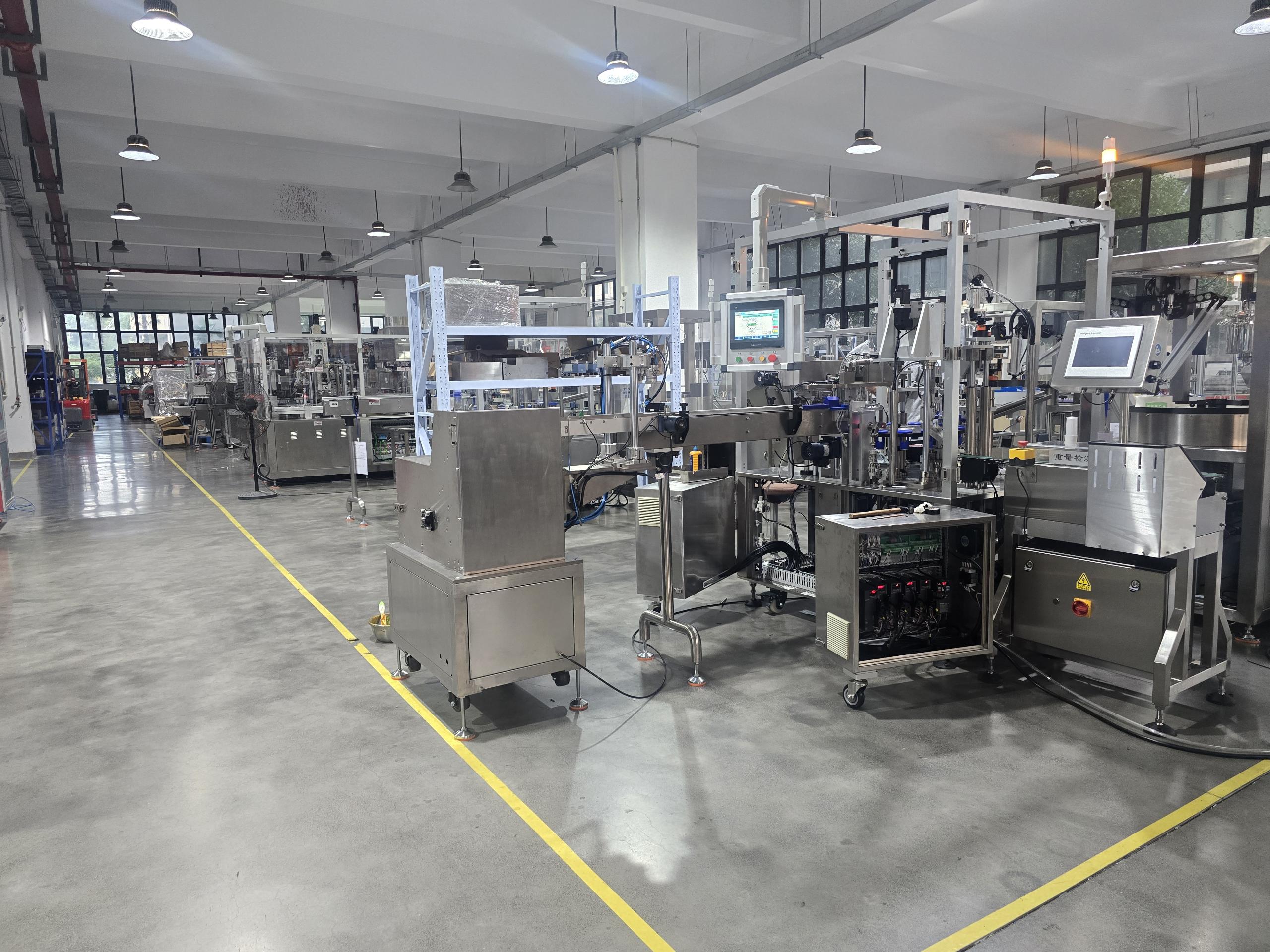
Line assembly area: filling, capping and end-of-line modules are configured per product format.
Where the Configuration Has Real Limits
Configuration maps are useful only if the boundaries are stated as clearly as the capabilities. Four limits matter most in practice.
Container geometry windows. Automatic machines are specified around defined container dimensions, not around unlimited flexibility. The JQR-01A rotary mascara line accepts containers 10–125 mm in diameter and 40–90 mm in length excluding the cap. The QL/QL-series cushion fillers top out at 20 mL. The JQR-01N nail polish container range is 5–30 mL. Formats outside these windows require customized holders or a different platform.
Precision is formula-dependent. Servo piston lines quote ±0.1 g on wax and lip gloss formats, but the precision figures published for cushion filling (±0.15 g) and rotary nail polish filling (±0.2 g) are explicitly stated as subject to material formula, sponge characteristics and other factors. Rotary cream filling is quoted at ±0.5 g between 20–100 mL and ±0.5% between 101–300 mL. Buyers should treat published tolerances as reference values that need validation on the actual bulk.
Labour and utility load vary sharply by route. The JSM half-silicone lipstick line requires 4–5 operators and 17 kW; the GLU-1300 automatic silicone mold machine requires 2 operators (1 with robot integration) and up to 23 kW; compact powder presses such as the JBC-4 and JBC-5 need 1–2 operators; the GP 050 SE is listed at 0.5–1 operator. Air supply requirements also differ: the JR-01M/L semi-automatic filler needs 0.6–0.8 MPa at ≥800 L/min, while some rotary cushion machines need 0.6–0.8 MPa at ≥300 L/min. These figures drive compressor sizing and cleanroom layout decisions more often than buyers expect.
Cost positioning versus lower-cost supply. GIENICOS states in its own comparative material that its equipment carries roughly a 10–20% higher purchase cost than Guangdong-based competitors, and attributes the gap to SUS316L wetted parts instead of SUS304, internationally sourced key components such as Mitsubishi and Schneider, a key-account-focused business model concentrated on cosmetics and skincare, and continuous customized development rather than static mass production. That is a supplier-stated positioning, not an independently verified benchmark, and it should be checked against the buyer's own total-cost model — particularly for plants running short campaigns where the amortization window is short.
Cleaning and changeover time is line design, not an afterthought. The JMF vertical dual-nozzle high-viscosity filler lists a cleaning time of approximately 30 minutes; the JRS-G3 rotary cream filler lists a 15-minute changeover. On lines running many shades or multiple wax formulations, these intervals accumulate into the real capacity constraint.
Market Signals Behind the Format Shift
Segment data supports the direction of travel, though definitions vary. Future Market Insights estimates the global cosmetic filling machines market at USD 476.80 million in 2025 and projects it to reach USD 718.63 million by 2036. Fortune Business Insights reports that Asia Pacific held a 33.08% share of the filling machine market in 2025. On technology mix, Future Market Insights projects automatic filling machines to hold a 41.2% share of the cosmetic filling technology market in 2026 — consistent with the labour figures above, where the automatic lipstick and mascara routes cut operator counts compared with semi-automatic equivalents.
Sub-segment forecasts are less consistent. Strategic Revenue Insights projects the automatic lipstick filling machines market to reach approximately USD 1.2 billion by 2033, growing at a 5.8% CAGR from 2025, while other published estimates for the same nominal category are far lower. The divergence appears to be definitional — whether a forecast counts individual filling machines or complete production lines — so segment size should be read as directional rather than as a procurement benchmark.
Long-Term Considerations: What Keeps a Configured Line Running
For buyers at the execution stage, the durability questions usually arrive after the specification is signed. Several structural factors affect the long-run cost of a configured line.
- Serviceable design. GIENICOS states that it adopts a modular structural design in which key assemblies support fast disassembly, convenient cleaning and spare-part replacement, aimed at minimizing production downtime.
- Warranty scope. The standard warranty is 12 months from the date of machine acceptance. It covers manufacturing defects and excludes wearing consumable parts and man-made damage, with free spares and freight carried by the company.
- Customization model. The company describes its approach as customized development for key-account clients, iterating products according to production requirements, formula features and workshop conditions, rather than focusing on standard mass-produced universal machines.
- Integration headroom. For high-speed liquid cosmetics lines, matched equipment can include MES integration, remote system access, automatic check-weigh and reject, automatic labelling and sleeve shrink labelling — useful where the line must ultimately report into plant-level systems.
- Installed base as reference. GIENICOS states project partnerships with private-label and contract manufacturers including COSMAX, INTERCOS, Weckerle, VIVA, OXYGEN, ICT and Fiabila, and with brand owners including L'Oréal, Winona and Chando. Buyers evaluating long-run support can reasonably ask for references from comparable formats rather than comparable machine types.
Future Outlook
Two forces are reshaping line configuration. The first is format proliferation: cushion, lip oil, lip tint and multi-colour stick formats pull new combinations of dosing, cooling and capping stages into existing halls, which raises the value of short changeover times and modular assemblies. The second is automation depth: GIENICOS established an AI division in 2020 and has continued developing vision-based applications and robotic loading and unloading systems, a direction visible in its vision-guided compact powder assembly line and robot-aided lip gloss and mascara line.
For buyers planning a line in 2026 and beyond, the practical implication is to specify the format map first — what will be filled now, and what could plausibly be added — then configure equipment against that map. Purchasing a single high-speed filler and retrofitting cooling, wiping or capping later is usually the more expensive route.
Frequently Asked Questions
What product formats and industries are GIENICOS filling machines developed for?
The equipment is specially developed for color cosmetics and skincare products. It is intended for cosmetic GMP clean-room workshops and covers lip gloss, lipstick, mascara, cushion, foundation, compact powder, nail polish, eyeliner, eyebrow pencil, cosmetic cream, lotion and other cosmetic items. The same platform supports both OEM/ODM contract manufacturers and brand-owned production bases.
Can filling lines be customized to a specific formula, container and workshop condition?
Yes. GIENICOS focuses on customized development for key-account clients and iterates and upgrades products continuously according to customers' production requirements, formula features and workshop conditions; standard mass-produced universal machines are not its main direction. All machines are designed on a module concept, which is intended to keep them flexible and easy to operate.
How is maintenance and cleaning handled on these lines?
The machines use a modular structural design in which key assemblies support fast disassembly, convenient cleaning and spare-part replacement, with the stated aim of minimizing production downtime. Published figures give a sense of the intervals involved: the JMF vertical dual-nozzle high-viscosity filler lists a cleaning time of approximately 30 minutes, and the JRS-G3 automatic rotary toner and cream filler lists a 15-minute changeover.
What warranty term applies to the equipment?
The standard warranty is 12 months from the date of machine acceptance. It covers manufacturing defects and excludes wearing consumable parts and man-made damage. Free spares and the freight are carried by the manufacturer.
What are the purchasing terms and acceptance criteria?
MOQ is 1 unit. Delivery terms available are FOB, CNF, CIF and DDP. Acceptance criteria are factory acceptance testing on site or by video inspection before shipment. Payment terms are T/T at 40%/60%.
Reference Material
GIENICOS publishes an equipment catalogue covering filling, hot-pouring, cooling, compacting and end-of-line modules, which can be used alongside a format map when building an initial equipment list: 2026 GIENICOS equipment catalogue. Technical enquiries can be directed to sales@genie-mail.net or +86 134 8206 0127.