
Commercial LED Lighting: 7 Fixtures for Warehouse, Outdoor, Indoor
Commercial LED Lighting: 7 Fixtures for Warehouse, Outdoor, Indoor
A commercial lighting shortlist is a decision tool, not a catalogue page. Warehouse aisles, exterior yards and interior fit-outs are judged against different criteria — ingress protection, mounting geometry, sensing, service access and warranty length — so the practical question is rarely which fixture is best in general, but which fixture belongs to which environment.
This reference article builds that shortlist by application, using seven fixture families from Zhejiang Lepeng Electric Appliance Co., Ltd.: the SH-E01 linear high bay, the HL-E01 UFO high bay, the FL-C01 outdoor floodlight, the solar security light 8200, the PL02 panel light, the FCL-E01 ceiling fan light and an A60 LED bulb. Each entry below is limited to attributes the manufacturer documents, with selection notes by environment and the boundaries a buyer should verify before ordering.
Why procurement now shortlists by environment, not by product category
Commercial LED lighting projects rarely buy a single fixture type twice. A distribution centre evaluates aisle uniformity at height; a manufacturing yard evaluates weather exposure and glare at the site boundary; an office or retail interior evaluates ceiling appearance, access for cleaning and how often the space can be shut down for maintenance. Grouping fixtures by product category hides those differences. Grouping them by environment exposes them early, before price negotiation begins.
The market backdrop explains why this matters more than it did a decade ago. Grand View Research estimated the global commercial lighting market at USD 47.54 billion in 2024, with LED products holding a 58.1% revenue share. Fortune Business Insights valued the wider LED lighting market at USD 109.11 billion in 2025, with a projection of USD 336.90 billion by 2034. On the supply side, OEC data records China exporting USD 31.4 billion in light fixtures in 2024 — 59.3% of global light fixture exports. When a large majority of fixtures on a tender list share the same origin and the same basic technology, differentiation moves from the light source to the fixture's fit with the site.
The supplier behind this shortlist
Zhejiang Lepeng Electric Appliance Co., Ltd. is an LED lamp and luminaire manufacturer founded in 2009 and headquartered in the Baiguan Industrial Zone of Shangyu, Zhejiang Province, China. The company operates its headquarters factory together with two additional production bases in Qiandaohu, Zhejiang and Jingdezhen, Jiangxi. It reports 200,000 m² of factory space, 2,000 skilled workers and a monthly production capacity of 45 million LED lamps and 5 million LED luminaires, supported by a 200-person R&D team. Its own brand MKOPTO is sold across global lighting markets, and approximately 90% of output is exported, with the EU, Southeast Asia, the Middle East and Latin America listed as main markets.
Two capability facts are relevant to a fixture shortlist rather than to a company profile. First, the company states that it holds industry certifications and qualification certificates that attest to its manufacturing standards, which is the documentation buyers normally request at the shortlist stage. Second, its factory is described as fully capable of undertaking OEM and ODM customised projects for global clients — a factor that matters when a project needs a modified housing, a specific mounting accessory or a private-label programme rather than a catalogue item.
Five filters that eliminate fixtures before price is discussed
Experienced buyers rarely compare a full fixture list on price. They apply environment filters first, because a fixture that fails a filter cannot be rescued by a discount. The five filters below are the ones that most often change a shortlist.
| Filter | Question to ask | Effect on the shortlist |
|---|---|---|
| Ingress protection (IP) | Will the fixture see dust, low-pressure jets, rain, or washdown-adjacent conditions? | Removes interior-rated fixtures from exterior and wet-process areas |
| Mounting height and geometry | Is the mounting plane high or low, and does the layout follow racking aisles or an open volume? | Decides between linear and round high bay formats |
| Thermal environment | Is the space hot, unventilated, or directly sun-exposed? | Makes housing material and heat path as important as wattage |
| Control and sensing | Does the site need automatic switching, motion response, or off-grid operation? | Determines whether PIR or solar variants are required |
| Warranty and service access | Who replaces the fixture, and how often can the site be shut down? | Turns warranty length into a maintenance-planning input |
Price is compared after these five, not before. A shortlist that survives all five filters is short enough to negotiate on cost, lead time and payment terms.
Warehouse, factory and workshop fixtures
SH-E01 linear high bay: IP65, 5-year warranty, aluminum alloy housing
The SH-E01 is a linear high bay specified for warehouses, factories and workshops. Three documented attributes define its position in this shortlist: IP65 ingress protection, a 5-year warranty, and an aluminum alloy housing. In practice, IP65 allows the fixture to be considered for production areas where dust and low-pressure water jets are part of routine cleaning, not only for dry storage halls — a distinction that frequently removes standard high bays from a factory shortlist. The aluminum alloy housing addresses the thermal path, which is the mechanism that governs how a high-output fixture behaves over years rather than months in an unventilated roof space.
The 5-year warranty is the attribute with the clearest procurement consequence. Where a site cannot be shut down often, the warranty period sets the horizon over which the fixture, rather than the lamp, sits inside the service contract. Buyers comparing a 5-year position against a shorter one should still read the warranty as a document: coverage scope, exclusions and the service route for an overseas project need to be confirmed in writing, not inferred from the headline period.
HL-E01 UFO high bay: warehouses, factories, retail and gyms
The HL-E01 is a UFO-format high bay for warehouses, factories, retail floors and gymnasiums. The round format concentrates the light source at a single suspension point, which suits open volumes where the fixture hangs above a working plane rather than following a racking line. Because the same family is specified across storage, production, retail and sports environments, it can carry a project that mixes back-of-house and customer-facing space under one roof, reducing the number of spare part references a facility team has to hold.
Choosing between the two high bay formats
A single decision rule resolves most of the choice. Where racking defines the aisles and the lighting layout follows the aisle grid, the linear format fits the geometry. Where the volume is open, mounting is point-based and the ceiling structure favours pendant points, the UFO format fits. Sites that mix a high open bay with a racked store commonly run both formats in one shortlist.
Selection boundary: a fixture list is an input to a lighting design, not a substitute for one. Illuminance levels, uniformity, spacing and emergency lighting compliance depend on ceiling height, racking layout, reflectance and local code, and must be verified through a project photometric study before quantities are fixed.
Outdoor and perimeter fixtures
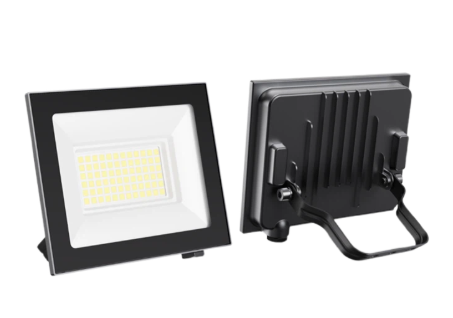
Outdoor floodlighting covers facade, yard and industrial perimeter applications within one fixture family.
FL-C01 outdoor floodlight, 10W to 300W
The FL-C01 is an outdoor floodlight offered across a 10W to 300W range and specified for residential, commercial and manufacturing environments. The practical value of a single family spanning that range is procurement simplification: facade lighting, yard lighting and industrial perimeter lighting can be sourced from one series rather than three, with one documentation set, one installation method and one spare-parts route for the facility team.
The boundary is that a wide wattage range does not remove the need to match the variant to the position. A low-wattage residential facade unit and a high-wattage manufacturing yard unit do not face the same weather, glare or aiming conditions. Ingress protection and light distribution should be confirmed for the specific variant and mounting position, and glare control at the site boundary should be checked against the requirements of neighbouring properties rather than assumed from the family specification.
Solar security light 8200: IP44, PIR sensor
The solar security light 8200 is an off-grid fixture with IP44 protection and a passive infrared (PIR) sensor. Its role in the shortlist is the location where a mains run is impractical or disproportionately expensive: site boundaries, storage compounds, access roads, temporary project facilities and remote gate areas. The PIR sensor provides automatic switching on movement without a control system, which keeps the installation independent of building wiring.
Two boundaries should be planned around rather than discovered later. First, IP44 denotes protection against splashing water; it does not make the fixture suitable for submersion or high-pressure washing, so mounting positions near jet-wash operations should be reconsidered. Second, solar operation is location-dependent: detection behaviour is influenced by mounting height, detection angle and ambient temperature, and nightly runtime depends on available solar irradiance and battery capacity. In low-sunlight seasons a site should not assume the same performance it observes in summer.
Indoor commercial and residential fixtures
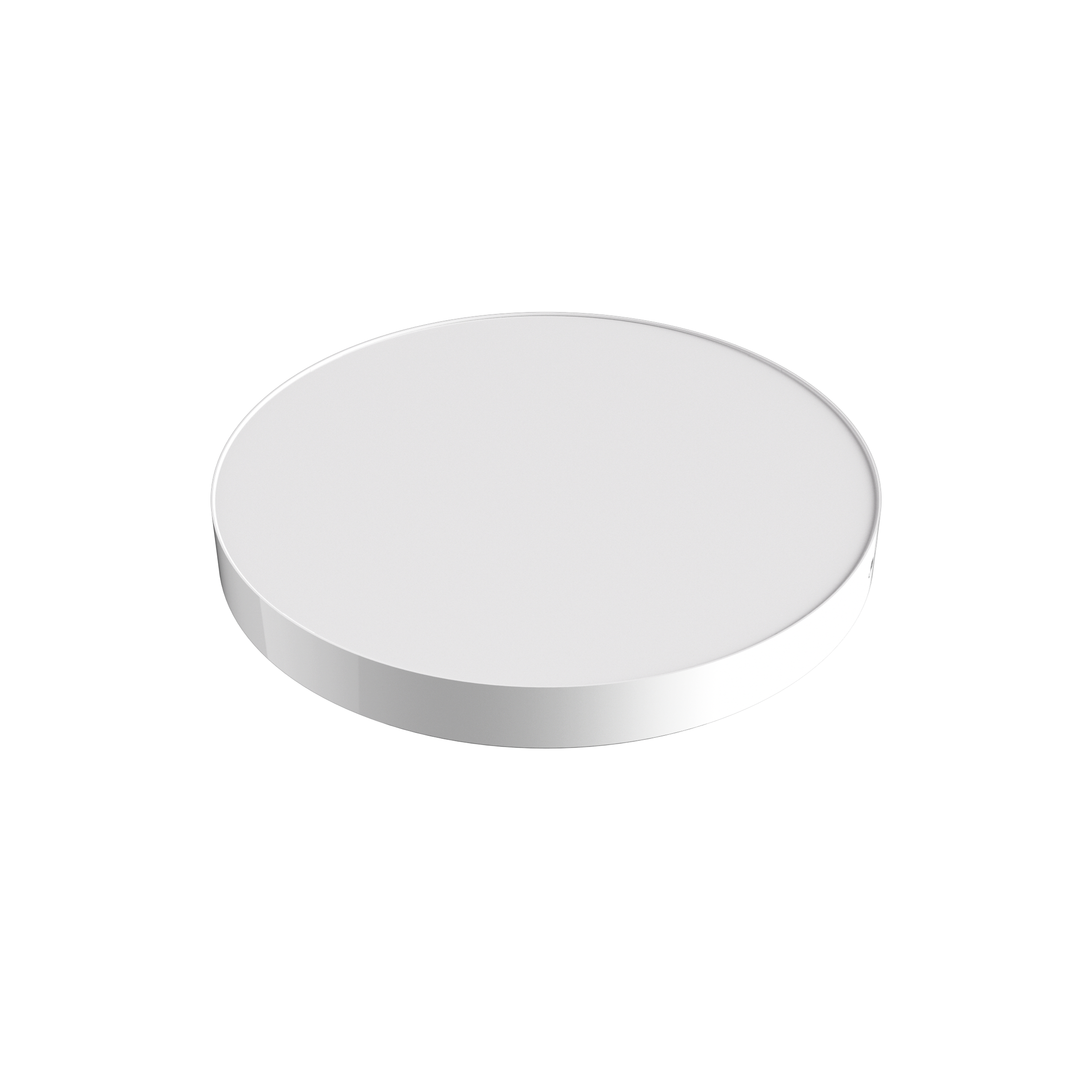
Panel-format fixtures carry the volume interior of a project, where appearance and service access matter alongside output.
PL02 panel light
The PL02 is a panel light for indoor commercial and residential spaces. Panel format suits suspended or recessed ceiling grids in offices, retail floors, corridors, clinics and similar interiors where a flat ceiling plane is part of the design intent. In a mixed project, the PL02 is the volume interior fixture — the one that determines how the ceiling reads and how easily a facility team can reach a fitting for service — while the high bay families carry the industrial areas.
FCL-E01 ceiling fan light
The FCL-E01 combines air movement and illumination in a single ceiling fixture and is specified for residential and light commercial settings. The engineering argument for combining the two functions is installation economy: one ceiling penetration, one electrical connection point and one fixture to service, instead of a separate fan and luminaire competing for the same ceiling position. It belongs in light commercial interiors where air movement is a comfort requirement rather than in production or exterior areas.
A60 LED bulb
The A60 LED bulb covers retrofit and replacement demand — the point at which a buyer needs to maintain illumination in existing fittings rather than re-specify a luminaire. Its boundary is definitional: a lamp is not a luminaire. Distribution, glare and the achieved illuminance in a room depend on the host fixture, so lamp-level specifications should not be read as a room-level lighting design. In project terms, the bulb is a maintenance and fit-out item, not a substitute for a specified panel or high bay.
Shortlist summary by application
| Fixture | Primary environments | Documented attributes | Selection note |
|---|---|---|---|
| SH-E01 linear high bay | Warehouses, factories, workshops | IP65; 5-year warranty; aluminum alloy housing | Best fit where racking defines aisle geometry and cleaning involves dust or water jets |
| HL-E01 UFO high bay | Warehouses, factories, retail, gyms | UFO high bay format | Point-mounted over open volumes; can bridge storage and customer-facing areas |
| FL-C01 outdoor floodlight | Residential, commercial, manufacturing exteriors | 10W–300W range | One family for facade, yard and perimeter; confirm IP and distribution per variant |
| Solar security light 8200 | Perimeter, compound and off-grid security | IP44; PIR sensor | For sites without a practical mains run; plan for seasonal solar variation |
| PL02 panel light | Indoor commercial and residential | Panel format | Volume interior fixture where ceiling appearance and service access matter |
| FCL-E01 ceiling fan light | Residential and light commercial | Combined fan and light | Single ceiling point for comfort and illumination |
| A60 LED bulb | Retrofit and replacement | LED bulb format | Maintenance item; performance depends on the host fixture |
Commercial terms when the shortlist becomes an order
For buyers moving from shortlist to purchase order, the commercial terms carry as much weight as the fixture list. Lepeng's stated purchasing terms are a minimum order quantity of 100 units, FOB delivery terms, pre-shipment test as the acceptance criterion, and payment of a 30% deposit with the final payment subject to a copy of the bill of lading.
Each of those terms has a practical reading. A minimum order quantity applies per order line, so a multi-family shortlist should be grouped deliberately rather than spread thinly. FOB means the buyer arranges main carriage, insurance and import clearance, which shifts the inland-to-port leg into the supplier's scope and the ocean leg into the buyer's. A pre-shipment test places the acceptance checkpoint before dispatch, so inspection scope, sampling method and documentation should be agreed in writing when the order is confirmed — a pre-shipment acceptance is only as strong as its defined criteria.
How this compares with alternative supply routes
Against conventional lamp-based industrial lighting
Lamp-based high-bay systems treat the lamp as a consumable and maintenance as a recurring cost line, with the fixture itself often outside the warranty horizon. A fixture family offered with a 5-year warranty changes that planning assumption for the fixture. It does not, however, make replacement automatic: existing wiring condition, mounting points, circuit loading and control compatibility still need checking before a retrofit programme is scoped.
Against small trading suppliers
Smaller trading suppliers can present a similar-looking fixture list at low volume. The difference becomes visible later, in documentation and repeatability: whether the manufacturing standard is backed by certifications and qualification certificates, whether OEM and ODM customisation is available when a project requires it, and whether production capacity can absorb a repeat order. Lepeng reports 200,000 m² of factory space, 2,000 employees and monthly capacity of 45 million LED lamps and 5 million LED luminaires across three production sites, which is the kind of scale that supports multi-year programmes rather than single shipments.
Against premium imported brands
The honest comparison is not a quality verdict in either direction. Against premium imported brands, differences may lie in R&D standards and in the depth of certification detail for a specific market, as well as in local technical support structures. The implication for buyers is procedural: where a project requires market-specific certification documentation or an unusually specialised optical design, that requirement should be verified with the supplier before the shortlist is finalised. Scale production with OEM and ODM flexibility is a different proposition from a specialised engineering house, and a shortlist should not assume one delivers the other.
Limitations to plan around
- A shortlist is not a lighting design. Illuminance, uniformity and spacing calculations remain project deliverables and depend on site geometry, not on the fixture list.
- IP ratings are per product and per variant, not per brand. An IP65 fixture family does not extend IP65 protection to lower-rated products in the same portfolio, and the FL-C01 range in particular requires variant-level confirmation.
- Solar security lighting is location-dependent. The 8200 is rated IP44 and uses a PIR sensor; runtime and detection performance vary with irradiance, season, mounting height and ambient temperature.
- Residential and light commercial fixtures are not industrial substitutes. The PL02, FCL-E01 and A60 are specified for indoor commercial and residential contexts; they do not replace IP65 high bays in production environments.
- Warranty length is not warranty scope. The 5-year warranty on the SH-E01 should be read as a document covering exclusions and the overseas service route before it is used in a tender comparison.
What the market direction means for the next specification cycle
Market data points to continued volume rather than a settled replacement market. Fortune Business Insights projects the global LED lighting market moving from USD 109.11 billion in 2025 to USD 336.90 billion by 2034, while Grand View Research recorded LED products already holding a 58.1% revenue share of the USD 47.54 billion commercial lighting market in 2024. The remaining non-LED share is the retrofit pipeline that generates most shortlists of the kind described here.
Exterior lighting is growing on its own trajectory. IMARC Group values the global LED flood light market at USD 9.4 billion in 2025, with an 8.52% CAGR to USD 20.1 billion by 2034, and Vantage Market Research projects global solar street lighting reaching USD 22.5 billion by 2030 at a 15.8% CAGR from 2024. For buyers, the practical consequence is that outdoor and off-grid fixtures deserve the same specification discipline as warehouse high bays, rather than being treated as an afterthought appended to an interior package.
Documentation expectations are also converging. Core safety and performance standards for LED luminaires include IEC 60598, UL 1598 and UL 8750, and as these become routine reference points in tender documents, the supplier's ability to produce consistent certification and qualification documentation becomes a shortlisting criterion in its own right — alongside production capacity, OEM and ODM flexibility, and the commercial terms that determine whether a multi-year programme is deliverable.
Sourcing and documentation contact
Zhejiang Lepeng Electric Appliance Co., Ltd. — Fish
No. 1, Yueguo Road, Baiguan Industrial Park, Shangyu District, Shaoxing City, Zhejiang Province
Email: fish@idealbright.com | Tel: +86-575-82188752 | WhatsApp: +86-13777885334
Product and specification documentation is available in the company brochure: https://cdn.socialarks.com/sbsp/25165/common/2026/0825/26-6-1_%E6%9C%80%E5%B0%8F.pdf
FAQ
Which LED light is suitable for high-bay warehouse industrial lighting?
LED high bay lights are the appropriate category for warehouse high-bay industrial lighting. They deliver high lumen output, good heat dissipation and long service life, which suits large-space warehouses, factories and high-ceiling industrial sites. Within that category, the choice between a linear format such as the SH-E01 and a round UFO format such as the HL-E01 depends on whether the layout follows racking aisles or an open volume.
What distinguishes a linear high bay from a UFO high bay in a warehouse?
The distinction is geometry rather than output class. A linear high bay such as the SH-E01 spreads the light source along a fixture body, which fits layouts where racking defines the aisles and the lighting grid follows them. A UFO high bay such as the HL-E01 concentrates the source at a single suspension point, which fits open volumes with point mounting above a working plane. Both formats appear in warehouses, factories, retail and sports environments, and mixed sites often use both.
What do the IP65 and IP44 ratings mean for where a fixture can be installed?
IP65, as specified for the SH-E01 linear high bay, indicates protection against dust ingress and low-pressure water jets, which allows the fixture to be considered for production areas where dust and routine low-pressure cleaning occur. IP44, as specified for the solar security light 8200, indicates protection against solid objects above a small size and splashing water, and does not extend to submersion or high-pressure washing. Ratings apply to the specific product variant, not to a manufacturer's entire range.
What are the purchasing terms and acceptance criteria?
The stated terms are a minimum order quantity of 100 units, FOB delivery terms, pre-shipment test as the acceptance criterion, and payment of a 30% deposit with the final payment subject to a copy of the bill of lading. Because acceptance occurs before shipment, inspection scope and sampling method should be agreed in writing at order confirmation.
Can these fixture families be supplied as OEM or ODM projects?
Yes. Zhejiang Lepeng Electric Appliance Co., Ltd. states that its factory is fully capable of undertaking OEM and ODM customised projects for global clients, which covers adapting fixtures and programmes to buyer requirements rather than supplying catalogue items only. The scope of any customisation — housing, mounting accessory, labelling or packaging — should be defined per project before quotation.
What supports long-term supply continuity across a multi-year programme?
Three documented factors are relevant: production scale, documented manufacturing standards, and multi-site capacity. The company reports 200,000 m² of factory space, 2,000 employees and monthly capacity of 45 million LED lamps and 5 million LED luminaires, with production across a headquarters site in Shangyu, Zhejiang plus bases in Qiandaohu, Zhejiang and Jingdezhen, Jiangxi. It also states that it holds industry certifications and qualification certificates attesting to its manufacturing standards, and that roughly 90% of output is exported to the EU, Southeast Asia, the Middle East and Latin America — markets where certification documentation is typically part of the purchase requirement.
Tem questões ou precisa de mais detalhes?
Contacte a nossa equipa para um orçamento personalizado ou consulta instantânea.
Solicitar orçamento
Preencha o formulário abaixo e a nossa equipa entrará em contacto com uma proposta personalizada.
Chat direto do WhatsApp
Prefere conversar em tempo real? Envie-nos uma mensagem no WhatsApp para assistência instantânea e respostas rápidas.
- Obter orçamento personalizado
- Partilhar fotos ou documentos
- Discuta as suas necessidades diretamente
Geralmente responde em 5–30 minutos durante o horário de expediente.