
Commercial LED Lighting Compliance: IP and Voltage Mapping
Commercial LED Lighting Compliance: IP and Voltage Mapping
A commercial LED lighting qualification rests on five declared values — the IP code, the input voltage band, the surge rating, the certificate number and the certificate scope — and on the supplier's ability to tie each one to the exact model being supplied. A compliance logo shows that a conformity route was followed; it does not state the conditions under which the fixture may be used.
That distinction matters most between the research and evaluation stages, when a buyer is narrowing fixtures for warehouses, outdoor security positions and indoor commercial ceilings. At that point the question is rarely whether a supplier holds certificates. It is whether the declared ratings on the specific model match the conditions of the specific project, and whether a document exists that says so in the same words.
Why a compliance mark is not a specification
A mark on a label answers a narrow question: has a conformity assessment route been followed for a defined product scope? It does not answer what a project approver actually needs to know — which standard was applied, at which revision, to which model, for which market. The core luminaire standards are well enumerated: IEC 60598 covers luminaires, UL 1598 covers luminaires and UL 8750 covers LED equipment, as listed by UL Solutions. A usable specification names the applicable standard and asks for evidence tying it to the catalogue number being supplied.
The scale of the market makes that discipline practical rather than bureaucratic. Grand View Research estimated the global commercial lighting market at USD 47.54 billion in 2024, with LED products holding a 58.1% revenue share. In the same year, China exported USD 31.4 billion of light fixtures, equal to 59.3% of global fixture exports, according to the Observatory of Economic Complexity. Inside a supply base of that size, a buyer is comparing documentation quality as much as hardware.
Three rating families that decide qualification
Qualification tends to reduce to three families of declared value, and each one fails in a different way.
- Ingress protection answers where a housing may be installed. It fails when an IP code is read as a general durability score instead of a boundary.
- Electrical compatibility answers whether a fixture will survive the supply it will actually see — input voltage band, surge protection, driver or power supply, and the factory-fitted cable. It fails when a nominal site voltage is used in place of the measured envelope.
- Evidence answers whether a claim can be checked by a third party — certificate number, issuing body, standard, market and declared scope. It fails when a family-level certificate is treated as model-level approval.
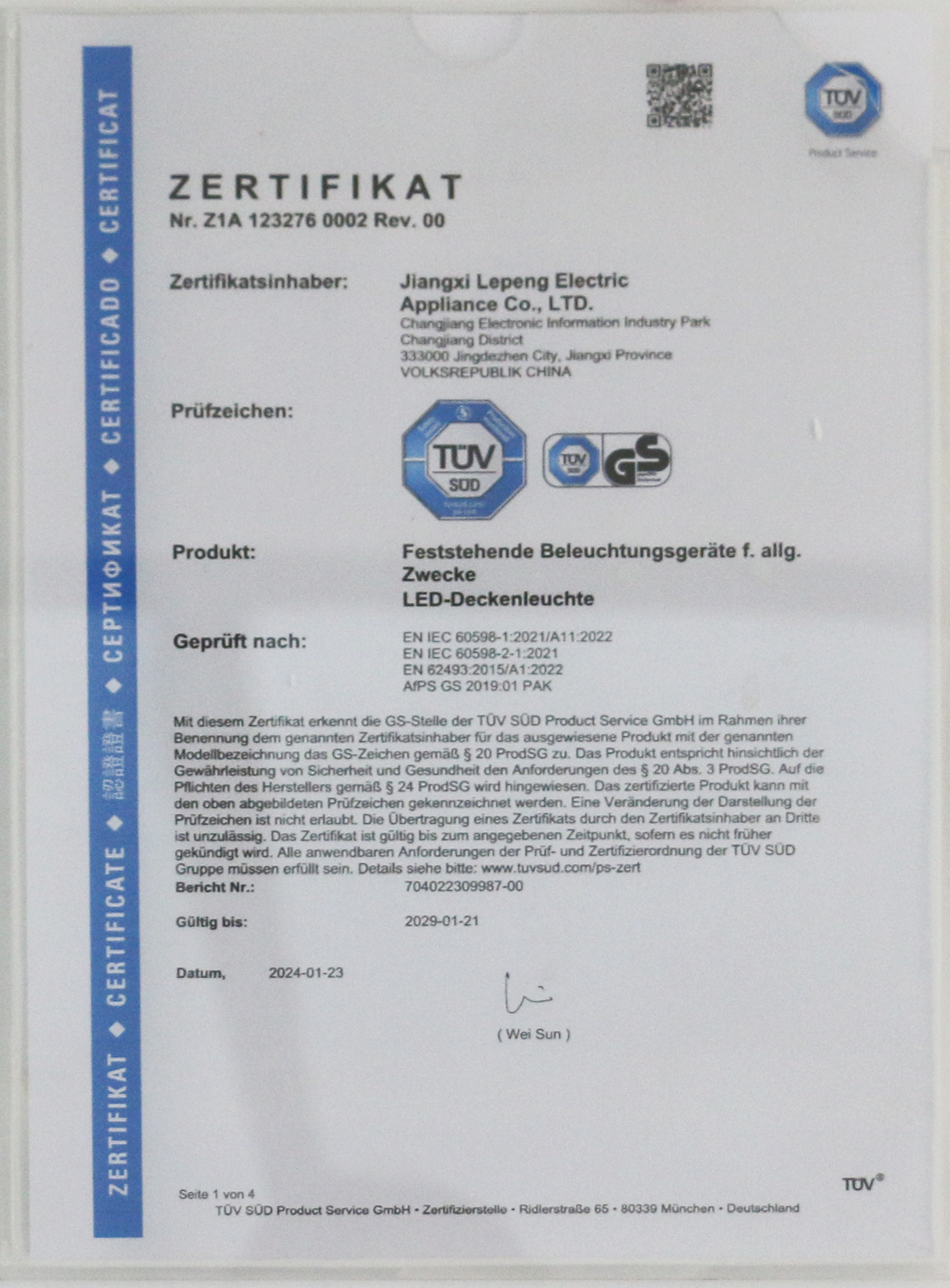
Certificate records are only useful in a qualification file when the number, issuing body, standard and declared scope are read together.
Mapping IP ratings to project environments
The declared IP code is the fastest filter a buyer has, provided it is read as a boundary rather than a ranking. The three ratings below are drawn from the published product data of Zhejiang Lepeng Electric Appliance Co.,Ltd. and are used here as worked examples of the mapping method.
| Model | Declared IP | Declared application | Boundary to confirm |
|---|---|---|---|
| PL02 LED panel light | IP20 | Commercial and residential indoor | No water protection; not for wet, dusty or washdown areas |
| 8200 solar security light | IP44 | Outdoor security — yards, driveways, garages, pathways, walls | Splash protection, not jet washing or immersion |
| SH-E01 linear high bay light | IP65 | Industrial and commercial — warehouses, factories, workshops | Confirm gland, cable entry and mounting method; IP does not describe corrosion resistance |
Read the digits literally. The first digit describes protection against solid objects and dust; the second describes protection against water. An IP20 fixture such as the PL02 panel provides no water protection, which is consistent with its declared indoor commercial and residential use. IP44, declared for the 8200 solar security light, adds protection against splashing water and suits the outdoor security positions the product is declared for. IP65, declared for the SH-E01 linear high bay light, adds dust-tight protection and protection against water jets, matching its declared use in warehouses, factories and workshops.
Two boundaries belong in the schedule itself. First, an IP code describes an enclosure under defined test conditions; it says nothing about resistance to salt, ammonia, UV exposure or mechanical impact, all of which require separate evidence on coastal, agricultural or heavy-traffic sites. Second, the code assumes the enclosure is closed as tested — gland type, cable entry, gasket seating and mounting orientation all affect whether an installed fixture behaves like the tested one. That is why installation conditions belong in the submittal rather than in an appendix.
Electrical ratings: the voltage band is a project decision
The HL-E01 high bay light is offered with two input voltage options, 185-265V and 100-265V, across power options of 100/150/200/240W and declared efficiencies of 140/160/185/210 lm/w, with CCT options of 4000K, 5000K and 6500K. The two voltage bands are not a quality hierarchy. The wider 100-265V band tolerates a larger supply envelope, including low-voltage conditions; the narrower 185-265V band requires the site supply, including voltage drop at the far end of a long circuit, to remain inside that window. The correct choice follows measured supply conditions and the electrical design, and the approved band should be recorded so that a later substitution does not pass unnoticed.
Surge protection is a separate criterion, not a variant of the voltage rating. The HL-E01 is declared at 6KV/6KV, a value that matters on circuits sharing a distribution board with large inductive loads or on exposed runs. The FL-C01 Series floodlight is declared with surge protection up to 2KV and a power factor above 0.9 across its 10-300W range. Different declared values suit different exposure classes; what a submittal should not accept is an unquantified statement that a fixture is surge protected.
Connection details complete the electrical picture. The HL-E01 is supplied with a 3x1.0mm² cable and 300mm exposed leads, pre-wired to the power supply, and its product description references Sosen and Moso power supplies. These are checkable items: a submittal can name the driver family and the cable specification, and an incoming shipment can be compared against them.
The SH-E01 linear high bay light adds the load-planning layer: 50/100/150/200W options, declared efficacy of 100/135/150 lm/w and a 90° (H) × 120° (V) beam angle across three body lengths. For an approver, the relevant question is whether the declared wattage and beam combination matches the layout that was modelled, not which number is largest.
The 8200 solar security light changes the electrical question entirely. At 10W and 1600LM at 6500K, with a monocrystalline silicon panel and no mains wiring, the qualification items become panel siting, cable routing and sensor behaviour. The product is designed so that the solar panel and light head can be mounted separately, with an extension cable included, and it carries a PIR motion sensor, remote control, an auto mode and timers of 1H/2H/4H.
For indoor commercial ceilings, the PL02 panel light is declared at 9/12/18/24W with 90/110 lm/w efficacy, 2700K-6000K three-CCT selection, 50%/75%/100% dimming, remote control and a microwave sensor, in 5-, 8- and 12-inch sizes with round or square bodies. Control electronics belong to the electrical scope: a fixture with a sensor and remote control has a control circuit the submittal should describe, and where radio control is used, radio requirements apply as a separate conformity route.
Certificate mapping: read the scope, not only the number
A certificate is useful in a qualification file only when four fields are read together: the number, the issuing body, the standard and the declared scope. The records below show how those fields appear for the products discussed in this article.
| Document | Number | Body / market | Declared scope or standard |
|---|---|---|---|
| GS Certificate (ZERTIFIKAT), CE-LVD | Z1A 123276 0002 Rev. 00 | TUV SUD / EU | Scope stated as LED-Deckenleuchte; EN 60598-1:2021+A11:2022, EN 60598-2-1:2021, EN 62493:2015, AFPS GS 2019:01 PAK |
| Attestation of Conformity, CE-EMC | E8A 123276 0630 Rev. 00 | TUV SUD / EU | Fixed general purpose luminaires / LED panel light; EMC Directive 2014/30/EU; related model PL02 |
| EU Type Examination Certificate, CE-RED | TPS-RED500722 (01) | TUV SUD / EU | Short range device / LED ceiling light; EN 300 220-1 V3.1.1, EN 301 489-1 V2.2.1, EN 301 489-3 V2.1.1; model 8222 |
The scope field deserves particular attention. The GS certificate issued by TUV SUD under number Z1A 123276 0002 Rev. 00 states its scope as 'LED-Deckenleuchte', an LED ceiling luminaire, alongside the standards listed above. An approver should reconcile that declared scope text with the fixture type actually being supplied, rather than relying on an associated model list by itself. The same discipline applies to the CE-EMC attestation E8A 123276 0630 Rev. 00, whose scope is stated as fixed general purpose luminaires / LED panel light under EMC Directive 2014/30/EU, and to the EU Type Examination Certificate TPS-RED500722 (01), which covers model 8222, the LED ceiling fan light, under radio equipment requirements.
This is not a comment on the validity of any particular document. It is the ordinary reading practice of a qualification engineer: a certificate answers only what its scope says it answers, and the submittal has to connect that answer to the model in the bill of quantities.
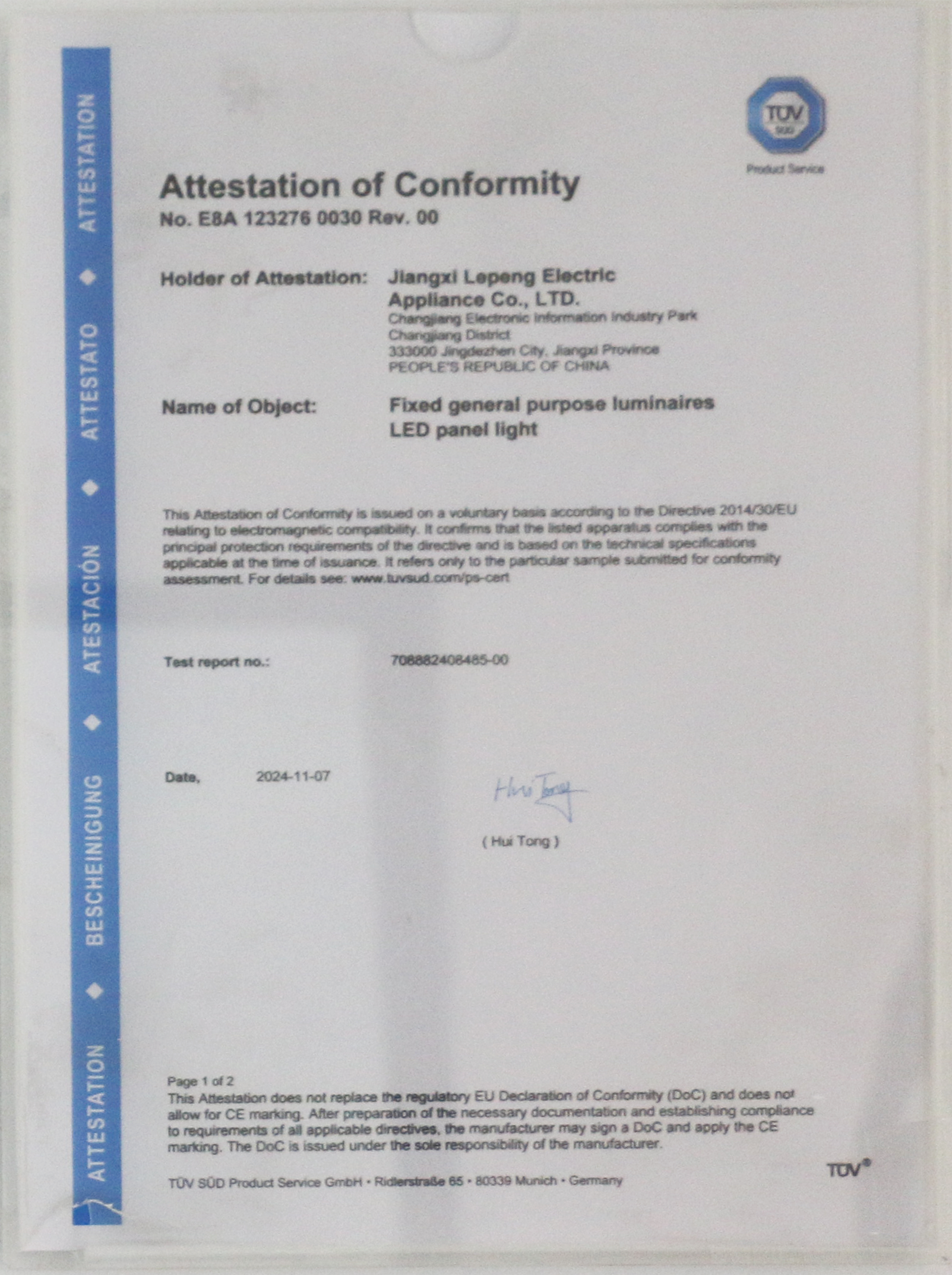
The PL02 panel light is linked to attestation E8A 123276 0630 Rev. 00, whose declared scope names fixed general purpose luminaires and LED panel light.
Matching fixtures to warehouses, outdoor security and indoor commercial space
Warehouses and high-ceiling industrial interiors
A warehouse specification combines three things: environment, mounting and maintenance access. The SH-E01 is declared at IP65 for industrial and commercial interiors — warehouses, factories and workshops — with a 5-year warranty, two mounting options (a surface mounting kit or chain/cable suspension), a one-piece connector design and CCT options from 3000K to 6500K. The linear form factor and 90° × 120° beam are layout decisions; the IP65 rating and the warranty term are qualification decisions, and both belong in the submittal. Where the supply is the binding constraint rather than the environment, the HL-E01 addresses the same high-ceiling role with its two voltage bands and 6KV/6KV surge declaration.
Outdoor security positions
Outdoor security lighting is judged on whether the fixture tolerates its mounting position and whether it behaves predictably when nobody is adjusting it. The 8200 solar security light is declared at IP44 with a PIR motion sensor, remote control, auto mode and 1H/2H/4H timers, in an ABS housing with a PC lens and a monocrystalline silicon panel. Because the panel and light head can be mounted separately, the qualification question extends to panel position and cable route — and, for a solar product, to the fact that the installation is off-grid rather than mains-fed. For positions requiring jet-wash cleaning or direct water jets, an IP44 declaration is a boundary, not a starting point for improvisation.
Indoor commercial ceilings
Indoor commercial space is where IP ratings are most often over-specified or quietly ignored. The PL02 panel light is declared at IP20 and is intended for commercial and residential indoor use; its qualification value lies elsewhere — three-CCT selection from 2700K to 6000K, three-level 50%/75%/100% dimming, a microwave sensor for automatic on/off, and surface or recessed mounting with adjustable hole spacing. Specifying IP65 in a dry office ceiling adds cost without adding fitness, while specifying a panel with no stated control behaviour removes a criterion the operator will notice every working day.
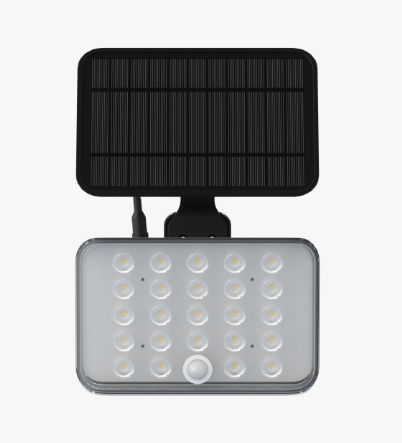
The 8200 solar security light is declared at IP44 with a PIR motion sensor, separate solar panel mounting and 1H/2H/4H timer options.
What to request from a supplier before approval
A short, repeatable request list produces comparable answers from different bidders. The items below indicate the kind of reference a supplier should be able to produce for the models discussed here.
| Request | What it establishes | Reference example |
|---|---|---|
| Model-specific declaration of conformity | That the standard, number, body and scope apply to this model | Attestation E8A 123276 0630 Rev. 00 for PL02 |
| Certificate revision matched to datasheet revision | That the document set describes the current build | Rev. 00 records cited above |
| Declared IP code with installation conditions | That enclosure protection survives cable entry and orientation | IP65 on SH-E01; IP44 on 8200; IP20 on PL02 |
| Input voltage band and surge rating | That the fixture tolerates the actual site supply | 185-265V or 100-265V; 6KV/6KV on HL-E01 |
| Driver or power supply reference | That the electrical front end is a named, repeatable component | Sosen and Moso power supplies referenced for HL-E01 |
| Cable and termination specification | That installation practice matches the supplied build | 3x1.0mm² cable, 300mm exposed leads, pre-wired |
| Control and sensor scope | That sensor, dimming and radio controls are covered | TPS-RED500722 (01) for model 8222 |
| Written warranty terms | That the commercial commitment is documented | 5-year warranty declared for SH-E01 |
Two further items are procedural rather than technical. Ask for the datasheet revision that matches the certificate revision, and ask for written confirmation that the driver or power supply named in the submittal will be the one shipped on later batches. Neither request is unusual; both are difficult to retrofit once a purchase order has been issued.
Where qualification programmes usually fail
- Treating a compliance mark as model approval. A certificate's scope text, not its model associations, defines what it covers.
- Reading IP as a general durability score. Corrosion, UV and impact resistance are separate properties, and coastal or agricultural sites need them stated.
- Matching a voltage band to a nominal figure instead of the measured supply envelope, including voltage drop at the end of a circuit.
- Comparing efficacy figures across families as though they were interchangeable. The SH-E01 is declared at 100/135/150 lm/w and the HL-E01 at 140/160/185/210 lm/w; each value belongs to a specific configuration, so the comparison that matters is within the configuration actually specified.
- Leaving controls and sensors outside the submittal. Sensor type, dimming method and any radio control are part of the technical file.
- Using warranty length as a proxy for service response. A 5-year warranty is a commercial commitment that should be read together with the claim route behind it.
Outlook: documentation as a procurement asset
With LED products holding an estimated 58.1% of commercial lighting revenue in 2024, being an LED fixture is no longer a differentiator in itself. Where that condition holds, qualification work shifts toward model-level documentation: certificate scope, voltage band, surge value and cable specification, each stated for the exact catalogue number. The effect is conditional rather than automatic, because it depends on a buyer applying one submittal format to every bidder. A schedule that asks each supplier for the same six fields produces comparable answers; a schedule that accepts 'certified' as an entry produces a folder of documents that cannot be compared with one another.
Supplier context
Zhejiang Lepeng Electric Appliance Co.,Ltd. manufactures LED lamps and LED luminaires, with its headquarters factory in Baiguan Industrial Zone, Shangyu, Zhejiang, and additional production bases in Qiandaohu, Zhejiang and Jingdezhen, Jiangxi. The company reports a 200,000 m² factory footprint and a monthly capacity of 45 million LED lamps and 5 million LED luminaires, offers OEM/ODM capability, states a lead time of 30-45 days, and lists the EU, Southeast Asia, the Middle East and Latin America among its export markets. Its published product data supports the model-level checks described in this article: PL02 at IP20 with CE-EMC attestation E8A 123276 0630 Rev. 00, SH-E01 at IP65 with a 5-year warranty, the 8200 solar security light at IP44, and HL-E01 with 185-265V or 100-265V voltage options. Current model data is published at www.idealbright.com.
FAQ
What is the practical difference between IP20, IP44 and IP65 in a commercial lighting schedule?
An IP code states protection against solids in the first digit and against water in the second. IP20 — the declared rating of the PL02 LED panel light — provides no water protection, which is why the panel is declared for commercial and residential indoor use. IP44, declared for the 8200 solar security light, adds protection against splashing water and is declared for outdoor security positions such as yards, driveways, garages and pathways. IP65, declared for the SH-E01 LED linear high bay light, provides dust-tight protection plus protection against water jets and is declared for industrial and commercial interiors such as warehouses, factories and workshops. The code describes an enclosure under defined test conditions; it does not describe corrosion, UV or impact resistance.
How can a buyer check an IP or voltage claim instead of accepting the datasheet?
Check the document chain. Ask for the declaration or certificate that names the model, the standard applied, the issuing body, the certificate number and the declared scope, and confirm that the datasheet revision matches. For electrical values, ask for the declared input voltage band — the HL-E01 high bay light is offered with 185-265V or 100-265V options — the surge rating, declared at 6KV/6KV on that model, and the factory-fitted cable specification, a 3x1.0mm² cable with 300mm exposed leads pre-wired to the power supply. A value that cannot be tied to a document and a specific model should be treated as unconfirmed.
Does a wider input voltage range make a high bay light more suitable for a project?
Not automatically. A wider band such as 100-265V tolerates a larger supply envelope, while a narrower band such as 185-265V — both offered on the HL-E01 — requires the site supply, including voltage drop at the end of long runs, to stay inside that window. The choice follows the measured supply conditions and the project's electrical design rather than a preference for a larger number. Surge protection is a separate criterion: the HL-E01 is declared at 6KV/6KV, while the FL-C01 Series floodlight is declared with surge protection up to 2KV and a power factor above 0.9.
Which documents should be assembled before an LED lighting submittal is approved?
At minimum: a model-specific declaration of conformity stating standard, certificate number, issuing body and scope; the datasheet revision matching that certificate revision; the declared IP code together with the installation conditions it assumes; the declared voltage band, surge rating and driver or power supply reference; and the written warranty terms, with the SH-E01 linear high bay light declared with a 5-year warranty. Where a fixture includes radio control, that route is a separate item — the EU Type Examination Certificate TPS-RED500722 (01) issued by TUV SUD covers model 8222, the LED ceiling fan light, under radio equipment requirements.
A downloadable brochure with model data for these fixtures is available here: commercial LED lighting product brochure (PDF).
Tem questões ou precisa de mais detalhes?
Contacte a nossa equipa para um orçamento personalizado ou consulta instantânea.
Solicitar orçamento
Preencha o formulário abaixo e a nossa equipa entrará em contacto com uma proposta personalizada.
Chat direto do WhatsApp
Prefere conversar em tempo real? Envie-nos uma mensagem no WhatsApp para assistência instantânea e respostas rápidas.
- Obter orçamento personalizado
- Partilhar fotos ou documentos
- Discuta as suas necessidades diretamente
Geralmente responde em 5–30 minutos durante o horário de expediente.