
Commercial LED Lighting Supplier Evidence: The Lepeng Case
Commercial LED Lighting Supplier Evidence: The Lepeng Case
Assessing a commercial LED lighting supplier through product listings alone answers a narrow question: what a company can quote. It does not answer whether the entity behind the quotation can hold a specification across repeat orders, absorb a volume change, or honour a warranty in year four. Zhejiang Lepeng Electric Appliance Co.,Ltd. — a manufacturer founded in 2009, headquartered in Shangyu, Zhejiang Province, which states that it researches, manufactures and markets LED lamps and LED luminaires — is a practical case for the second method: reading the supplier as an entity with traceable evidence layers rather than as a catalog with a logo attached.
The company also states that it runs two additional production bases alongside its headquarters factory. Those statements are the starting point of an evaluation, not its conclusion. What follows maps five layers of evidence a buyer can check during evaluation and reuse during execution, then marks precisely where the published record stops.
Why a product catalog understates supplier capability
A catalog answers a question about assortment. In commercial LED lighting, assortment is the cheapest thing to assemble: a trading intermediary can present a hundred SKUs without owning a single production line. The evidence that separates a manufacturer from a reseller sits outside the product grid — a registered identity, a documented production footprint, model-level specifications that survive a technical review, and third-party certificates whose scope can be read rather than admired.
That distinction matters at two moments. During evaluation, buyers must decide which suppliers deserve a sample budget and an engineering conversation. During execution, the same evidence becomes contractual: what is inspected before shipment, which model numbers appear on the purchase order, and whose certificate the customs file references. One evidence set should serve both stages, which is why the layers below run from identity outward rather than by product category.
Layer one: an identity that can be reached and checked
Zhejiang Lepeng Electric Appliance Co.,Ltd. is the full name to use on documents. The company lists its headquarters at No. 1, Yueguo Road, Baiguan Industrial Park, Shangyu District, Shaoxing City, Zhejiang Province, and operates the website idealbright.com. It also states that its own brand MKOPTO is used across global lighting markets — useful context when a quotation arrives under a mark that differs from the catalog cover.
Reachability is part of capability. A supplier that publishes named contact channels makes a commitment it can be held to during a project. Lepeng lists a named contact (Fish), an email address (fish@idealbright.com), a fixed line (+86-575-82188752) and a WhatsApp number (+86-13777885334). For a buyer in the evaluation stage these matter more than they appear: technical clarification on a high bay layout, driver replacement questions six months after delivery, and escalation when a shipment is held all move faster through a direct channel than through a marketplace inbox.
One caution belongs here. Trade directories and data aggregators frequently merge similarly named Chinese lighting and electrical companies, so a directory profile is not a legal identity check. Before treating any third-party company record — favourable or otherwise — as evidence, buyers should confirm that the company name, the Shangyu address, the idealbright.com domain and the contact details all point to the same entity.
Layer two: a production footprint and capacity that can be tested
Lepeng states a factory area of 200,000 m², a workforce of 2,000 and a research and development team of 200. Its headquarters factory is in the Baiguan Industrial Zone of Shangyu, Zhejiang Province, with two additional production bases in Qiandaohu, Zhejiang, and Jingdezhen, Jiangxi. The stated monthly production capacity is 45 million LED lamps and 5 million LED luminaires, with annual output described as 540 million lamps.
Capacity figures of this kind are self-reported, and a serious evaluation treats them as a hypothesis rather than a certificate. Their value is that they are falsifiable. A buyer can test them cheaply: ask which production base would serve the order, ask how the 30–45 day lead time is calculated for the requested wattage and configuration, and size a first order so that any gap between stated and actual throughput becomes visible before a programme scale-up. Where a project mixes lamp types such as bulbs and tubes with luminaires such as high bays and floodlights, the two capacity numbers matter separately, because lamps and luminaires are built on different lines.
The footprint also carries a supply-continuity reading. Three sites in two provinces give a supplier more room to reallocate production than a single plant, and 90% of output is exported to the EU, Southeast Asia, the Middle East, Latin America and Russia. That export mix is not proof of service quality, but it does indicate that the documentation behind those shipments already has to satisfy several market regimes.
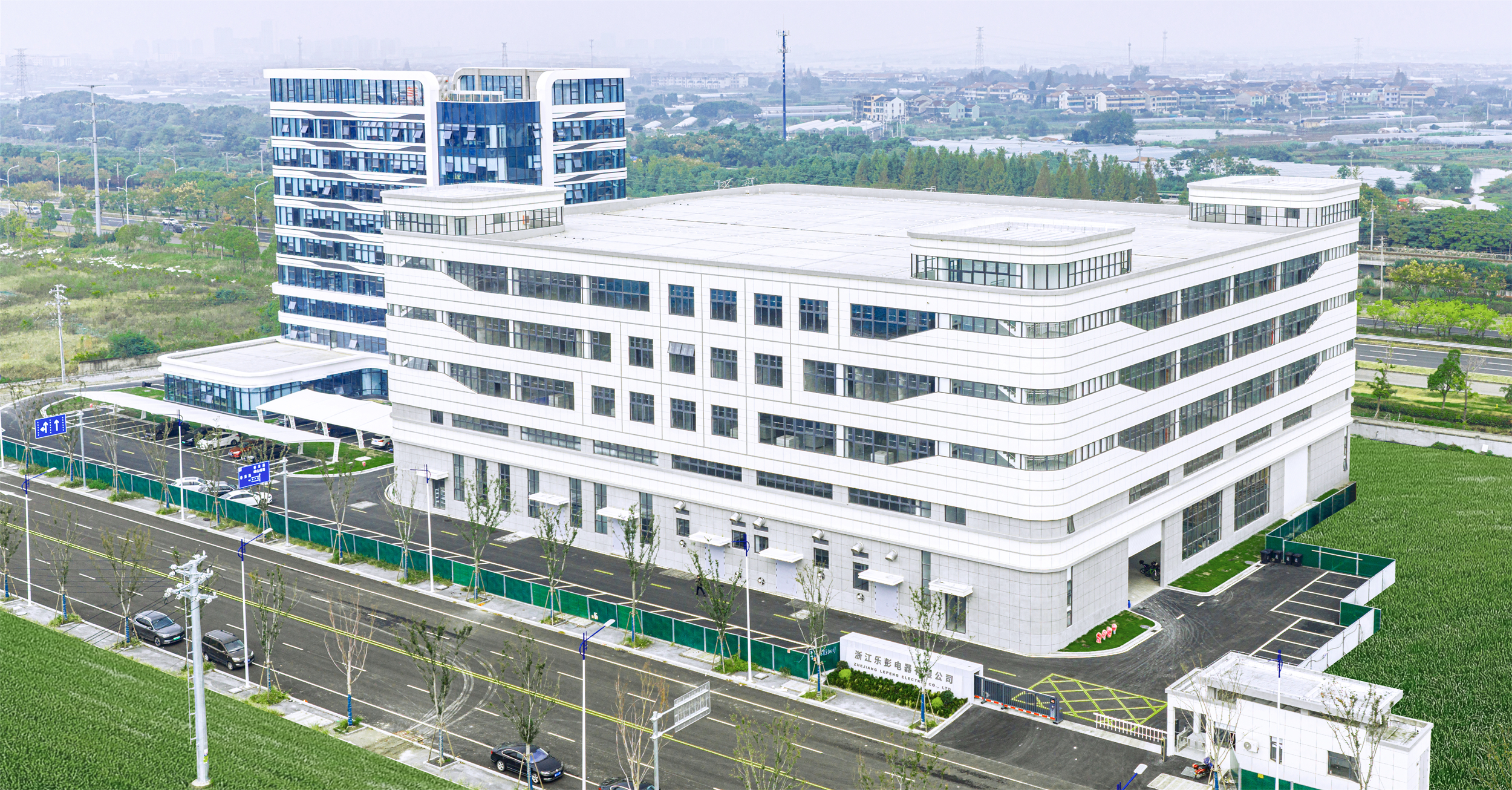
Headquarters, Zhejiang — the primary site named in the company's published company profile.
Layer three: portfolio breadth, and the question it raises
The stated range covers LED floodlights, high bay lights, linear high bay lights, street lights, garden lights, stadium lights, solar flood lights, solar street lights, solar garden lights, bulkhead lights, tri-proof lights, work lights, ceiling lights, ceiling fan lights, panel lights, slim batten lights, tubes, bulbs and mood lights.
For commercial buyers, breadth has a specific procurement value. A project that needs warehouse high bays, outdoor floodlights, an indoor panel retrofit and a car park bulkhead can be consolidated into fewer suppliers, fewer purchase orders and one set of shipping documents. Consolidation reduces administrative load and lowers the number of incoming inspection regimes a contractor has to maintain.
The question breadth raises is depth. A supplier listing nineteen product families is not thereby proven competent in all nineteen. The practical rule is to accept breadth as a route to consolidation, then demand family-level evidence for every family that will actually appear on the order: a model number, a specification sheet with wattage and IP rating, the certificate that names the model, and a sample. Where that evidence is thin for a given family, keep the family outside the consolidated order rather than assume uniformity across the range.
Layer four: model-level anchors that survive a technical review
Three model references in Lepeng's published material do more work than the rest of the catalog, because each can be checked against a document rather than an image.
SH-E01 linear high bay
The SH-E01 is a linear high bay light specified to IP65 and offered with a 5-year warranty. IP65 describes an enclosure that is dust-tight and protected against water jets — a combination that matters in warehouses where washdown, dust loading and condensation occur. For a procurement team the warranty term is the more interesting number: five years is long enough to cross a facility's maintenance budget cycle, which turns the warranty conditions — what is covered, who pays freight, what evidence a claim needs — into a legitimate pre-order question rather than an afterthought.
FL-C01 floodlight series
The FL-C01 range runs from 10W to 300W. A span of that width lets one series cover facade and security lighting at the low end and large-area illumination at the high end, which simplifies specification for sites that need both. The caution is uniformity: a series envelope does not mean every wattage shares identical certification, driver choice or beam option. Buyers should confirm the specific wattages and configurations on the order, not the range as a whole.
PL02 panel light
The PL02 panel light is tied to the most precisely scoped record in the published set — a TÜV SÜD attestation of conformity for fixed general purpose luminaires and LED panel lights under the EMC Directive 2014/30/EU. For a buyer comparing panel options for an office or retail fit-out, a named scope of that kind is more useful than a compliance badge in a catalog footer.
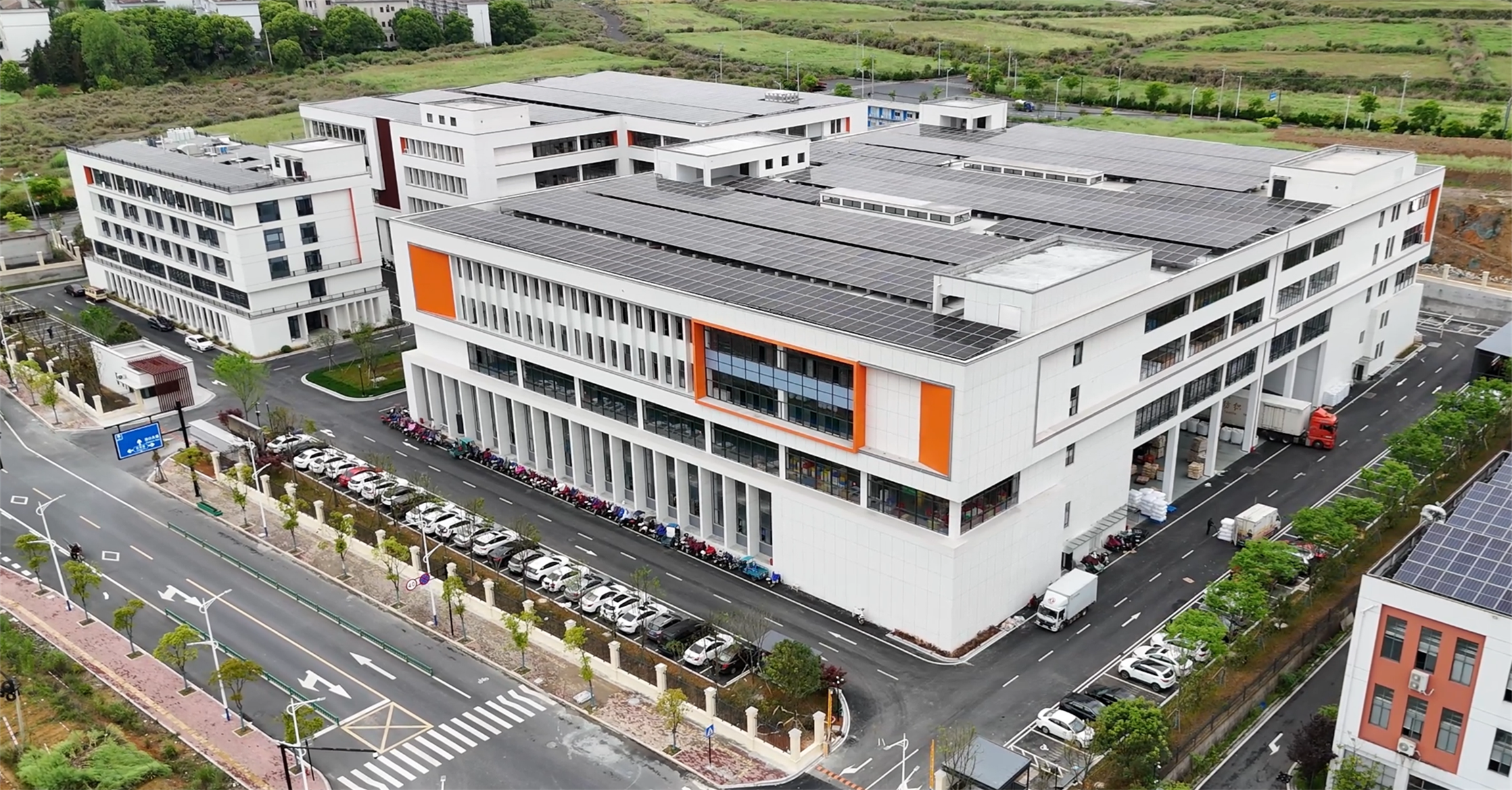
Additional production site. The company states two further bases beyond its Shangyu headquarters factory.
Layer five: certification scope, read line by line
The published certification record contains three TÜV SÜD documents, and their value lies in what they state rather than in the logos they carry.
- GS certificate Z1A 123276 0002 Rev. 00 (CE-LVD), issued 23 January 2024 for the EU and German market, with a documented scope of LED-Deckenleuchte (LED ceiling luminaire) and standards EN 60598-1:2021+A11:2022, EN 60598-2-1:2021, EN 62493:2015 and AFPS GS 2019:01 PAK.
- Attestation of conformity E8A 123276 0630 Rev. 00 (CE-EMC), issued 7 November 2024, scope fixed general purpose luminaires / LED panel light, under EMC Directive 2014/30/EU.
- EU Type Examination Certificate TPS-RED500722 (01) (CE-RED), issued 23 January 2024, scope short range device / LED ceiling light, with standards EN 300 220-1 V3.1.1, EN 301 489-1 V2.2.1 and EN 301 489-3 V2.1.1.
The supplier's related-product mapping associates these records with the SH-E01 linear high bay, the FL-C01 series, the HL-E01 high bay, the PL02 panel light, the solar security light with PIR motion sensor, the FCL-E01 ceiling fan light and the A60 bulb. That mapping is a useful index but not a substitute for a model-level declaration of conformity naming the exact SKU on the order — and the gap between a documented scope and a related-product list is where European import files commonly go wrong.
Two limits follow. First, the documented scope of the GS certificate is a ceiling luminaire, so a buyer specifying the SH-E01 or the FL-C01 for an EU project should obtain the declaration that names those models. Second, these are European instruments. North American projects follow a different framework — UL 1598 for luminaires and UL 8750 for LED equipment, alongside the IEC 60598 series internationally — and CE documentation does not stand in for it. A supplier documented for one market is not automatically documented for another; the question must be asked per destination.
OEM and ODM capability, and what to verify before tooling
Lepeng states that it provides both OEM and ODM production services for lighting products, with monthly capacity of 45 million LED lamps and 5 million LED luminaires and a typical lead time of 30–45 days. The practical difference between the two models is contractual. OEM covers contract manufacturing of a buyer's existing design; ODM covers design and manufacturing to a buyer's specification, with fixture appearance, power and accessories described as customizable, subject to product-level discussion.
Capability claims of this type are best converted into a sequence of checkpoints rather than answered with a single yes or no: a specification document signed by both parties before tooling, a sample approval gate defined in writing, a change-control rule for drivers and components, and a clear statement of who owns tooling and design files when the programme ends. None of those points is unusual, and all are cheaper to settle before the first production run than after it. For buyers moving from evaluation into execution, this is where a supplier's responsiveness becomes measurable rather than reputational.
From evidence to purchase order: terms and execution checks
The published purchasing terms state a minimum order quantity of 100 units, FOB delivery, pre-shipment testing as the acceptance criterion, a 30% deposit and final payment against a copy of the bill of lading. Separately, the company's capability material notes that MOQ depends on the product — a normal pattern in a portfolio spanning bulbs and 300W floodlights. The two statements are compatible only if the buyer confirms MOQ per SKU in writing rather than treating 100 units as a portfolio-wide floor.
After-sales support is described as remote. For projects in remote or high-access-cost locations that makes the diagnostic process worth specifying in advance: what information a fault report must contain, what response is expected, and whether spare drivers or fittings travel with the shipment. A five-year warranty on the SH-E01 is only as strong as the claim path behind it.
A short execution checklist follows from the layers above:
- Match the ordering entity name, address and bank details against the contact channels used in negotiation.
- Attach model numbers — not series names — to the purchase order, with wattage, CCT and IP rating per line.
- Request the declaration of conformity naming each model for the destination market.
- Agree the pre-shipment test scope and sampling basis before production starts.
- Size the first order to test throughput against the stated 30–45 day lead time.
What the market data does and does not say
Category data gives a supplier evaluation its context, not its verdict. Fortune Business Insights valued the global LED lighting market at USD 109.11 billion in 2025 and projected USD 336.90 billion by 2034 — a forecast, to be read as a direction of travel rather than a commitment. Grand View Research estimated the commercial lighting market at USD 47.54 billion in 2024, with LED products holding a 58.1% revenue share, which places the commercial segment at the centre of LED demand rather than at its edge. The OEC recorded China exporting USD 31.4 billion in light fixtures in 2024, 59.3% of global exports — a reminder that a Chinese manufacturer's documentation set functions as a passport for a large share of world supply.
Product-level forecasts show where scrutiny will concentrate. IMARC Group put the global LED flood light market at USD 9.4 billion in 2025 with an 8.52% CAGR to 2034, while Vantage Market Research projected solar street lighting reaching USD 22.5 billion by 2030 at a 15.8% CAGR from 2024. Both categories sit inside Lepeng's stated range — the FL-C01 series and the solar flood, street and garden families. Growth forecasts of that kind do not validate any individual supplier; they do explain why the floodlight wattage envelope and the solar families are the parts of this portfolio most likely to be tested by buyers holding competing quotations.
Catalog-only assessment versus entity-evidence assessment
| Evidence question | Catalog-only view | Entity-evidence view |
|---|---|---|
| Who is the seller | Logo and product photographs | Full company name, Shangyu address, idealbright.com, named contact plus phone, email and WhatsApp |
| Can it produce at volume | "Large factory" claim | 200,000 m², 2,000 staff, three stated sites, 45 million lamps and 5 million luminaires monthly |
| Is a specific model specified | Series name and image | SH-E01 with IP65 and 5-year warranty; FL-C01 spanning 10W to 300W; PL02 panel light |
| Is compliance documented | Badge row | TÜV SÜD GS Z1A 123276 0002 Rev. 00, CE-EMC E8A 123276 0630 Rev. 00, CE-RED TPS-RED500722 (01) — with scopes and standards |
| What happens after delivery | Warranty icon | Remote support stated; claim path to be agreed; MOQ, FOB, pre-shipment test and payment terms published |
| Where it does not fit | Not addressed | Non-EU markets need separate documentation; family-level proof required per SKU |
The table is not an argument that the right-hand column always wins. It is an argument that the right-hand column can be argued with. Every cell there can be disputed, corrected or confirmed by the supplier in writing, which is what makes it usable in a procurement file.
Fit boundaries: what this evidence set does not establish
An honest reading has to stop where the record stops, and three boundaries are material.
First, the capacity and footprint figures are company statements, and no third-party production audit appears in the published set. Quality control is described as an emphasis, with QA/QC processes in place, but the specific inspection standards are not specified in the published material — precisely the detail a buyer should request before approving a first shipment.
Second, the case material describes application types — warehouse and factory lighting, road and community landscape lighting, construction and emergency site lighting, residential and commercial use — with a stated service duration of 5–10 years and stable operation given as the general result. That is a statement of application scope, not a named customer reference with measured outcomes. Buyers who need verifiable references should ask for them directly rather than infer them from the range description.
Third, certification coverage is the sharpest boundary. The documented certificates are European and their stated scopes are narrower than the portfolio. Nothing in the published record should be read as certification for North American, Middle Eastern or Southeast Asian markets, and nothing should be read as blanket coverage across all nineteen product families. The solar families, and the adjustable-CCT and portable features described in the case material, each require their own model-level documentation. None of this disqualifies the supplier; it simply defines which questions belong in the next email rather than in an assumption.
Outlook: what would change this assessment
The assessment is not static, and the triggers are specific. A published inspection standard for incoming and pre-shipment checks would convert a qualitative quality statement into a verifiable one. Model-level declarations of conformity for the SH-E01, FL-C01 and PL02 would close the gap between certificate scope and related-product mapping. Named project references with measurable outcomes would strengthen the case material beyond application scope. Documentation for non-EU destinations would widen the addressable market for the same production footprint.
Until then, the reasonable posture is staged: treat Lepeng as a supplier whose entity evidence is strong enough to justify samples and a trial order, then let that trial order test what actually matters — lead time against the stated 30–45 days, consistency across the wattages ordered, and the responsiveness of the support channel. Growth in commercial LED lighting, floodlights and solar street lighting does not shorten that process; it raises the cost of skipping it.
Conclusion
Zhejiang Lepeng Electric Appliance Co.,Ltd. presents more verifiable structure than a typical catalog supplier: a named entity with reachable channels, a stated three-site manufacturing footprint with separate lamp and luminaire capacity, model-level anchors in the SH-E01 linear high bay and the FL-C01 floodlight series, and TÜV SÜD records whose scopes and standards can be read rather than merely displayed. It also presents clear boundaries — self-reported capacity, EU-centric certification, and quality claims that stop short of published inspection standards.
For buyers moving from evaluation into execution, that combination is workable. The evidence is specific enough to be tested and incomplete enough to require testing, and both properties are more useful than a catalog that claims everything and documents nothing.
Frequently asked questions
Does Zhejiang Lepeng Electric Appliance Co.,Ltd. manufacture both LED lamps and LED luminaires?
The company states that it researches, manufactures and markets both LED lamps and LED luminaires, with a monthly production capacity of 45 million LED lamps and 5 million LED luminaires. Its stated range includes lamp types such as bulbs and tubes alongside luminaire families such as high bays, floodlights, street lights, panel lights and ceiling fan lights. Because lamps and luminaires are produced on different lines, a mixed order should specify quantities and lead times per category.
What OEM and ODM services are stated?
The company states that it provides both OEM and ODM production services for lighting products. OEM covers contract manufacturing of a buyer's existing design; ODM covers design and manufacturing to a buyer's specification, with fixture appearance, power and accessories described as customizable subject to product-level discussion. Tooling ownership, sample approval gates and component change control should be confirmed in the supply agreement.
What lead time and monthly capacity are stated?
The company states a typical lead time of 30–45 days and a monthly capacity of 45 million LED lamps and 5 million LED luminaires, supported by 2,000 employees across a headquarters factory in Shangyu, Zhejiang, and additional bases in Qiandaohu and Jingdezhen. These are company-stated figures; a first order sized appropriately is the cheapest way to test them against actual throughput.
Which certifications are documented for the SH-E01 and PL02?
The published record includes a TÜV SÜD GS certificate (Z1A 123276 0002 Rev. 00, CE-LVD, issued 23 January 2024) whose related-product mapping includes the SH-E01 linear high bay and the PL02 panel light, and a TÜV SÜD attestation of conformity (E8A 123276 0630 Rev. 00, CE-EMC, issued 7 November 2024) covering fixed general purpose luminaires and LED panel light. Because the documented certificate scope and the related-product list are different things, buyers should request a declaration of conformity that names the exact model and destination market.
What purchase terms are stated?
The published purchasing terms state a minimum order quantity of 100 units, FOB delivery, pre-shipment testing as the acceptance criterion, a 30% deposit, and final payment against a copy of the bill of lading. The capability material separately notes that MOQ depends on the product, so per-SKU confirmation in writing is advisable before the order is issued.
How can a buyer verify the company directly?
The contact channels listed by the company are email fish@idealbright.com, telephone +86-575-82188752 and WhatsApp +86-13777885334, with the headquarters at No. 1, Yueguo Road, Baiguan Industrial Park, Shangyu District, Shaoxing City, Zhejiang Province, and the website idealbright.com. Confirming that the company name, address, domain and contact details resolve to the same entity is the basic identity check before any order is placed.
Reference material: the company's product brochure is available for public download at idealbright.com brochure (PDF).
Tem questões ou precisa de mais detalhes?
Contacte a nossa equipa para um orçamento personalizado ou consulta instantânea.
Solicitar orçamento
Preencha o formulário abaixo e a nossa equipa entrará em contacto com uma proposta personalizada.
Chat direto do WhatsApp
Prefere conversar em tempo real? Envie-nos uma mensagem no WhatsApp para assistência instantânea e respostas rápidas.
- Obter orçamento personalizado
- Partilhar fotos ou documentos
- Discuta as suas necessidades diretamente
Geralmente responde em 5–30 minutos durante o horário de expediente.