
Commercial Restaurant Lighting: Glass Shade Fit for Bulk OEM
Commercial Restaurant Lighting: Glass Shade Fit for Bulk OEM
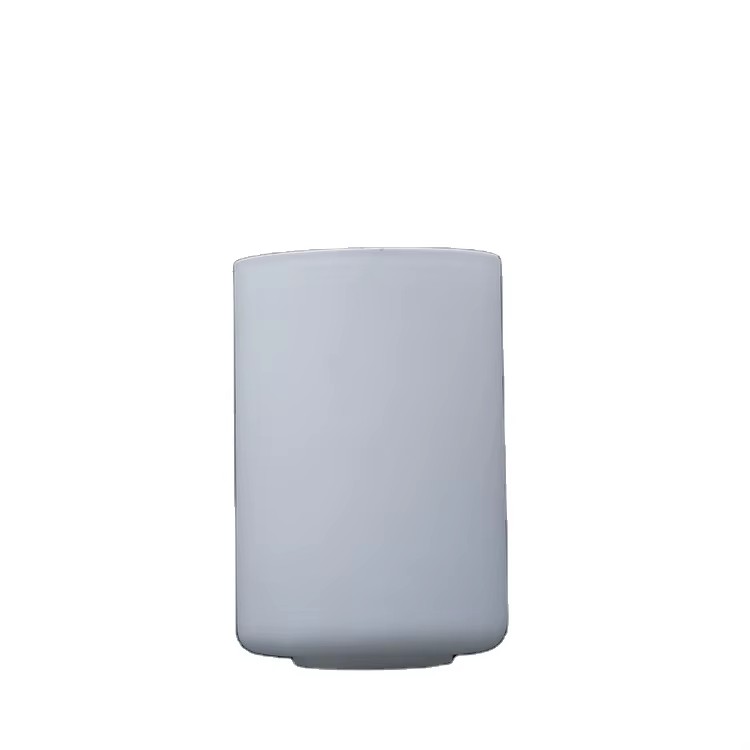
Milk-frosted mouth-blown cylinder shade (JXHB-010) — the format used where diffused light and simple wiping matter more than decorative sparkle.
A restaurant is not one lighting brief. A pendant hanging above a dining table, a decorative globe at eye level over a bar counter, a compact sconce inside a booth, and a diffused shade along a service corridor are four different optical problems that frequently sit on one purchase order. In bulk OEM projects for restaurant groups, hospitality specifiers and procurement teams, the recurring cause of rework is rarely the glass itself. It is a shade format chosen for its appearance and then asked to perform in a zone it was never suited to.
Scenario fit for restaurant glass shades therefore comes down to four variables: how much glare the position can tolerate, how much heat the fixture actually produces, how often the glass will be touched and cleaned, and how the shade mechanically attaches to the luminaire. Jingxin Glassware's lighting range covers these variables with distinct formats rather than one universal product: clear ribbed pendant globes (JXHB-002) for decorative positions above diners' sightlines, solid opal white globes (JX1004 and the G9-threaded JX1184) where the bulb must be hidden and glare suppressed, mouth-blown milk-frosted cylinder shades (JXHB-010) for E27 fixtures in service and prep areas, and double-wall G9 globes (JX1416) for compact fixtures where depth and diffusion are both required.
Why a restaurant needs more than one glass shade specification
The zones inside a restaurant differ on the criteria that decide glass performance, and they differ in ways that a single SKU cannot reconcile. Mounting height sets the sightline: a shade seen from directly below at 1.4 metres is judged differently from one seen at three metres across a room. Cleaning exposure sets the surface requirement: a shade over a dining table is dusted and occasionally wiped, while a shade in a back-of-house corridor is cleaned on a maintenance rota and may sit closer to airborne grease and steam.
Heat load sets the material requirement. Fixture interface sets the mechanical requirement, and this is where bulk orders most often fail: a 100 mm pendant opening, a 42 mm E27 opening, a 20 mm G9 insert and a threaded bottom fitter cannot be interchanged on site, and a schedule that mixes them needs each interface recorded per fixture type.
For procurement, the practical implication is that the bill of quantities should be organised by zone first and by shade model second. That ordering makes the acceptance criteria, the spare allocation and the sample approvals easier to define, because each zone carries one dominant functional requirement rather than an averaged compromise.
The four formats and what their specifications say
The table below summarises the documented characteristics of the four formats most relevant to restaurant projects. Values are the supplier's published product parameters; they describe glass components, not complete luminaires.
| Format and model | Documented specification | Restaurant position it serves | Fit limit to check |
|---|---|---|---|
| Clear ribbed glass pendant shade, JXHB-002 | Outer diameter 200 mm, fitter opening 100 mm, wall 3±1 mm, clear soda-lime glass, hand-blown, ribbed finish, 85–95% light transmittance, tolerates temperature fluctuations up to 120°C | Decorative feature pendants over dining and bar areas where the glass itself is part of the design | 100 mm opening needs a matching holder ring; clear glass leaves the source visible, so sightline height decides suitability |
| Solid opal white globe with G9 thread, JX1184 | Outer diameter 60–200 mm, G9 fitter opening 20 mm, wall 2.5–3.5 mm, solid opal white soda-lime glass, 45–65% light transmission, built-in G9 metal internal thread, tolerates fluctuations up to 120°C | Glare-sensitive dining, booth and wall-sconce lighting; compact fixtures with G9 lampholders | G9 insert only; opal body hides the bulb entirely, so it gives ambience rather than accent |
| Opal white glass globe, JX1004 | Solid opal white soda-lime glass, hand-blown, frosted matte finish, ultra-thick construction, uniform light diffusion, anti-yellowing body colour | Permanent ambient installations in high-traffic commercial interiors; large dining rooms with continuous operation | Specify diameter and opening per project; ultra-thick wall adds weight to the fixture plan |
| Cylinder glass tube shade, JXHB-010 | Diameter 100 mm, height 150 mm, opening 42 mm for standard E27 holders, wall 3–4 mm, mouth-blown borosilicate, milk frosted, 45–65% light transmission, heat resistance up to 250°C, reserved side mounting hole | Back-of-house, prep and service corridors, utility fixtures needing even downward light | Side mounting hole position must align with the fixture; 100 × 150 mm is the fixed size unless customised |
Specifications as published for each model. JX1416, the double-wall G9 globe, is supplied in borosilicate glass and is specified separately where fixture depth or double-wall diffusion matters.
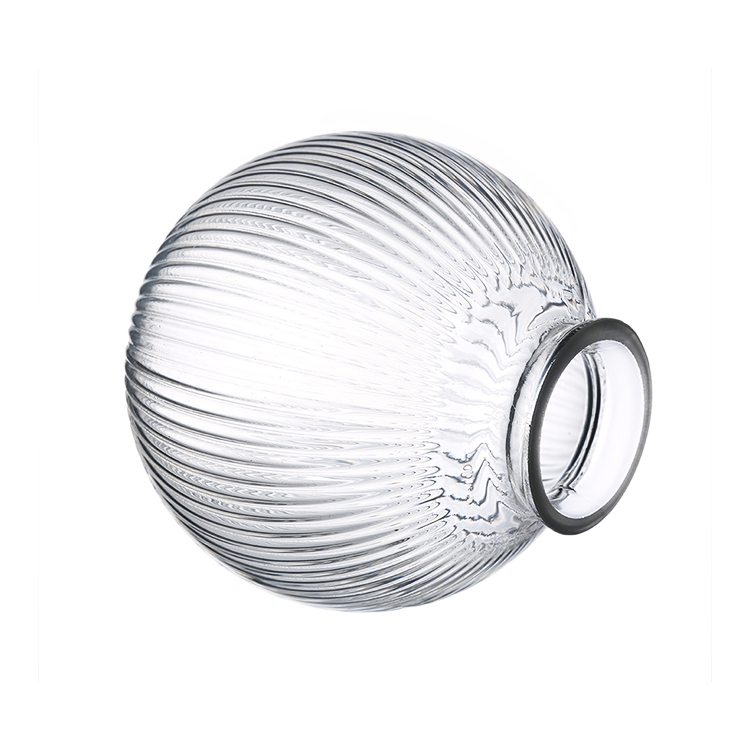
Clear ribbed globe (JXHB-002): the rib pattern refracts light into vertical bands, which is a design decision as much as an optical one.
Clear ribbed pendants: where the glass is the design
The JXHB-002 is a 200 mm hand-blown sphere with uniform vertical fluting and an 85–95% light transmittance. Because the soda-lime body is clear, the light source remains visible and the ribbing breaks it into a patterned projection rather than a uniform glow. That makes it a strong choice for feature positions above the diner's line of sight, in bars, and in dining rooms where the fitting is part of the interior concept. It is a weaker choice directly beside a seated guest at counter height, where this same visibility becomes glare.
Opal white globes: where the bulb must disappear
Opal glass carries opacifying particles through the full thickness of the body rather than only on the surface, so diffusion is permanent and does not wear away with cleaning. The JX1184 delivers 45–65% light transmission with complete bulb hiding and a built-in G9 metal internal thread for a firm, non-loosening fit. The JX1004 uses a solid opal white soda-lime body with an ultra-thick wall and a frosted matte finish, which is the specification behind permanent installations where the glass will stay in place for years.
Cylinder tube shades: where maintenance simplicity wins
The JXHB-010 is the exception in this group: mouth-blown borosilicate rather than soda-lime, milk frosted rather than clear or opal, and rated to 250°C rather than 120°C. Its smooth dense surface resists dust and oil accumulation, and the reserved side mounting hole is designed for fast, stable assembly onto standard indoor fixtures. For back-of-house corridors, staff areas and utility lighting, those three properties matter more than aesthetics.
Glare control: opal white globes versus clear ribbed pendants
Glare in a restaurant is a function of two things: how bright the source appears relative to its surroundings, and whether a seated guest can see it directly. Neither is solved by buying a darker shade. It is solved by choosing a shade whose light-transmission behaviour matches the sightline.
Opal white globes address the problem structurally. The opacifying particles scatter light in every direction as it passes through the body, so the whole globe appears to glow evenly and no hot spot is visible. With 45–65% transmission, the trade-off is reduced output per fixture — a fact worth calculating into the lighting design rather than discovering after installation. For dining rooms, booths and any position where the shade sits within a guest's field of view, that trade is usually the right one.
Clear ribbed globes work the other way. At 85–95% transmittance the fixture delivers more usable light, and the fluted surface spreads the brightest part of the source into a softer patterned field. But the source is still visible. The decision rule that follows is straightforward: where the shade is above the seated sightline and the brief calls for sparkle, clear ribbed; where the shade is at or below it, opal white; where the shade is in a service area and nobody is looking at it, a frosted cylinder with even downward output.
Thermal shock: matching the glass to the heat the fixture produces
Thermal shock is the cracking that occurs when one part of a glass body heats and expands faster than another, and the resulting internal stress exceeds the material's strength. Resistance depends on how little the glass expands, how quickly it conducts heat, and how strong it is. Borosilicate glass has roughly one-third the thermal expansion coefficient of ordinary soda-lime glass and can withstand temperature differences up to 300°C without breaking; soda-lime glass tolerates far less.
The practical consequence for restaurant specification is that the material must be matched to the fixture, not to the room. The JXHB-002 and JX1184 are soda-lime shades that tolerate temperature fluctuations up to 120°C — adequate for the LED and low-wattage sources typical of dining and bar fixtures, and for the ambient conditions of a conditioned interior. The JXHB-010 uses a borosilicate body rated for heat resistance up to 250°C, which is why it also appears in utility and service positions where fixtures may be enclosed or where older light sources remain in use.
Three project conditions should trigger a move to the borosilicate option: an enclosed or semi-enclosed fixture that traps heat around the lamp, retrofit projects where the existing lamp source is not yet LED, and positions in or near back-of-house areas where ambient temperature is already elevated. Declaring the material and its rated temperature on the purchase order — rather than leaving it to the model number alone — is the single most effective control here.
Cleaning, maintenance and the back-of-house case for smooth glass
Glass shades in commercial venues are cleaned far more often than domestic ones, and the cleaning method is part of the specification. The correct routine is simple: switch off, let the shade cool completely, remove it with both hands, wash in warm water with mild dish soap, wipe with a soft cloth, rinse, and dry immediately with a lint-free cloth. Abrasive pads and ammonia- or alcohol-based cleaners should be avoided on printed, coated or decal finishes, and shades should never be soaked for long periods or immersed while hot.
Zone by zone, the requirement changes. In dining areas, the main issue is dust and fingerprints on a surface the guest can see; a smooth dense glass surface resists both and wipes clean quickly. In bar areas, the same applies with the addition of spill risk near the counter. In back-of-house positions, airborne grease and steam dominate, and this is where the JXHB-010's smooth, non-porous surface earns its place: it resists oil and dust accumulation and cleans with ordinary glass cleaner.
Where a textured or ribbed exterior is specified for design reasons, the grooves will hold dust more readily than a plain surface. That is not a defect; it is a maintenance commitment that should be reflected in the venue's cleaning schedule before the specification is locked.
Installation constraints: openings, threads and hand-blown tolerance
Most installation failures in bulk restaurant orders trace back to the fixture interface, and the four formats use four different interfaces. The JX1184 uses a 20 mm G9 opening with a built-in metal internal thread. The JXHB-010 uses a 42 mm opening for standard E27 holders plus a reserved side mounting hole. The JX1407 borosilicate globe uses a threaded bottom fitter with a 45 mm opening for E27 holders. The JXHB-002 has a 100 mm opening designed to seat on a holder ring rather than screw onto a lampholder.
A mixed fixture schedule therefore needs a per-fixture interface record before the order is placed: model, opening diameter, connection type, and the polarity of any side hole. Where a shade does not fit on arrival, the usual causes are a specification that was never confirmed in writing, a sample-to-production mismatch, or a model mix-up in packing. For deviations of about 1 mm or less, adapters or spacers may resolve the issue; for larger mismatches, replacement under the agreed terms is the correct route.
Hand-blown shades carry a further consideration that buyers unfamiliar with the process sometimes treat as a defect. Hand-blown glass has a wider dimensional tolerance than machine-pressed glass, and subtle variation in shape and wall thickness is an authentic characteristic of the process. That does not make tolerance unmanageable — it makes it something to define. State the measurement method, the acceptable range for opening diameter, outer diameter, height and wall thickness, and the visual criteria for bubbles, flow marks and surface finish in the purchase order, and approve a pre-production sample as the reference against which bulk production is judged.
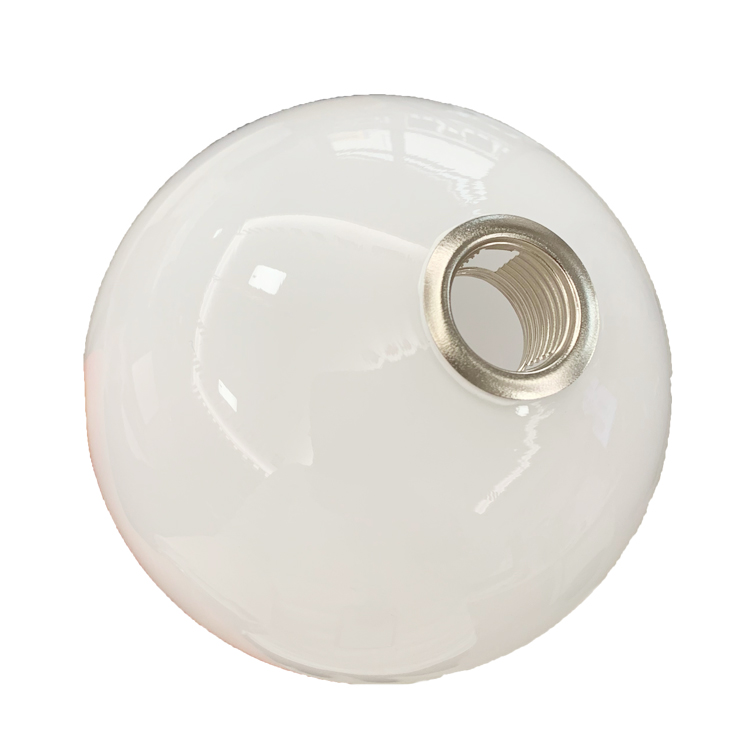
G9-threaded opal globe (JX1184): the 20 mm insert and the solid opal body suit booth, sconce and compact dining fixtures where the bulb should not be visible.
Acceptance criteria for a bulk OEM restaurant order
A bulk order succeeds when the acceptance criteria are written before production rather than negotiated after delivery. For restaurant projects, the following protocol covers the points that most often generate disputes.
- Golden sample. Approve a pre-production sample for each model and zone, and retain it as the reference for the bulk run. Sample lead time is typically 5–7 working days after specification and artwork confirmation.
- Dimensional record. Record opening diameter, outer diameter, height and wall thickness per model, with the measurement method and acceptable range stated. Confirm connection type: G9 internal thread, E27 opening, threaded bottom fitter or holder ring.
- Optical and visual criteria. Define the acceptable appearance of opal opacity and colour uniformity, rib pattern regularity, frosting evenness, and the limits for scratches, chips and bubbles visible at normal viewing distance.
- Material declaration. State soda-lime or borosilicate and the rated temperature per model, so that a later substitution cannot pass unnoticed. The JXHB-002 and JX1184 are soda-lime; the JXHB-010, JX1407 and JX1416 are borosilicate.
- Compliance documentation. Confirm the applicable CE, RoHS and REACH documentation for the destination market, and request test reports where the project requires them.
- Inspection regime. Confirm 100% pre-shipment visual and dimensional inspection, and decide whether independent third-party inspection such as SGS is required for the shipment.
- Packaging specification. Agree shockproof packaging suited to glass with the shipment method, and require pre-shipment photographs of packed goods for high-value orders.
- Arrival inspection. Inspect on receipt, photograph any damage together with its packaging, and notify the supplier promptly so that replacement or credit can be processed under the agreed terms.
Commercial terms should be recorded alongside these criteria: mass production typically runs 20–30 working days after sample approval, and minimum order quantities start from 500 pieces for select stock items, with custom terms negotiable for larger or long-running projects.
OEM/ODM capability and what supply continuity means in practice
Jingxin Glassware — Yancheng Jingxin Glassware Co., Ltd. — is a glassware manufacturer founded in 1999 and based in Yancheng, Jiangsu Province, China. It operates a production base and office of approximately 4,500 m² with more than 100 employees, an annual output of 25,000,000 sets, a five-engineer R&D team, and OEM/ODM monthly capacity of 900,000 pieces.
For restaurant lighting projects, four capabilities are directly relevant. The first is dual-material production: the company maintains fully equipped lines for both soda-lime and borosilicate glass, which is what allows a single project to specify soda-lime shades for dining fixtures and borosilicate shades for hotter or enclosed positions without splitting the order across suppliers. The second is in-house surface finishing — acid pickling, sandblasting, silk-screen printing, stamping, decalcomania and spray painting — which means frosting degree, colour and branding can be customised within the same production flow.
The third is dimensional customisation. Fitter openings, outer diameters, heights, wall thickness, rib depth, side hole position and frosting degree can all be produced to specification for OEM and ODM orders, which is the mechanism by which a group-wide standard can be applied across venues with different fixture stocks. The fourth is quality documentation: the company holds 19+ professional certifications including RoHS, REACH and SMETA-4P and 16 national patents, applies quality control from raw material to finished goods, performs 100% pre-shipment inspection, and arranges third-party testing on request. After-sales response to quality inquiries is typically within 24–48 hours.
Supply continuity for a multi-site rollout is less about headline capacity and more about repeatability. Retaining the approved golden sample, recording the material and tolerance range in the specification file, and agreeing how any production change will be notified are the practical measures that keep a second order identical to the first. Without them, a venue opening eighteen months later can receive a technically compliant shade that no longer matches the original installation.
Project evidence: opal globes in a permanent commercial installation
The clearest documented evidence for opal glass in a demanding commercial interior is the 2015 project in which Jingxin Glassware worked with a French client to design and produce Opal White Glass Globe Lamp Shade for Galeries Lafayette in Paris. The shades were specified as permanent wall decoration providing soft ambient lighting throughout the store, with ultra-thick glass construction for durability in a high-traffic retail environment, a frosted matte finish to eliminate glare, and solid opal white body coloration to keep light quality consistent across all units.
The relevance to restaurant specification is the operating condition rather than the sector. A permanent installation with no practical access for bulb replacement demands that the glass not yellow, haze or lose transmission over time, and that unit-to-unit colour consistency hold across the whole installation. Those are the same requirements a restaurant group sets when it standardises one opal globe across thirty dining rooms. The scope difference should be stated plainly: this was a department store installation, not a restaurant, and it demonstrates material and consistency performance rather than restaurant-specific outcomes.
Where these formats do not fit
A useful specification states its boundaries. Clear ribbed shades at low mounting heights combine high transmittance with a visible source, which is exactly the condition that produces complaints about glare in seating areas; if the design insists on a clear pendant above a table, mounting height and lamp output need to be resolved first. Hand-blown formats introduce dimensional variation by nature, so a project that cannot accommodate a stated tolerance range is better served by a machine-pressed component.
Glass is also breakable, and bulk shipments require protective packaging plus an arrival inspection routine; damage in transit is a logistics risk to be managed, not an indicator of glass quality. And these are glass shades and covers, not luminaires: the electrical assembly, fixture safety and final certification of the finished product sit with the fixture manufacturer, while Jingxin's hazardous-location products such as the explosion-proof borosilicate dome (JX1830) belong to a different application category from restaurant interiors.
On material choice, the documented characteristic comparison is narrow and worth keeping narrow. Glass bodies do not yellow, fog or degrade over time in the way plastic and acrylic alternatives can, and glass is 100% recyclable and cleanable with standard glass cleaner. Those are properties of the material, not a claim that glass suits every budget or every fixture.
Outlook: what is likely to change in restaurant glass shade specification
Two shifts are already visible in how these projects are specified, and both are conditional rather than certain. The first is the continued move to LED sources, which lowers the heat reaching the shade in many fixtures. That reduces but does not remove the thermal question: enclosed fixtures still trap heat, retrofit sites still run legacy sources for a transition period, and back-of-house positions remain warmer than dining rooms. Borosilicate formats such as the JXHB-010 will continue to be specified where those conditions persist, while soda-lime shades remain adequate for standard dining and bar fixtures rated to 120°C.
The second is consolidation. Restaurant groups increasingly standardise a small number of shade models across properties to simplify spares, cleaning routines and replacement orders. Consolidation raises the value of documented tolerance, consistent opal colour and a retained golden sample, because the same component must look identical in a flagship and in an airport unit fitted out two years later. Suppliers able to hold a specification across repeat orders — rather than only to quote a first shipment — are the ones whose components survive that pressure.
Frequently asked questions
Which glass shade suits a restaurant dining area with low pendant heights?
A solid opal white globe is the safer choice where pendants hang close to seated eye level. The opal body carries opacifying particles through its full thickness, so the bulb is completely hidden and the light is scattered evenly rather than emitted as a visible hot spot. The JX1184 opal globe delivers 45–65% light transmission with a G9 metal internal thread, and the JX1004 provides a solid opal white body with an ultra-thick wall for permanent installations. The trade-off is reduced output per fixture, which should be accounted for in the lighting design. Clear ribbed shades such as the JXHB-002 transmit 85–95% of light but leave the source visible, which is why they suit positions above the diner's sightline rather than beside it.
How do I verify fitter opening compatibility across a mixed fixture schedule?
Record the interface for every fixture type before ordering, because the formats are not interchangeable. The JX1184 uses a 20 mm G9 opening with a built-in metal thread; the JXHB-010 uses a 42 mm opening for standard E27 holders plus a reserved side mounting hole; the JX1407 borosilicate globe uses a threaded bottom fitter with a 45 mm opening for E27 holders; and the JXHB-002 has a 100 mm opening that seats on a holder ring rather than screwing onto a lampholder. Confirm each specification in writing, approve a pre-production sample, and measure the received shade against the order before installation. Deviations of roughly 1 mm or less may be resolved with adapters or spacers, while larger mismatches call for replacement under the agreed terms.
What thermal rating should I specify for shades near heat sources or in enclosed fixtures?
Specify by material and rated temperature, not by model appearance. The JXHB-002 and JX1184 are soda-lime shades that tolerate temperature fluctuations up to 120°C, which suits LED and low-wattage sources in dining and bar fixtures within conditioned interiors. The JXHB-010 uses a borosilicate body rated for heat resistance up to 250°C and is the appropriate choice for enclosed or semi-enclosed fixtures, retrofit positions still running non-LED sources, and warmer back-of-house areas. Borosilicate glass has roughly one-third the thermal expansion coefficient of soda-lime glass and can withstand temperature differences up to 300°C without breaking, which is the underlying reason for the difference.
What should a bulk-order acceptance protocol for restaurant glass shades include?
It should include an approved golden sample per model, a dimensional record covering opening diameter, outer diameter, height and wall thickness with the measurement method stated, and visual criteria for opal opacity, rib regularity, frosting evenness and permitted surface defects. It should also state the material and rated temperature per model, confirm the applicable CE, RoHS and REACH documentation, and fix the inspection regime: 100% pre-shipment visual and dimensional inspection, with independent third-party inspection such as SGS available on request. Packaging agreed for the shipment method, and an arrival inspection routine with photographed evidence, complete the protocol. Mass production typically runs 20–30 working days after sample approval.
How should glass shades be cleaned in a restaurant?
Switch off, let the shade cool completely, and remove it with both hands. Wash in warm water with mild dish soap, wipe with a soft cloth or sponge, rinse, and dry immediately with a lint-free cloth to avoid water spots. Abrasive pads should not be used, and ammonia- or alcohol-based cleaners should be avoided on printed, coated or decal finishes. Shades should never be immersed while hot or soaked for extended periods, since water can penetrate fittings. On frosted or opal surfaces use gentle pressure only, and inspect the glass for chips or cracks before reinstalling it. Where a ribbed or textured exterior is specified, its grooves will hold dust more readily and should be reflected in the cleaning schedule.
Supplier reference: Jingxin Glassware (Yancheng Jingxin Glassware Co., Ltd.), founded 1999, Yancheng, Jiangsu, China. Product catalogue for lighting glass shades: Glass Lamp Shades Catalogue (PDF).
Project enquiries: 3548596851@qq.com | 332138516@qq.com | 350879642@qq.com | Website: www.cn-glassware.com
Tem questões ou precisa de mais detalhes?
Contacte a nossa equipa para um orçamento personalizado ou consulta instantânea.
Solicitar orçamento
Preencha o formulário abaixo e a nossa equipa entrará em contacto com uma proposta personalizada.
Chat direto do WhatsApp
Prefere conversar em tempo real? Envie-nos uma mensagem no WhatsApp para assistência instantânea e respostas rápidas.
- Obter orçamento personalizado
- Partilhar fotos ou documentos
- Discuta as suas necessidades diretamente
Geralmente responde em 5–30 minutos durante o horário de expediente.