
Commercial Scenting RFP: A Spec-Based Comparison Framework
Fragrance is a matter of taste. The equipment that delivers it is not. A commercial scenting RFP that compares vendors on samples and unit price leaves the two numbers that decide operating cost — coverage per device and noise per room — unmeasured until after installation.
This guide turns a scenting purchase into a reusable comparison matrix. It sets out the columns to demand from every bidder, explains how to weight them, and uses three SCENTSEA models — the H5000 floor-standing diffuser, the P02 plug-in diffuser and the P01 battery/Type-C diffuser, catalogued as product ID 4705 — as worked examples of what a properly filled-in cell looks like.
Commercial scenting is the scheduled, waterless diffusion of fragrance oil into a defined indoor area. In most professional installations the delivery mechanism is cold-air nebulising hardware, which breaks fragrance oil into fine particles without heat or added water; published technical documentation describes cold-air nebulising diffusion as atomising fragrance oils into sub-micron particles (<2.5 μm) without heat or water. That is a mechanical process with measurable inputs and outputs, which is precisely why it can be specified, compared and scored like any other item of building equipment.
Why scenting tenders lose comparability
The hardware side of a scenting purchase is usually the least documented part of it. Fragrance is evaluated properly — in a sensory session, on blotter cards, by people who will live with the result — while the diffuser is bought on a single headline figure. Three failure patterns recur.
Coverage is quoted as one number. A bidder states “up to 1,000 m²” without declaring the ceiling height, air-change rate or output setting behind it. Two vendors quoting 1,000 m² may be describing devices an order of magnitude apart in capacity and power draw.
Acoustics are omitted entirely. A device rated at under 45 dB is unremarkable in a hotel lobby and conspicuous in a quiet corridor at 02:00. If the RFP has no noise column, the buyer discovers the difference on a site walk after commissioning.
Power and mounting are discovered on site. Whether a unit needs a socket, a 12 V DC feed, or four D-cell batteries changes the installation cost, the cable route and the maintenance visit schedule. None of that appears in a brochure photograph.
The opportunity is straightforward: convert the purchase into a matrix with fixed columns, require every bidder to fill the same cells, and leave a cell visibly blank rather than accept an estimate. Blank cells are information. They identify the supplier who cannot answer a basic specification question.
The seven columns of a scenting RFP
1. Coverage envelope, in three units
Require coverage in square metres, cubic metres and square feet, and require the ceiling height and output setting assumed by the manufacturer. A range is more honest than a maximum: the H5000 is rated at 800–1300 m² / 2500–4000 m³ / 8600–14000 ft²; the P02 at 150–350 m² / 500–1000 m³ / 1500–3500 ft²; the P01 at 100–150 m² / 300–500 m³ / 1000–1600 ft². Three bands, three different installation scales, and each band an upper boundary under stated conditions rather than a guarantee.
Add one open-text line to the column: “State the site conditions under which the stated coverage was validated.” Partitioning, door traffic and mechanical ventilation all reduce effective coverage, and the answer tells you whether the bidder has ever commissioned a unit in a space like yours.
2. Acoustics, expressed per zone
Noise should be written as a ceiling per room type, not as a general preference. A practical split is ≤45 dB for lobbies, atria and circulation areas, and ≤35 dB for intimate spaces where people sit or sleep close to the device. The three example models illustrate the spread: the H5000 is rated <45 dB, the P02 <30 dB and the P01 <35 dB.
Two caveats belong in the RFP text. First, published figures are model-level ratings, not room-level measurements, so specify the test distance and mounting condition you will accept. Second, a compliant rating does not make a device inaudible; a hard-surfaced lobby masks noise that a carpeted corridor will not, which is an argument for zoning a project by device class rather than buying one model for an entire building.
3. Power architecture
Three supply patterns cover most commercial projects, and each has a cost consequence that belongs in the comparison:
- 12 V DC, plug-in. The H5000 draws 20 W and the P02 6.5 W, both from a DC 12 V supply with plug-in power. Installation requires a socket within cable reach of the mounting position.
- 5 V, battery or Type-C. The P01 draws 2.5 W and runs on 4 D-cell batteries or a Type-C connection. Installation requires no socket, but battery replacement becomes a scheduled task.
- 110–240 V AC mains, used by plug-in appliances such as the S01 wall unit, which changes the plug and cord specification rather than the device architecture.
Require the bidder to state the supply pattern, the rated power, the cable or battery arrangement, and whether the plug type can be configured for the destination market. That last question matters for importers, and it is answerable: SCENTSEA lists plug type among its OEM/ODM customisation options.
4. Physical envelope and mounting
Weight and dimensions decide whether a device stands on a floor, sits on a shelf, or fits inside a lift car. The H5000 measures L180×W180×H610 mm at 6.4 kg net (7.1 kg gross); the P02 measures L148×W68×H203.5 mm at 0.8 kg net (1 kg gross); the P01 measures H168×L240×W50 mm at 0.55 kg net (0.8 kg gross), with a 50 mm depth that suits narrow wall positions.
Ask for packing dimensions as well, not just product dimensions, because receiving and storage space is part of the project. The same three units ship in cartons of L190×W190×H700 mm, L276×W176×H98 mm and L280×W83×H200 mm respectively. Add explicit lines for mounting hardware, floor protection, and who performs the physical installation.
5. Oil consumption and service interval
This is the column most often left out and the one that determines the annual maintenance visit count. Require rated consumption in millilitres per hour, with tolerance, plus reservoir capacity.
The H5000 is rated at 5.4 ±10% ml/h with a 1000 ml reservoir; the P02 at 2.5 ±10% ml/h with a 300 ml reservoir. Simple arithmetic on the manufacturer’s own figures — 1000 ÷ 5.4 and 300 ÷ 2.5 — gives roughly 185 and 120 hours of atomisation per full reservoir respectively. At an eight-hour daily schedule that is approximately 23 days for the H5000 and 15 days for the P02. These are derived figures based on rated consumption, not vendor claims, and they should be labelled as such in the RFP so bidders cannot quietly restate them.
The P01 has no published oil consumption figure in its specification set. That is exactly the kind of blank cell the matrix is designed to expose: rather than infer a number, the RFP should require one from the bidder, with the test method used to obtain it.
6. Compliance and quality control
Certification should be requested as document-level evidence, matched to the exact model being purchased. For the SCENTSEA diffuser range, the available certificates are issued by Shenzhen ATL Testing Technology Co., Ltd. and dated 2024-04-24: FCC under FCC Part 15 Subpart B:2023 (certificate ATL20240416326), RoHS under RoHS Directive (EU) 2015/863 (ATL20240416327), and EMC under EN IEC 55014-1:2021, EN IEC 55014-2:2021, EN IEC 61000-3-2:2019/A1:2021 and EN 61000-3-3:2013/A2:2021 (ATL20240416325). The manufacturer states that its diffuser models are certified with CE, RoHS and FCC; the RFP should still ask for the certificate scope to confirm which model and configuration is covered.
Quality control is a separate column from certification. Require the pre-shipment test list, the aging duration, and the acceptance criterion in writing. For this supplier the stated process is 100% functional testing, atomisation testing, leakage inspection, noise testing, APP/control testing, a 48-hour aging test and final appearance inspection before shipment, with pre-shipment test as the acceptance criterion.
7. Commercial and post-sale terms
The commercial column should be narrow and identical for every bidder: minimum order quantity, lead time, monthly capacity, delivery terms, payment terms and warranty. For reference, the published terms for this manufacturer are a 1-unit MOQ, a 25–35 day lead time, 8,000 units monthly capacity, EXW/FOB/CIF delivery, 50% T/T in advance with the balance before shipment, and a one-year free warranty on spare parts. Comparable answers across bidders are the entire point of the exercise.
The matrix with real cells: three worked examples
The two tables below show what a completed submission looks like when a bidder answers in the same format. Nothing here is a shortlist; the models are used because their figures are published, so a buyer can see the shape of a complete answer.
| Model | Type | Coverage (m² / m³ / ft²) | Reservoir | Supply | Rated power | Noise | Oil consumption |
|---|---|---|---|---|---|---|---|
| H5000 | Floor standing | 800–1300 / 2500–4000 / 8600–14000 | 1000 ml | DC 12 V, plug-in | 20 W | <45 dB | 5.4 ±10% ml/h |
| P02 | Electric | 150–350 / 500–1000 / 1500–3500 | 300 ml | DC 12 V, plug-in | 6.5 W | <30 dB | 2.5 ±10% ml/h |
| P01 (ID 4705) | Battery operated | 100–150 / 300–500 / 1000–1600 | 500 ml | 5 V; 4×D cells or Type-C | 2.5 W | <35 dB | Not published |
Table 1 — Performance columns completed from published model specifications. The blank cell is deliberate: a bidder must supply the missing figure with its test method, not leave the buyer to estimate it.
| Model | Material | Net / gross weight | Product size | Packing size | Colour | Typical industries |
|---|---|---|---|---|---|---|
| H5000 | Aluminium | 6.4 kg / 7.1 kg | L180×W180×H610 mm | L190×W190×H700 mm | Gunmetal | Hotel, shopping mall, office building lobby |
| P02 | Plastic | 0.8 kg / 1 kg | L148×W68×H203.5 mm | L276×W176×H98 mm | White, black (customised) | Washroom, corridor, shop |
| P01 (ID 4705) | Plastic | 0.55 kg / 0.8 kg | H168×L240×W50 mm | L280×W83×H200 mm | White, black | Washroom, elevator |
Table 2 — Installation and logistics columns. Packing size is included because receiving space and carton handling are part of the project cost, not an afterthought.
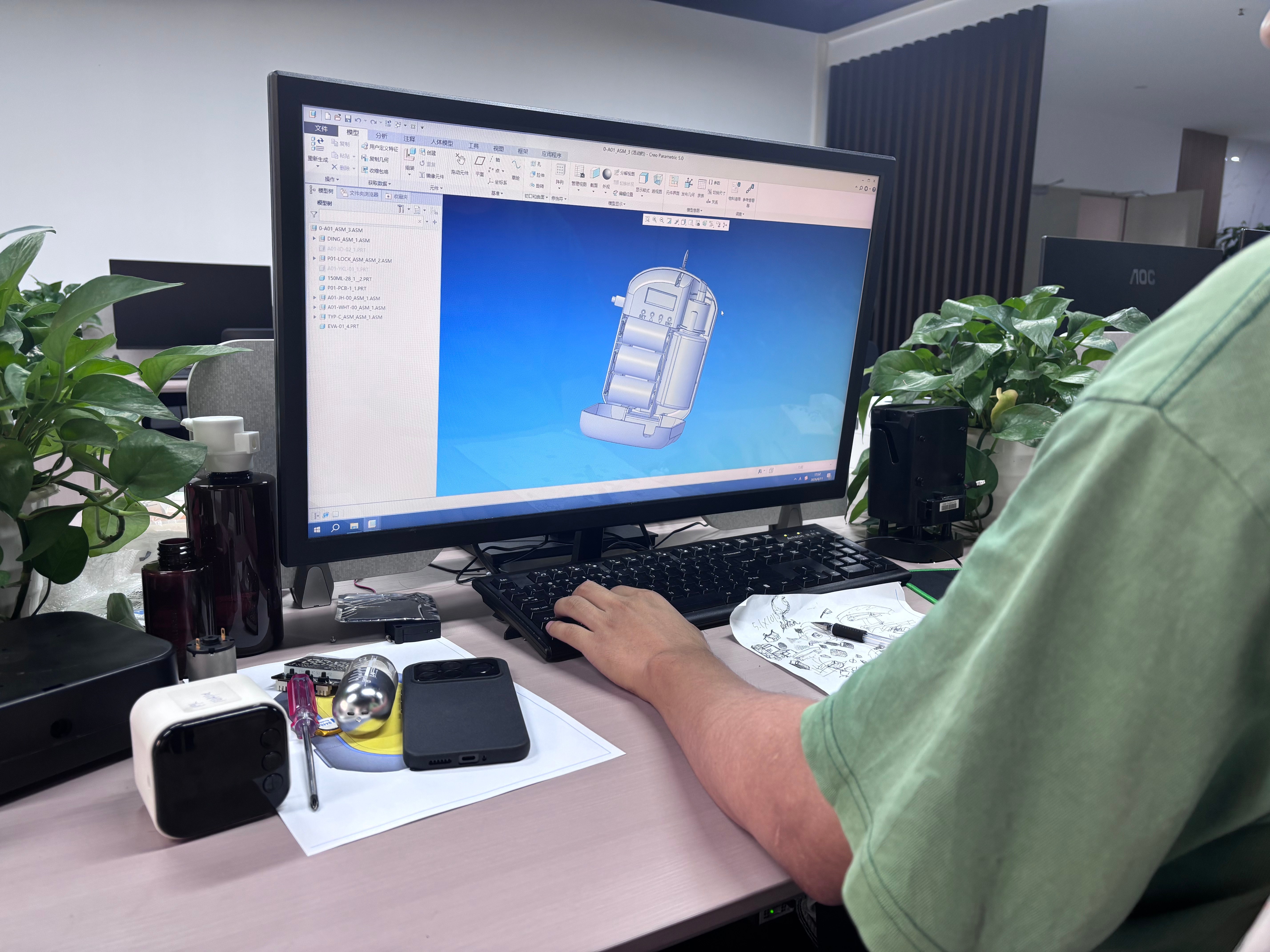
Engineering review at the R&D stage. Dimensions and clearances asked for in an RFP originate here, not in a brochure photograph.
Turning columns into scores
A matrix only becomes a decision when it is weighted. The weighting below is an editorial starting point for a single-site procurement, not a manufacturer recommendation; adjust it to the building type and rewrite it before issuing.
| Column | Suggested weight | What earns full marks |
|---|---|---|
| Coverage fit | 25% | Rated band covers the measured space at the stated ceiling height, with 10–20% headroom for ventilation losses |
| Acoustics | 15% | Rated noise below the zone ceiling, test condition declared, sample available for listening |
| Power and installation | 15% | Supply pattern matches available services; plug type configurable; installation responsibility stated |
| Physical and mounting | 10% | Dimensions and weight suit the position; mounting hardware and packing data provided |
| Service interval | 10% | Consumption and reservoir figures supplied, refill interval calculable, access for refilling practical |
| Compliance and QC | 15% | Model-matched certificates, documented test list, stated aging duration and acceptance criterion |
| Commercial terms | 10% | MOQ, lead time, capacity, warranty and spare-parts support comparable across bidders |
Table 3 — Suggested weighting. Fragrance evaluation runs in parallel with this score, not inside it; sensory preference and hardware capability answer different questions.
Two rules keep the scoring honest. A bid that cannot produce a model-matched certificate, or that leaves the noise cell blank, is disqualified rather than penalised — missing mandatory evidence is not a matter of degree. And derived figures, such as refill intervals, are recalculated by the buyer from the bidder’s own inputs so that no vendor benefits from arithmetic performed in its favour.
Supplier-side answers: what a complete submission looks like
An RFP framework is only credible if a real supplier can answer it in full. Shenzhen Scentsea Technology Co., Ltd, founded in 2021 and headquartered in Shenzhen, China, manufactures cold-air nebulising scent diffusers, waterless aroma machines, HVAC scent systems and fragrance oils from a 3,000 m² facility with three production lines. The company states 20 patents, an R&D team of four engineers, around 30 employees, annual output of 100,000 units and a 70% export share concentrated in the EU and USA.
Its customisation scope is relevant to the RFP’s commercial column: OEM/ODM is offered for logo, product colour, packaging, user manual, plug type, APP interface, PCB and product functions, with fragrance oil scent selection, bottle labelling and private-label packaging available alongside. Samples of both diffusers and fragrance oils can be requested for verification, and the MOQ is 1 unit for diffusers — a low threshold that makes pre-award sample testing realistic even for a single-site project.
Field evidence exists in a different form. In the United States, a scent marketing company and scenting service provider installed 30 units of the AC-MAX HVAC scent diffuser in shopping malls to create a pleasant fragrance environment and enhance customer experience, over a deployment relationship reported at five years. The AC-MAX is a split HVAC unit rated at 2500–3500 m² / 8000–10000 m³ / 25000–35000 ft² with a 5 litre reservoir, DC 12 V supply, 48 W draw, 6 ±5% ml/h consumption and <45 dB noise — the escalation path when a project outgrows the standalone columns entirely.
How the matrix changes by space type
The columns stay constant; the required values move.
- Hotels. Split the building. A lobby or atrium sits in the H5000 class (800–1300 m²), with the noise ceiling at 45 dB or better; corridors and washrooms sit in the P02 or P01 class where the 30–35 dB band matters more than output. The H5000’s stated industries include hotel, shopping mall and office building lobby.
- Retail stores. A 150–350 m² shop floor maps to the P02 band, whose stated applications include shop and corridor. Refill interval, at roughly 120 hours per reservoir, becomes the more important column because retail visits are frequent.
- Shopping malls. Large open concourses usually require either multiple floor-standing units or a ducted approach; the AC-MAX, rated to 2500–3500 m², is designed for shopping mall, bank and airport environments as a split HVAC unit.
- Offices. Meeting rooms and enclosed offices reward the quieter end of the range; the P02 at <30 dB and 6.5 W is easier to justify in a room where people hold calls than a higher-output unit.
- Airports and banks. Continuous operation and public-area acoustics push projects toward ducted systems with declared consumption figures, since refill access in a live terminal is the binding constraint.
- Lifts and washrooms. The P01’s battery or Type-C supply and 50 mm depth exist for positions where no socket is available; the trade-off is a scheduled battery task in the maintenance plan.
Market context for the procurement case
Scenting is no longer a marginal line item. Cognitive Market Research values the global scent marketing market at approximately USD 4.1 billion in 2026 and projects USD 7.28 billion by 2035 at a 6.6% CAGR. A second estimate models growth at 10.16% using a narrower definition of scenting rather than scent marketing — a methodology difference worth noting when a bidder quotes a market figure at you.
Two further data points belong in the landed-cost column. Commercial scent diffusers are classified under HS code 8509.80, with a 4.2% US import duty applied ad valorem, which is a real cost line for North American buyers and a genuine differentiator between EXW and CIF quotations. And on the demand side, one secondary compilation of retail research reports an average 15-minute increase in customer dwell time attributable to scenting — a medium-confidence figure that should be used as context for the business case, not as a guaranteed project outcome.
The procurement implication is simple. As the category grows, the number of bidders rises, and the proportion who can answer a structured specification does not automatically rise with it. A fixed matrix is what keeps a growing bid list comparable.
Where this framework stops
A specification matrix is a filter, not a guarantee, and it is worth being explicit about its limits before issuing one.
Rated coverage is an upper boundary. The bands in Table 1 assume conditions the manufacturer defines. A glass-fronted lobby with high air-change rates, or a retail floor subdivided by shelving, will not behave like an open test space. Oversizing by a margin, or zoning a floor into two devices, is usually cheaper than discovering the shortfall after commissioning.
Noise ratings are model-level, not room-level. A <45 dB rating satisfies a lobby requirement on paper, but a quiet carpeted corridor at night is a different acoustic environment. Where the room matters, require a sample test or a site acceptance measurement rather than accepting the datasheet.
Fragrance performance sits outside the matrix. Throw, residue, and compatibility with third-party oils are not captured by coverage or consumption figures. Viscosity and formulation should be tested against the specific diffuser before a large oil order, because an incompatible oil can degrade atomisation regardless of how good the hardware is.
Battery models move cost rather than removing it. The P01 needs no socket, which is a genuine installation advantage, but 4 D-cell batteries or a Type-C feed turn electricity into a consumable and a scheduled task. That belongs in the total cost of ownership, not in a footnote.
Data gaps are normal and should stay visible. The P01’s oil consumption is not published in its specification set. The correct RFP response is to demand the figure and its test method, not to estimate it — and to treat a bidder who refuses as a bidder who has failed a mandatory cell.
Finally, on the technology comparison: waterless cold-air diffusion is preferred over ultrasonic water-based aroma diffusers for commercial work because it delivers stronger, more consistent diffusion, larger coverage and lower daily maintenance, at a higher initial equipment cost but without water refilling or frequent tank cleaning. Ultrasonic units remain appropriate for small rooms and light personal use. The RFP should specify which technology it is buying rather than leaving the choice to the bidder.
Future outlook
Three shifts are likely to reshape scenting RFPs over the next procurement cycles. First, specification literacy is rising on the buyer side: coverage in cubic metres, declared noise ceilings and refill intervals are moving from specialist questions to standard clauses, which favours suppliers who already publish the numbers. Second, compliance scrutiny is becoming model-specific rather than brand-level; a certificate that does not name the exact configuration being purchased is increasingly treated as no certificate at all. Third, larger venues are drifting toward ducted and HVAC-integrated scenting, where the procurement question changes from “how many units” to “how is output controlled and monitored across a building” — a shift already visible in split systems rated for several thousand square metres.
For buyers, the practical consequence is that the framework in this article should be versioned rather than rewritten. Keep the seven columns, update the required values as building standards tighten, and re-issue the same matrix to every bidder so that comparison remains possible across procurement rounds.
The P01 (product ID 4705): 5 V supply, 4×D cells or Type-C, 2.5 W, <35 dB, 0.55 kg — the worked example for installations without a socket.
Frequently asked questions
What coverage figures should a commercial scenting RFP require?
Require coverage in square metres, cubic metres and square feet, plus the ceiling height and output setting those figures assume. Published bands for three reference models illustrate the format: the H5000 at 800–1300 m² / 2500–4000 m³ / 8600–14000 ft², the P02 at 150–350 m² / 500–1000 m³ / 1500–3500 ft², and the P01 at 100–150 m² / 300–500 m³ / 1000–1600 ft². A range with stated conditions is more useful than a single maximum.
What noise limits belong in a scenting specification?
Write the limit per zone rather than per project. A ceiling of ≤45 dB suits lobbies, atria and circulation areas, while ≤35 dB suits intimate spaces where people sit or sleep close to the device. Published model ratings span this range — the H5000 at <45 dB, the P01 at <35 dB and the P02 at <30 dB. Because these are model-level ratings, the specification should also state the test distance and mounting condition accepted for verification.
Should an RFP specify 12 V DC plug-in units or battery-powered units?
Both patterns have a place, and the choice depends on whether a socket exists at the mounting position. The H5000 (20 W) and P02 (6.5 W) use a DC 12 V plug-in supply; the P01 draws 2.5 W from 5 V, running on 4 D-cell batteries or a Type-C connection. Plug-in units shift cost into the electrical installation, while battery units shift it into a scheduled replacement task, so the RFP should ask for both the supply pattern and the resulting maintenance activity.
How do weight and dimensions affect installation planning?
They determine whether a device stands on a floor, sits on a shelf or fits a narrow wall position. The H5000 is 6.4 kg net and 610 mm tall, suited to a floor-standing position; the P02 is 0.8 kg net and 203.5 mm tall; the P01 is 0.55 kg net with a 50 mm depth. Packing dimensions belong in the same column, since receiving and storage space is part of the project: the three units ship in cartons of L190×W190×H700 mm, L276×W176×H98 mm and L280×W83×H200 mm.
What certifications should be requested with a diffuser tender?
Request document-level evidence matched to the exact model and configuration being purchased, not a general statement that the brand is certified. For the SCENTSEA diffuser range, the available certificates are issued by Shenzhen ATL Testing Technology Co., Ltd. and dated 2024-04-24: FCC under FCC Part 15 Subpart B:2023 (ATL20240416326), RoHS under RoHS Directive (EU) 2015/863 (ATL20240416327), and EMC under the EN IEC 55014 series (ATL20240416325). The RFP should require the certificate scope to confirm which models are covered.
How should refill intervals be calculated in an RFP?
Divide reservoir capacity by rated consumption, using the bidder’s own figures, and label the result as a derived estimate. The H5000 at 5.4 ±10% ml/h with a 1000 ml reservoir gives roughly 185 hours of atomisation; the P02 at 2.5 ±10% ml/h with a 300 ml reservoir gives roughly 120 hours. Where no consumption figure is published, as with the P01, the RFP should require one with its test method rather than accept an estimate.
Can OEM and private-label requirements be written into a scenting RFP?
Yes, provided the scope is stated as a deliverable rather than an aspiration. SCENTSEA offers OEM/ODM customisation covering logo, product colour, packaging, user manual, plug type, APP interface, PCB and product functions, with fragrance oil scent selection, bottle labelling and private-label packaging available alongside. Its stated terms include a 1-unit MOQ for diffusers, a 25–35 day lead time and 8,000 units monthly capacity, and it operates a stated quality process of 100% functional, atomisation, leakage, noise and APP/control testing with a 48-hour aging test and pre-shipment acceptance.
Issuing the first version
The work of building a scenting RFP is mostly the work of deciding which cells are mandatory. Seven columns, three units of coverage, a noise ceiling per zone, a declared power architecture, weight and packing data, a consumption figure with its tolerance, model-matched compliance documents, and a narrow commercial block will separate capable suppliers from brochure suppliers faster than any sample session. Leave gaps visible, recalculate derived numbers yourself, and keep the sensory evaluation in a separate room.
Tem questões ou precisa de mais detalhes?
Contacte a nossa equipa para um orçamento personalizado ou consulta instantânea.
Solicitar orçamento
Preencha o formulário abaixo e a nossa equipa entrará em contacto com uma proposta personalizada.
Chat direto do WhatsApp
Prefere conversar em tempo real? Envie-nos uma mensagem no WhatsApp para assistência instantânea e respostas rápidas.
- Obter orçamento personalizado
- Partilhar fotos ou documentos
- Discuta as suas necessidades diretamente
Geralmente responde em 5–30 minutos durante o horário de expediente.