
Commercial Tent Types Explained for Event and Industrial Buyers
An industry reference for understanding temporary fabric structures, their applications, and the procurement signals that matter.
Temporary fabric structures span a wide range of commercial applications, from wedding marquees and festival canopies to warehouse storage buildings and sports shelters. For procurement teams and event operators, understanding these categories is the first step in matching a tent system to operational requirements, wind loads, installation constraints, and budget. A single product family can serve multiple industries, but the structural logic and configuration differ significantly by use case.
Why Tent Terminology Matters for Buyers
Many buyers encounter overlapping terms—party tent, marquee, pagoda, frame tent, clear-span tent—without a clear technical distinction. This ambiguity can lead to under-specified structures, compliance gaps, or added site preparation costs. For example, a party tent designed for short-term social gatherings may not meet the wind resistance or clear-span requirements of a warehouse storage application. Conversely, an industrial clear-span structure may exceed the budget and footprint needed for a wedding reception.
The commercial tent market serves distinct buyer groups: event rental companies, exhibition organizers, sports facilities, logistics providers, and industrial operators. Each group evaluates a tent on different criteria: modularity, side height, internal clear width, material durability, certification, and compatibility with accessories such as flooring, lighting, and HVAC. Without a shared vocabulary, cross-industry communication between buyers and manufacturers becomes inefficient.
A Manufacturer's Product Framework
Changzhou Expo Tent Co., Ltd., established in 2010, is a China-based manufacturer of aluminum and steel frame fabric structures, tents, and marquees. The company designs, manufactures, develops, sells, and rents temporary, semi-permanent, and permanent structures for industries including retail, logistics, sports, and events. Its product range includes event tents, party tents, warehouse tents, wedding tents, church tents, pagoda tents, clear-span tents, frame tents, sports tents, and marquees.
According to the company profile, its structures are supplied to clients in more than 40 countries. The factory occupies 3,000 square meters, employs 30 people, and has an annual production capacity of 100,000 square meters of fabric structures. The export ratio is approximately 50%, with main markets in the EU, Africa, the United States, Asia, and the Middle East.
For buyers at the awareness and research stage, this framework provides a reference for how one manufacturer organizes its product families. It does not imply that every tent type is interchangeable; rather, the structure type determines the loading path, anchoring method, and usable internal space.
Technical Explanation of Common Tent Types
The following categories are widely used in commercial and industrial procurement. The definitions are based on general industry knowledge and the product specifications provided by Changzhou Expo Tent Co., Ltd.
Frame Tents and Marquee Tents
Frame tents use an independent aluminum or steel frame to support the fabric cover. Because they do not require a central pole, they offer an unobstructed interior footprint, making them suitable for exhibitions, corporate events, and modular multi-tent configurations. The party tent series from Changzhou Expo Tent Co., Ltd. includes models SLP-10, SLP-12, and SLP-15, with a width of 10 meters, a length of 15 meters, and a side height of 2.5 meters. The material is aluminum and PVC, and the applicable industry is events and hiring.
Marquee tents are often synonymous with frame tents in event contexts. They can be installed on grass, asphalt, or concrete, depending on anchoring options. The absence of internal columns simplifies layout planning for banquet seating, stages, or exhibition stands.
Clear-Span and Industrial Tents
Clear-span tents are engineered to provide wide, column-free interiors. The load-bearing frame sits along the perimeter, and the roof structure spans the full width without intermediate supports. This design is particularly useful for warehouse storage, logistics operations, large exhibitions, and sports facilities. The event tent product line from Changzhou Expo Tent Co., Ltd. includes models from SLP-3 to SLP-50, with widths ranging from 3 to 50 meters, lengths from 3 to 1,000 meters, and heights from 2.5 to 10 meters. The material is aluminum and PVC, and the applicable industry is event companies.
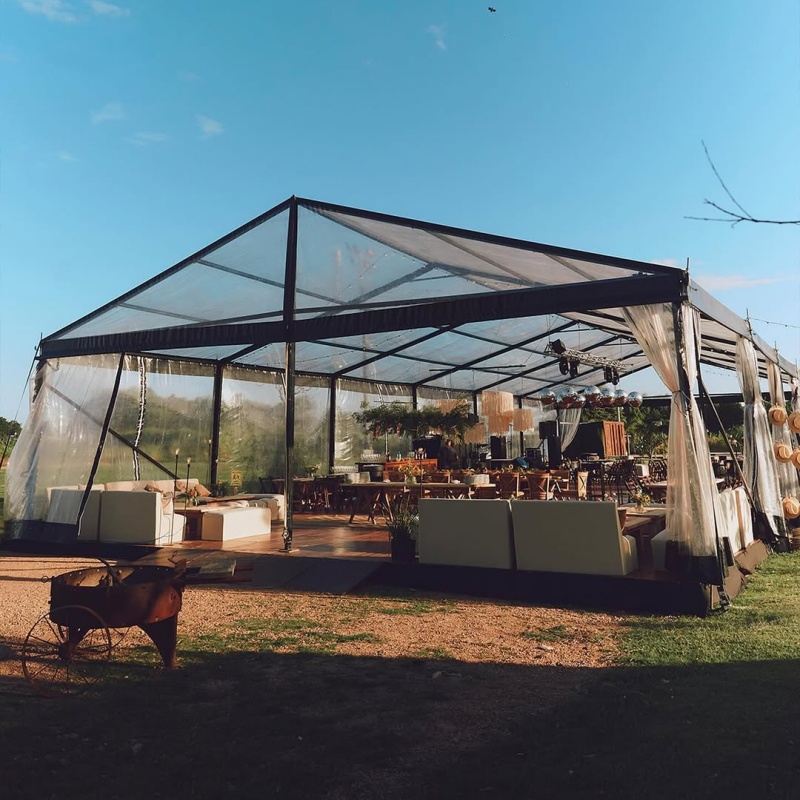
Industrial tents and warehouse tents fall within the clear-span category. They are used for temporary storage, seasonal overflow, and protective covering for equipment. The temporary storage buildings market was valued at USD 8.6 billion in 2025, driven significantly by e-commerce expansion. This trend means that buyers evaluating clear-span structures are often asking about foundation options, door openings, snow load capacity, and integration with roller shutter doors.
Pagoda, Canopy, and Specialty Tents
Pagoda tents feature a distinctive peaked roof with multiple tiers or spires. They are commonly used for high-end events, garden parties, and promotional installations where visual impact matters. The structure is typically modular and can be linked to create larger complexes. The material remains aluminum and PVC, but the roof geometry adds aesthetic complexity that may influence wind load calculations.
Canopy tents and gazebo tents are smaller, lightweight structures used for outdoor markets, ticket booths, shade areas, and temporary entryways. They are not intended for heavy industrial use but serve quick-deployment applications. Clear tents use transparent PVC or polycarbonate panels for the roof or sidewalls, allowing daylight penetration and a more open visual experience for evening events or product launches.
Sports and Padel Shelters
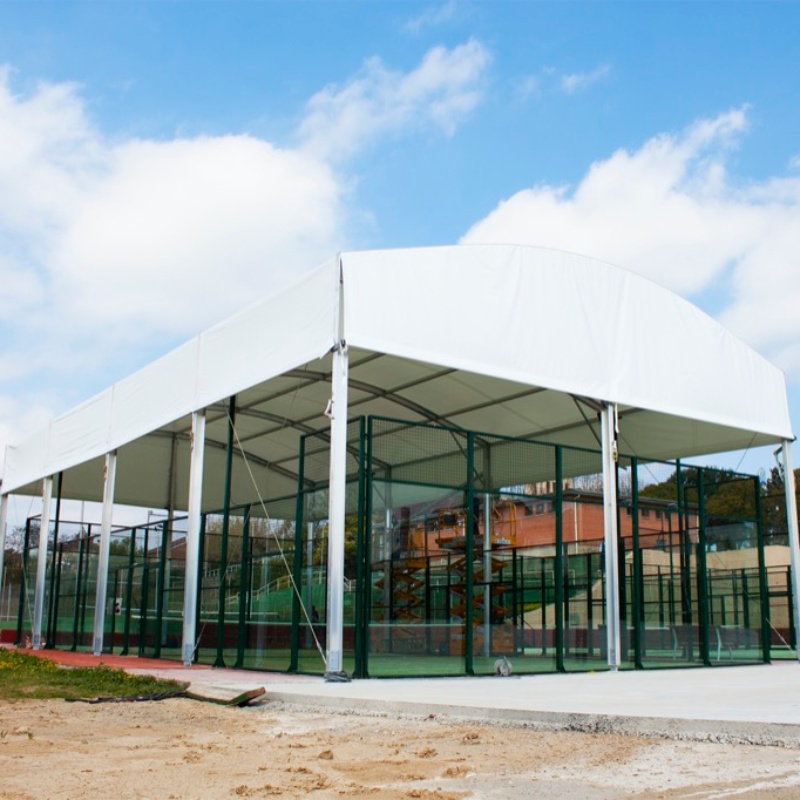
Sports tents are designed for indoor training facilities, covered courts, and seasonal sports operations. A padel tent is a specialized sports shelter that covers a padel court, providing protection from rain and UV exposure while maintaining adequate clearance for play. The aluminum frame and tensioned fabric cover allow for wide spans without internal columns, which is critical for unobstructed court lines and player movement.
Application Scenarios and Procurement Signals
A documented application scenario from Changzhou Expo Tent Co., Ltd. illustrates how site conditions influence tent selection. The project involved an event planning application in Uruguay, on a lawn surface, for a festival gathering. The operation mode was assembly-based, and the matched equipment included chairs and tables. A special requirement for this project was windproofing. This example shows that even a basic festival tent procurement must consider ground conditions, anchoring method, and wind resistance before finalizing a model.
Procurement signals vary by application:
- Event and party buyers prioritize aesthetics, side height, interior flexibility, and ease of installation.
- Warehouse and industrial buyers prioritize clear width, eave height, roller shutter compatibility, and resistance to environmental loads.
- Sports facility buyers prioritize internal clearance, UV stability of the membrane, and air circulation for player comfort.
- Exhibition organizers prioritize modular linking, rapid assembly and dismantling, and internal lighting integration.
These differences mean that a single tent model cannot satisfy all requirements. A party tent with a 2.5-meter side height may meet social event needs but would be inefficient for warehouse forklift operations. Conversely, a 10-meter-high clear-span structure would be over-engineered for a small garden party.
Market Trends and Verified Data
Third-party market data supports the growing commercial relevance of tent-based structures. The global party supply rental market, which includes tent rentals, was valued at USD 15.2 billion in 2023 and is projected to reach USD 32.0 billion by 2030, according to Grand View Research. Asia Pacific dominated the party supply rental revenue share with 37.0% in 2023, reflecting strong manufacturing and domestic demand.
Within the tent rental segment, Dataintelo reported that the global tent rental market reached USD 8.2 billion in 2025, with weddings accounting for the largest share at 38.5%. This indicates that event-related applications remain a core revenue driver, but industrial and sports segments are expanding.
Compliance data also shapes procurement. Commercial event tents generally require safety certifications including ISO 9001 for quality management, NFPA 701 for flame resistance, and EN 13782 for structural safety. These standards are not optional for buyers operating in regulated markets; they are a baseline for insurance, venue approval, and public safety. Changzhou Expo Tent Co., Ltd. states that its structures meet the most recent standards, but buyers should verify the specific certificates applicable to their region and use case.
Comparison with Permanent Structures and Boundaries
Temporary fabric structures are not a direct replacement for permanent buildings in all scenarios. While they offer faster deployment, lower upfront capital cost, and reconfigurability, they also have boundaries. For example, a clear-span industrial tent may not provide the same long-term thermal insulation as a conventional insulated warehouse. In regions with sustained extreme snow or wind loads, a temporary tent may require additional engineering or permanent anchoring systems. A party tent may not be suitable for continuous occupancy in harsh climates without climate control upgrades.
The advantage of temporary structures is their flexibility: a warehouse tent can be relocated, expanded, or removed as seasonal demand changes. A permanent building cannot. However, buyers should treat the two as complementary tools rather than competitors. The appropriate choice depends on the expected service life, local building codes, and operational continuity requirements.
Future Outlook
The commercial tent market is likely to move toward greater modularity, stronger compliance documentation, and wider use of transparent or semi-transparent materials for event aesthetics. As e-commerce continues to pressure logistics networks, warehouse tent applications may grow in parallel with event-driven demand. Sports shelters, including padel and indoor training structures, represent a smaller but expanding niche that requires precise clear-span engineering without internal columns.
For manufacturers like Changzhou Expo Tent Co., Ltd., the ability to document key specifications—width, length, side height, material, and applicable industry—will become a competitive baseline. Buyers will increasingly expect not just a list of products but a clear mapping from product family to use case and compliance requirement. This is a positive development for the industry because it reduces specification errors and improves procurement efficiency.
Frequently Asked Questions
A: A frame tent uses a perimeter frame that may allow modular configurations but can have internal supports depending on width. A clear-span tent is engineered to provide a column-free interior across the full width, making it suitable for warehouse storage, large exhibitions, and sports facilities. The choice depends on the required unobstructed area and the expected load conditions.
A: A party tent or marquee tent with aluminum frame and PVC cover is commonly used for weddings and social events. For example, the party tent series SLP-10, SLP-12, and SLP-15 offers a width of 10 meters, a length of 15 meters, and a side height of 2.5 meters, which is suitable for banquets and gatherings. Buyers should consider floor plan, wind resistance, and sidewall options.
A: Warehouse tent buyers should evaluate clear width, eave height, door openings, and compatibility with roller shutter doors. The event tent series from Changzhou Expo Tent Co., Ltd. includes models with widths from 3 to 50 meters and heights from 2.5 to 10 meters. The material is aluminum and PVC. Site anchoring and local snow or wind load requirements should also be confirmed.
A: Commercial event tents often require certifications such as ISO 9001 for quality management, NFPA 701 for flame resistance, and EN 13782 for structural safety. Buyers should request the relevant certificates from the manufacturer and verify that they apply to the specific tent model and regional regulations. The manufacturer's stated compliance alone should not replace independent verification.
A: Key factors include ground surface (lawn, asphalt, concrete), wind resistance, installation method (assembly-based), accessory requirements such as tables and chairs, and aesthetic expectations. A documented festival project in Uruguay on lawn required windproofing and used assembly-based operation with chairs and tables, indicating that site-specific conditions directly affect the choice of tent type and anchoring system.
A: Yes, temporary fabric structures can be used for semi-permanent industrial storage, particularly for seasonal overflow or e-commerce logistics. However, they are not always a direct replacement for permanent buildings in terms of long-term thermal insulation or continuous occupancy in extreme climates. The specific engineering requirements must be reviewed against the intended service life and local building codes.
For additional product specifications, the company brochure can be downloaded at this link.