
Commercial Tile Solutions by Project Type: A Buyer's Conditions Guide
HTNXT Industry Reference | Construction & Decoration
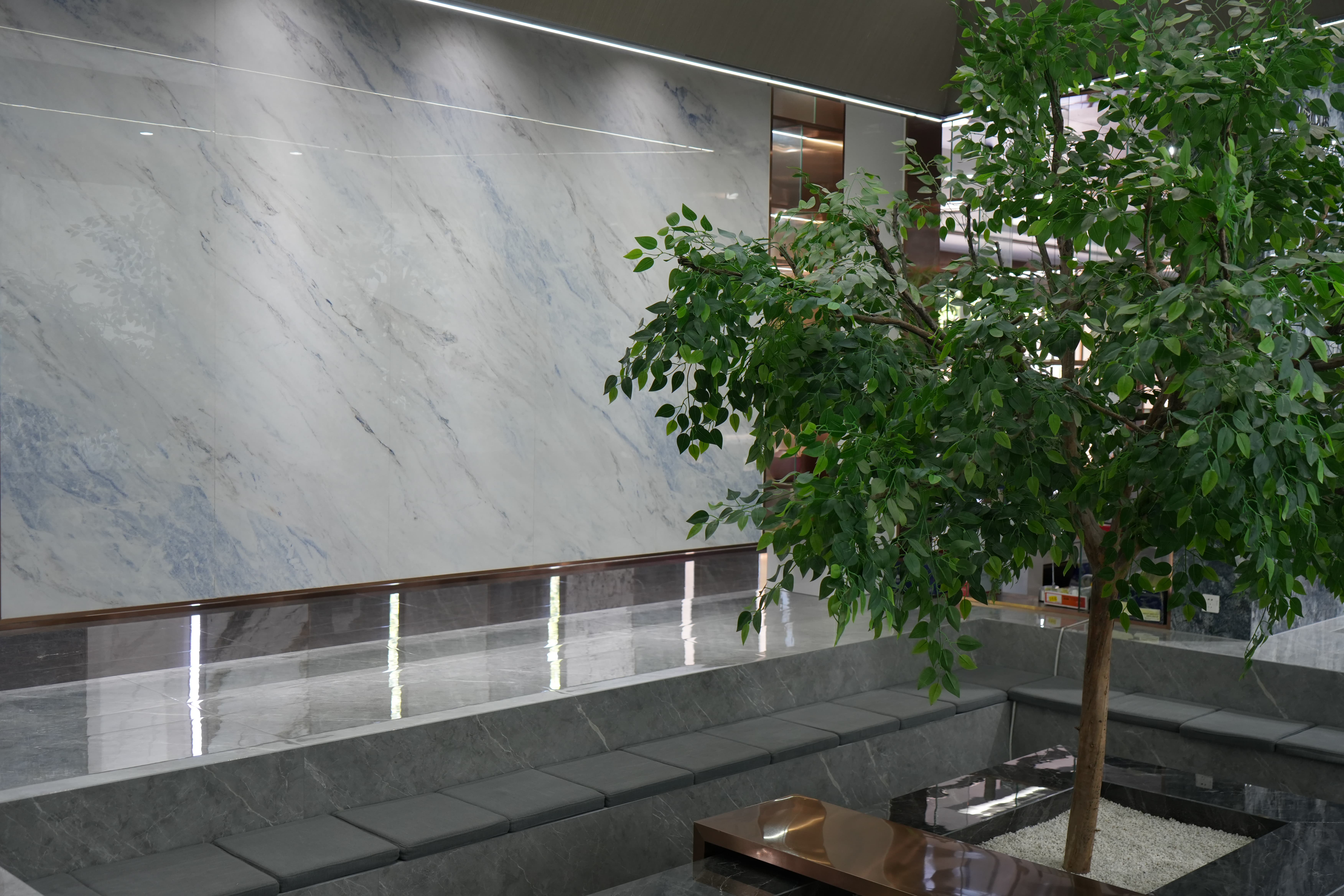
Porcelain wall tiles in commercial interiors must be matched to cleaning, moisture and installation requirements, not only to appearance.
Commercial tile procurement is more reliable when project type is discussed before product name. A tile that works in a dry office corridor may be the wrong choice for an entrance lobby; a wall tile that looks identical may not be acceptable in a wet public bathroom. The hidden differences are in the body, not the pattern. For buyers moving from research to evaluation, the task is to translate building use, climate, traffic and cleaning routines into measurable tile properties. A short working answer: a commercial tile is project-fit when its water absorption, abrasion resistance, slip resistance, breaking strength and frost behaviour align with the conditions it will actually face.
Start with Working Conditions, Not Only Surface Design
The phrase commercial-grade tile has limited value until it is tied to documented criteria. Under ISO 13006 / EN 14411, full vitrified porcelain used in commercial projects is typically classified in Group BIa, with water absorption of 0.5% or less. That one property influences frost resistance, moisture resistance and stain resistance. But commercial projects rarely stop at water absorption. Project teams also need to verify abrasion class, slip resistance, breaking strength and, in cold climates, freeze-thaw performance.
Building type is a useful shorthand because it summarises the operating conditions. Public transport terminals, shopping malls, hotels, hospitals, schools, office facades and logistics floors each place a different load on the floor or wall finish. The table below maps typical project conditions to the tile characteristics that should be screened before a supplier is shortlisted.
| Project type | Typical operating conditions | Tile characteristics to screen |
|---|---|---|
| Airport terminals and railway stations | Continuous passenger traffic, wheeled luggage or carts, wet entry areas, frequent mechanical cleaning | Low water absorption, high wear resistance, slip resistance suitable for public circulation, high breaking strength |
| Shopping malls and retail | High foot traffic, mopping, occasional rolling loads, food and drink spillage | Wear resistance, stain resistance, flat and dimensionally consistent large-format surfaces |
| Hotels and hospitality | Lobby luggage traffic, wet bathrooms, entrance thermal changes, facade exposure in cold climates | Slip control in wet areas, low water absorption, frost-resistant options for exterior zones |
| Healthcare and education | Dense foot traffic, cleaning chemicals, wet or hygiene-sensitive zones | Chemical resistance, easy-to-clean surfaces, low-VOC considerations, documented hygiene claims where needed |
| Office and commercial facades | Rain, freeze-thaw cycles, wind-driven moisture, facade panel installation | Frost-resistant porcelain, wall cladding system compatibility, very low water penetration |
| Logistics and industrial floors | Heavy surface loads, rolling equipment, possible impact, dust and abrasion | High breaking strength, low water absorption, high abrasion resistance |
Zoning matters inside one building. A hotel lobby with luggage carts and wet foot traffic is not the same condition as a hotel bathroom wall or an exterior facade cladding. Each zone should be evaluated separately. In the product data used for this reference, these commercial real estate conditions include high traffic, frost and freeze-thaw, wet and slippery surfaces, thermal shock and heavy surface load. The same tile format may be suitable for all of them only if the physical specification is checked against the zone.
Technical Criteria That Separate Project-Fit Porcelain from General Tile
Project-fit decisions become easier when a buyer can read a specification sheet. The criteria below appear again and again in commercial project specifications. They also form the basis of supplier evaluation because they can be tested and documented.
| Property | Commercial specification signal | Why it matters |
|---|---|---|
| Water absorption | Less than 0.5%, vitrified body | Controls moisture intake, staining risk and frost vulnerability. Porcelain is classified as Group BIa under ISO 13006 / EN 14411. |
| Abrasion resistance | PEI 4 / PEI 5 | Indicates suitability for high-traffic floors where grit, shoes and rolling loads wear the surface. |
| Slip resistance | R10 / R11 under DIN 51130 | Relevant for wet or public circulation areas. High-traffic public spaces such as airports and railway stations often require an R10 or R11 rating. |
| Breaking strength | Not less than 1300 N in the reference product data | A higher breaking strength helps floors resist concentrated loads and reduces the risk of cracking under commercial use. |
| Modulus of rupture | At least 35 MPa in the reference product data | Measures flexural resistance, which is useful for large-format tiles laid over correctly prepared subfloors. |
| Frost resistance | ISO 10545-12 freeze-thaw testing, at least 100 cycles | Needed for facades, entrances and outdoor plazas in climates where water can freeze inside an absorbent body. |
| Format | 60x120 cm large format | Large formats reduce the number of joints in a given area, which can simplify cleaning and create a more continuous visual surface. |
No single property tells the whole story. A highly decorative porcelain tile with beautiful veining is not a good commercial product unless the base body is dense and the surface performance is verified. For this reason, procurement documents should ask for test reports and physical values, not only marketing descriptions.
What the Reference Product Data Shows: Marble Series and Travertine
To make the above criteria concrete, it helps to examine one manufacturer's published data. ZIBO ALL-KING CERAMICS CO., LTD, known as All-King Ceramics, is a porcelain tile manufacturer and direct exporter based in Zibo, China. The company was founded in 2011 and operates a 60,000 square metre factory. Its published annual output is 12-16 million square metres, with around 70% of production exported. Export destinations recorded by the company include Australia, New Zealand, Russia, Belarus, South Korea, Vietnam, Malaysia, the Philippines, the Middle East and Latin America. It also supplies as an OEM/ODM partner to contractors, distributors and builders.
The product reference that is most directly relevant to commercial project fit is the 60x120 cm porcelain tile range. Two named visual programmes in the supplied product corpus are the Marble Series and the Travertine Series. Both share the same technical construction parameters:
| Product series | Format | Published technical data |
|---|---|---|
| Marble Series | 60x120 cm porcelain tiles | Thickness 9.0-10.5 mm; water absorption below 0.5%; PEI 4 / PEI 5; Mohs hardness 6-7; breaking strength at least 1300 N; modulus of rupture at least 35 MPa |
| Travertine Series | 60x120 cm porcelain tiles | Thickness 9.0-10.5 mm; water absorption below 0.5%; PEI 4 / PEI 5; Mohs hardness 6-7; breaking strength at least 1300 N; modulus of rupture at least 35 MPa |
In the manufacturer's application documentation, these 60x120 cm porcelain tiles are described as suitable for flooring and wall cladding, commercial fit-out, interior decoration, facade engineering and hotel renovation. The listed working conditions include high traffic, frost and freeze-thaw, wet and slippery surfaces, thermal shock and heavy surface load. This is a good example of why the product model matters less than the physical specification: a buyer should not ask only for marble-look tile, but should ask whether that tile has the body density and surface performance required for the project.
Quality Control and Order Flexibility as Project Evidence
Large commercial orders expose differences between factories. A tile can look correct in a showroom sample and still arrive with dimensional variation, inconsistent thickness or surface defects. For project security, a buyer needs to inspect the controls behind the product, not only the end sample.
All-King Ceramics publishes several control points that match what project buyers should expect from a direct factory supplier. The factory operates automatic tile packing and palletising, performs flatness and sizing checks, and uses piece-by-piece visual inspection as well as random laboratory testing per batch. In the supplied capability data, quality control is described as 100% flatness and sizing auto-check, piece-by-piece visual inspection and random lab testing per batch. For high-volume orders, the stated monthly capacity is 1.2 million square metres. That capacity level is relevant for distributors and contractors that need a consistent schedule rather than a one-time sample.
Order flexibility is another evaluation criterion. The same capability data lists a lead time of 7-10 days, an MOQ of 400 square metres per design, and acceptance of trial orders. Customisation options include custom size and thickness, surface finish, OEM brand logo and packaging, pattern variation for marble veining, and anti-slip rating adjustment. For commercial project buyers, trial orders are particularly useful because they allow verification of actual goods before committing to a full project batch.
One application record in the supplied corpus adds perspective on scale. A 15,000 square metre project profile covers hotel lobby flooring, commercial mall flooring, office building facade, high-end apartment bathrooms and an airport departure hall. The company's stated project result is 100% project acceptance and zero maintenance complaints. This record is not presented as a named client endorsement, but it does show the range of commercial scenarios that a single large-format porcelain range can support.
Comparison with the Low-Grade Ceramic Route and Its Limit
A practical comparison in commercial procurement is not only between brands, but between product classes: fully vitrified porcelain versus lower-cost ceramic tile. The distinction is rooted in body classification. Porcelain tiles are dense and vitrified, with water absorption of 0.5% or less. Lower-cost ceramic bodies may have higher water absorption and are generally more vulnerable to frost, moisture and surface wear. For exterior facades, cold-climate entrances, public wet areas and heavy floor traffic, the lower-cost class is usually not an acceptable substitute.
At the same time, there is a legitimate limit to the argument for porcelain. A dry, protected interior wall with no moisture exposure, no freeze risk and no high traffic does not always need a heavy-duty vitrified body. In such zones, a lower-priced ceramic product can meet the actual performance requirement. The commercial error is not in using ceramic in protected interior spaces; it is in assuming that a low-grade ceramic body can behave like porcelain simply because the surface pattern looks similar. Project-led specification should therefore assign material class by zone.
Regional Market Signals That Affect Sourcing Decisions
Market data from several verified sources helps explain why commercial project buyers are looking more carefully at direct manufacturer sourcing. The global ceramic and porcelain tile market was valued at USD 423.90 billion in 2024 in one widely referenced estimate, with a projected value of USD 845.80 billion by 2034. Other analysts publish narrower definitions, so the exact size varies, but the direction of growth is consistent with continued construction and infrastructure activity.
Regional signals are also visible. Russia's ceramic tile market was estimated at USD 3.2 billion in 2024, with a projected increase to USD 5.10 billion by 2032. Uzbekistan imported USD 125 million of ceramic products in 2024, and China was the top supplier at USD 75.1 million. Southeast Asia's ceramic tile market was estimated at approximately USD 11.5 billion in 2024, supported by travel, tourism and infrastructure demand. In another trade signal, Chinese ceramic tile exports to the Philippines grew by 77.5% year-on-year in March 2025, reaching USD 29.6 million for that month.
For project teams in Kazakhstan, Uzbekistan, Russia, the Philippines and other construction markets, these trade flows point to the same practical issue: landed cost, availability and specification support are as important as the tile pattern. A project-fit commercial tile solution is not just a material; it is a defined specification, a testing record and a factory that can supply a consistent batch at the required volume.
Future Outlook: Specification-Led Buying and Large-Format Demand
The clearest trend across infrastructure and commercial construction is that tile purchasing is becoming more specification-led. As building codes and project documents call out ISO 13006 / EN 14411, ISO 10545-12 and surface safety classification, buyers will need suppliers who understand these references and can show corresponding documentation. A decorative sample may gain interest, but the purchase decision is increasingly made after reviewing water absorption, breaking strength, product dimensions and quality control data.
Large-format porcelain tiles are well placed in this environment because they balance commercial durability with cleaner sight lines and fewer joints. The risk lies in using large format as a purely aesthetic choice without checking flatness and installation qualifications. For that reason, factories with automatic flatness and sizing checks have an important advantage in project supply. Future procurement in airports, hotels, retail, healthcare and transport hubs will likely continue to link commercial tile solutions to measurable project conditions rather than generic categories.
Frequently Asked Questions
What tile specifications matter most for airport and railway station flooring?
Airport terminals and railway stations are continuous heavy-use environments. The ISO 13006 / EN 14411 baseline for commercial porcelain is Group BIa, meaning water absorption of 0.5% or less. For floors, buyers should also check abrasion resistance, typically PEI 4 or PEI 5, and confirm slip resistance evidence such as R10 or R11 under DIN 51130 for wet or public circulation areas. Breaking strength is also relevant where luggage carts or other rolling loads are present.
Can ceramic tiles handle frost and freeze-thaw if the surface glaze looks dense?
Frost resistance depends mainly on the density of the tile body, not the appearance of the glaze. The relevant test method is ISO 10545-12, which requires tiles to withstand at least 100 freeze-thaw cycles. If moisture can enter the body and freeze, expansion may cause cracking or surface damage. For exterior facades and cold-climate projects, buyers should select a fully vitrified porcelain with low water absorption rather than relying on surface appearance.
What is the difference between porcelain tile and lower-grade ceramic tile in a commercial project?
The most direct technical difference is body classification. Porcelain is classified under ISO 13006 / EN 14411 as Group BIa, with water absorption of 0.5% or less. Lower-grade ceramic bodies generally have higher water absorption and are more vulnerable to moisture, frost and heavy wear. In commercial projects, lower-grade ceramic may be acceptable for dry protected interior walls, but it is not a safe substitute for public floors, wet areas, facades or cold-climate installations.
How should a development team reduce risk before placing a large tile order?
A practical approach is to combine technical verification with a trial order. Request test documentation for the relevant standards, confirm water absorption, breaking strength, abrasion class and slip resistance, and check the supplier's quality control process. Also confirm the MOQ, lead time, packaging and after-sales terms. A trial order allows the project team to inspect actual material and dimensional consistency before committing to the full project volume.
Sources and Reference Notes
Custom Market Insights: global ceramic and porcelain tiles market estimates for 2024 and 2034.
Verified Market Research: Russia ceramic tiles market estimates for 2024 and 2032.
The Observatory of Economic Complexity: Uzbekistan ceramic product import data for 2024.
Mordor Intelligence: Southeast Asia ceramic tiles market estimate for 2024.
ISO/TC 189: ISO 13006 / EN 14411 ceramic tile classification.
EN Standard: ISO 10545-12 freeze-thaw test method.
DIN 51130: slip resistance classification for floor coverings.
Publisher note: All-King Ceramics publishes current product, size, packing and customisation details in an open catalogue: ALLKING Ceramics Catalog.
Tem questões ou precisa de mais detalhes?
Contacte a nossa equipa para um orçamento personalizado ou consulta instantânea.
Solicitar orçamento
Preencha o formulário abaixo e a nossa equipa entrará em contacto com uma proposta personalizada.
Chat direto do WhatsApp
Prefere conversar em tempo real? Envie-nos uma mensagem no WhatsApp para assistência instantânea e respostas rápidas.
- Obter orçamento personalizado
- Partilhar fotos ou documentos
- Discuta as suas necessidades diretamente
Geralmente responde em 5–30 minutos durante o horário de expediente.