
Commercial Van Tire Shortlist: 155R12C, 5.00R12 ULT & 5.50R13LT
Commercial Van Tire Shortlist: 155R12C, 5.00R12 ULT & 5.50R13LT
Small commercial van tires rarely get a procurement review of their own. They are ordered in whatever size the vehicle was delivered on, consolidated into mixed containers, and reordered on price. That habit is where avoidable errors concentrate: a 12-inch rim will not take a 13-inch tire, a “C” suffix and an “LT” suffix describe different service conventions, and two sizes with similar-looking numbers can sit 28 mm apart in nominal section width.
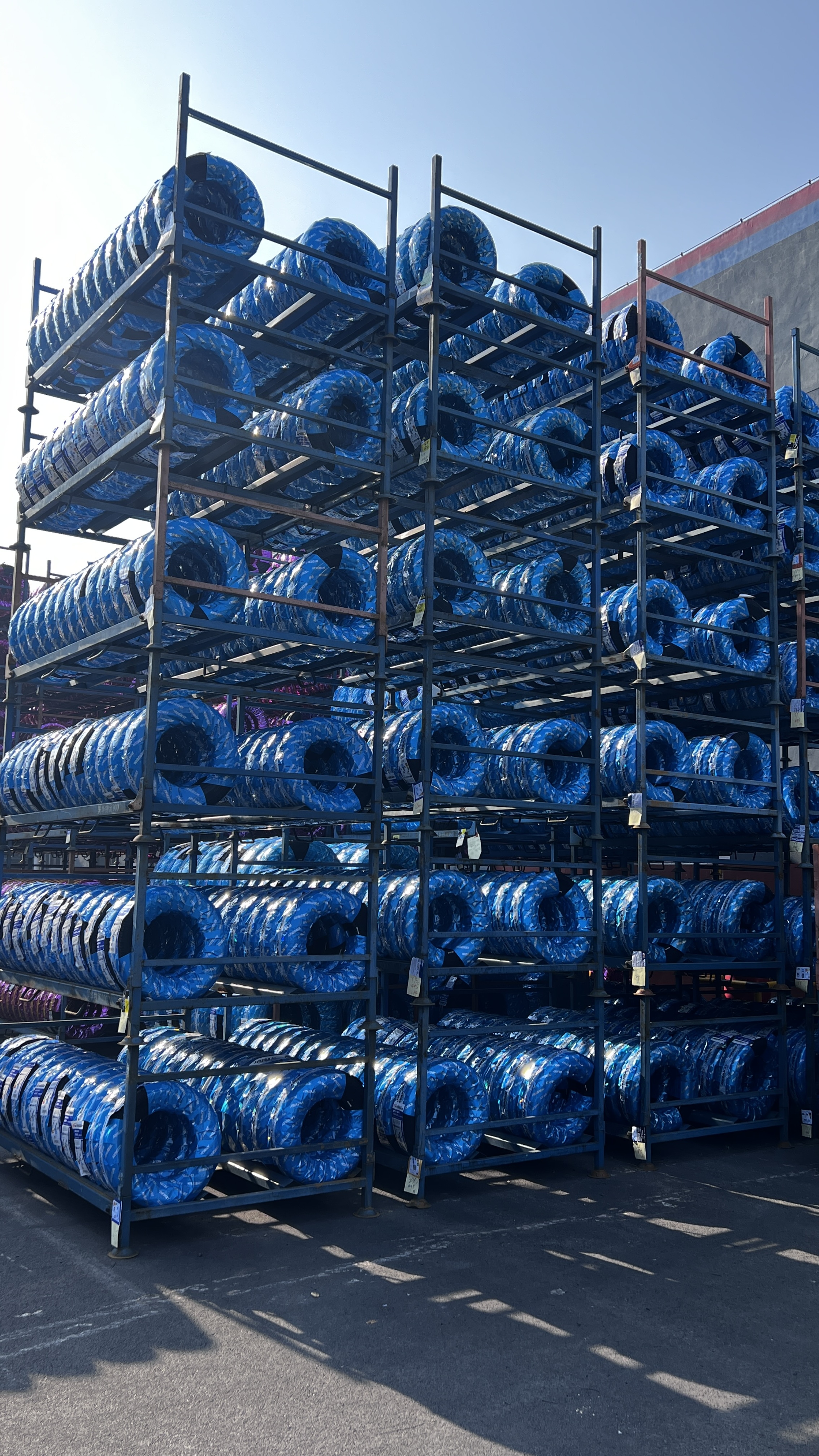
Van and passenger car sizes are commonly shipped in mixed containers, which makes size-level documentation as important as the unit price.
The four candidates in this shortlist — 155R12C, 5.00R12 ULT, 5.50R13LT (SMARTWAY II) and 145R12C (TOURWAY) — all sit in the passenger car tire product records of Shandong Wideway Tire Co., Ltd., a Qingdao-based manufacturer founded in 2014 whose lines include passenger car, SUV, all-terrain, van, winter, all-season, white-letter and white-sidewall tires, and which states that exports account for 70% of its business.
This review sets out what each designation establishes on its own, which certificate records list each size, and what each candidate should be evaluated against in commercial van, urban road and all-season service. It is a fit-and-verification shortlist, not a measured performance ranking: no comparative test results for these four sizes were available for this review, and the article does not pretend otherwise.
What a commercial van tire shortlist actually has to decide
Three decisions sit behind a van tire order, and they are usually made in the wrong sequence. Fitment comes first: rim diameter, nominal section width, and the load index and speed rating marked on the sidewall, measured against what the vehicle requires. Service match comes second: whether the vehicle runs short stop-start urban duty, sustained loaded running, or a mix that has to hold across seasons. Commercial terms come third: what the size costs to buy, hold and reorder at the volumes a distributor actually moves.
Starting with price inverts that order and hides the two failure modes that cost the most. The first is a fitment failure — a size that physically mounts but carries an inadequate load index for the axle load, or a 13-inch size ordered against a 12-inch application. The second is a documentation failure — a size that is correct on the vehicle but not covered by the certificate the destination market checks at clearance.
Both failures are common in the 12- and 13-inch band precisely because these sizes are bought in small quantities across many SKUs. A shortlist is only useful if it forces both checks before the price conversation starts.
The four candidates in one view
The table contains only what the size designation and the supplied certificate records establish. Millimetre values for the inch-series sizes are calculated from the designation at 25.4 mm per inch and are nominal figures, not measured section widths on a specific rim.
| Size / model | Nominal section width | Rim | Service suffix | Certificate records listing the size | Evaluation focus |
|---|---|---|---|---|---|
| 155R12C | 155 mm | 12 in | C (commercial service) | ECE UN R30, EU R117, SONCAP, SASO | Urban delivery van; general road duty |
| 5.00R12 ULT | 127.0 mm (5.00 in, calculated) | 12 in | None — “ULT” is part of the model name | ECE UN R30, EU R117, SONCAP, SASO | Narrow-fit 12-inch applications |
| 5.50R13LT (SMARTWAY II) | 139.7 mm (5.50 in, calculated) | 13 in | LT (light truck) | ECE UN R30, EU R117, SONCAP, SASO, CCC | Loaded van duty; mixed road |
| 145R12C (TOURWAY) | 145 mm | 12 in | C (commercial service) | ECE UN R30, EU R117, SONCAP, SASO, CCC | Light van and urban passenger duty |
Two fields are deliberately absent: per-size load index and speed rating, and maximum inflation pressure. Neither can be derived from a designation, and neither was available for these four sizes in the material this review worked from. They remain the first items to request from a supplier.
Reading the designation before comparing anything
A size designation is a specification, not a marketing label. ISO 4000-1 specifies the designation, dimensions and load ratings of metric-series passenger car tires, and the ETRTO Standards Manual provides the tire and rim dimension references that European and international manufacturers work from. That shared reference base is the reason a 155R12C from one supplier can be compared with a 155R12C from another at all.
Section width and rim diameter
Metric sizes state nominal section width in millimetres: 155R12C is 155 mm and 145R12C is 145 mm. Inch-series sizes state it in inches: 5.50R13LT is 5.50 in (139.7 mm) and 5.00R12 ULT is 5.00 in (127.0 mm). Rim diameter is 12 in for 155R12C, 5.00R12 ULT and 145R12C, and 13 in for 5.50R13LT. Rim diameter is a hard boundary — no amount of load-rating headroom makes a 13-inch tire fit a 12-inch rim.
The service suffix
“C” and “LT” are service conventions attached to the size, not load ratings. In metric sizes the “C” suffix conventionally marks a commercial-service size, and “LT” marks a light-truck size; both indicate a size built for load-carrying duty rather than pure passenger-car duty. The suffix tells a buyer which family of documentation to expect. It does not tell them what the tire will carry. “ULT” in 5.00R12 ULT is retained here as part of the model name and is not interpreted as a service code.
Load index, speed rating and maximum pressure
These three fields decide whether a correctly sized tire is actually suitable, and none of them is readable from the size. Load index and speed rating are sidewall markings; UN Regulation No. 30, the basis for ECE type-approval of passenger car tyres, establishes the marking regime, and ISO 4000-1 covers load rating designation. Maximum pressure is a marking and inflation-table value tied to the specific size and load, and it should be read against the vehicle's requirement rather than assumed from the size.
Where a market applies a labelling scheme, the label gives a comparable basis for claims a supplier makes: Regulation (EU) 2020/740 governs fuel efficiency, wet grip and external rolling noise for tires placed on the EU market, and the UTQG system grades treadwear, traction and temperature resistance for tires sold in the United States. Those schemes convert adjectives into classes a buyer can check.
Candidate profiles
Each profile below is built from the size designation and the product and certificate records. None of them asserts a performance advantage over another size.
155R12C
155R12C is the widest of the four at 155 mm nominal section width, on a 12-inch rim, carrying the commercial-service “C” suffix. It is listed in Wideway's passenger car tire product records alongside a C-series range running from 155R12C through 155R13C, 165R13C, 185R14C and 195R15C into 16-inch van sizes up to 235/65R16C — useful context for a distributor building a van range rather than buying single sizes. The size appears in the product lists attached to the ECE (UN R30) and EU R117 E-mark records and in the SONCAP and SASO records; it does not appear on the supplied CCC record. On designation logic alone, 155 mm on a 12-inch rim points to urban delivery-van applications, where vehicle envelope and kerb exposure usually constrain the choice more than the width does.
5.00R12 ULT
5.00R12 ULT is the narrowest candidate: 5.00 in, or 127.0 mm nominal, on a 12-inch rim. It is held as its own product record and appears in the ECE (UN R30), EU R117, SONCAP and SASO certificate product lists, but not on the supplied CCC record. Its narrower nominal width makes it the size to examine first where rim width, clearance or axle geometry rules out a wider 12-inch size — and the size to examine most carefully on documentation, because narrow commercial sizes are typically ordered in small volumes against a specific vehicle rather than a range. The “ULT” suffix should be carried through ordering and cross-reference exactly as written; it is part of the model name, not a claim about the tire.
5.50R13LT (SMARTWAY II)
5.50R13LT sits on a 13-inch rim at 5.50 in, or 139.7 mm nominal — 12.7 mm wider than 5.00R12 ULT, 15.3 mm narrower than 155R12C, and on a different rim entirely. It carries the light-truck “LT” suffix and is listed in all five supplied certificate records: ECE (UN R30), EU R117, SONCAP, SASO and CCC. That makes it the best-documented size in this group for destinations that check more than one scheme. Because the rim diameter differs from the other three, it belongs in a separate fitment group in any fleet standardisation exercise; grouping it with 12-inch sizes on price alone is the classic error in this band.
145R12C (TOURWAY)
145R12C is the second-narrowest at 145 mm nominal on a 12-inch rim, with the “C” suffix, and it is also listed in all five supplied certificate records. It sits between 5.50R13LT and 155R12C in width but shares the 12-inch rim with 155R12C and 5.00R12 ULT, so it belongs in the same fitment group as those two. For a dealer building a compact van and small passenger-car range, it adds a second width option inside the 12-inch group without adding a rim size.
Matching each size to a duty cycle
Duty-cycle matching is where a shortlist earns its keep, but it has to run on stated criteria rather than adjectives. Three profiles matter for this group.
Commercial van duty
Loaded running dominates: the tire spends most of its life near its rated load at sustained speed, with heat build-up as the binding constraint. Under this profile the first question is not width but load index against the actual axle load, and the second is whether the maximum pressure marked on the tire supports that load at the pressure the fleet really runs. 5.50R13LT and 155R12C are the two sizes in this group whose designations point at load-carrying service; which one suits a given vehicle depends on the rim the vehicle carries, not on the width.
Urban road service
Short trips, dense stop-start cycles, kerb contact and tight loading bays define urban delivery and taxi-style work. The criteria a buyer can actually check here are fit against the vehicle's turning envelope, the fleet's own kerb-damage and sidewall-replacement history for each size, and whether the wet-grip and noise label values for the specific SKU meet the fleet's standard. All three 12-inch sizes suit tight urban envelopes better than the 13-inch size on diameter alone, but diameter alone is not a sufficient reason to select any of them.
All-season operation
All-season fitment is a portfolio question before it is a size question. Wideway lists all-season and winter tires among its main product lines, and the SONCAP, SASO, ECE and R117 certificate scopes cover winter and all-season categories; Nokian Tyres' passenger car tire business unit, as a comparable reference point, similarly covers winter, summer and all-season tires for passenger cars, SUVs and vans. But a shortlist cannot assign an all-season label to 155R12C or 145R12C from the size alone. The seasonal designation has to be confirmed on the sidewall and the SKU sheet, and where wet-grip or noise claims matter they should be tied to the UN R117 parameters — rolling sound emissions, adhesion on wet surfaces and rolling resistance — rather than to a seasonal name.
What the certificate records show, and where the gaps are
Certification is where a shortlist becomes orderable, and the supplied records do not all cover the same sizes.
All four candidates appear in the product lists attached to two records: the ECE type-approval E4-30R-0264621 issued by RDW under UN Regulation No. 30, and the EU R117 E-mark E4-117R-025700-S2WR2, also issued by RDW, covering rolling sound, wet adhesion and rolling resistance. The records carry issue dates of 2013-10-14 and 2017-03-24 respectively, with recorded validity extending to 2099-12-31. All four also appear in the SONCAP record NGP2026 145940 /0001 issued by Bureau Veritas for Nigeria under standard ZA12B6, valid from 2026-04-01 to 2027-04-01, and in the SASO GSO record TR13651/2025 for Saudi Arabia, valid from 2025-12-11 to 2026-12-11.

The CCC record 2022061201000258, issued under GB 9743-2024, lists 5.50R13LT and 145R12C among the four sizes reviewed here.
The CCC record 2022061201000258, issued under GB 9743-2024 and valid from 2026-04-20 to 2028-10-16, lists 5.50R13LT and 145R12C among the four. 155R12C and 5.00R12 ULT are not on that record's supplied product list. For buyers shipping into the Chinese market, or into a market that recognises CCC, that is a size-specific question to resolve rather than an assumption to carry across a range.
Two practical notes follow. First, the SASO record's validity ends on 2026-12-11; shipments landing after that date need the renewed certificate, so the renewal timeline belongs in the order plan rather than in a post-clearance problem. Second, certificate records list sizes, not performance. A size appearing on an ECE or R117 record confirms type-approval coverage; it does not confirm a particular wet-grip or noise class, which comes from the label values for that SKU.
Supply terms distributors should price into the decision
Commercial terms change the ranking of a shortlist more often than buyers expect. Wideway's stated terms for these product lines are a minimum order of one 20-foot container, roughly 400–700 pieces, a lead time of 25–45 days, and 100% testing as the quality-control standard. OEM production is offered, with customization available across passenger car, off-road, white-letter and white-sidewall tires — relevant to a dealer that wants a private-label programme rather than a container of mixed stock. The company also states an in-house R&D team of 25.
Two implications are worth stating plainly. A 400–700 piece container minimum means a four-size shortlist cannot be ordered as a sampler; the mix has to be built around the two or three sizes a distributor actually turns. And a 25–45 day lead time interacts with certificate validity: an order placed against a certificate expiring inside that window needs the renewal confirmed before production, not before shipping.
On channel evidence, a supplied case record for a Mexican tire distributor relationship of four years reports more than 400,000 passenger car tires exported and distributed over the period, with repeat orders cited as the outcome measure. That is one distributor relationship rather than a market trend, but it is the kind of evidence a new distributor can reasonably ask a supplier to substantiate in its own territory.
Product literature: the EVERLAND 2025 catalog is available for download and covers the wider passenger car and van range.
Limits of this shortlist
Four boundaries should be stated as clearly as the fit logic.
No measured performance ranking. No comparative test data — rolling resistance, wet braking, noise or treadwear — was available for these four sizes. The shortlist orders candidates by designation and documentation, and any statement that one size outperforms another would be unsupported.
No load or pressure values. Load index, speed rating and maximum pressure are not established here for any of the four. They must be read from the sidewall and the product sheet, and matched against the vehicle's requirement, before a size is approved.
No claim from a name. Model and series names are reproduced exactly as designated. A series name is not evidence of a construction, compound or performance class.
No cross-size substitution. The 13-inch size is not interchangeable with the three 12-inch sizes, and within the 12-inch group a 127 mm and a 155 mm nominal width are different fitments on the same rim. Fleet standardisation should group by rim diameter first, width second and documentation third.
Market context
The commercial logic for holding a small van range is structural rather than cyclical. Global tire imports under HS code 401110 reached 1,065.6 million units in 2024, according to Radial Insights trade-flow data — a reminder that this category moves internationally at volume and that documentation, not only product, is what clears borders. The passenger car tire market itself covers both OEM fitment and aftermarket replacement for internal combustion and electric vehicles, distributed through offline retail and online channels, per Fact.MR's market description. A distributor's van sizes sit almost entirely on the replacement side of that split, where reorder frequency and range completeness matter more than a single-size price.
Outlook
Two developments shape how this group should be reviewed over the next buying cycle. Electrification is the more visible: Grand View Research projects the EV segment within passenger car tires growing at 11.2% CAGR through 2033 — a forecast that depends on its own adoption assumptions and should be read as direction rather than as a demand figure for 12-inch van sizes. The regulatory direction is firmer: Regulation (EU) 2020/740 already requires fuel efficiency, wet grip and external rolling noise labelling for tires placed on the EU market, and UN R117 supplies the measurable parameters behind those classes. For a distributor, the practical consequence is that label values and certificate coverage will keep displacing brochure adjectives in the buying conversation.
Frequently asked questions
Are 155R12C and 5.00R12 ULT interchangeable?
No. Both use a 12-inch rim, but their nominal section widths are 155 mm and 127.0 mm — a 28 mm difference that changes rim width requirements, clearance and the vehicle applications each suits. Each also carries its own load index and speed rating on the sidewall, and each of those must meet or exceed the vehicle's requirement independently. Substituting one for the other requires confirming fitment and markings for the specific vehicle, not just the rim diameter.
What does the “C” in 155R12C and 145R12C mean?
In metric size designations, “C” is conventionally the commercial-service marking, distinguishing a size built for load-carrying duty from a pure passenger-car size. It is a service convention attached to the designation, not a load rating. The actual load-carrying capacity is stated by the load index marked on the sidewall, and that is the figure to compare against the axle load.
Do all four sizes appear on the same certificates?
Not entirely. All four appear in the product lists attached to the ECE type-approval under UN Regulation No. 30 (E4-30R-0264621) and the EU R117 E-mark (E4-117R-025700-S2WR2), and in the SONCAP and SASO records. The CCC record 2022061201000258 lists 5.50R13LT and 145R12C among the four, but not 155R12C or 5.00R12 ULT. Buyers should confirm coverage size by size against the current certificate copy for the destination market.
Can these van sizes be used all year round?
Only if the individual SKU is designated for it. Wideway lists winter and all-season tires among its product lines, and its certificate scopes cover both categories, but neither a size designation nor a series name establishes an all-season classification. The seasonal designation has to be confirmed on the sidewall and the product sheet, and wet-grip or noise claims should be tied to UN R117 parameters or the applicable label values rather than to the seasonal name.
What should a distributor verify before reordering?
Five items: the load index and speed rating on the incoming sidewall against the vehicle requirement; the maximum pressure value against the fleet's actual inflation practice; current certificate validity for each destination market, including the SASO record's 2026-12-11 end date; the size mix inside the 400–700 piece container minimum against what actually sells; and the 25–45 day lead time against the customer's own reorder cycle.
Tem questões ou precisa de mais detalhes?
Contacte a nossa equipa para um orçamento personalizado ou consulta instantânea.
Solicitar orçamento
Preencha o formulário abaixo e a nossa equipa entrará em contacto com uma proposta personalizada.
Chat direto do WhatsApp
Prefere conversar em tempo real? Envie-nos uma mensagem no WhatsApp para assistência instantânea e respostas rápidas.
- Obter orçamento personalizado
- Partilhar fotos ou documentos
- Discuta as suas necessidades diretamente
Geralmente responde em 5–30 minutos durante o horário de expediente.