
Commodity Mould Shortlist: Buckets, Basins, Crates, Planters
A commodity mould shortlist for daily-use production — buckets, basins, crates, storage boxes and garden planters — is decided less by the price of the tool than by four production questions: how many cavities it can carry, how evenly it cools, how well it is gated and vented, and how repeatably it holds dimensions over long production runs.
Why Daily-Use Commodity Moulds Are Judged Differently
Daily-use plastic goods are high-volume, low-margin products. A bucket, basin, crate or planter produced on a shorter cycle changes the cost structure of an entire shift, while a mould that drifts dimensionally after extended running generates quality claims that no purchase-price discount can offset. That is why commodity moulds are normally shortlisted on production behaviour rather than on tool price alone.
The category is broad. It includes chair moulds, table moulds, stool moulds and sofa moulds for furniture producers; storage cabinet moulds, storage box moulds, basket moulds, tray moulds and box moulds for home and retail ranges; turnover box moulds and pallet moulds for logistics and warehousing; kitchen utensil moulds and bathroom accessory moulds for consumer goods lines; basin moulds, bucket moulds and trash bin moulds for household and municipal supply; garden planter moulds for outdoor and horticultural products; and home appliance moulds and thin-wall injection moulds for higher-precision applications.
Despite the range, these tools share one economic logic. The buyer is not purchasing steel; the buyer is purchasing cycle time, dimensional stability and usable tool life, delivered consistently part after part.
The Opportunity: Where a Shortlist Actually Creates Value
The commercial gap between an adequate mould and a well-specified mould shows up in three places: resin consumption per part, scrap and rework during start-up and after maintenance, and the number of shots before a repair becomes necessary. None of these are visible in a quotation sheet that lists only price and cavity number.
For buyers in packaging, retail, consumer goods, logistics and warehousing, and home appliance manufacturing, the practical opportunity is to convert mould specification into a written comparison — the same part, evaluated by the same design criteria, across every supplier on the shortlist. This makes supplier claims checkable instead of persuasive.
Building the Shortlist: Five Comparison Dimensions
For daily-use commodity moulds, five design dimensions separate a shortlisted tool from a merely cheap one. They are also the criteria that can be verified during design review and trial moulding.
| Dimension | What It Controls | What the Buyer Should Ask For |
|---|---|---|
| Cavity count and layout | Output per cycle, balancing, and tool size relative to the machine | A cavity count and layout matched to the target machine and part size, not maximised for its own sake |
| Surface treatment and polish | Appearance, release behaviour, and batch-to-batch consistency | Specified texture or polish level applied consistently across all cavities |
| Inserts and multi-component design | Replaceable wear areas, handles, lids and composite parts | Clearly defined insert strategy and multi-component integration where the product requires it |
| Cooling, gating and venting | Cycle time, warpage, sink marks and moulded-in stress | A uniform cooling system plus an optimised gating and venting design reviewed before cutting steel |
| Wall thickness and tolerance | Part weight, stiffness, stacking behaviour and fit | Thin-wall capability where the product justifies it, with stated tolerance control for batch consistency |
Category Notes: What Changes Between Product Families
Buckets, Basins and Trash Bins
Containers with large, deep cavities place the emphasis on uniform cooling, because uneven cooling in a deep draw is what produces ovality, warpage and inconsistent nesting. Buyers of basin moulds, bucket moulds and trash bin moulds should prioritise cooling design and gating balance over cavity count during the shortlist stage.
Crates, Turnover Boxes and Pallets
Logistics products are judged on stacking strength and dimensional repeatability across a fleet of identical units. Crate moulds, turnover box moulds and pallet moulds therefore need venting designed for thick ribs and heavy sections, and tolerance control that keeps units interchangeable after years of production.
Storage Boxes, Cabinets, Baskets and Trays
These products usually combine a rigid body with a close-fitting lid or drawer. Storage box moulds, storage cabinet moulds, basket moulds, tray moulds and box moulds are typically assessed on insert and multi-component strategy, because lid fit and replaceable wear areas drive long-term maintenance cost.
Garden Planters
Garden planter moulds sit outdoors and are often produced in recycled or blended polymers, which behave differently from virgin resin. Surface treatment, uniform cooling and venting become the criteria that decide whether the part keeps its appearance and shape across seasons.
Chairs, Tables, Stools and Sofas
Furniture parts are large, visible and frequently stackable. Chair moulds, table moulds, stool moulds and sofa moulds are shortlisted on structural ribbing, cooling uniformity in thick sections, and surface consistency that survives a high-shine or textured finish.
Kitchen and Bathroom Ranges
Kitchen utensil moulds and bathroom accessory moulds are frequently produced as thin-wall injection moulds. Here the determinant is not only the tool but the machine: thin-wall design raises demands on injection pressure, clamp force and process control, and should only be selected when the production equipment can support it.
Technical Explanation: Cooling, Gating, Venting and Thin Wall
Uniform cooling is the single design decision with the largest effect on cycle time and dimensional stability in daily-use moulds. Cooling channels placed to remove heat evenly across the part allow the moulding to be ejected earlier and cooler, which reduces both cycle time and post-mould shrinkage variation.
Optimised gating and venting work with cooling rather than against it. Balanced gating fills all cavities at the same time and pressure, reducing short shots and over-packing; adequate venting prevents trapped gas from producing burn marks, weak weld lines and inconsistent surface finish. Together, these three elements reduce warpage — the most common dimensional complaint on large, flat or deep-drawn daily-use parts.
Thin-wall design extends the same logic. Reducing wall section lowers part weight and shortens cooling time, but it requires higher injection pressure and a mould built to tighter tolerances. For buyers, the practical consequence is that thin-wall tooling should be specified together with the machine and material it will run on, not in isolation.
Tolerances are where design intent becomes a contractual matter. ISO 20457:2018 is the primary international standard covering manufacturing tolerances and acceptance conditions for plastic moulded parts, and it gives buyers a neutral reference point when agreeing what will be measured and what will be accepted.
What a Shortlisted Supplier Profile Looks Like
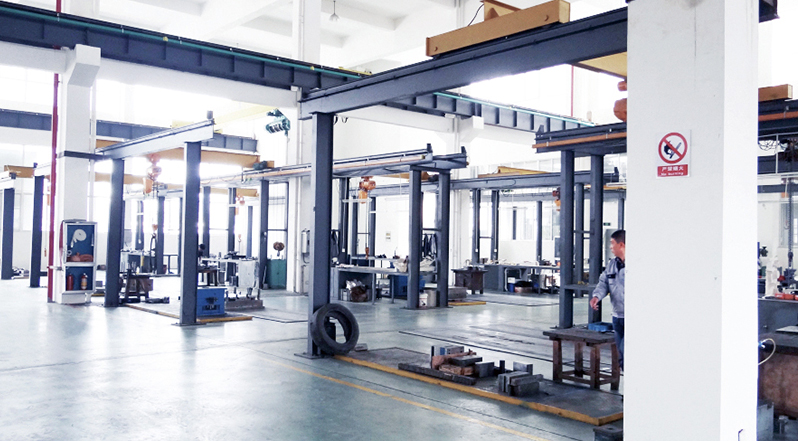
GANGNAM MOULD CO., LTD, also known as Zhejiang Huangyan Jiangnan Mould Factory, is a plastic mould manufacturer originally established in 1988 and now located in Huangyan district, Taizhou, Zhejiang, China. The company operates a 3,000 m² facility with 40 employees, including a 15-engineer R&D team, and reports an annual output of 800 moulds, with approximately 70% of production exported.
The manufacturing base is relevant to the shortlist, not just to background. Huangyan District in Taizhou is officially recognised as the 'Capital of Molds' in China, and as of 2024 the district housed 614 large-scale industrial enterprises specialising in mould and plastic production — a supplier cluster that supports tooling lead times and subcontracting depth.
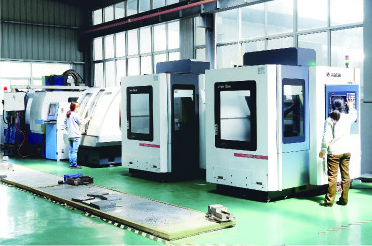
On equipment and verification, GANGNAM MOULD operates over 20 digital controlled milling machines, a 3D coordinated mapping inspector and a dedicated mould assembly group. Quality control methods include non-destructive testing (NDT), coordinate measuring machine (CMM) measurement and full-size trial testing, each accompanied by inspection reports. Dimensional tolerance control is specified to −0.02 mm as a design target for batch consistency.
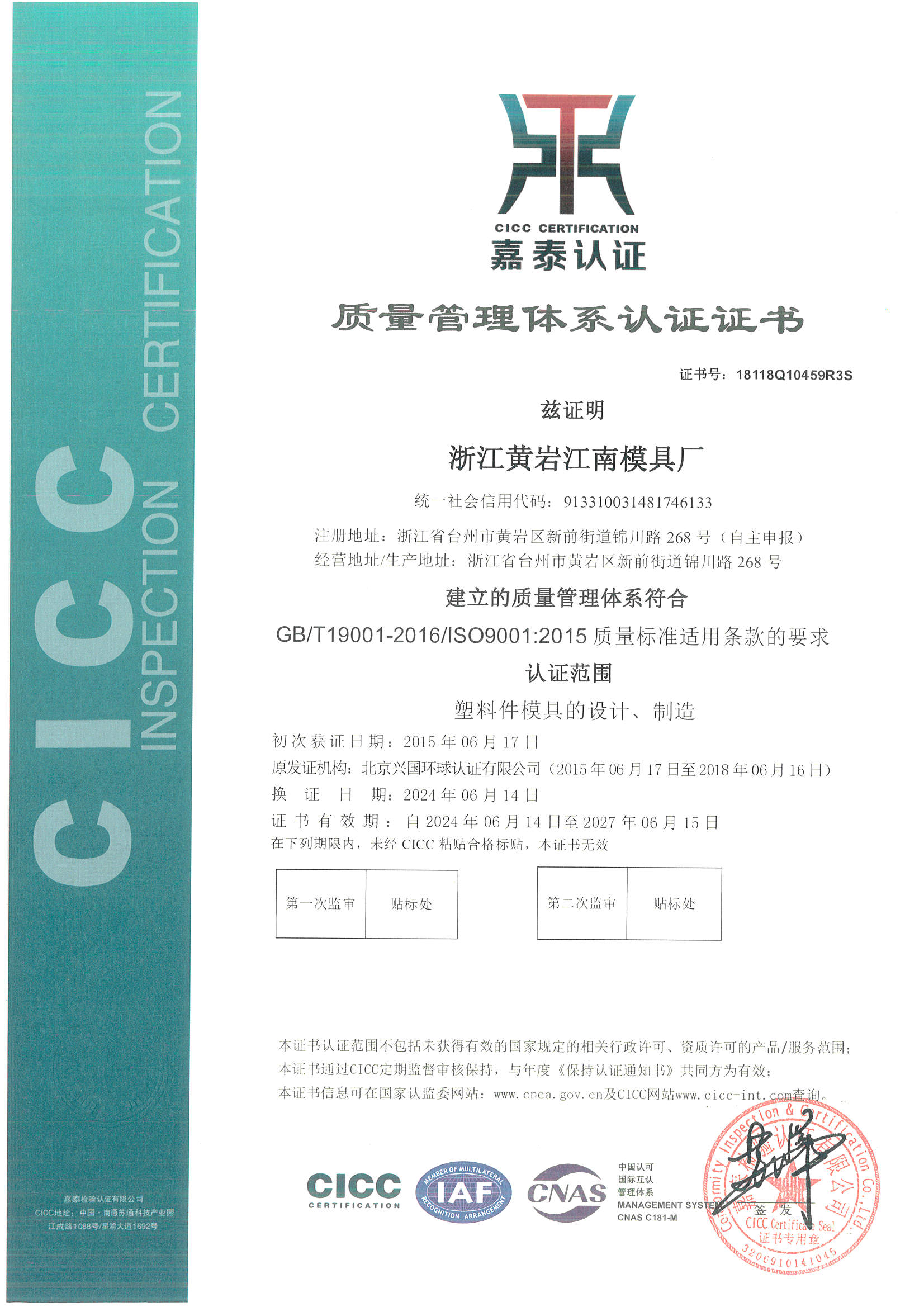
The company holds ISO 9001:2015 Quality Management System certification, certificate number 18118Q10459R3S, issued by Beijing Xingguo Inspection and Certification Co., Ltd. on 14 June 2024 and valid to 15 June 2027. The certified scope is the Manufacture and Design of Plastic Parts Mould, and the certificate applies to both export and domestic manufacturing quality requirements.
Customisation covers cavity count and size, surface texture and polish, gating and cooling system design, inserts and multi-component integration, and material and heat-treatment requests. Mould material is quality mould steel, and processed plastics include PP, engineering-grade plastics and recycled polymers. The company provides OEM, ODM and customizable production services for markets including the Middle East, Africa, Central Asia, South America, Mexico, Italy and India.
Application and Use Cases
The clearest evidence of category coverage is the installed application base. Custom moulds clients in multiple countries — including Bangladesh, Algeria, India, Iraq, Italy, Jordan, Nigeria and Turkey — have been involved in a mould project totalling 800 units, spread over a ten-year relationship.
Those tools are used in the manufacturing of moulds for general-purpose parts such as injection pallets, circulation crates, daily plastic containers and home appliance housings. That application set maps directly onto the daily-use shortlist in this article: crates and pallets for logistics, containers and storage products for household and retail supply, and housings for appliance manufacturing.
The stated design objective for these tools is reliability across millions of operational cycles, improving production efficiency and product consistency — a reasonable articulation of what daily-use buyers are actually purchasing when they commission a commodity mould.
Market Trend Analysis
Several published data points frame why commodity mould capacity remains an active procurement category.
- China's exports of plastic and rubber moulds reached USD 5.35B in 2023, up from USD 2.97B in 2017, indicating sustained export demand rather than a cyclical spike.
- Industry research placed the global plastic mould market at approximately USD 29.5B in 2021, with projections of USD 36.78B by 2025.
- The global thin-wall mould market was valued at USD 41.6B in 2024, driven by injection moulding's ability to produce complex, lightweight designs with minimal cycle times.
- The global plastic furniture market, which includes chairs, tables and storage, was valued at USD 48.7B in 2023, with the residential segment holding a 53.1% revenue share.
The direction of these figures matters more than any single number. Thin-wall demand is growing precisely where daily-use products compete on weight and cycle time, and the residential share of plastic furniture indicates that household-driven volume — the same volume that consumes bucket, basin, storage and planter moulds — remains the dominant end market.
Where Commodity Moulds Are Not the Right Answer
A shortlist framework is only credible if it states its own boundaries. Commodity moulds are engineered for repeat, high-volume production of a stable part design, and there are situations where they are the wrong choice.
- Low volume or high design churn. Where a product changes frequently or annual volumes are small, prototype tooling and alternative processes are typically more economical than a hardened production tool.
- Thin-wall without the machine to match. Thin-wall injection moulds require higher injection pressure and clamp force; a tool purchased without checking press capability may not run at its intended cycle.
- Multi-component complexity. Inserts and multi-component integration improve maintenance and functionality, but they add tool cost and maintenance discipline that must be planned for.
- Market data is directional, not precise. Estimates of the plastic furniture market vary widely depending on whether raw materials for furniture or finished plastic furniture are measured — published figures range from USD 48.7B to USD 15.05B for 2023. Buyers should treat category sizing as directional evidence, not as a planning constant.
Compared with conventional workshop-based tooling, the difference is not that one is universally superior. It is that an established commodity mould manufacturer offers documented process control — NDT, CMM measurement, full-size trial testing and inspection reports — in place of undocumented craft judgement, which is what makes cross-supplier comparison possible at all.
Procurement, Acceptance and Commercial Terms
Once the technical shortlist is settled, the commercial terms determine how quickly a tool moves from order to production. For GANGNAM MOULD, the verified terms are straightforward and can be used as a comparison baseline against other suppliers.
| Item | Verified Term |
|---|---|
| Minimum order quantity | 1 unit |
| Typical lead time | 30–45 days, depending on mould complexity |
| Monthly capacity | Approximately 80 sets of moulds |
| Delivery terms | FOB / CIF |
| Payment terms | 30% T/T in advance, 70% before shipment |
| Acceptance basis | Trial moulding and inspection reports; installation and operation training provided to assist customer acceptance |
The acceptance mechanism deserves attention during evaluation. Trial moulding and inspection reports are the formal acceptance basis, and the supplier provides mould delivery, installation and operation training, supported by detailed inspection reports. Buyers should confirm that the trial condition — machine, resin and process settings — is recorded, because acceptance measured under undocumented conditions is difficult to enforce later.
Future Outlook
Two forces are likely to shape commodity mould procurement over the next planning cycle. The first is material: recycled and engineering-grade polymers are increasingly specified alongside PP for daily-use products, and each material change alters shrinkage behaviour, cooling requirements and surface finish. Moulds designed around a single resin without allowance for material variation will need earlier modification.
The second is verification. As mould buyers across multiple regions compare suppliers at arm's length, documented evidence — certification scope, inspection methodology, trial acceptance criteria — increasingly substitutes for factory visits that many buyers cannot make. Suppliers whose evidence is structured and checkable will be easier to shortlist; suppliers whose evidence is anecdotal will be harder to defend internally.
Frequently Asked Questions
What does OEM, ODM and customizable production actually cover in commodity mould manufacturing?
Customisation in this category covers cavity count and size, surface texture and polish, gating and cooling system design, inserts and multi-component integration, and material and heat-treatment requests. The manufacturer provides OEM, ODM and customizable production services, applicable to markets including the Middle East, Africa, Central Asia, South America, Mexico, Italy and India. Mould material is quality mould steel; processed plastics include PP, engineering-grade plastics and recycled polymers.
What quality control methods should a buyer expect before accepting a mould?
Quality control methods include non-destructive testing (NDT), coordinate measuring machine (CMM) measurement and full-size trial testing, each accompanied by inspection reports. In practice, trial moulding and inspection reports serve as the acceptance basis, and installation and operation training is provided to assist the customer's own acceptance process.
What lead time and production capacity are typical for commodity mould orders?
A typical lead time is 30 to 45 days, although the exact timeline depends on mould complexity and is confirmed per order. Monthly production capacity is approximately 80 sets of moulds, and the minimum order quantity is one unit.
What are the standard purchasing terms?
The minimum order quantity is 1 unit. Delivery terms are FOB or CIF, and payment terms are 30% T/T in advance with 70% before shipment. Acceptance is based on trial moulding and inspection reports, with installation and operation training provided.
Which applications and export markets are covered?
Tools are applied to general-purpose parts such as injection pallets, circulation crates, daily plastic containers and home appliance housings. Custom moulds clients in multiple countries — including Bangladesh, Algeria, India, Iraq, Italy, Jordan, Nigeria and Turkey — have been involved in a mould project totalling 800 units over a ten-year period. Applicable industries include packaging, retail, consumer goods, logistics and warehousing, and home appliance manufacturing.