
Commodity Moulds for Impact-Resistant Pallets and Crates
Commodity Moulds for Impact-Resistant Pallets and Crates
Pallets and crates are the most-handled assets in a warehouse, and the tooling that produces them decides how well they survive that handling. In logistics and warehousing, commodity moulds are the production tools behind injection-moulded plastic pallets, circulation crates and turnover boxes — parts that are dropped, dragged, stacked under load, washed and returned to service repeatedly before they are retired.
A commodity mould is an injection mould built for high-volume, general-purpose plastic parts, where commercial value comes from tool life, dimensional consistency and predictable cycle time rather than from one-off geometry. That definition is what makes the category relevant to logistics: the pallet or crate is standardised, the volume is high, and every unit has to match the previous one.
GANGNAM MOULD CO., LTD (Zhejiang Huangyan Jiangnan Mould Factory) is a plastic mould manufacturer established in 1988 and based in Huangyan District, Taizhou, Zhejiang, China. The company builds commodity moulds for daily-use, packaging, appliance and logistics parts, including pallet moulds, crate moulds and turnover box moulds.
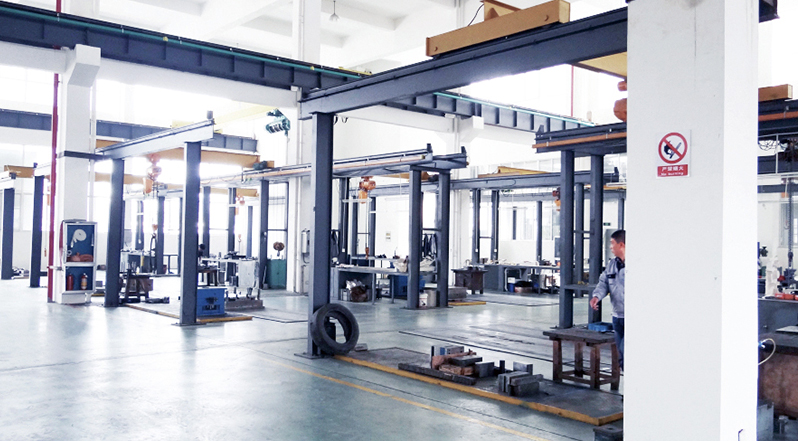 Mould manufacturing workshop: commodity tools for pallets, crates and other high-volume plastic handling parts.
Why Logistics Operations Are Rethinking the Pallet
Wooden pallets remain the default in many warehouses because they are inexpensive and easy to source in almost any market. Their weaknesses appear over time and inside closed loops. Wood takes on moisture, which changes weight and stiffness. Deck boards splinter and can damage packaging or hands. Fasteners work loose. And because boards are assembled rather than moulded, two pallets from different suppliers rarely measure exactly the same.
In purely manual operations that inconsistency is tolerable. In operations that feed conveyors, automatic stretch wrappers, automated storage and retrieval systems or robotic depalletising, it becomes a recurring source of downtime and re-work.
Moulded plastic pallets and crates attack the same problem from a different direction. Because every unit comes out of one tool, geometry repeats. There are no nails, no boards, no moisture absorption and no splinters. Units produced from a single mould match each other in dimension, which is what allows them to move through automated handling equipment with fewer jams and less manual correction.
The trade-off is structural: a plastic handling asset is manufactured rather than bought off the shelf, so the mould is the entry point of the investment. That shifts the buyer's attention from the price of a pallet to the quality, life and maintainability of the tool that makes it.
The Mould Formats That Carry a Warehouse
Logistics and warehousing draw on several mould families within the commodity mould category. They are not interchangeable, because each is designed around a different combination of load, geometry and handling method.
| Mould category | Typical moulded part | Primary performance demand | What buyers evaluate |
|---|---|---|---|
| Pallet moulds | Injection pallets and pallet decks for stacking and transport | Impact resistance under forklift contact and repeated drop | Load path and ribbing design, flatness across the deck, corner behaviour |
| Crate moulds | Circulation crates for returnable transport loops | Wall stiffness, corner impact resistance, cleanability | Stacking tolerance, handle and hinge areas, surface finish |
| Turnover box moulds | Reusable boxes for line-side and distribution loops | Repeatable fit between box and container flow | Warpage control, gate and vent placement, wall consistency |
| Box moulds | General containment and storage boxes | Consistent wall thickness across large flat areas | Cooling uniformity, surface appearance, dimensional repeatability |
| Thin wall injection moulds | Lightweight containers and tote elements | Short cycle times with thin sections | Flow balance, venting, tool strength under fast cycling |
The heavier the moulded part, the more the tool's cooling design, steel selection and press match matter. A pallet deck is a large, thick, flat part with a long cooling requirement; a thin-wall container is the opposite. Both can sit inside the same commodity mould category, but they are not built the same way.
How Impact Resistance Is Built Into a Commodity Mould
Impact resistance is not a property a mould simply has. It is the result of part geometry, polymer grade and process consistency, and the mould governs the last of those three. A pallet deck that warps will not sit flat, will rock under a forklift, and will concentrate stress at the corners. In practice, most failures in moulded pallets and crates begin where wall thickness changes abruptly, or where residual stress from uneven cooling has already weakened the part before it ever takes a hit.
Gangnam Mould publishes four design focuses for its commodity moulds, and each one maps directly onto handling performance:
- Customisable cavity count and size, so tool output is matched to the buyer's real demand pattern rather than to a generic standard.
- A uniform cooling system designed to shorten cooling time and reduce the internal stress that later shows up as cracking.
- Optimised gating and venting to reduce warpage in large flat parts such as pallet decks and crate walls.
- Surface treatment and tolerance control for batch consistency, so unit 500 behaves like unit 5.
On the material side, Gangnam Mould builds these tools from quality mould steel, and the processed plastics include PP and engineering-grade plastics as well as recycled polymers. The material pairing matters in logistics because recycled polymer content and the choice of grade both influence how a pallet or crate behaves under repeated impact.
Verification is where a mould project either becomes predictable or stays a gamble. The company's quality control methods are NDT, CMM measurement and full-size trial testing with inspection reports. For a buyer, the full-size trial is the decisive step: it shows whether the first shots meet dimensional and appearance requirements before the tool is accepted and shipped.
Cleaning, Reuse Cycles and the Case for a Closed Loop
Cleanability is often the second reason a warehouse moves away from wood, after dimensional consistency. A moulded part has no fibre to trap moisture and no fasteners to loosen. Surfaces can be specified smooth or textured during tool design, and crates and pallets can be washed and put back into service instead of being segregated or scrapped. In operations where handling equipment comes into contact with food packaging, retail displays or clean manufacturing areas, that matters.
Durability is the other half. Gangnam Mould's case record for this part family describes moulds designed for reliability to withstand millions of operational cycles, improving production efficiency and product consistency. That is a design intent for the tool, and it is expressed in the part rather than in a datasheet.
The economics still depend on the loop closing. A plastic pallet that returns many times a year is a different investment from one that leaves the site once and never comes back. Buyers evaluating moulded pallets and crates against wooden alternatives should therefore test the concept against their own return rate and handling profile, not against a generic payback assumption.
Where These Moulds Fit: Application Scenarios
Commodity moulds for pallets, crates and boxes are specified into industries including packaging, retail, consumer goods, logistics and warehousing, and home appliance manufacturing. The scenario changes the tool, but the reasoning is consistent.
Distribution centres and warehouse floors
Large pallet volumes, mixed stacking, forklift contact and racking all put a premium on flatness and corner strength. Pallet moulds and crate moulds are the relevant tools here, and dimensional repeatability is what keeps automated handling running.
Manufacturing line-side and component handling
Turnover box moulds and box moulds support internal logistics between production steps. Gangnam Mould's case record for this family covers moulds for general-purpose parts including injection pallets, circulation crates, daily plastic containers and home appliance housings — a combination that reflects how mixed a factory's container fleet usually is.
Retail and consumer goods replenishment
Returnable crates move goods from distribution centres to stores and back. They need consistent external dimensions, cleanable surfaces and enough impact resistance to survive repeated handling at both ends of the route.
 Production base behind the tooling: commodity mould capacity for pallets, crates and daily-use plastic parts.
A ten-year programme, not a single order
The clearest logistics example in Gangnam Mould's record is a ten-year custom mould programme covering 800 units of moulds for general-purpose parts such as injection pallets, circulation crates, daily plastic containers and home appliance housings, delivered to clients in markets recorded across South Asia, North Africa, the Middle East and Europe. Ten years is the meaningful number: it implies repeat orders, spare capacity and a working relationship that survived more than one product cycle.
A Buyer's Evaluation Framework for Pallet and Crate Moulds
When pallets and crates are being sourced for the first time, the mould decision usually gets made on price and cavity count alone. Both are the wrong starting points. The criteria below are the ones that determine whether the tool is still producing consistent parts three years later.
| Evaluation criterion | What to check | Why it matters in logistics |
|---|---|---|
| Part geometry and load path | Ribbing, corner radius, wall transitions reviewed against the real load | Determines where impact failures will start |
| Cavity count versus demand | Customisable cavity count and size matched to actual output needs | Over-tooling raises cost; under-tooling caps throughput |
| Cooling design | Uniform cooling system and its effect on cycle time | Uneven cooling creates the residual stress behind most cracks |
| Gating and venting | Optimised gating and venting layout for large flat parts | Controls warpage on pallet decks and crate walls |
| Surface and tolerance control | Surface treatment and tolerance approach for batch consistency | Keeps unit-to-unit variation low across a long production run |
| Inspection evidence | NDT, CMM measurement and full-size trial testing with inspection reports | Gives the buyer evidence instead of assurances |
| Commercial terms | Minimum order quantity, lead time, monthly capacity | Sets realistic expectations for launch and repeat orders |
| After-sales and training | Delivery, installation, operation training, trial inspection reports | Reduces ramp-up losses on the buyer's press |
What Gangnam Mould Brings to Logistics Mould Projects
GANGNAM MOULD CO., LTD operates a 3,000 m2 facility with around 40 employees, including a 15-engineer research and development team. Production equipment includes more than 20 sets of digitally controlled milling machines, a 3D coordinated mapping inspector and a dedicated mould assembly group, giving a stated capacity of over 800 sets of moulds per year and roughly 80 sets per month.
The company works in OEM, ODM and fully customisable modes. Customisation covers cavity count and size, surface texture and polish, gating and cooling system design, inserts and multi-component integration, and material and heat-treatment requests — the range that logistics buyers typically need when adapting a standard pallet or crate design to a specific handling environment. Minimum order quantity is one unit, and lead time depends on mould complexity; the company's stated process runs from requirement and design through manufacturing and trial and inspection to delivery and training, with 30–45 days as the working reference and exact timing confirmed per order.
Quality control is documented rather than implied: NDT, CMM measurement and full-size trial testing with inspection reports. The company holds ISO 9001:2015 Quality Management System certification, certificate number 18118Q10459R3S, issued by Beijing Xingguo Inspection and Certification Co., Ltd. on 2024-06-14 and valid to 2027-06-15, with a scope of Manufacture and Design of Plastic Parts Mould. Export accounts for roughly 70% of output, with Southeast Asia as the main market and additional export markets listed across the Middle East, Africa, Central Asia, South America, Mexico, Italy and India.
Geography also matters for buyers assessing tooling risk. Huangyan District in Taizhou, where the company is based, is officially recognised as the Capital of Molds in China and houses 614 large-scale industrial enterprises specialising in mould and plastic production — a cluster that supports both component supply and skilled labour depth.
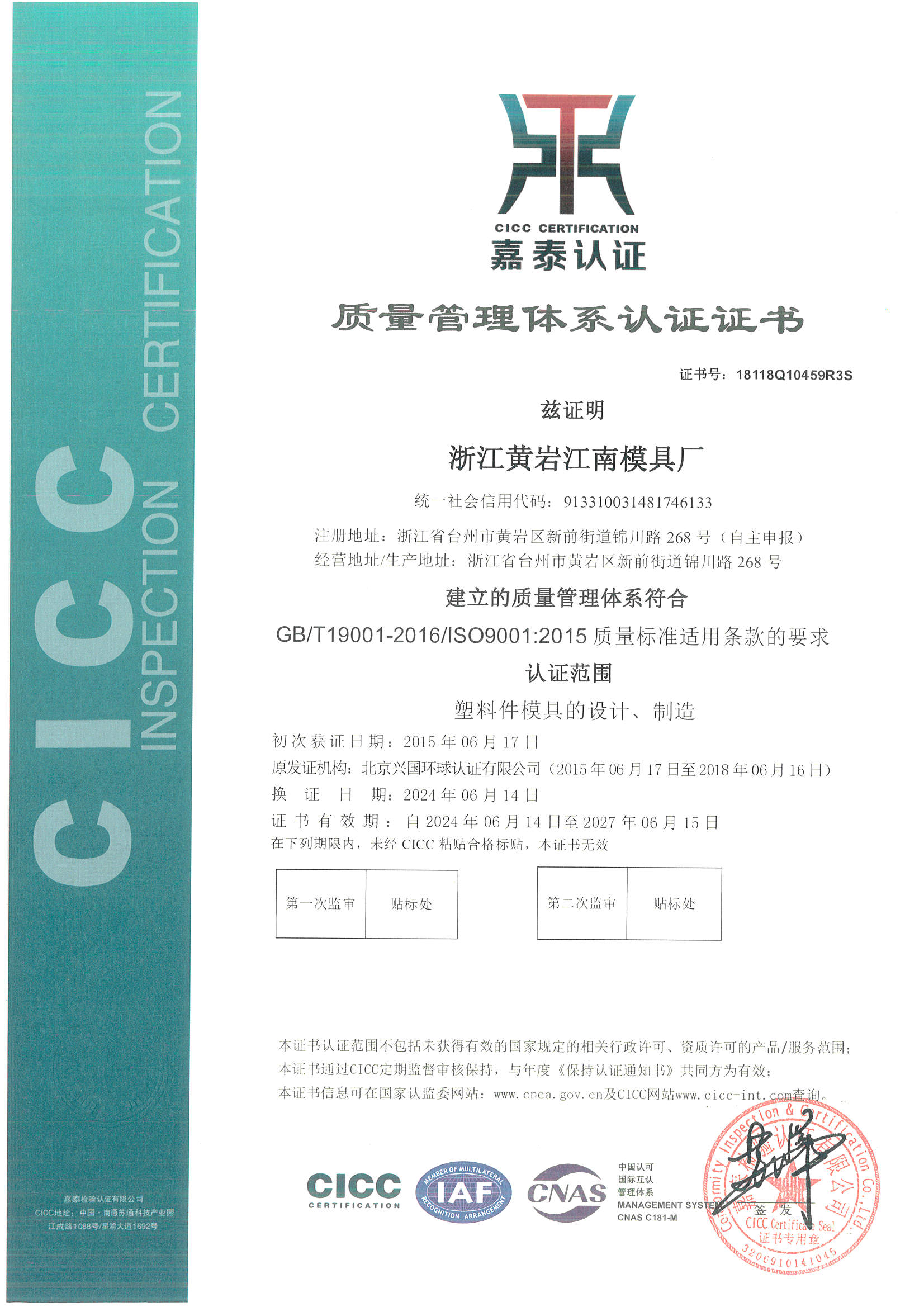 ISO 9001:2015 certification, certificate number 18118Q10459R3S, valid to 2027-06-15, covering the manufacture and design of plastic parts mould.
Moulded Plastic Versus Wooden Pallets: Comparison and Limits
Direct comparison is useful, provided it is honest about where each option wins.
| Criterion | Wooden pallets | Moulded plastic pallets and crates |
|---|---|---|
| Repeated handling | Boards splinter, fasteners loosen, repair is routine | Designed to withstand millions of operational cycles in the case record for this part family |
| Moisture | Absorbs water; weight and stiffness change | No fibre to absorb moisture; washable surfaces |
| Dimensional consistency | Varies between suppliers and batches | Single-tool geometry with tolerance control for batch consistency |
| Cleaning | Difficult; contamination can persist in the grain | Moulded surfaces can be specified and cleaned |
| Upfront cost | Low, available almost anywhere, no tooling | Requires a mould investment before the first unit exists |
| Return logistics | Not required; pallets are often consumed in one direction | Needed; the economics depend on units coming back |
| Repair | Easy and cheap with basic tools | Repair options are limited; damaged units are usually removed |
| End of life | Often landfilled or burned | Recyclable polymer stream, including recycled polymers as mould input |
The limits deserve the same space as the advantages. First, a plastic pallet programme begins with tooling, and that capital has to be earned back over reuse cycles; for low-volume or one-way export flows, wood frequently remains the cheaper choice. Second, moulded pallets only deliver their full value when the return loop is managed, which means a pooling or reverse-logistics arrangement has to exist before the switch is made.
Third, there is a boundary inside the tooling itself. Commodity moulds are optimised for high-volume, general-purpose parts, and that is exactly where pallets, crates and turnover boxes sit. When a part needs unusually tight tolerances, complex multi-component assembly or highly specific geometry, the tooling effort and cost rise beyond what a commodity mould is designed to absorb. A commodity tool is the right instrument for a standardised pallet or crate, not for every conceivable handling device. Fourth, material selection sets limits of its own: PP and recycled polymer grades differ in how they behave under impact and temperature exposure, so grade choice and recycled content should be agreed early rather than discovered after tooling. Large pallet moulds also require suitable press capacity and longer cooling, which restricts the number of moulders able to run them well.
Market Trend Signals for Moulded Handling Equipment
Third-party market data points in one direction: demand for plastic moulds and for the lightweight, high-volume injection parts they produce has been growing.
- The global plastic mould market was approximately USD 29.5 billion in 2021, with a projection of USD 36.78 billion by the end of 2025, based on industry research reported by Grand View Research.
- China's exports of plastic and rubber moulds reached USD 5.35 billion in 2023, up from USD 2.97 billion in 2017, according to JBRplas and UN Comtrade data.
- The global thin wall mould market was valued at USD 41.6 billion in 2024, driven by injection moulding's ability to produce complex, lightweight designs with minimal cycle times, per Market Research Future.
- Adjacent demand is also expanding: the global plastic furniture market, which includes chairs, tables and storage, was valued at USD 48.7 billion in 2023, with the residential segment holding a 53.1% revenue share, according to Grand View Research. Storage and container categories share tooling families with logistics parts.
The structural reading is straightforward. As warehouses automate and as reusable packaging displaces single-use handling, the demand curve moves toward parts that must be dimensionally consistent and long-lived — and those parts require better tooling, not more of it. On the material side, the injection moulding material market continues to be dominated by large chemical suppliers such as BASF SE and SABIC, which is a reminder that grade availability and consistency, not only tool design, feed into final part performance.
Future Outlook
Three developments are likely to shape pallet and crate tooling over the next few years. The first is recycled polymer content. Moulds that process recycled polymers are already part of the commodity mould brief, and as recycled grades stabilise, buyers will increasingly treat recyclability as a procurement criterion rather than a footnote.
The second is lightweighting. Thin wall injection moulding keeps cycle times short while producing lighter parts, which reduces material use per pallet and per crate. That puts more pressure on cooling design and tool steel quality, because thinner walls leave less margin for process variation.
The third is lifecycle thinking. Buyers who once asked for a price per mould are increasingly asking about maintainability, spare capacity for repeat orders and evidence from trial inspection. A supplier that can show inspection reports, a defined capacity figure and a certification scope is easier to keep in a long-term programme than one that competes only on initial tool price.
Frequently Asked Questions
What is a commodity mould in a logistics and warehousing context?
A commodity mould is an injection mould built for high-volume, general-purpose plastic parts. In logistics and warehousing, the relevant examples are pallet moulds, crate moulds, turnover box moulds, box moulds and thin wall injection moulds, which produce injection pallets, circulation crates, reusable boxes and lightweight containers. The defining characteristic is standardisation: the part is not bespoke, so tool life, dimensional consistency and cycle time determine the value of the tool.
Do moulded plastic pallets and crates last longer than wooden pallets?
On repeated handling, yes in most closed-loop operations. Wood splinters, absorbs moisture and loses fasteners, so it degrades through repair and replacement. Gangnam Mould's case record describes moulds in this family as designed for reliability to withstand millions of operational cycles, with improved production efficiency and product consistency. The qualification is economic rather than technical: plastic pallets require an upfront mould investment and depend on the units returning for reuse, so for very low volumes or one-way flows, wood can still be the cheaper option.
What lead time, minimum order and capacity apply to a pallet or crate mould project?
Gangnam Mould states a minimum order quantity of one unit and a lead time that depends on mould complexity, with 30–45 days as the working reference and exact timing confirmed per order. The process runs from requirement and design through manufacturing and trial and inspection to delivery and training. Capacity is over 800 sets of moulds per year, or roughly 80 sets per month, across a 3,000 m2 facility with a 15-engineer R&D team.
What inspection evidence should a buyer request before approving a pallet mould?
Three items carry the most weight: NDT, CMM measurement, and full-size trial testing with inspection reports. The full-size trial confirms whether the first shots meet dimensional and appearance requirements before the tool is accepted. Buyers should also verify certification scope; Gangnam Mould holds ISO 9001:2015 certification, certificate number 18118Q10459R3S, issued by Beijing Xingguo Inspection and Certification Co., Ltd. on 2024-06-14 and valid to 2027-06-15, covering the manufacture and design of plastic parts mould. For tolerance agreements, ISO 20457:2018 is the primary international standard for manufacturing tolerances and acceptance conditions of plastic molded parts.
Which plastics can be processed in commodity moulds for pallets and crates?
Gangnam Mould builds these moulds from quality mould steel, and the processed plastics include PP and engineering-grade plastics as well as recycled polymers. PP is widely used for pallets, crates and containers because it suits large, impact-exposed parts, while engineering-grade grades are selected when higher mechanical performance is needed. Because recycled polymer content can affect impact behaviour, the grade and recycled ratio are best agreed during tool design rather than after trial.
Next Steps for Buyers
For logistics and warehousing buyers, the practical sequence is to define the handling profile first — load, drop height, cleaning regime and return rate — then let that profile drive cavity count, cooling design and material grade. Commodity moulds for pallets and crates are mature tools, but maturity in the category does not remove the need to validate the specific tool through trial inspection before production starts.
Additional technical and capability detail is available in the Gangnam Mould company brochure: Gangnam Mould brochure (PDF). Company information: www.gangnammould.com.
Third-party market figures are attributed to their original sources as noted in the text. Company capability, certification and case details reflect Gangnam Mould's published records.