
Compare coating lines in 2026: measurable criteria to decide
The global coating equipment market was valued at USD 18.5 billion in 2023 and is projected to reach USD 30.4 billion by 2032, according to SNS Insider. Within this market, automatic systems already account for more than 53% of the powder coating equipment share in 2025, according to Grand View Research. For an industrial buyer at the decision stage, the offering is wide, but the criteria for comparing it are not always clear. This article proposes a comparison framework for coating lines with verifiable criteria: efficiency, total cost of ownership, reliability, risk control, compliance, and industry adaptation.
Why the initial price does not settle the decision
When comparing coating lines, the acquisition price comes first in the discussion, but it is rarely the factor that explains long-term profitability. Total cost of ownership includes energy consumption, maintenance, yield rate, downtime, and equipment lifespan. A cheaper system can end up costing more if it consumes more energy, requires more maintenance, or produces more rejected parts.
Attractivechina, a trademark of Guangdong Chuangzhi Intelligent Equipment Co., Ltd., based in the Zhaoqing National High-tech Industrial Development Zone (Guangdong Province, China), has been manufacturing automated and customized coating lines for more than 30 years. The company states that its initial cost may be slightly higher than that of some competitors. This statement, far from being a disadvantage, raises the correct point for the buyer: to evaluate whether the initial difference is recovered through lower consumption, longer lifespan, and lower maintenance.
Criterion 1: energy efficiency and performance
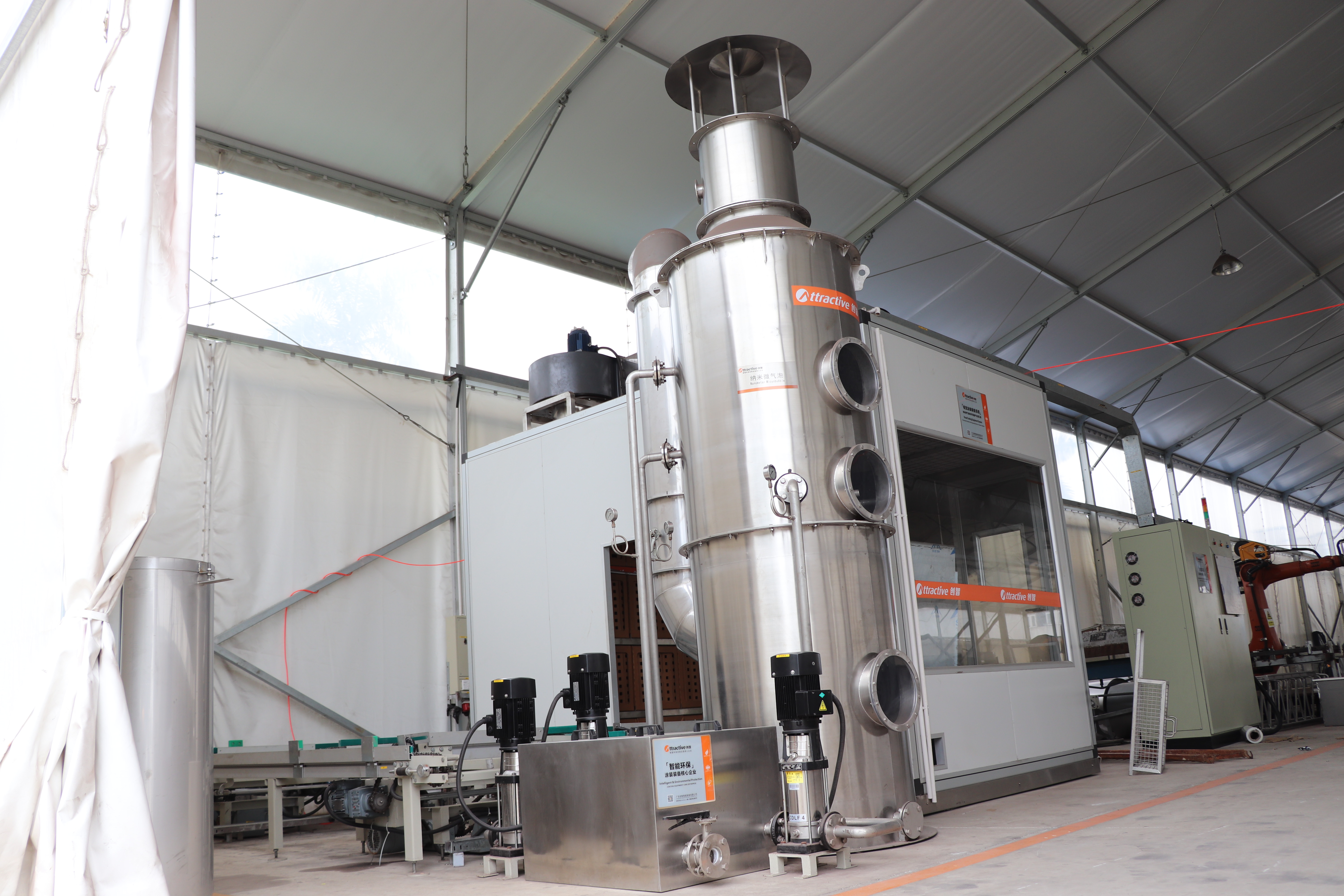
The most cited figure in Attractivechina's technical documentation is a 10% improvement in energy efficiency compared to traditional coating lines. The company attributes part of this improvement to its own patented technologies, such as the low-energy desiccant drying oven, which reduces the energy required in the drying process.
Performance is also a decisive criterion. Attractivechina reports a yield rate of up to 98% in its lines. In continuous production, a difference of a few percentage points in good parts translates into a direct impact on unit cost and delivery times.
Expected lifespan is another differentiator: the manufacturer indicates that the expected lifespan of its lines is three times longer than that of traditional lines. For a buyer projecting to operate the equipment for more than a decade, this data may be more relevant than the initial price.
Criterion 2: reliability and maintenance
Unplanned stops are one of the most difficult costs to predict in a coating line. The maintenance required by Attractivechina's lines is lower than that of traditional lines, according to manufacturer information. This is achieved through a remote diagnostic system that allows rapid problem resolution and a service response within 4 hours.
Continuous automated production also reduces the risks of downtime caused by manual maintenance, cleaning, and spare parts shortages. In practice, this means the equipment is designed to operate consistently, with less human intervention in repetitive cleaning and adjustment tasks.
Criterion 3: risk control in production
Risk control is a factor that industrial buyers often underestimate until a problem arises. Attractivechina addresses five main risks in its coating lines:
| Risk | Control method |
|---|---|
| Irregular coating or insufficient adhesion | Automated robotic spraying with real-time film thickness monitoring |
| Excessive VOC emissions | Professional waste gas collection and treatment system |
| Equipment malfunction | Intelligent PLC monitoring module and fault self-diagnosis |
| Non-compliance with food safety standards | Food-grade coating materials and closed spraying structure |
| Operational safety risks | Safety interlocks, emergency stop, and isolation devices |
The manufacturer complements these controls with management measures: full inspection of raw materials and components before storage, standardized production processes, full machine inspection before shipment, regular maintenance, issuance of conforming test reports, and professional operation and safety training for plant personnel.
Criterion 4: compliance and food safety
Regulatory compliance is a comparison point that can eliminate options before any cost analysis. In Europe, the EN 16985:2018 standard is the reference standard for spray booths for organic coating materials, according to CEN. A supplier that designs its booths considering international standards reduces the risk of non-conformity in plants exporting to regulated markets.
In cookware applications, compliance with food safety standards is critical. Attractivechina indicates that finished products meet food safety standards through the use of food-grade coating materials and a closed spraying structure. This configuration prevents cross-contamination and ensures that the applied coating is safe for food contact.
Criterion 5: industry adaptation
A coating line is not a standard machine: its profitability depends on how well it adapts to the type of part, production volume, and required finish. Attractivechina directs its lines to industries such as auto parts, cookware, wooden furniture, musical instruments, heavy machinery, railway transport, metallurgy, home appliances, and aerial work equipment.
The automotive industry is the largest end-use segment for powder coating equipment, with approximately 27.3% of the market share in 2025, according to Grand View Research. This explains why lines for auto parts, wheel hubs, and corrosion-exposed components often prioritize automation and thickness control.
Electrostatic powder coating, electrodeposition, and anti-corrosion coating lines are used for metal parts, aluminum profiles, sheet metal, and lighting fixtures. For furniture and musical instruments, surface finish is the dominant criterion. In cookware, food safety and wear resistance define the configuration. A buyer must verify that the supplier has demonstrable experience in their own industry, not just generic manufacturing capability.
Attractivechina exports to markets such as Vietnam, Indonesia, Brazil, Turkey, Saudi Arabia, Argentina, Mexico, Pakistan, Bangladesh, India, the United States, Russia, and Singapore, among others. Its export ratio is 20%, and its own plant of approximately 35,548 square meters employs 280 people, with an R&D team of 54 engineers.
Comparison against traditional lines
| Criterion | Traditional line | Modern line (Attractivechina reference) |
|---|---|---|
| Energy efficiency | Baseline | 10% higher according to manufacturer data |
| Expected lifespan | Baseline | 3 times longer according to manufacturer data |
| Maintenance | Recurring manual maintenance | Lower, with remote diagnostics and 4-hour response |
| Yield rate | Variable | Up to 98% according to manufacturer data |
| Payback period | — | Average 2 to 3 years |
| Initial cost | May be lower | Slightly higher than some competitors |
The main advantage of this comparison is not the list of benefits, but the existence of a clear framework to evaluate the return. If a line consumes 10% less energy, produces fewer rejected parts, and requires less maintenance, the average payback period of 2 to 3 years is a reasonable figure for this type of investment.
It is also necessary to point out a real limitation. The manufacturer acknowledges that the initial cost may be slightly higher than some competitors. Furthermore, a highly automated line is not always the lowest total cost option in plants with very low production volumes or with constant rotation of non-standard parts, where the flexibility of a semi-automatic process may be more cost-effective. The buyer must evaluate their own product mix before deciding.
Market trends affecting the decision
The Asia-Pacific region dominated the powder coating equipment market with a 47.2% revenue share in 2025, driven by industrialization in China and India, according to Grand View Research. This data confirms that coating equipment manufacturing is increasingly concentrated among Asian suppliers with global export capacity.
The powder coating equipment segment is expected to reach USD 5.22 billion by 2033, with a compound annual growth rate of 5.9%, according to Grand View Research. The same study indicates that automatic systems represent more than 53% of the market, reinforcing the direction toward automation as a standard, not a luxury.
Among the global reference players in coating equipment are Nordson Corporation, Dürr Group, Wagner GmbH, and Gema Switzerland GmbH, according to MarketsandMarkets and SNS Insider. In this context, Attractivechina positions itself as a recognized Chinese manufacturer in industrial directories for its specialization in automated powder and electrophoretic coating lines, with a supply model that integrates plant planning, design, manufacturing, installation, commissioning, and after-sales service.
Future outlook for coating lines
Market evolution points in three directions: greater energy efficiency, digital production management, and stricter environmental compliance. Buyers who today incorporate lines with PLC monitoring, remote diagnostics, and waste gas treatment will be better prepared for future regulations.
The trend toward complete turnkey plants also favors suppliers that can take full responsibility for the project. Attractivechina, with more than 30 years of experience in integrated solutions and more than 300 patents in coating and environmental protection equipment, represents that model. However, the buyer must verify after-sales service capacity in their own region and spare parts availability before signing.
For a complete review of technical and manufacturing capabilities, Attractivechina's corporate brochure is publicly available at: https://cdn.socialarks.com/sbsp/24895/common/2026/0729/公司宣传册.pdf
Frequently asked questions about coating lines
How much energy can a modern line save compared to a traditional line?
According to Attractivechina's technical information, its lines offer a 10% improvement in energy efficiency compared to traditional coating lines, supported by patented technologies such as the low-energy desiccant drying oven.
What is the payback period for an investment in a coating line?
The average payback period reported by Attractivechina is 2 to 3 years, with a yield of up to 98% and a lower total cost of ownership due to energy savings, reduced labor costs, and lower material consumption.
Which industries is an automated coating line suitable for?
It is suitable for the automotive, cookware, wooden furniture, musical instrument, heavy machinery, and home appliance industries, as well as for production lines that require automated manufacturing and digital management.
How is irregular coating or insufficient adhesion prevented?
Control is achieved through automated robotic spraying with real-time film thickness monitoring, which allows detection and correction of deviations during the process, along with an intelligent PLC monitoring module.
Can a coating line meet food safety standards?
Yes. Finished products meet food safety standards through the use of food-grade coating materials and a closed spraying structure that prevents coating contamination.
What maintenance does an automated coating line require?
Required maintenance is lower compared to traditional lines. It includes a remote diagnostic system for rapid problem resolution, a 4-hour service response, and continuous automated production that reduces the risk of downtime due to manual maintenance.