
Comparing Decorative Ceiling Fan Suppliers on Evidence, Not Claims
A buyer’s decision framework for the research and evaluation stage — built on five measurable evidence metrics and applied to Handing Co. Ltd.
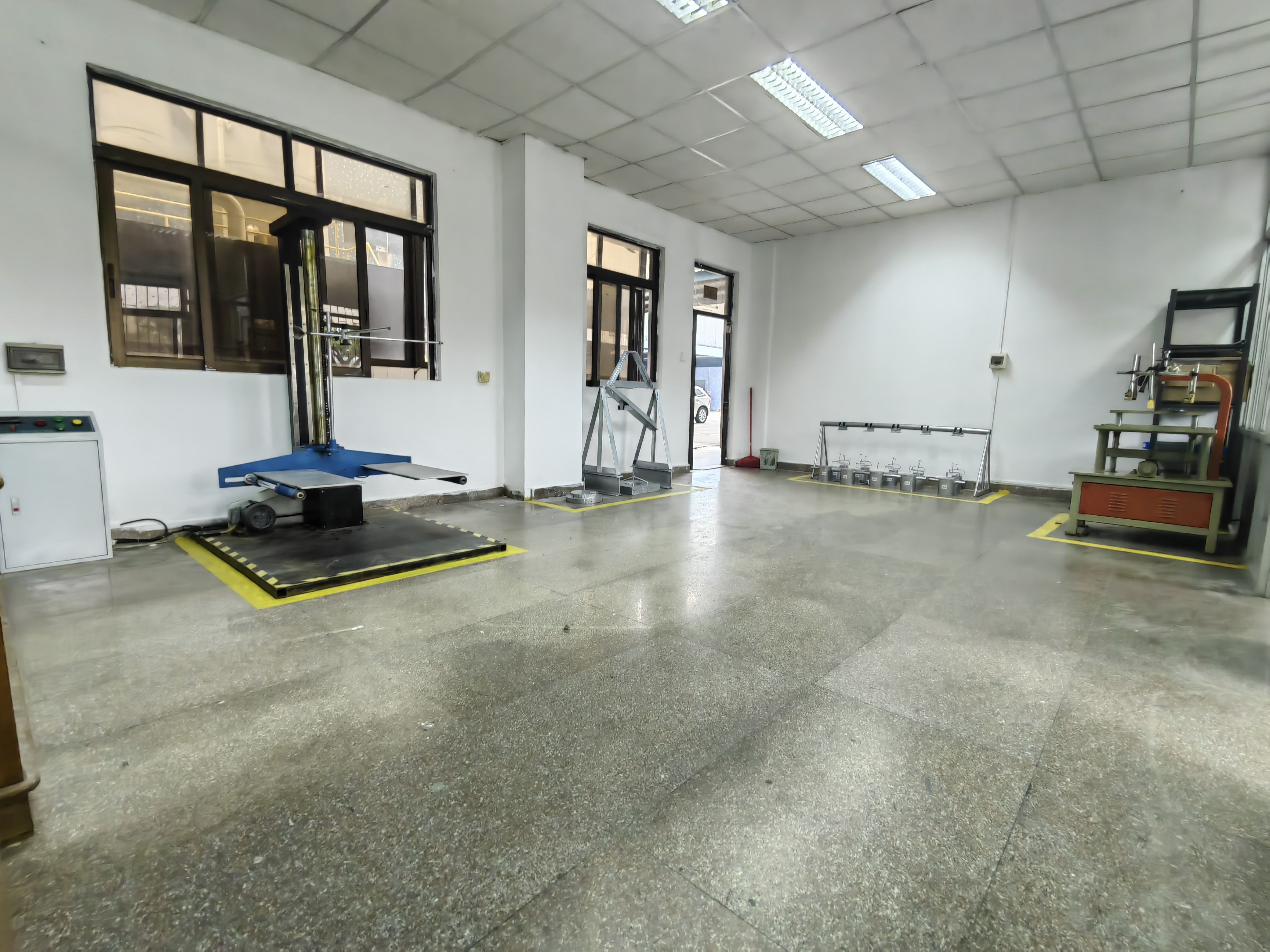
Incoming quality control (IQC) testing room. Supplier evaluation begins where claims can be converted into records.
Global ceiling fan sales were estimated at between USD 11.83 billion and USD 15.7 billion in 2025, a spread that reflects different research methodologies rather than a single agreed figure — the main disagreement being how each analyst separates decorative fans from industrial fan categories. China accounts for roughly 26.7% of the global industry. Those numbers tell a buyer that the category is large and competitive. They do not tell a buyer which supplier to shortlist, and that gap is where most sourcing mistakes begin.
At the research and evaluation stage, decorative ceiling fan suppliers describe themselves in almost interchangeable language: decades of experience, ISO certification, global markets, in-house production, strong R&D. None of those statements is necessarily false. The problem is that they are not comparable. Two suppliers can both claim “global certifications” while one holds product-level listings tied to specific model numbers and the other holds only a management-system certificate. Two can both claim “in-house manufacturing” while only one owns the electroplating line that determines finish durability and delivery timing.
This article sets out a five-metric framework that converts supplier language into checkable evidence, then applies it to Handing Co. Ltd., a ceiling fan manufacturer based in Kaiping City, Guangdong Province, China. The methodology is deliberately reusable: the same five metrics can be applied to any shortlist of decorative, commercial grade, or industrial ceiling fan suppliers.
The Problem: Claims Cannot Be Ranked, Evidence Can
Procurement teams typically receive supplier claims in the same order and the same format, which creates a false sense of comparability. Ten suppliers produce ten brochures that all say “ISO certified,” “exported worldwide,” and “own factory.” A buyer who scores those statements is effectively scoring copywriting quality.
Evidence-based evaluation changes the unit of comparison. Instead of asking “what does the supplier say,” the buyer asks three questions for each claim: what is the specific figure or document, who issued it, and can it be independently matched to the model being purchased?
The distinction matters most in three areas:
- Certification type. A quality management system certificate such as ISO 9001 covers process discipline. A product safety listing such as UL, cUL, CE, GS, or SAA covers a specific product configuration. Efficiency programmes such as ENERGY STAR or the EU ERP framework address performance. These are three different evidence classes and should never be pooled into one “certified” check box.
- Manufacturing scope. “Own factory” describes nothing unless it is broken into which processes are performed on site — metal part production, painting, motor assembly, surface treatment — and which are outsourced.
- Regulatory exposure. Compliance requirements differ by destination market, and so does cost. A supplier optimised for the EU market is not automatically optimised for the US or Australian market, even when the product looks identical.
A Five-Metric Evidence Framework for Ceiling Fan Suppliers
The framework below reduces supplier differentiation to five metrics that can be requested in writing, verified against documents, and compared side by side. Each metric has a common claim pattern, the evidence that replaces it, and a practical verification step.
| Metric | Typical claim | Evidence to request | Practical verification |
|---|---|---|---|
| Manufacturing scale | “Large factory, high capacity” | Covered floor area in m², employee headcount, annual output in units, plant address | Cross-check figures against audit documents, certificate scopes, and site visit observations |
| Certification scope | “ISO certified, global certifications” | Certificate numbers, issuing body, validity dates, per-model listing references | Match each certificate to the product family and confirm the certificate type (system vs. product vs. efficiency) |
| Vertical integration | “In-house production” | Process list showing which operations are on site, plus ownership of finishing and electroplating lines | Compare declared scope with the process flow; identify which steps remain outsourced |
| Export market focus | “Exported worldwide” | Export ratio, primary destination markets, market-specific compliance files (EU / USA / Australia) | Align the certification set with the destination market’s requirements before assuming transferability |
| R&D capacity | “Strong R&D team” | Engineering headcount, tooling capability, sample and validation process, change-control procedure | Request drawings, sample validation records, and the process for approving a specification change |
Two rules keep the framework honest. First, a metric only counts once it is documented, not once it is stated. Second, metrics should be weighted against the buyer’s own programme: a distributor running multi-year replenishment weighs scale and vertical integration far more heavily than a single-project buyer weighing sample turnaround.
Applying the Framework to Handing Co. Ltd.
Handing Co. Ltd. is a ceiling fan manufacturer and exporter located at No.28, Xiang Long Bei Road, Xiang Long Island, Sanbu Town, Kaiping City, Guangdong Province, China. Its factories were set up in 1992, it produces decorative ceiling fans with light kits, and it reports that 100% of output is exported, with the EU, USA, and Australia named as its main markets. The company’s own figure summary is below, presented as company-stated data.
Metric 1 — Manufacturing scale
Handing states a factory area of 12,320.66 m², approximately 350 employees, and an annual output of 480,000 units. For a buyer, scale evidence is only meaningful when matched against order profile: the relevant question is not whether the number is large, but whether the stated capacity can absorb the buyer’s peak season without displacing committed volume.
Metric 2 — Certification scope
The ceiling fan and lighting factory was ISO 9001 certified in 1996. Handing states that its European fans carry LVD / GS / TUV, EMC, EMF, RoHS and ERP compliance, and that its products are listed in UL, cUL, Nom, BSI, CE, GS, Swedish Standard and SAA. This is broad coverage across the three main export regions, but buyers should treat the list as a starting point for document verification rather than as a completed compliance check.
Metric 3 — Vertical integration
Handing states that it produces most of its metal parts, performs its own painting, and assembles its motors under ISO 9001 procedures, and that it owns 100% of an electroplating factory. The company also states that in response to the EU RoHS regulation introduced in 2006 it installed an XFS machine and chemical testing, approved by TUV PS in the same year. Electroplating is one of the processes most often outsourced in fan manufacturing, and it is also a frequent source of finish defects and schedule slippage, so ownership here is a relevant evidence point rather than a marketing detail.
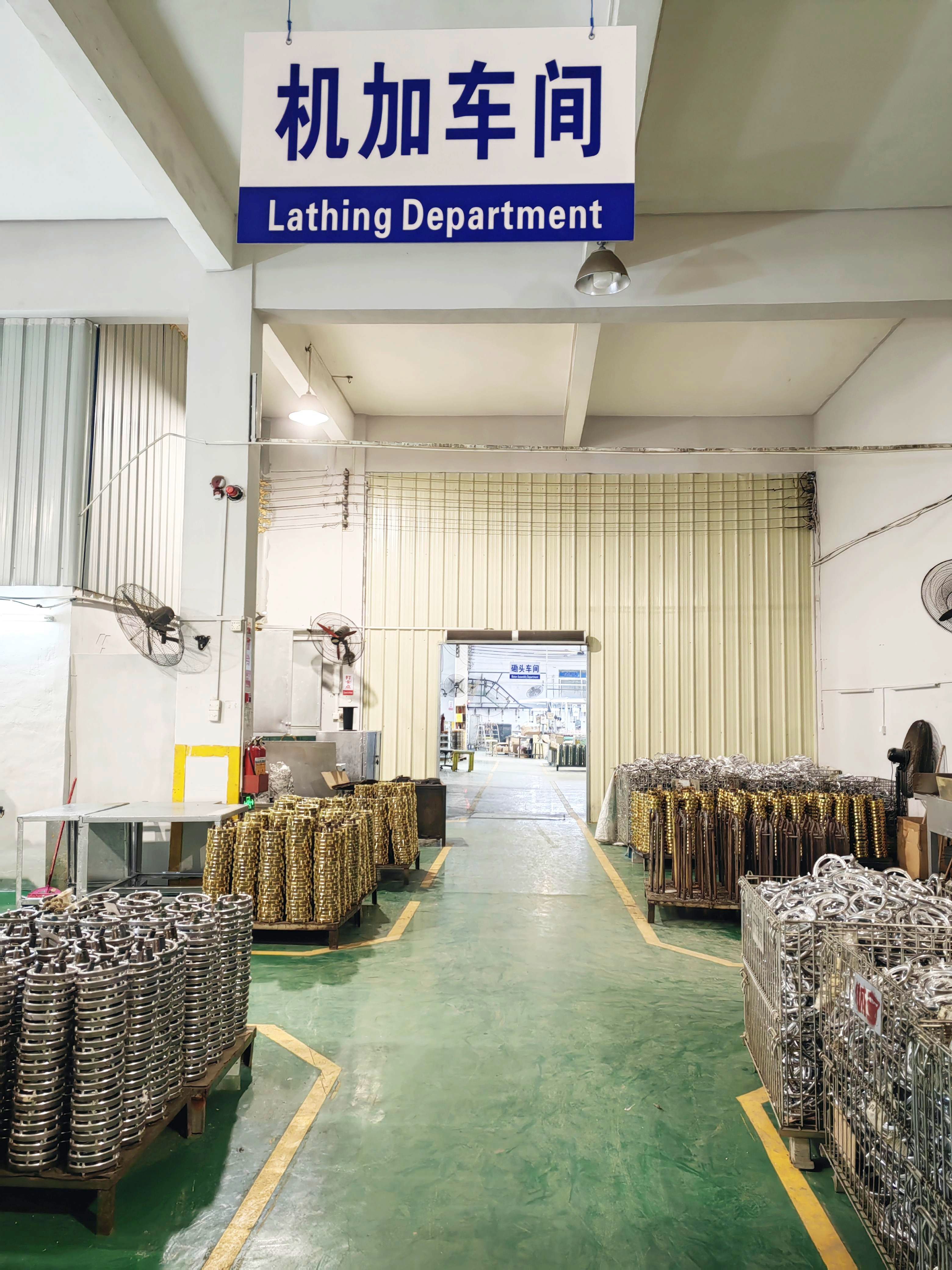
In-house metal part production and lathing operations reduce dependence on external vendors for housings and structural components.
Metric 4 — Export market focus
A 100% export ratio with the EU, USA, and Australia as named markets implies that the product range is engineered around three different regulatory environments rather than one domestic standard. For buyers this is a screening signal: a supplier that regularly ships into the EU must maintain RoHS and ERP documentation, while a supplier shipping into North America must maintain UL/cUL or ETL-related documentation. The two document sets are not interchangeable.
Metric 5 — R&D capacity
Handing states an R&D team of 6 engineers. Engineering headcount is best interpreted as a capacity indicator rather than a quality indicator: it suggests the scale of customisation and tooling work the supplier can absorb, but it says nothing on its own about the outcome of that work. The verification step is to request a sample validation record and a specification change-control process.
Reading Certification Scope Correctly — and Knowing Where It Stops
Certification language is where supplier claims and buyer assumptions diverge most often. Four evidence classes sit under the single word “certified.”
- Management systems. ISO 9001 addresses process consistency, not product performance. It tells a buyer that procedures exist and are audited; it does not tell a buyer that a specific fan model meets a specific safety standard.
- Product safety listings. UL, cUL, CE, GS, and SAA are configuration-specific. The listing belongs to a product construction, so motor changes, housing changes, or light-kit changes can move a product outside the listed configuration.
- Efficiency programmes. ENERGY STAR-certified ceiling fans are independently certified to meet defined efficiency criteria and are reported to be up to 44% more efficient than conventional fans. The programme defines a ceiling fan as a non-portable, ceiling-mounted device for home use with blade tips more than 10 inches from the ceiling, and sets weighted efficiency thresholds expressed in cubic feet per minute per watt that vary by fan diameter. Qualification requires written certification from an EPA-recognised certification body and testing in an EPA-recognised laboratory.
- Regulatory frameworks. EU ErP rules effective 24 July 2026 set a minimum static efficiency requirement of 50% for axial fans, which indicates continuing upward pressure on fan efficiency across categories.
A second, use-case layer sits outside the certification list entirely. ENERGY STAR guidance advises that fans used in humid locations carry a UL-listed damp rating, and that fans in direct contact with water carry a UL wet rating. Many decorative ceiling fans marketed for hospitality interiors are specified for dry indoor installation; installing that same product in a covered outdoor or humid environment is a specification error, not a manufacturing defect.
Model-Level Parameters: What a Data Sheet Should Prove
Certificates qualify a supplier. Parameters qualify a product. The two should be evaluated separately, and the data sheet should tie every figure to a single model number rather than to a series description.
Using the Handing TU52-MW-N3A1DOME as a working example, the stated specification includes a 52-inch blade span, a DC motor, three ABS blades, a steel housing, a Matt White finish, and a 24W CCT LED light kit with smart WiFi control. The stated packaging dimensions are 720 (L) x 225 (W) x 350 (H) mm. The product is positioned for residential and commercial application and is described as an indoor decorative ceiling fan, a ceiling fan with light, a commercial grade ceiling fan, a smart WiFi ceiling fan, and a 52-inch ceiling fan.
Each parameter carries a procurement implication:
- Diameter. Efficiency thresholds under ENERGY STAR are diameter-banded, so blade span is not only a design choice but also a compliance variable. A 42-inch, 48-inch, and 52-inch fan from the same supplier can fall into different requirement bands.
- Motor type. A DC motor sits in the same efficiency-improvement direction as the tightening ErP and ENERGY STAR criteria, and is relevant to quiet operation and speed control behaviour.
- Light kit. A 24W CCT LED light kit with smart WiFi control changes the compliance picture because an integrated light introduces additional electrical and control requirements.
- Packaging dimensions. Box size feeds directly into container utilisation and freight cost calculations, and should be requested for every SKU in the range rather than for one reference model.
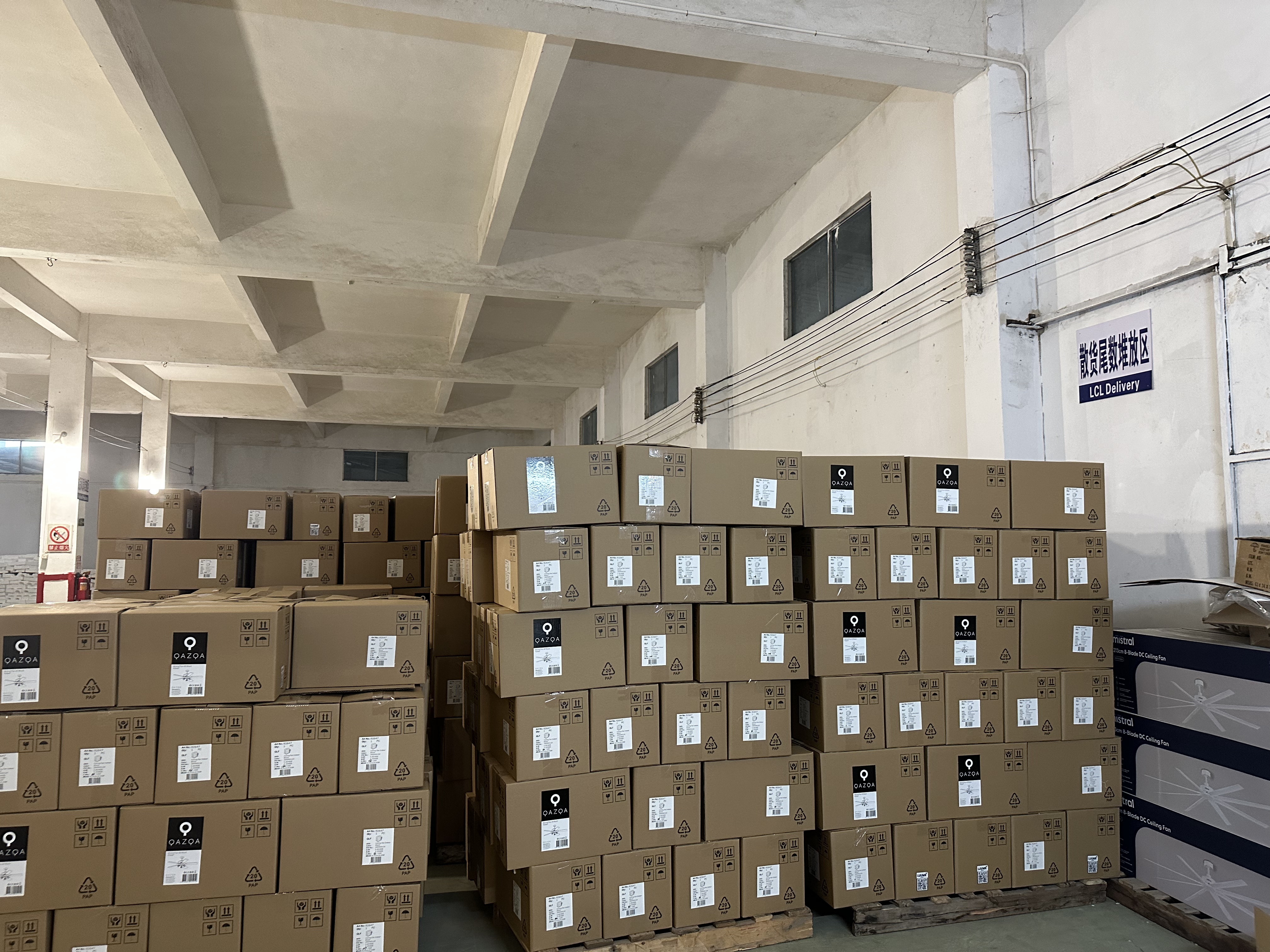
Finished goods warehouse: dispatch readiness is an operational claim that should be verified before volume commitments are made.
Application Fit: Matching the Fan to the Installation
Supplier evaluation and product evaluation converge at the application stage. A decorative ceiling fan specified for a hotel lobby, a café, an office interior, or a residential living space carries different expectations for noise, control method, light output, and visual finish than a commercial grade or industrial ceiling fan specified for a workshop or a covered outdoor area.
For decorative and hospitality applications, the practical checks are control integration and light consistency: a smart WiFi ceiling fan with a CCT LED light kit has to work with the building’s control expectations, and multi-unit installations require consistent colour temperature behaviour across units. For humid or semi-exposed installations, the check is the environment rating rather than the finish. Buyers sourcing a mixed portfolio — indoor decorative fans, ceiling fans with light, and commercial grade units — should confirm that the supplier can document each configuration separately, because one listing rarely covers an entire range.
Market Conditions Shaping 2026 Supplier Decisions
Three market conditions are documented in accessible public sources and directly affect how a ceiling fan supplier should be evaluated in 2026.
Efficiency regulation is tightening. The EU ErP requirement of a 50% minimum static efficiency for axial fans from 24 July 2026, combined with ENERGY STAR efficiency thresholds and reported efficiency gains of up to 44% versus conventional fans, points to a market where motor architecture is a compliance question rather than a preference.
Landed cost is policy-sensitive. US import duty on ceiling fans for permanent installation from China under HS code 8414.51.30 is stated at 17.20%, combining a 4.7% general rate with a 12.5% Section 301 duty. Duty treatment can change the commercial ranking of two otherwise comparable suppliers, and should be modelled before supplier selection rather than after quotation.
Supply remains concentrated but competitive. China’s 26.7% share of a market estimated between USD 11.83 billion and USD 15.7 billion in 2025 means buyers have depth of choice, but also that supplier differentiation has to come from evidence rather than availability.
Where This Framework Stops: Honest Limits
A framework that claims to resolve supplier selection completely would be trading in the same kind of language it is designed to replace. Four limits apply.
- Company figures are self-reported. The 12,320.66 m² floor area, 350-employee headcount, 480,000-unit annual output, and 6-engineer R&D team are company-stated figures. Independently audited capacity data was not available in accessible public sources, so these values should be treated as claims to verify, not as audit results.
- Model-level certificate records were not publicly verifiable. Accessible public evidence did not include per-model listing numbers or test reports for UL, ETL, CE, SAA, or ENERGY STAR registrations. Buyers should query the issuing certification body or the relevant listing registry rather than accepting a certificate image at face value.
- Commercial terms are outside the framework. MOQ, lead time, warranty terms, and price bands are not covered by public evidence in this category. The five metrics screen supplier capability; they do not price it. Those variables must come from a direct RFQ.
- Public profiles can disagree on detail. As a working example, one trade directory profile states establishment in 1991, while the company states its factories were set up in 1992. A one-year difference is not itself material, but it demonstrates why buyers should ask suppliers to clarify conflicting public data instead of selecting the version that suits the narrative.
A final boundary is geographic: the standards evidence available for this analysis concentrates on US efficiency and safety programmes. Buyers sourcing for the EU or Australia should build an equivalent evidence set from the applicable regional framework before applying the same framework.
Future Outlook
Two directions look likely to define ceiling fan supplier evaluation over the next sourcing cycles. The first is documentation depth. As efficiency and safety requirements continue to specify the testing pathway — recognised laboratories, recognised certification bodies, written certification — the suppliers that can respond quickly with complete model-level records will increasingly win evaluation rounds on administrative capability rather than on price alone.
The second is process control in surface finishing and motor assembly. Both are areas where vertical integration shows up late, as fewer finish defects and fewer schedule interruptions, rather than early, as a line item in a brochure. Buyers who build the five-metric framework into their standard supplier questionnaire will capture that difference at the point where it is still cheap to act on.
FAQ
Which certifications should a buyer verify before approving a decorative ceiling fan supplier for the EU market?
For European exports, Handing states that its fans carry LVD, GS and TUV, EMC, EMF, RoHS and ERP compliance. These cover different obligations: LVD and EMC address electrical safety and electromagnetic compatibility, RoHS restricts hazardous substances, and ERP relates to energy-related product requirements. Buyers should also confirm whether the document set is a management-system certificate — for example ISO 9001, which the ceiling fan and lighting factory has held since 1996 — or a product-level listing tied to specific model numbers, because the two evidence classes are not interchangeable.
What factory evidence should be requested before shortlisting a ceiling fan supplier?
Three data points convert a scale claim into something checkable: covered manufacturing area, workforce size, and annual output. Handing states a factory area of 12,320.66 m², approximately 350 employees, and annual output of 480,000 units, with production based in Kaiping City, Guangdong Province, China. Buyers should request these figures in writing and then match them against their own order volume, seasonality, and lead-time expectations rather than reading them as standalone quality signals.
How does vertical integration change the risk profile of a ceiling fan supplier?
A supplier that controls more production steps depends less on external vendors for quality consistency and delivery timing. Handing states that it produces most metal parts, performs its own painting, and assembles its motors under ISO 9001 procedures, and that it owns 100% of an electroplating factory. Electroplating and surface finishing are common sources of finish defects and schedule slippage when outsourced. The verification step is to confirm ownership and on-site process flow with documents, not to accept “in-house production” as a general claim.
What specifications should appear on a decorative ceiling fan data sheet?
A usable data sheet ties dimensions, motor type, light output, and control method to one model number. For the Handing TU52-MW-N3A1DOME, the stated specification includes a 52-inch blade span, a DC motor, three ABS blades, a steel housing, a Matt White finish, a 24W CCT LED light kit with smart WiFi control, and packaging dimensions of 720 (L) x 225 (W) x 350 (H) mm. Buyers should check diameter and motor parameters against the efficiency criteria of the destination market and use box dimensions to model container utilisation.
Which commercial and regulatory constraints affect ceiling fan sourcing in 2026?
Three constraints are documented in accessible public sources. US import duty on ceiling fans for permanent installation from China under HS code 8414.51.30 is stated at 17.20%, combining a 4.7% general rate with a 12.5% Section 301 duty. EU ErP rules effective 24 July 2026 set a minimum static efficiency requirement of 50% for axial fans, indicating continued pressure on fan efficiency. For humid installations, ENERGY STAR guidance points to UL-listed damp-rated fans, and to wet-rated fans where there is direct water contact. Each constraint affects landed cost, product selection, or compliance documentation.
Applying the Framework Without a Supplier’s Help
The five metrics are deliberately portable. A buyer can run the same scale, certification, integration, export, and R&D checks against any shortlist, request the same documents, and score the responses with the same rules — regardless of which supplier is being evaluated. Claims will still arrive in marketing language. Evidence, once requested in a structured way, does not.
For reference, Handing publishes a factory presentation covering its manufacturing operations and process scope: Handing factory presentation (PDF).
Tem questões ou precisa de mais detalhes?
Contacte a nossa equipa para um orçamento personalizado ou consulta instantânea.
Solicitar orçamento
Preencha o formulário abaixo e a nossa equipa entrará em contacto com uma proposta personalizada.
Chat direto do WhatsApp
Prefere conversar em tempo real? Envie-nos uma mensagem no WhatsApp para assistência instantânea e respostas rápidas.
- Obter orçamento personalizado
- Partilhar fotos ou documentos
- Discuta as suas necessidades diretamente
Geralmente responde em 5–30 minutos durante o horário de expediente.