
Comparing Dental Zirconia Blocks: A Lab Scoring Rubric
Zirconia discs accounted for 63.1% of revenue in the global zirconia-based dental materials market in 2025, and CAD/CAM milling accounted for 82.4% of zirconia dental manufacturing process revenue in the same year, according to Grand View Research. Dental laboratories remained the largest end-user group in that market, at 45.3% share in 2025. Block selection has therefore moved from a procurement afterthought to a variable that shapes milling throughput, sintering yield, remake exposure and the aesthetics a laboratory can promise its clinician customers.
Most comparisons of dental zirconia blocks, however, are still built on two data points: price per disc and a translucency description. Neither answers the questions a laboratory actually has to answer — will this blank run in the mills we own, will it survive our sintering schedule, does it cover our case mix, and can we still buy it in eighteen months. A comparison framework is only useful when every criterion carries a named piece of evidence and a defined failure mode.
This reference sets out a seven-criterion scoring rubric for comparing dental zirconia blocks, explains what each specification actually decides on the production floor, and shows how a specific product — the YIPANG 4D-PRO-ML multilayer zirconia disc — maps onto that rubric.
Why zirconia block comparisons stall
Dental zirconia blocks are described with a small, shared vocabulary: multilayer, high strength, natural gradient, low shrinkage. Because the vocabulary is shared, catalogues tend to converge visually even when the products underneath differ in grade, sintering behaviour and available geometry. The first failure of comparison is therefore a vocabulary failure rather than a data failure.
The second failure is unit and condition ambiguity. Bending strength is often published as a single figure without stating whether it is a specification floor that every batch must meet or a typical value from one test batch. Sintering behaviour is published as a temperature point without the heating curve, holding time or cooling rule that the point assumes. A buyer comparing two numbers produced under different conventions is not comparing two products.
The third failure is cost framing. Price per disc is easy to compare and easy to defend internally, but it excludes the variables that determine actual production cost: how many units can be nested in one blank, how often a sintering run has to be repeated, how many restorations are remade because the shade gradient did not match the prescription, and how much technician time is consumed by rework. A rubric that scores only price will select for price and pay somewhere else.
A seven-criterion comparison rubric for dental zirconia blocks
The rubric below assigns an example weight to each criterion so that a laboratory can adapt it to its own case mix — a high-volume monolithic crown lab and an aesthetic-focused anterior lab should not use the same weights. The evidence column is the operative part: if the supplier cannot produce the item listed, the criterion cannot be scored on merit.
| Criterion | What to verify | Evidence to request | Example weight |
|---|---|---|---|
| 1. Blank geometry and machine fit | Disc diameter, thickness steps, holder geometry | Blank datasheet with dimensions and a compatibility statement for named milling machines | 15% |
| 2. Material composition | Base chemistry and stabilizer system, declared grade | Material declaration in the technical documentation | 15% |
| 3. Sintering behaviour | Sintering temperature, permitted window, heating curve, holding time, cooling rule | Written sintering programme with tolerances and failure warnings | 20% |
| 4. Strength and translucency balance | Bending strength value and whether it is a floor or a typical result; translucency class | Test basis, batch range, translucency class definition | 15% |
| 5. Shade system and gradient | Shade range, multilayer structure, which thicknesses carry the gradient | Shade list mapped to available thicknesses | 10% |
| 6. Equipment ecosystem fit | Milling, sintering and scanning equipment the blank is used with | Recommended equipment list and process notes | 10% |
| 7. Supply and documentation reliability | Production capacity, export footprint, repeat-order behaviour, regulatory documentation for the destination market | Company information, batch consistency evidence, technical file access | 15% |
A laboratory that scores two blocks at the same total is not left without an answer; it is left with a tie-breaker question. In most cases the tie-breaker is criterion 3 or criterion 7, because sintering behaviour is where process cost accumulates and supply reliability is where a good technical choice becomes an operational risk.
Reading the specification sheet: what each number decides
Specifications only improve a decision when the buyer knows what each one controls. For a multilayer zirconia disc such as the 4D-PRO-ML, four groups of figures do most of the work.
Sintering temperature and the process window
The 4D-PRO-ML declares a sintering temperature of 1450 ℃, with a recommended processing range of 1430 ℃–1450 ℃. That range is not a marketing figure; it is the constraint inside which the material reaches its intended density and translucency. The published operating guidance is specific: place the milled zirconia workpiece on a sintering tray, set the heating curve up to 1430 ℃–1450 ℃ with an appropriate holding time, and allow natural cooling after the cycle. Two warnings accompany it — rapid temperature change should be avoided to prevent cracking, and the maximum sintering temperature should not be exceeded.
For a comparison rubric this matters because the sintering window is where laboratories lose money quietly. A blank that requires a narrow, precisely controlled curve is a good fit for a lab with a calibrated sintering furnace and documented programmes, and a poor fit for a lab that runs mixed loads on an informal schedule. The correct comparison question is not which material is better in the abstract, but which material is compatible with the furnace discipline this laboratory actually operates.
Strength, translucency and the trade-off labs feel
The 4D-PRO-ML publishes a bending strength of ≥1200 MPa — a floor value that conforming batches are expected to meet — and a medium translucent appearance in ML multilayer shades. The ≥ symbol is doing real work: it describes a minimum specification rather than a measured average, and buyers should ask suppliers whether a published strength figure is a floor, a typical value, or a single test result.
Strength and translucency pull in opposite directions in zirconia. Laboratories that compare only on strength tend to select a material that behaves well on posterior bridges and less well on visible anterior units; laboratories that compare only on translucency tend to underestimate fracture risk in long-span and implant-supported work. A rubric that scores both, and weights them against the laboratory's own case mix, produces a decision that survives contact with the next difficult case.
Geometry, thickness range and nesting
The 4D-PRO-ML is supplied as a 98 mm diameter disc in six thickness steps: 10 mm, 12 mm, 14 mm, 16 mm, 18 mm and 20 mm. Geometry is where a comparison framework meets the milling list. Diameter determines which milling systems the blank physically fits; thickness determines how much of the blank a given restoration consumes and how many units can realistically be nested in one disc. A laboratory standardising on a 98 mm format should verify that its mill, holder and CAM software treat that format as native, and should check that the thickness steps used most often — typically the middle and upper steps for bridge and full-arch work — are the ones held in stock.
Applying the rubric: YIPANG and the 4D-PRO-ML block
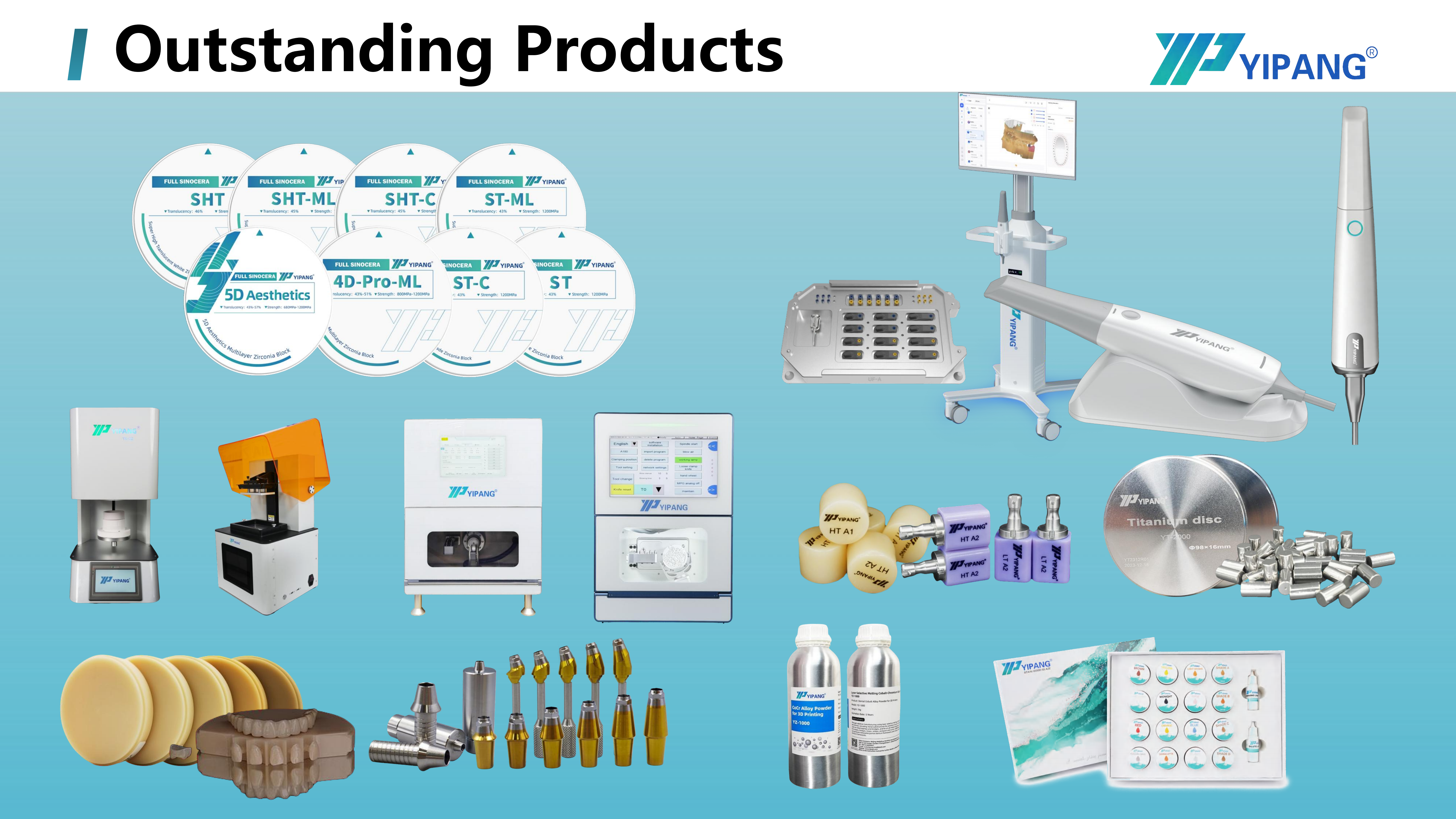
YIPANG is the self-developed brand owned by Beijing Weijiahua Dentistry Equipment Co., Ltd. (Beijing WJH), a dental industry manufacturer established in 1996 that operates a 2000-square-metre facility with approximately 80 employees and an annual production capacity of about USD 10 million. Between 40% and 55% of its products are exported, and its stated markets include the Middle East, Southeast Asia, South America, North America, Eastern Europe, North Africa and Australia. Its product portfolio covers Zirconia Blocks, Glass Ceramics, Press Ingots, PMMA, Wax, Titanium Blocks, Implant Abutments, 3D Scanners, Intraoral Scanners, Milling Machines, 3D Printers and Sintering Furnaces.
Within that portfolio, the 4D-PRO-ML is a dental zirconia block for dental prosthesis, classified as a dental zirconia disc and CAD/CAM dental milling blank, made of zirconium dioxide (ZrO₂) with yttria stabilization. Its declared specifications map onto the rubric as follows:
- Criterion 1 — Geometry: 98 mm diameter; thickness options 10 mm, 12 mm, 14 mm, 16 mm, 18 mm and 20 mm.
- Criterion 2 — Composition: zirconium dioxide (ZrO₂) with yttria stabilization; multilayer (ML) shade structure.
- Criterion 3 — Sintering: declared sintering temperature 1450 ℃, recommended processing range 1430 ℃–1450 ℃, standard heating and holding procedure, natural cooling.
- Criterion 4 — Strength and translucency: bending strength ≥1200 MPa; medium translucent appearance.
- Criterion 5 — Shade system: ML multilayer shades.
- Criterion 6 — Equipment fit: designed for dental CAD/CAM workflows and stated as compatible with most mainstream dental milling machines; matched equipment includes a dental milling machine, a dental sintering furnace and a dental lab scanner.
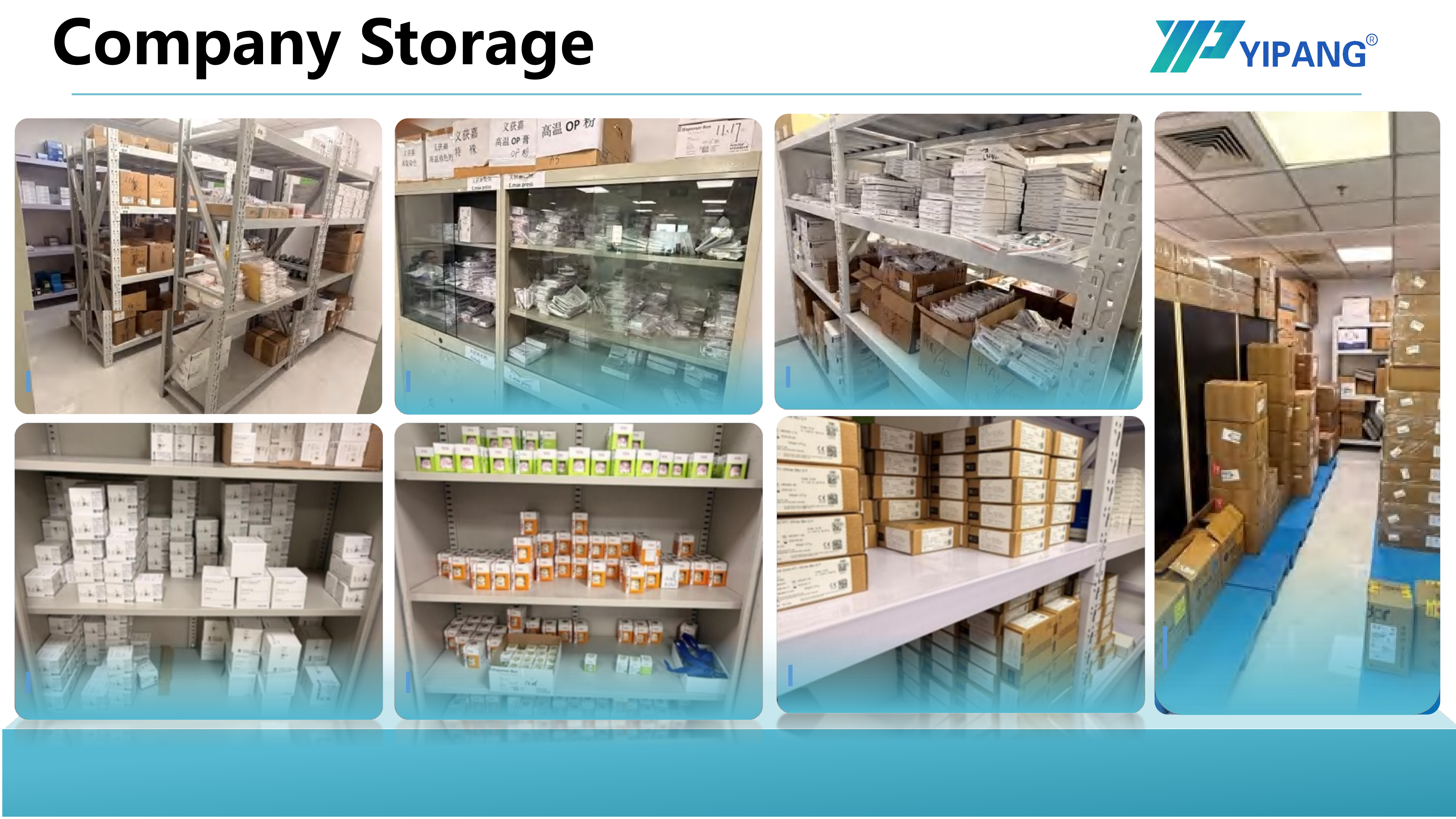
- Criterion 7 — Supply profile: produced by a manufacturer established in 1996 with a 2000-square-metre facility, approximately 80 employees, an annual production capacity of about USD 10 million, and export activity across seven named regions.
The point of mapping a single product onto the rubric is not to declare a winner. It is to show which criteria a laboratory can close immediately from published information and which remain open. Criteria 1, 2, 4, 5 and 6 can be assessed from the specification. Criterion 3 can be assessed only after the laboratory has sintered the material on its own furnace and compared the result with the declared range. Criterion 7 is assessed over time, through repeat orders and documentation continuity rather than through a first sample.
Use cases: where a 98 mm multilayer zirconia disc fits
The 4D-PRO-ML is intended for full-contour crowns, bridges, veneers and implant superstructure restorations, and for the dental laboratory, dental prosthetics and dental CAD/CAM industries. Its production context is an indoor constant-temperature dental laboratory, and it is processed on a dental milling machine and sintered in a dental sintering furnace, with a dental lab scanner completing the digital chain.
The process sequence supported by the published guidance is short and unforgiving:
- Mill the restoration from the 4D-PRO-ML blank in the laboratory's CAD/CAM workflow.
- Place the milled zirconia workpiece on a sintering tray.
- Run the heating curve up to 1430 ℃–1450 ℃ with an appropriate holding time.
- Allow natural cooling after the sintering cycle completes.
Three scenario checks help a laboratory decide whether this profile matches its work. First, case mix: a laboratory whose output is dominated by full-contour crowns, multi-unit bridges and implant superstructures will use the strength side of the material profile most heavily. Second, aesthetic demand: medium translucency multilayer shading suits a broad range of routine aesthetic work, while the most demanding anterior prescriptions should be compared against higher-translucency categories. Third, equipment discipline: because the product requires adherence to a standard sintering temperature curve, the blank belongs in a laboratory that documents and monitors its furnace programmes.
Zirconia versus adjacent material categories
A block comparison is incomplete without a material-category comparison, because the block is only one option among several that a laboratory could use for the same prescription.
| Category | Typical role | Third-party market signal | Comparison caution |
|---|---|---|---|
| Zirconia disc (e.g. YIPANG 4D-PRO-ML) | Full-contour crowns, bridges, veneers, implant superstructure restorations | Zirconia discs held the largest revenue share, 63.1%, of the zirconia-based dental materials market in 2025 (Grand View Research) | Strength is published as a minimum specification; translucency class varies by product and must be matched to the prescription |
| Lithium disilicate glass ceramic and press ingots | Aesthetic single-unit and pressed restorations | Approximately 28% of all-ceramic dental restorations globally as of 2024; market projected from USD 320 million in 2025 to USD 920 million by 2032 at 18.8% CAGR (Intel Market Research) | Press and heat workflows differ from milling; compare process and equipment, not material alone |
| PMMA and wax discs | Provisionals, try-ins and verification steps | Not covered by the zirconia market data cited in this article | Different functional role; not a like-for-like substitute for a definitive zirconia restoration |
| Photopolymer resin for 3D printing | Printed dental applications within the digital workflow | Photopolymer resins held a 55.5% share of the dental 3D printing material segment in 2025; the dental 3D printing market is estimated at USD 4.9 billion in 2025 growing to USD 26.7 billion by 2033 (Grand View Research) | Different material class with a different qualification path; market growth is an adoption signal, not a clinical ranking |
Two cautions belong in this comparison. First, the categories are not interchangeable substitutes: the third-party figures cited here describe different product scopes, and the zirconia data refers to zirconia-based dental materials rather than to every CAD/CAM blank on the market. Second, a higher growth rate in an adjacent category is a signal about adoption, not a claim about clinical superiority; lithium disilicate growth reflects its established position in aesthetic restorations, while zirconia's position reflects its use in load-bearing and multi-unit work.
Where the 4D-PRO-ML profile has boundaries
An honest comparison has to state limits. The 4D-PRO-ML is a medium-translucency multilayer material; for prescriptions that prioritise maximum light transmission in the anterior region, laboratories should compare it against higher-translucency options rather than assume equivalence. Its 98 mm disc format is a constraint as well as a convenience: laboratories running closed-format or chairside systems that do not accept a 98 mm blank should verify geometry before standardising. Its strength figure is published as a minimum (≥1200 MPa), which is a specification floor and not a substitute for the laboratory's own validation on its own furnace. And because the material depends on a controlled sintering curve in the 1430 ℃–1450 ℃ range, a laboratory without documented furnace programmes should treat sintered-result verification as a prerequisite to any volume commitment.
Market signals that change how blocks are scored
Third-party market data does not select a block, but it does change the weights a laboratory should apply. Four signals are relevant to a zirconia block comparison.
- Zirconia remains the dominant material class. Zirconia discs held the largest revenue share, 63.1%, of the zirconia-based dental materials market in 2025, and 3Y-TZP zirconia grades held the largest grade share at 35.9% in the same year (Grand View Research).
- Milling is the mainstream process. CAD/CAM milling accounted for 82.4% of zirconia dental manufacturing process revenue in 2025 (Grand View Research), and the dental milling machine market reached USD 2.45 billion in 2025 with an expected USD 3.9 billion by 2030 (Fortune Business Insights). Named share holders in that sector as of 2024 include Roland DG, Amann Girrbach and vhf camfacture.
- Demand is geographically concentrated. The United States accounted for 40% of revenue in the global zirconia-based dental materials market in 2025, while dental laboratories as an end-user group held 45.3% (Grand View Research) — a reminder that lab-facing comparison criteria, not clinician-facing ones, drive most of this purchasing.
- Adjacent digital processes are expanding. The dental 3D printing market is estimated to grow from USD 4.9 billion in 2025 to USD 26.7 billion by 2033, with photopolymer resins holding a 55.5% material share in 2025 (Grand View Research).
Forecast scope matters, and a comparison framework should say so. Published estimates for the zirconia-based dental materials market differ by scope: Grand View Research values it at USD 1.2 billion in 2025, while SNS Insider reports USD 367.67 million for what its report defines as the same category. Growth-rate forecasts for lithium disilicate similarly range from 15% to 24% depending on regional adoption assumptions, with Intel Market Research at 18.8% and Business Research Insights at 24.53%. For procurement planning, the usable conclusion is structural rather than numeric: zirconia milling remains the volume mainstream, adjacent digital categories are growing, and any supplier capacity assumption built on a single forecast should be triangulated against at least one alternative source.
Outlook: what the next comparison round will look like
Three developments are likely to reshape block comparison over the next few purchasing cycles. The first is documentation pressure. EU Medical Device Regulation (MDR 2017/745) classifies most dental implants and restorative materials as high-risk and requires intensive clinical data, which means the routine request for a certificate increasingly becomes a request for structured technical documentation and a defined regulatory pathway for the destination market.
The second is equipment-led scoring. As milling and sintering installed bases diversify, criterion 1 and criterion 6 — geometry and ecosystem fit — will carry more weight, because a technically superior blank that does not match the laboratory's machine and furnace discipline produces worse outcomes than an adequate blank that does.
The third is repeat-order evidence. Zirconia block supply is a continuity question before it is a price question, and laboratories increasingly score suppliers on how the second and third orders behave rather than on the first sample. A rubric that cannot be re-scored twelve months later is not a comparison framework; it is a one-time purchase decision.
FAQ
Which criterion should a dental laboratory compare first when two zirconia blocks look identical on paper?
Start with blank geometry and sintering behaviour. Diameter and thickness steps determine whether the blank runs in the laboratory's milling system and how restorations can be nested, while the sintering temperature window determines process risk. The YIPANG 4D-PRO-ML, for example, is a 98 mm disc supplied in six thickness steps from 10 mm to 20 mm, with a declared sintering temperature of 1450 ℃ and a recommended range of 1430 ℃–1450 ℃. Comparing price before these two criteria usually produces a decision that has to be reversed later.
What 4D-PRO-ML specifications can be verified directly from published product information?
The published specification covers material composition (zirconium dioxide with yttria stabilization), product classification (dental zirconia disc and CAD/CAM dental milling blank for dental prosthesis), diameter (98 mm), thickness options (10 mm, 12 mm, 14 mm, 16 mm, 18 mm, 20 mm), shade system (ML multilayer), sintering temperature (1450 ℃), bending strength (≥1200 MPa), translucency (medium), and intended restorations (crowns, bridges and aesthetic dental restorations). Stated compatibility covers most mainstream dental milling machines, and the matched equipment set is a dental milling machine, a dental sintering furnace and a dental lab scanner.
Is a higher bending strength always the better choice for a dental zirconia block?
No. Strength and translucency trade off in zirconia, so the correct choice depends on restoration type. High strength favours load-bearing and multi-unit work such as bridges and implant superstructures, while higher translucency favours visible anterior units. Two further checks matter: whether a published figure is a minimum specification floor or a measured typical value, and whether the number was produced under conditions comparable to the laboratory's own process. The 4D-PRO-ML figure of ≥1200 MPa is expressed as a minimum, and the material is described as medium translucent.
Why does the sintering window matter more than the headline strength figure?
Because sintering determines whether the milled restoration reaches its intended properties at all. The published operating guidance for the 4D-PRO-ML is to place the milled workpiece on a sintering tray, run the heating curve to 1430 ℃–1450 ℃ with an appropriate holding time, and allow natural cooling. Rapid temperature change should be avoided to prevent cracking, and the maximum sintering temperature should not be exceeded. A laboratory that cannot control its furnace programme consistently will see variation in shrinkage, translucency and cracking risk regardless of the strength specification on the label.
Which equipment should be included in a zirconia block comparison?
At minimum, the milling machine that will cut the blank, the sintering furnace that will fire it, and the scanner that captures the case. These three form the matched equipment set for the 4D-PRO-ML. Including equipment in the comparison prevents a common error: evaluating a blank as a standalone material when its real performance depends on the specific mill geometry, furnace curve control and scan data quality already in the laboratory. Blank diameter and holder compatibility should be confirmed against the actual milling system before standardising.
How does medium translucency affect which cases a zirconia block suits?
Medium translucency multilayer zirconia covers a wide range of routine aesthetic and load-bearing work, including full-contour crowns, bridges, veneers and implant superstructure restorations, which is the intended application range for the 4D-PRO-ML. For cases that require maximum light transmission, particularly in the anterior region, laboratories generally compare medium-translucency zirconia against higher-translucency categories or glass ceramic alternatives rather than treating them as equivalent. Translucency class should be matched to the prescription, not to the material's marketing position.
How should market forecasts be used in a zirconia block purchasing decision?
As context for weighting and capacity planning, not as a selection criterion. Published estimates differ by scope: Grand View Research values the zirconia-based dental materials market at USD 1.2 billion in 2025, while SNS Insider reports USD 367.67 million for the same category, and lithium disilicate growth forecasts range from 15% to 24%. The stable structural readings are that zirconia discs held 63.1% of zirconia material revenue in 2025, CAD/CAM milling accounted for 82.4% of process revenue, and dental laboratories remained the largest end-user group at 45.3%. These support treating block supply as a mainstream, continuity-sensitive purchasing category.
For laboratories that want the full specification and company background in one document, the YIPANG company information brochure is available here: WJH Company Information (PDF).