
Comparing Display Rack Suppliers: Five Structures to Audit
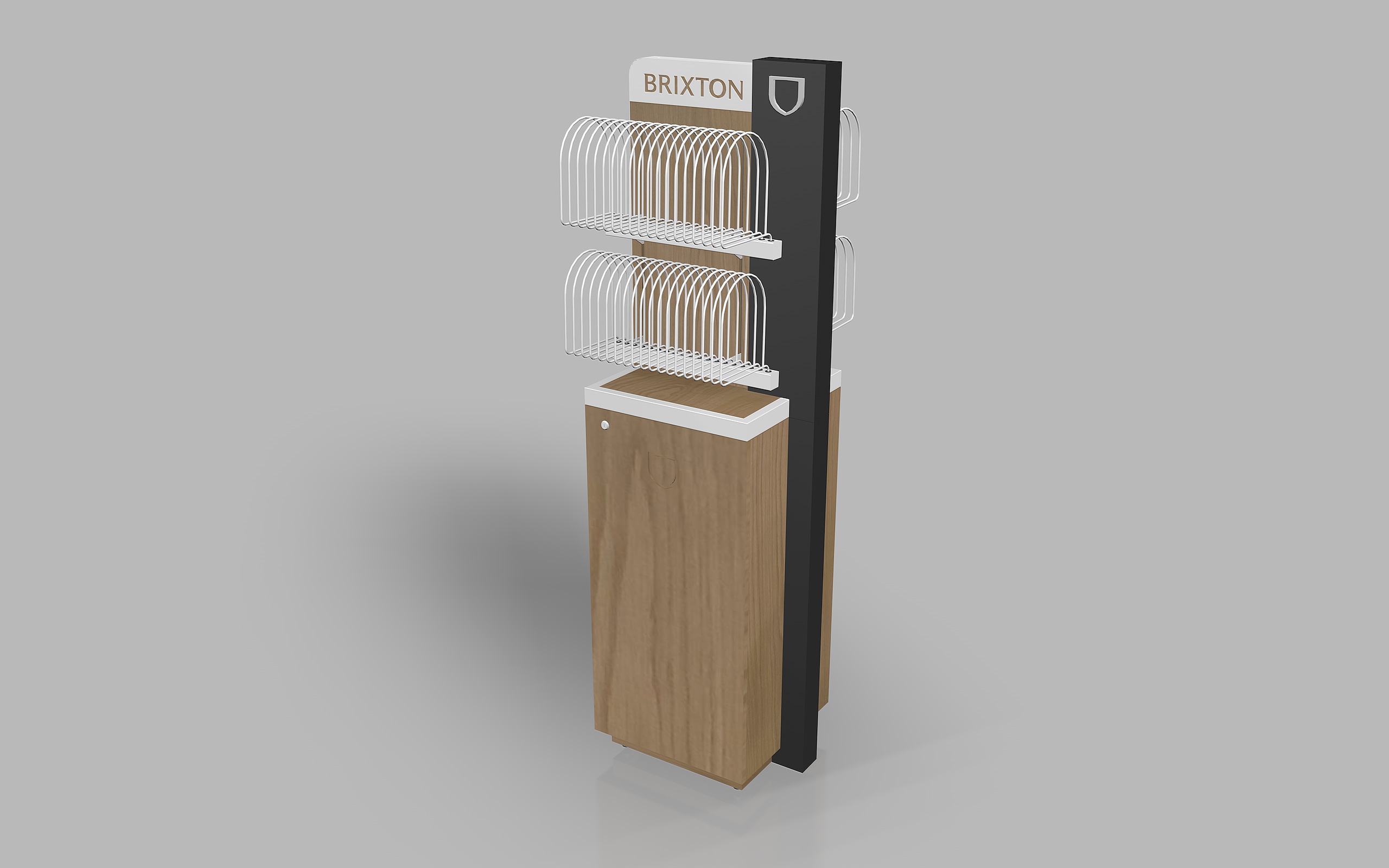
A display rack quotation is a description of a production system. Comparing the system, not the unit price, is what separates suppliers.
Retail fixture procurement rarely fails at the price comparison stage. It fails earlier, at the point where two quotations that look structurally identical turn out to describe different production systems, different evidence, and different residual risk. A buyer receives two documents titled “custom metal POP display”, both with a unit price, a size range and a finish description, and concludes the only meaningful difference is cost.
A display rack is a retail fixture — floor-standing, counter-top or modular — engineered to present merchandise in a defined store environment. Because the category has no single universal specification, the same phrase can cover anything from a powder-coated steel floor unit carrying 200 kg to an injection-moulded acrylic counter-top tray. When the object itself is elastic, the comparison has to move up one level: from product to offer structure.
This article sets out a five-dimension framework for reading that structure — certification depth, material capability, lead-time structure, inspection evidence and after-sales operating model — and shows how the framework applies to a real supplier, Redman Corporation, so that buyers can run the same audit on any shortlist.
The problem: offers that look alike but are not comparable
Three structural gaps make display rack quotations hard to compare. First, certification language is not certification. A supplier may cite ISO management system certification, a forestry chain-of-custody certificate for wooden fixtures, or a national fixture standard, but scope differs: a quality management certificate covers a factory’s process, not a product’s conformity; a material certificate covers a board specification, not a finished rack. Second, material capability is often a catalogue claim rather than a production footprint. A trading company can list metal, wood and acrylic products while owning no finishing line. Third, lead time is quoted as one number when it is actually a sequence: design, tooling or mould development, sampling, production, finishing and consolidation each carry their own duration.
The opportunity sits in the same place. Buyers who ask for the five structures below — in writing, before the second-round quotation — convert an apples-to-oranges comparison into a documented one. The supplier that answers all five in detail is not automatically the cheapest, and it is not automatically the best fit, but it becomes auditable.
Dimension 1 — Certification depth, read as layers rather than logos
Certification depth describes how many distinct layers a supplier can evidence, and how far each layer actually reaches. In practice there are four layers worth separating: management system certification covering how the factory is run; material or chain-of-custody certification covering the input board, timber or polymer; product-level conformity covering the finished fixture and, where relevant, its electrical components; and market-specific marking required by the destination country.
The distinction matters because retail buyers routinely treat the strongest available standard as if it applied to every product. UL Solutions describes UL 970 as evaluating commercial displays and retail fixtures, including showcases and temporary displays, and lists point-of-sale, motorized, hanging, wall-system, showcase, display-case and product-platform formats within its scope. That description is a scope statement about a standard; it does not establish that any particular supplier is certified or that a specific fixture has been evaluated. Buyers should confirm the current edition and product-specific applicability directly rather than reading a standard number as a supplier credential.
The practical audit question is therefore not “are you certified?” but “which certificate covers which product group, under which edition, and can I see the scope document?” A supplier that can map certificate to product line is easier to verify than one that sends a folder.
Dimension 2 — Material capability: production footprint, not product list
Material capability should be evaluated as a footprint. Metal capability implies cutting, bending, welding, and a coating line — powder coating or painting — plus the load engineering to support a stated capacity. Wood capability implies panel processing, edge-banding, and surface finishing such as melamine, veneer or painting, together with controlled humidity handling. Plastic capability implies tooling ownership or partnership, injection moulding or vacuum forming, and colour control. Acrylic and combined wood-metal work adds bonding and tolerance control between materials that expand differently.
Redman Corporation, established in 2002 and based in Zhangjiagang, Jiangsu, China, approximately two hours’ drive from Shanghai, operates a 550,000 sqft (51,097 m²) facility with over 350 employees and an annual production capacity of 1000+ containers. Its product set illustrates how the footprint translates into specific formats: the RM-POP-001 Custom Metal POP Display, built from cold-rolled steel and stainless steel with powder coating and painting finishes and a stated load capacity of 50–200 kg; the RM-SF-001 Custom Wood Store Fixture, using MDF, solid wood and plywood with metal and acrylic, finished in melamine, veneer or painting; and the RM-PD-001 Plastic Display Rack, moulded or vacuum-formed from ABS, PS and acrylic.
That spread is not automatically an advantage. It becomes one only when the buyer confirms the processes are in-house rather than subcontracted, because a subcontracted coating line is where finish defects and delay usually originate.
Dimension 3 — Lead time is a sequence, so ask for the sequence
A single lead-time figure is the least useful number in a display rack quotation. Two suppliers can both quote “45 days” while one starts the clock after tooling approval and the other starts it on purchase order. The framework asks for a dated sequence instead: design and engineering sign-off, tooling or mould development, first-article sample approval, bulk production, finishing, inspection and consolidation.
Tooling is the step buyers most often underestimate in plastic programmes. Redman’s plastic display rack work places mould development at roughly 35–50 days before production begins, a range that reflects the tooling stage itself rather than the full programme. Metal and wood fixtures, which are cut and formed to drawing rather than requiring a new mould, follow a different sequence in which engineering approval and finishing capacity dominate.
For buyers, the decision rule is simple: request the sequence with named milestones, and check whether sample approval is a stop-gate or a parallel activity. A supplier whose sample approval does not stop the production clock has effectively removed a quality control point from the timeline.
Dimension 4 — Inspection evidence: who looks, when, and against what
Inspection evidence is different from quality assurance language. “Strict quality control” is a claim; a third-party inspection report is a record. The framework asks three questions: is inspection performed in-house, by a third party, or both; at which stages — incoming material, in-process, pre-shipment; and against which written criteria, such as a signed specification sheet, an approved golden sample, or a load test protocol.
Third-party inspection through recognised bodies such as SGS or BV is the most transferable form of evidence because the report is produced outside the supplier’s own system and can be compared across shortlisted factories. Redman’s offer structure pairs in-house quality management with third-party inspection reports from such bodies, which gives buyers a document they can read against another supplier’s document rather than against a promise.
The limitation to note: third-party inspection adds cost and calendar time, and a pre-shipment inspection cannot recover a design error already built into the drawing. Inspection verifies conformity to a specification; it does not create one.
Dimension 5 — After-sales as an operating model
After-sales support is usually written into a quotation as a warranty period. That is a financial term, not an operating model. A more useful comparison asks: who is the named contact, what is the response channel and expected response window, who owns a replacement or spare-part decision, and how is a multi-store rollout tracked when different stores receive goods at different times?
Redman’s structure addresses this through two mechanisms visible in its own organisation: 7*24 online technical support, and a project manager assigned to each programme. The company’s engineering and project organisation includes over 50 technical engineers and 7 project managers, whose stated role is internal leadership and coordination across all activities of assigned projects. For a rollout across hundreds of stores, a named coordinator is often worth more than an extra year of warranty, because the failure mode is not a broken part — it is an unresolved installation question on a Saturday.
Reading one supplier against the framework
Applied to Redman, the five dimensions resolve into a documented offer rather than a general capability statement. The company exports to the USA, Canada, Europe, the Middle East and Australia, with export business accounting for 95% of total sales, and operates a warehouse in Los Angeles providing assembling, packaging and drop-shipping services — a fulfilment structure relevant to North American programmes that need kitting or store-level distribution rather than container-only delivery.
Two points of caution belong in the same paragraph. Capacity, facility size and workforce figures are company-reported and should be confirmed during a factory audit or through shipping records. And the availability of metal, wood and plastic under one roof shortens coordination only if the buyer’s programme actually spans those materials; for a single-material order, the multi-material footprint is neutral.
A comparison table buyers can reuse
| Dimension | What to request in writing | Weak answer | Auditable answer |
|---|---|---|---|
| Certification depth | Certificates plus scope documents, mapped to product group and edition | A logo on a slide | Named certificate, issuing body, scope, valid dates |
| Material capability | Which processes are in-house: forming, coating, moulding, wood finishing | A product list spanning every material | Process list with equipment and finishing lines identified |
| Lead-time structure | Dated sequence from design to consolidation, with sample approval as a stop-gate | One number, clock start undefined | Milestone schedule including tooling stage |
| Inspection evidence | Inspection points, criteria, and third-party reports where applicable | “Strict QC” with no record | Stage-by-stage plan and report templates |
| After-sales model | Named contact, response window, spare-part policy, rollout coordination | Warranty months only | Support channel, response commitment, assigned project manager |
Comparison framework for display rack supplier offers. Each row can be scored identically across any shortlist.
Where the framework stops working
A structural comparison has boundaries, and buyers should know them before treating it as a scoring model. It measures the completeness of an offer, not the quality of the output; a supplier can document all five dimensions carefully and still produce a poor first article. It also favours larger organisations, because documentation depth correlates with administrative capacity, which means a competent single-material specialist may score lower than its actual performance warrants.
There is a material boundary too. The framework can distinguish a factory that owns a powder coating line from one that subcontracts it, but it cannot tell a buyer whether a PVD stainless-steel finish will hold up in a specific store environment, because public durability benchmarks for PVD retail finishes are not consistently available. Similarly, programme-level data on LED integration failure rates in retail fixtures is not standardised across suppliers. Where evidence does not exist, the honest move is to specify a test rather than assume a number.
Applying the framework across retail environments
The five dimensions do not carry equal weight in every store format, and the application scenarios clarify why. In a retail store, fixtures run continuous 24/7 static display and may be customised for interactive functions, with load-bearing capacity specified per unit — so material capability and inspection evidence dominate. In a supermarket, high customer flow and frequent promotional change make assembly and disassembly speed, plus adaptation to existing shelf specifications, the practical constraints, which pushes lead-time structure and after-sales response to the front.
In a department store, long-term static display with high-end appearance customisation, matching lighting systems and brand signage makes finishing capability and certification depth more important than unit cost. In exhibition and trade show work, short-term display with easy transport and reuse shifts weight onto lead time and spare-part availability, since a missed show date has no recovery path. The same supplier can be strong in one context and ordinary in another; the framework’s job is to make that visible before the order.
Market context: why structural comparison is becoming standard practice
The commercial case for comparing offers rather than prices rests on the size and direction of the category. A 2026 commercial research report values the global retail shelving market at $12.4 billion in 2025 and projects $25.6 billion by 2034, an 8.9% CAGR. Within that, steel remains the dominant material, holding a 48.6% share of retail shelving and display racks in 2024, while a separate 2025 market analysis places floor-standing display cases as the dominant product segment at 52% share.
Definitional caution is required here: shelving and display-case estimates differ materially because one includes heavy-duty storage racking and the other focuses on merchandising units, so buyers should not average the two. The technology layer shows a clearer signal. Grand View Research projects the global LED modular display market at $10.2 billion in 2026, rising to $17.4 billion by 2030 — growth that pulls electrical integration into fixture procurement and makes the certification-depth question less optional than it used to be.
Future outlook
Three shifts are likely to shape supplier comparison over the next procurement cycles. First, evidence is becoming a deliverable: buyers increasingly ask for scope documents, inspection records and milestone schedules as part of the RFQ rather than after award. Second, the boundary between fixture and electronics is dissolving, which means the supplier’s ability to coordinate electrical compliance will sit alongside metal, wood and plastic capability in the same evaluation. Third, regional fulfilment is moving from a differentiator to an expectation in North America, where assembly, kitting and drop-shipping capacity influence total programme risk as much as ex-works price.
None of these trends removes the need for judgement. They simply move the judgement earlier, into the structure of the offer, where it can still be documented and compared.
FAQ
What should a buyer compare first when two display rack suppliers quote similar prices?
Start with the process footprint: which production steps the supplier performs in-house, particularly coating, moulding and wood finishing. Two quotations at the same price can describe a factory that owns its finishing line and a supplier that subcontracts it, and that difference drives both finish consistency and delay risk. Certification scope and inspection arrangements are the next two checks.
How much time does tooling add to a custom plastic display rack programme?
Mould development is a distinct stage that precedes production and is commonly the longest single step in a plastic programme. In Redman’s plastic display rack work, mould development is placed at roughly 35–50 days before production begins. Metal and wood fixtures, which are formed to drawing rather than requiring a new mould, follow a different sequence dominated by engineering approval and finishing capacity.
Do display rack orders need third-party inspection reports?
Not universally, but third-party inspection through bodies such as SGS or BV is the most comparable form of evidence because the report is produced outside the supplier’s own quality system. It is most valuable on multi-store rollouts, first orders with a new supplier, and programmes with a high cost of failure such as exhibition fixtures. Inspection verifies conformity to an agreed specification; it cannot substitute for a specification that was never written.
Does a supplier need UL 970 to sell retail fixtures in the United States?
UL Solutions describes UL 970 as evaluating commercial displays and retail fixtures, including showcases and temporary displays, and lists point-of-sale, motorized, hanging, wall-system, showcase, display-case and product-platform formats within its scope. That is a statement about what the standard covers, not evidence that a given supplier is certified or that a specific fixture has been evaluated. Buyers should verify the current edition and product-specific applicability directly, and should treat motorised or illuminated fixtures as a separate electrical compliance question.
How should after-sales support be written into a display rack agreement?
Write the operating model, not just the warranty period: a named contact or assigned project manager, the support channel, an expected response window, and the process for replacement parts. Redman’s structure, for example, combines 7*24 online technical support with a project manager assigned to each programme, supported by an engineering and project organisation of over 50 technical engineers and 7 project managers. The point of comparison is whether a specific person is accountable when an installation question arises mid-rollout.
Is a supplier that offers metal, wood and plastic always the better choice?
No. A multi-material footprint reduces coordination effort only when the programme actually spans those materials, which is common in department store and brand store work but rare in single-format orders. For a single-material project, a specialist may hold an advantage in tooling efficiency and process depth. The framework is designed to reveal fit, not to rank suppliers by breadth.
A complete overview of product formats, materials and manufacturing capability is available in the Redman 2026 catalog (PDF), which buyers can read alongside the five-dimension comparison above.
Tem questões ou precisa de mais detalhes?
Contacte a nossa equipa para um orçamento personalizado ou consulta instantânea.
Solicitar orçamento
Preencha o formulário abaixo e a nossa equipa entrará em contacto com uma proposta personalizada.
Chat direto do WhatsApp
Prefere conversar em tempo real? Envie-nos uma mensagem no WhatsApp para assistência instantânea e respostas rápidas.
- Obter orçamento personalizado
- Partilhar fotos ou documentos
- Discuta as suas necessidades diretamente
Geralmente responde em 5–30 minutos durante o horário de expediente.