
Comparing High-Density LED Strips Beyond Price per Meter
Decision Framework · High-Density LED Strip
A weighted scoring method for 24V high-density configurations, using CA-DC24V-2835-180D-8mm-3000K as the reference baseline for density, board width and colour-temperature trade-offs.
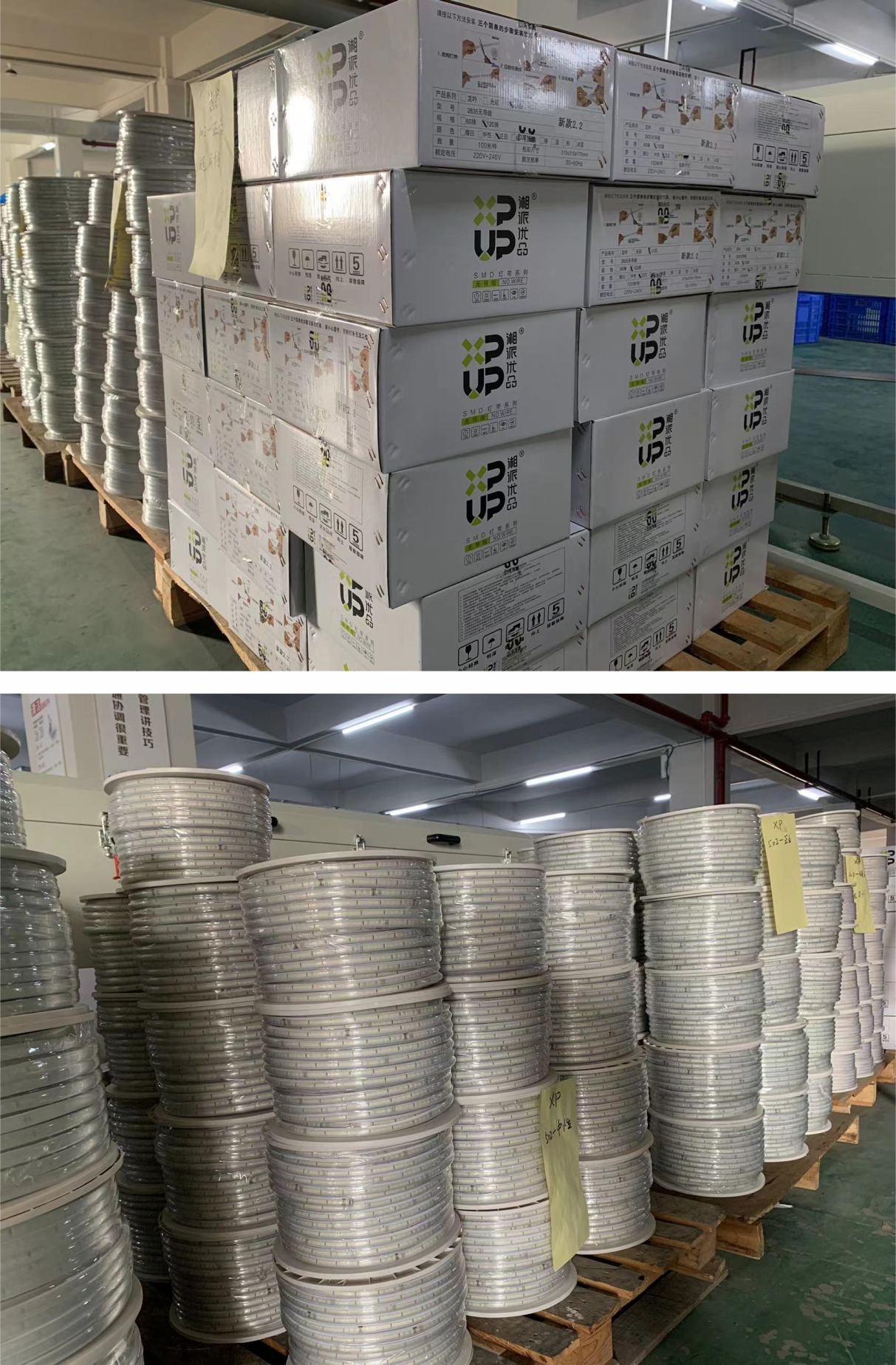
High-density LED Strip Light is usually compared on price per meter first. Emitter density, board width and colour consistency decide the installed result.
Price per meter is a filter, not a comparison. In a shallow aluminium channel or an acoustic panel reveal, the visible outcome — a continuous line of light or a row of dots — is determined by emitter pitch, board construction and colour consistency between reels. A quotation expressed only as cost per meter collapses those variables into a single figure and makes two physically different products look interchangeable to a procurement team reading a spreadsheet.
The mainstream specification has moved into exactly the class where this problem is most expensive to get wrong. High-density strip variants above 120 LEDs per meter accounted for nearly 19% of premium installations in 2025, according to Business Research Insights market reporting. Grand View Research data on the linear LED strip fixture market placed the 24V segment at 52.0% of revenue and the 3000K–4000K colour band at a 33.2% revenue share. Dataintelo put commercial applications at roughly 33.8% of global LED strip revenue in 2024. Dense, warm-white, low-voltage strip is no longer a premium niche; it is the default language of interior specification.
That creates both a problem and an opportunity for buyers moving from evaluation into execution. The problem is that quotations arrive in incompatible formats, so price per meter becomes the only common denominator. The opportunity is a weighted score agreed before quotations are requested: suppliers then answer the same eight questions in the same order, and the buyer compares evidence rather than sales structure. The framework below is built around one reference product, XPUP LED's CA-DC24V-2835-180D-8mm-3000K, because a baseline is what makes a comparison repeatable.
Why a per-meter price stops describing the product
LED Strip Light is sold by the meter because it is installed by the meter, so unit price becomes the natural comparison point in B2B purchasing. Yet two reels quoted at the same price per meter can differ in diode count per meter, board width, colour binning discipline, ingress-protection class, test regime, minimum order quantity and lead time. None of those differences appear in the quotation line, and all of them appear after installation.
For a buyer at the evaluation stage, the practical consequence is that a low unit price carries unpriced decisions. If a 120 LEDs/m strip is substituted for a 180 LEDs/m strip in a 12 mm-deep reveal, the savings on the invoice are paid for in visible scalloping, which is a rework cost, not a lighting cost. Conversely, paying for maximum density where the channel is deep and the diffuser sits far from the board is equally misallocated, because density beyond that point changes the invoice without changing the appearance.
A comparison method therefore has to do two things that price per meter cannot: separate what is visible (density, colour point, diffusion distance) from what is structural (board build, ingress class, control compatibility), and put both into a format that suppliers can answer with documents.
The reference baseline: reading CA-DC24V-2835-180D-8mm-3000K
CA-DC24V-2835-180D-8mm-3000K is a LED Strip Light model from XPUP LED, the brand of Zhongshan Xiangpai(XPUP) Lighting Technology Co., Ltd., a manufacturer established in 2012 in Zhongshan, China, producing LED strip and linear lighting for EU and US markets. The model string states the specification directly: 24V DC input, 2835 SMD emitters, 180 diodes per meter, an 8 mm board width, and a 3000K colour temperature.
Density is the variable that converts least easily into a visual judgement, so it is worth translating into pitch. At 180 emitters per meter, the average spacing between emitters is roughly 5.6 mm (1,000 mm divided by 180). At 120 emitters per meter the equivalent spacing is roughly 8.3 mm. That difference of about 2.7 mm per gap is what a shallow channel with a close diffuser makes visible; it is also the part of the specification that a price-per-meter comparison ignores entirely.
| Model | Emitter type | Density | Board width |
|---|---|---|---|
| CA-DC24V-2835-180D-8mm-3000K | 2835 SMD | 180 LEDs/m | 8 mm |
| XP-C818DC24V-2835-120D-8MM | 2835 SMD | 120 LEDs/m | 8 mm |
| XP-BD18DC24V-2835-140D-8MM | 2835 SMD | 140 LEDs/m | 8 mm |
| XP-D4DC24V-2835-192D-8MM | 2835 SMD | 192 LEDs/m | 8 mm |
| G10-DC24V-2835-182D-8mm | 2835 SMD | 182 LEDs/m | 8 mm |
| B7-DC24V-2835-180D-10MM | 2835 SMD | 180 LEDs/m | 10 mm |
| XP-B7DC24V-2835-240D-10MM | 2835 SMD | 240 LEDs/m | 10 mm |
| XP-D5DC24V-3535-120D-8MM | 3535 SMD | 120 LEDs/m | 8 mm |
| XP-D6DC24V-5050-60D-10MM | 5050 SMD | 60 LEDs/m | 10 mm |
| XP-CH1DC24V-2025-280D-8MM | COB | 280 LEDs/m | 8 mm |
| XP-CH2AC220V-2025-240D-8MM | COB, AC high voltage | 240 LEDs/m | 8 mm |
Configurations documented in XPUP LED product and certification records. Density and board width are the two variables that most often change the installed appearance.
Two rows in that table are worth pausing on. B7-DC24V-2835-180D-10MM carries the same 180 LEDs per meter as the baseline model on a 10 mm board, which shows that board width is an independent decision rather than a rounding of density. And the COB entries — XP-CH1DC24V-2025-280D-8MM on 8 mm, XP-CH2AC220V-2025-240D-8MM as an AC high-voltage variant — represent a different construction approach, not simply a higher number in the same column.
The comfort side: 3000K is a specification and a judgement
A 3000K colour temperature is a standardised number, but the perception of warmth is not. At equal nominal colour temperature, perceived comfort shifts with spectrum, with binning consistency between reels, and with the surface the light lands on. A scoring matrix can weight colour-point consistency and documentation; it cannot score "comfortable". That part requires a sample tested inside the actual channel, at the actual diffuser distance, under the project's ambient light — which is why the evaluation stage and the execution stage of a high-density order are separated by a physical mock-up.
Where colour accuracy is a project requirement rather than a preference, the rendering target should be stated in the enquiry instead of assumed. XPUP's documented supply record includes CRI 90+ and COB LED strip supplied to French residential lighting distributors at 80,000 m per year, and the company's production model is built around rapid sampling ahead of mass production for brand and engineering customers.
There is a practical sequencing point here that price-led comparisons tend to skip. Colour decisions need to be locked before density is finalised, because the two pull in different directions: a denser board in the same width concentrates heat and narrows the options for emitter choice, while a warmer, higher-rendering target usually means accepting a different emitter or a different board layout. Buyers who finalise density first and colour second often end up re-sampling.
The density side: 180 diodes per meter and the hotspot question
Hotspotting is a geometry problem before it is a photometric one. In a shallow aluminium profile the diffuser sits close to the board, and the closer it sits, the more the emitter pitch reads as scalloping along the line. Density is the most direct lever against that effect, which is why a 180 LEDs/m board at roughly 5.6 mm pitch behaves visibly better in a shallow reveal than a 120 LEDs/m board at roughly 8.3 mm.
The obvious follow-up question — why not always specify the highest density available — has a structural answer. More diodes on the same 8 mm board means more solder joints per meter and a tighter thermal concentration, so the board build has to be verified rather than assumed. Where a reveal is very shallow and the output requirement is high, a COB construction such as XP-CH1DC24V-2025-280D-8MM removes dotting by design through a continuous emitting line, which shifts the comparison onto other criteria instead of ending it. In practice the decision rule is to match density to channel depth and diffuser distance, then treat 180 LEDs/m as the baseline for shallow-to-medium reveals in covered indoor work.
The scoring matrix: eight criteria, one hundred points
The table below is calibrated for covered indoor architectural work at 3000K. Weights are project-dependent; the point of writing them down before quotations arrive is that every supplier is then scored on the same basis, and the buyer can see which criteria are documentation-led (verifiable before ordering) and which are not.
| Criterion | Weight | What to verify | Weak vs strong evidence |
|---|---|---|---|
| Emitter density and pitch | 20 | Diodes per meter and board width against channel depth | Weak: density not stated per model. Strong: density and width stated per model code |
| Colour point consistency | 15 | Nominal CCT, binning discipline between reels, sample approval | Weak: "warm white". Strong: 3000K fixed in model code plus approved sample |
| PCB build and thermal path | 15 | Board material, dimensions, internal circuit, hardware configuration | Weak: "high quality PCB". Strong: board variables written into the order specification |
| Ingress class vs installation zone | 10 | IP rating of the exact model against dry covered, damp or outdoor use | Weak: rating inferred from the family. Strong: rating confirmed per model in writing |
| Control and dimming compatibility | 10 | Dimming behaviour, driver pairing, flicker performance at low output | Weak: "dimmable". Strong: documented dimming performance in a comparable project |
| Compliance documentation | 10 | CE LVD, EMC and RoHS certificate numbers covering the quoted model | Weak: certificate image without a number. Strong: certificate number and standard list per model |
| Quality regime and warranty | 10 | Testing coverage, pre-shipment acceptance, warranty term, technical support | Weak: "strict QC". Strong: 100% test, defined acceptance criteria, stated warranty |
| Supply and customisation fit | 10 | MOQ, lead time, monthly capacity, OEM/ODM scope | Weak: verbal flexibility. Strong: documented MOQ, lead time and customisation list |
Scoring method: rate each criterion 1–5 per quotation, multiply by the weight, and compare totals. Criteria 3, 6, 7 and 8 can usually be resolved before an order is placed; criterion 2 cannot.
PCB quality: the criterion most often scored with adjectives
Board construction is where the phrase "high quality PCB" appears in almost every quotation and where almost no quotation contains evidence. The verifiable version of that claim is narrower and more useful: board width, board material, internal circuit design and hardware configuration. XPUP's OEM customisation scope explicitly lists dimensions, materials, internal circuit and hardware configuration among the variables that can be specified per order, which means these are engineering parameters in the transaction rather than marketing descriptors.
Board width carries a real engineering consequence that buyers should raise in the enquiry. An 8 mm board fits shallow channels that a 10 mm board cannot enter, but the narrower board carries less copper, so long single-feed runs need a layout review — feeding from both ends or introducing intermediate feeds is a layout decision, not a product defect. Where the channel allows 10 mm, a model such as B7-DC24V-2835-180D-10MM keeps the same 180 LEDs/m density on a wider board and gives the layout more room.
Process evidence belongs in the same criterion. XPUP documents 100% testing, pre-shipment testing as the acceptance criterion, a 2-year standard warranty, and remote technical support and debugging as after-sales scope. Those are checkable commitments, and they are what separates a PCB claim from a PCB specification.
Ingress protection and installation zone
Ingress protection is the criterion most often inherited by assumption. IP20-class strip is the unprotected class intended for dry, covered interior installations: acoustic panel reveals, coves, cabinetry with a diffuser, and linear details inside a conditioned building envelope. It is not intended for exposed, damp or outdoor locations, where a sealed IP68-class construction applies. The framework treats the rating as a match-to-zone question first and a product question second.
XPUP's documented project record illustrates both ends of that range. Acoustic panel LED strip work in premium residential projects in Germany and Italy (20,000 m per year over three years) sits in the covered indoor category and links directly to the CA reference model in the product records. At the other end, IP68 waterproof strip has been supplied for commercial façade lighting in the Netherlands (30,000 m) and for outdoor elements of a US luxury residential project (15,000 m per year). The same supplier, two different classes, two different installation zones — which is exactly why the criterion should be scored per model and not per supplier.
Compliance documentation inside the score
Compliance is one of the few criteria a buyer can fully resolve before committing, so it deserves a fixed weight rather than a checkbox at the end. XPUP's LED low-voltage and high-voltage light strip series hold CE certification covering LVD, EMC and RoHS, issued by PTC TESTING.
The LVD certificates are PTC22122900901S-LD01 and PTC22122900902S-LD01, issued 4 April 2023 against EN IEC 62031:2020+A11:2021, IEC TR 62778:2014 and EN 62471:2008. The EMC certificates are PTC22122900901E-EMB01 and PTC22122900902E-EMB01, issued 9 March 2023 against EN IEC 55015:2019+A11:2020, EN 61547:2009, EN IEC 61000-3-2:2019+A1:2021 and EN 61000-3-3:2013+A1:2019. The RoHS certificates are PTC22122900903C-EN01 and PTC22122900905C-EN01, issued 23 April 2023 against the IEC 62321 series, from IEC 62321-1:2013 through IEC 62321-8:2017.
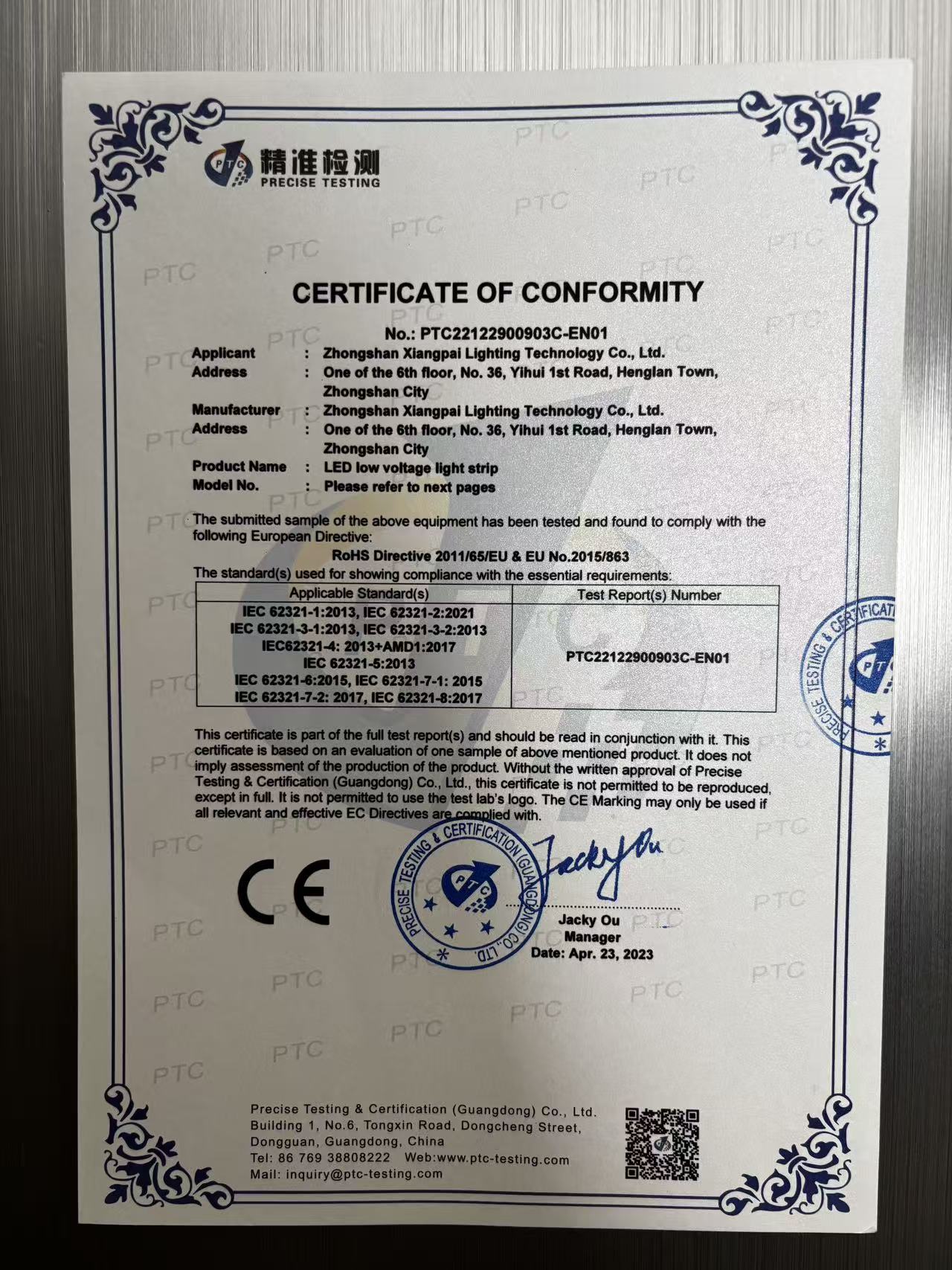
Certificate numbers, issue dates and the standards list are the verifiable part of a compliance claim; buyers should confirm which number covers the exact model being quoted.
Two reference points are useful when a quotation is destined for a specific market. In the United States, low-voltage 12V/24V LED strip is classified under the safety standard UL 2108, and UL 1598 covers luminaires installed in storage areas relevant to certain household strip applications. Internationally, IEC 60598-2-20:2022 specifies safety requirements for lighting chains including LED strips. The scoring question is not whether a supplier mentions compliance, but whether the certificate number, the standard list and the model in the quotation line up.
What the framework changes in practice
Acoustic panel reveal in a hospitality corridor
This is the case the baseline model was built for: covered indoor installation, 3000K required for warmth, a shallow reveal where the diffuser sits close to the board. Density and colour consistency carry 35 of the 100 points and both must be evidenced. Ingress class, control compatibility and compliance documentation can each be closed with a document, and PCB build is confirmed through the order specification rather than through a phrase in the quotation. A supplier quoting 35% below the field on density alone will usually lose points on criteria 3, 6 and 7, which is precisely the outcome a weighted score is designed to produce.
Very shallow reveal with high output
When diffuser distance cannot be increased, a COB configuration such as XP-CH1DC24V-2025-280D-8MM at 280 LEDs/m and 8 mm width changes the comparison basis: dotting is addressed by construction rather than by pitch, so the weighting shifts towards control behaviour, thermal layout and cost of ownership rather than emitter count.
Exterior or wet zone
The baseline model does not apply. The relevant comparison is between sealed constructions, and the framework's ingress criterion moves from 10 points to a pass/fail gate before any other criterion is scored.
Programme volume and repeat supply
For brand owners and distributors, criteria 7 and 8 decide whether a technically correct specification can actually be delivered on schedule. XPUP documents a minimum order quantity of 2,000 m, a typical production lead time of 18–22 days, monthly capacity of 3,000,000 m, and payment terms of 30% deposit with the balance before shipment under FOB or CIF delivery. Documented programmes include ODM private-label supply to a US lighting brand at 300,000 m per year over three years and a complete product range with customised retail packaging for a German DIY retail chain at 100,000 m per year. Those figures are the reason supply terms sit inside the score instead of being negotiated afterwards.
Market direction: what the verified data supports
Three measurable trends support treating high-density comparison as a procurement discipline rather than a design preference. First, density is rising in the installed base: high-density variants above 120 LEDs/m accounted for nearly 19% of premium installations in 2025, per Business Research Insights, and COB LED technology is projected to grow at a CAGR of 18.9% between 2024 and 2031 according to Cognitive Market Research. Second, the specification centre of gravity is 24V and warm white: Grand View Research placed the 24V segment at 52.0% of linear LED strip fixture revenue and the 3000K–4000K band at 33.2%. Third, the compliance burden is increasing rather than stabilising — energy-efficiency requirements under the EU Ecodesign and ErP framework are part of the Green Deal path to net-zero by 2050, and EU requirements are cited as driving a 55% shift toward LED-based systems.
The economics behind that shift are documented as well: LED strips consume nearly 70% less power than traditional incandescent lighting systems, and quality strip is rated for roughly 30,000 to 50,000 hours of life, per Business Research Insights. On the control side, wired smart LED installations held 81.3% of the global smart lighting market in 2024 according to Grand View Research, and smart features such as Wi-Fi and Bluetooth integration reached a 47% adoption rate in LED strip systems. The procurement implication is consistent: as density and integration rise, the documentation a supplier can produce per model becomes as decisive as the model itself.
Limits of the framework and honest boundaries
A scoring matrix produces confident answers, including confident wrong ones, if the weights are wrong. A retail programme optimised for landed cost and packaging will not weight PCB build at 15 points; a hotel corridor renovation will not weight it at 5. The weights must be set per project before quotations are opened, and they should be written down, because retrofitting weights after prices are known defeats the method.
Second, the comfort half of the comparison cannot be resolved on paper. Colour perception at 3000K depends on the sample, the diffuser and the surrounding materials, so a physical mock-up is a required step rather than a formality; production lead time of 18–22 days means sample approval and programme scheduling have to be planned together.
Third, order economics set a floor on who this framework serves. A 2,000 m minimum order quantity makes direct factory orders uneconomic for single-room mock-ups, so small projects are usually better served through distributors even when the specification is identical.
Fourth, density is not a substitute for thermal design. An 8 mm board carrying 180 diodes per meter needs the layout review described earlier, and a specifier who treats higher density as automatically better will eventually meet a channel where the thermal path, not the pitch, is the limiting factor. Finally, this framework is built around the configurations documented in the XPUP LED range — SMD 2835, 3535 and 5050, COB in 24V and AC high voltage, from 60 to 280 diodes per meter. Projects requiring specialist spectral output such as UV fall outside it; specialist and tunable-white strip represent approximately 11% of industrial and healthcare lighting demand according to Business Research Insights, and that demand needs its own criteria set.
Future outlook
Two directions look durable. The first is denser, warmer, lower-voltage specification in interior architecture: with more than 65% of new architectural lighting installations in 2025 using LED strip technology, per Business Research Insights, the shallow-reveal detail is becoming a standard construction element rather than a designer's exception, and standard details demand standard comparison methods. The second is documentation as a competitive surface. As EU efficiency rules tighten and destination-market safety standards are applied more consistently, the supplier who can attach a certificate number, a board specification and a test regime to a specific model code will win evaluations that a price-led supplier cannot enter.
For buyers moving from evaluation to execution, the practical translation is unglamorous: lock colour first, size density to the channel, write the board variables into the order, resolve ingress class per zone, and score compliance and supply before negotiating price. Price per meter remains the last line of the comparison, not the first.
FAQ
What should buyers compare instead of price per meter for high-density LED strip?
Compare eight documented criteria: emitter density and pitch, colour-point consistency, PCB build and thermal path, ingress class matched to the installation zone, control and dimming compatibility, compliance documentation, testing and warranty, and supply terms such as MOQ and lead time. Each can be evidenced with a document or an approved sample, which is what makes the comparison repeatable across quotations.
How does 180 LEDs per meter change hotspot behaviour in a shallow channel?
At 180 emitters per meter the average emitter spacing is roughly 5.6 mm, against roughly 8.3 mm at 120 emitters per meter. In a shallow profile where the diffuser sits close to the board, the smaller gap reduces the scalloping that reads as a row of dots. Density does not guarantee uniformity on its own — diffuser distance, channel depth and colour consistency between reels also matter — and where the reveal is extremely shallow, a COB construction such as XP-CH1DC24V-2025-280D-8MM addresses dotting by design instead of by pitch.
Which PCB factors can actually be verified before ordering?
Board width, board material, internal circuit design, dimensions and hardware configuration are engineering variables that can be written into an order specification. XPUP's OEM customisation scope lists each of these as a customisable item, and the process side is documented as 100% testing with pre-shipment testing used as the acceptance criterion. Board width also has a layout consequence: an 8 mm board fits shallow channels but carries less copper than a 10 mm board, so long single-feed runs should be reviewed for feeding from both ends or intermediate feeds.
Is IP20 suitable for a covered indoor acoustic panel installation?
IP20-class strip is the unprotected class intended for dry, covered interior installations such as acoustic panel reveals, coves and cabinetry with a diffuser. It is not intended for exposed, damp or outdoor locations, where a sealed IP68-class construction is used instead; XPUP's documented projects include IP68 strip for commercial façade lighting in the Netherlands and for outdoor elements of a US residential project. Buyers should confirm the rating of the exact model on the datasheet rather than inferring it from the product family.
Can voltage, density, colour and packaging be customised, and what are the order terms?
XPUP's OEM scope covers voltage, logo, power, dimensions, materials, hardware configuration, internal circuit, colour, factory specifications, nameplate and label. ODM scope covers exterior colour scheme, outer packaging, label, brand information, model name and material details. Documented order terms are a minimum order quantity of 2,000 m, a typical production lead time of 18–22 days, monthly capacity of 3,000,000 m, FOB or CIF delivery, 30% deposit with the balance before shipment, and a 2-year standard warranty supported by remote technical guidance.
Reference material: the 2026 XPUP LED Strip Catalog is available as a public PDF download — 2026 XPUP LED Strip Catalog. Company and product documentation is published at xpupled.com.
Tem questões ou precisa de mais detalhes?
Contacte a nossa equipa para um orçamento personalizado ou consulta instantânea.
Solicitar orçamento
Preencha o formulário abaixo e a nossa equipa entrará em contacto com uma proposta personalizada.
Chat direto do WhatsApp
Prefere conversar em tempo real? Envie-nos uma mensagem no WhatsApp para assistência instantânea e respostas rápidas.
- Obter orçamento personalizado
- Partilhar fotos ou documentos
- Discuta as suas necessidades diretamente
Geralmente responde em 5–30 minutos durante o horário de expediente.