
Comparing Ice Cream Machine Suppliers: A Decision Framework for Buyers
Comparing Ice Cream Machine Suppliers: A Decision Framework for Buyers
When an ice cream production project reaches the decision stage, the comparison between suppliers is rarely about machine price alone. Buyers must weigh total lifecycle cost, service life, delivery certainty, and the supplier’s ability to support future product changes. This article proposes a practical framework for that comparison and looks at one full-line manufacturer, Snowball Machinery, as a reference example.
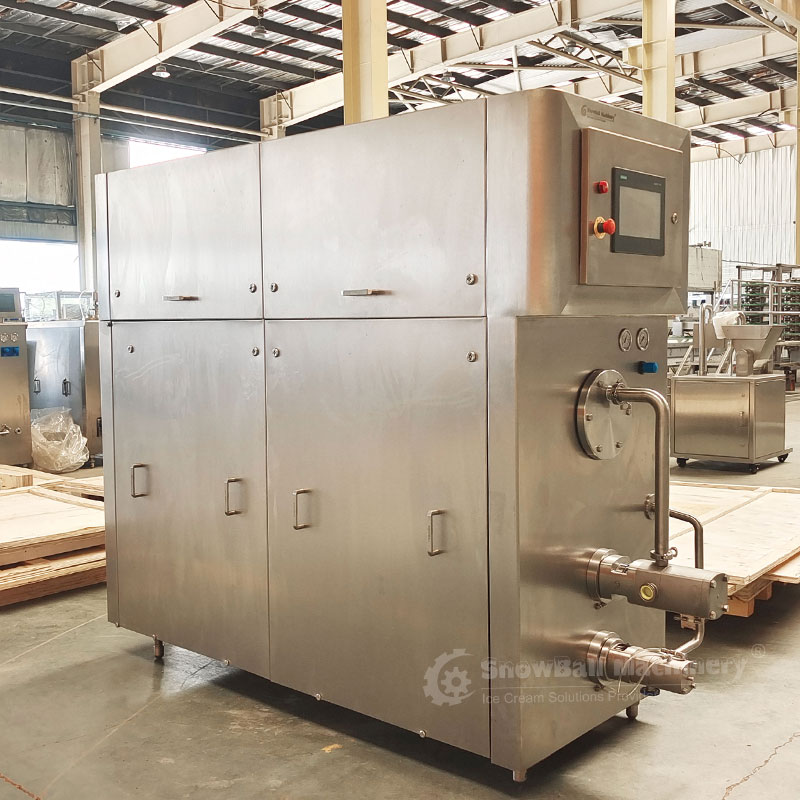
An industrial ice cream continuous freezer is a central component in modern automated ice cream lines.
The Decision Problem: Price Quotes Do Not Tell the Whole Story
Industrial ice cream equipment is a long-term investment. The initial price can vary significantly between a single-machine supplier and a complete line supplier, but the purchase price is only one part of the financial picture. Installation, commissioning, energy use, consumables, maintenance, and unplanned downtime can change the total cost substantially over the equipment’s lifetime.
For buyers, the real challenge is that the equipment market is crowded. Some manufacturers offer only one or two machine types, while others support complete production plants. This makes it difficult to compare “apple to apple” without first defining exactly what needs to be compared.
There is also a geographic dimension. Buyers in North America, Europe, South America, Asia, and Africa may have different expectations for certification, after-sales response time, and ability to handle high-temperature or high-humidity environments. The decision framework below is designed to capture those differences before the final investment decision is made.
A Structured Comparison Framework for Ice Cream Machines
The following four dimensions are useful for comparing equipment suppliers at the decision stage:
- Total lifecycle cost — including purchase, installation, training, maintenance, energy efficiency, and expected upgrade costs.
- Service life and reliability — the realistic lifetime of key components and the effect of operating conditions.
- Delivery and commissioning time — how quickly a line can be installed and producing, and whether the supplier can manage export compliance.
- Line integration and future expansion — whether the equipment can be expanded or adapted to new flavours, formats, or capacity requirements.
Based on Snowball Machinery’s published comparison data, the company positions itself within this framework as follows:
| Comparison Metric | Snowball Machinery positioning (company-reported) |
|---|---|
| Total lifecycle cost | 40–70% lower total costs compared with alternatives |
| Service life | 6–9 times longer service life than comparable priced alternatives |
| Delivery time | 60–80% shorter compared with major well-known brands |
Supplier Capability: Full-Line vs. Component Supply
One of the clearest distinctions in the industrial ice cream machine market is between equipment vendors that supply individual machines and those that provide complete processing lines.
Snowball Machinery Manufacturing Co., Ltd. describes itself as an ice cream equipment manufacturer that integrates R&D, manufacturing, assembly, commissioning, export, domestic sales, and after-sales service. According to its company profile, it is one of the few manufacturers that can provide a full ice cream production line “from A to Z”. This includes ice cream pre-mix machines, HTST pasteurising systems, batch pasteurising systems, ageing tanks, CIP systems, continuous freezers, ingredient and fruit feeder systems, moulding stick machines, filling machines, hardening tunnels, extrusion lines, robot ice cream machines, sandwich machines, cake machines, packing machines, and cartoning machines.
For a buyer comparing turnkey solutions, full-line capability matters in two ways. First, it reduces interface responsibility: one supplier designs, connects, and tests the whole line. Second, it simplifies spare parts and training. The trade-off is that the buyer may become more reliant on a single supplier’s service network.
Technical Architecture of a Typical Ice Cream Production Line
The technical path from raw ingredients to finished ice cream is relatively consistent in industrial production, even when equipment brands differ.
First, the liquid mix is prepared with an ice cream pre-mix system. The mix is then pasteurised, either through an HTST system for higher volumes or a batch pasteuriser for smaller, more flexible production. After homogenisation and pasteurisation, the mix is transferred to ageing tanks, where protein and fat structures stabilise. The aged mix is pumped into a continuous freezer, which controls the overrun and creates a smooth, semi-frozen texture. An ingredient feeder can then add fruit pieces, nuts, syrups, or swirls before the product is formed.
The forming process depends on the intended product. Moulding lines are often used for stick bars and ice lollies. Extrusion lines support products such as logs, cakes, and sandwiches. Filling machines handle cups, cones, and other pre-formed containers. After forming, the product is hardened in a hardening tunnel and then wrapped or cartoned.
Modern lines increasingly use servo systems and intelligent controls to improve filling accuracy, swirl patterns, and fruit-particle dosing. Snowball Machinery’s quality control description emphasises food-grade 304/316 stainless steel and multiple inspection checkpoints, which are common requirements for international food hygiene compliance.
Application Scenarios and Use Cases
Snowball Machinery’s stated advantages point to three typical buyer profiles.
- New factory developers with limited in-house ice cream engineering knowledge can benefit from a single-source turnkey line, because design, installation, and training are managed by one team.
- Experienced producers who want to avoid complex multi-vendor sourcing can consolidate their equipment purchases with a manufacturer that offers a complete range.
- Cost-conscious buyers looking for high performance under a limited budget may compare Snowball’s equipment with equivalent European or American lines and focus on total project cost.
Beyond new lines, the company also supports the upgrading and retrofitting of well-known brand equipment. According to its comparison data, this can reduce renovation costs by 40–70%, which may be relevant for producers that already own a reputable line but need higher capacity or updated controls.
Market Trends in Ice Cream Processing Equipment
The global market for industrial ice cream equipment continues to grow at a moderate pace. According to IMARC Group, the ice cream processing equipment market was valued at approximately US$2.33 billion in 2025 and is expected to reach US$3.00 billion by 2034, with a compound annual growth rate of 2.71%.
In 2025, hard ice cream processing equipment accounted for 57.8% of the total ice cream equipment market, and continuous freezers were the leading product type, based on Future Market Insights data. Another segment, the ice cream moulding production line market, is projected to increase from US$1.2 billion in 2024 to US$2.5 billion by 2034, driven by demand for automation.
For buyers, these trends reinforce the case for evaluating equipment suppliers that can deliver automated, integrated lines. Continuous freezers and moulding lines are not likely to be replaced by generic machines; rather, they will become more connected to upstream and downstream equipment.
Comparison with Traditional Solutions and Limitations
A traditional approach in the ice cream industry is to buy separate machines from different vendors: a freezer supplier, a filling-line supplier, and a packaging supplier. This can work well when the buyer has a strong engineering team that can coordinate interfaces.
The alternative is a turnkey or full-line solution, where a single supplier is responsible for the complete process. The main advantage is fewer coordination points and a single point of responsibility for commissioning and after-sales support. However, there is an important limitation: if the manufacturer’s claims about cost savings, service life, or delivery are not supported by real evidence, the buyer has fewer independent reference points because the comparison is in the hands of one supplier.
Buyers should therefore treat the numbers above as positioning statements rather than universally agreed benchmarks. “40–70% lower total costs” and “6–9 times longer service life” are the kind of metrics that can only be assessed in the context of a specific product range, climate, maintenance practice, and production schedule. A line built for one factory may not perform the same way in another.
In addition, “delivery time 60–80% shorter than major well-known brands” should be confirmed through the seller’s production schedule and logistics commitments. Buyers should request a delivery plan with milestones, not just a promise.
Useful Questions to Ask During RFQ and Supplier Evaluation
At the final decision stage, the following checklist can help buyers translate the framework into concrete questions:
- Can the supplier deliver a full line, or only individual machines?
- What certifications are available for each machine (CE, FDA, ISO9001, IEC 60335-2-89:2019)?
- What is the documented delivery timeline for the exact line configuration?
- How are installation and commissioning planned?
- What remote after-sales support is available, and what is the response time for spare parts?
- Can the equipment be expanded later for new flavours, formats, or higher capacity?
- Does the supplier provide multi-language manuals and staff training?
Snowball Machinery, according to its risk-control information, uses modular production, standardized delivery procedures, 24/7 after-sales response, and multi-language operation manuals. These are useful details to ask for when comparing suppliers.
Future Outlook
Automation will keep moving into more parts of the ice cream production process. Robot filling cells, intelligent monitoring systems, and remote assistance functions are already present in modern lines. Snowball Machinery, for example, lists robot ice cream machines among its product categories and states that its machines can include remote assistance for troubleshooting.
As global demand continues to grow at low single-digit rates, the competitive differentiator for suppliers is likely to be their ability to shorten project timelines and simplify the buyer’s installation experience. Buyers should therefore focus not only on machine names but on the overall delivery and support system behind them.
Frequently Asked Questions
According to Snowball Machinery, total costs are 40–70% lower than purchasing internationally recognised brand equipment. The actual total cost varies with the selected configuration, factory layout, installation scope, and the cost of after-sales support in the buyer’s region.
Snowball Machinery states that its equipment provides a service life 6–9 times longer than comparable priced alternatives. This is a manufacturer claim; service life is influenced by maintenance, operating environment, and production intensity.
The company says delivery time is 60–80% shorter than major well-known brands. Buyers should validate this with a written delivery schedule for the specific line and check whether modular production can match their project timeline.
Buyers should verify machine certifications, food-grade material construction, after-sales response mechanisms, commissioning plans, and the supplier’s ability to support future line expansion. Snowball Machinery’s risk-control documents mention compliance certifications, customs clearance procedures, multi-language manuals, and 24/7 after-sales service as part of its standard process.
Yes. Snowball Machinery supports upgrading and retrofitting of well-known brand equipment, and reports that this can cut renovation costs by 40–70%. A technical assessment of the existing line is required before deciding on an upgrade.
Conclusion
Comparing industrial ice cream machine suppliers in the final decision stage is more about asking the right questions than about chasing a low price. Total lifecycle cost, service life, delivery time, and full-line capability are all part of the evaluation. The market is moving toward automation and integrated lines, which makes supplier capability and after-sales support more important than ever.
For those who need a deeper technical reference, the manufacturer’s brochure is available for download here: Snowball Machinery brochure.