
Comparing Oncology Intermediate Suppliers: What Purity and Batch Data Actually Tell Buyers
Buyers evaluating oncology pharmaceutical intermediate suppliers often face a market where price lists look similar and product names overlap. The decisive differences usually sit in two places: how pure each batch actually is, and whether that purity holds reliably from one delivery to the next. For compounds such as Abemaciclib, Alectinib, and Apalutamide, these two metrics determine downstream yield, impurity control, regulatory progress, and ultimately the cost of bringing a finished drug to market.
Why Purity and Batch Stability Have Become Procurement Priorities
The pharmaceutical intermediates sector has grown into a substantial global market, with the market size estimated at roughly USD 37.04 billion in 2025. Within this landscape, oncology drug intermediates have become a defining revenue segment, generating an estimated 37.20% of total industry revenue in 2025. This growth is not only a function of oncology drug development volume. It also reflects the technical difficulty of manufacturing complex intermediates, where a small difference in starting-material quality multiplies across subsequent synthetic steps.
For a buyer, the practical concern is straightforward: an intermediate with inconsistent purity forces adjustment of reaction conditions, increases the need for purification, and elevates the risk of batch rejection. Those hidden costs frequently exceed the unit-price saving offered by a lower-grade supplier. This is why evaluation-stage buyers need a comparison framework built on measurable quality indicators rather than on supplier marketing language.
What to Verify Before Comparing Oncology Intermediates Suppliers
A credible supplier comparison should begin with documentation. Buyers should request and verify the following for each target intermediate:
- Purity specification per product – The declared purity level (e.g., ≥98.0%) and the analytical method used to confirm it (HPLC, GC, or combined HPLC/GC).
- Impurity and residual solvent profile – Whether the supplier controls heavy metals, residual solvents, and related substances within defined limits.
- Batch-to-batch consistency records – Historical CoA data showing how purity, crystal form, and particle size behave across different production runs.
- Storage and stability data – Documented behavior under specified storage conditions, particularly for intermediates requiring low-temperature or light-protected handling.
- GMP-aligned quality systems – Certification such as ISO 9001:2015 and evidence that production practices align with pharmaceutical industry expectations, including ICH Q7 principles for APIs and intermediates.
These verification points matter because the intermediates used in oncology drug synthesis are rarely purchased as off-the-shelf commodities. A buyer comparing candidates for a CDMO project or an API manufacturing program needs evidence, not assurances.
Benchmarking Purity: Reading Beyond the ≥98.0% Label
Most established suppliers list purity of ≥98.0% for their oncology intermediates. On paper, this makes competing products appear equivalent. In practice, the number represents a minimum threshold, not the actual purity of every batch. The relevant question for a buyer is whether a supplier consistently delivers above the declared minimum, and by how much.
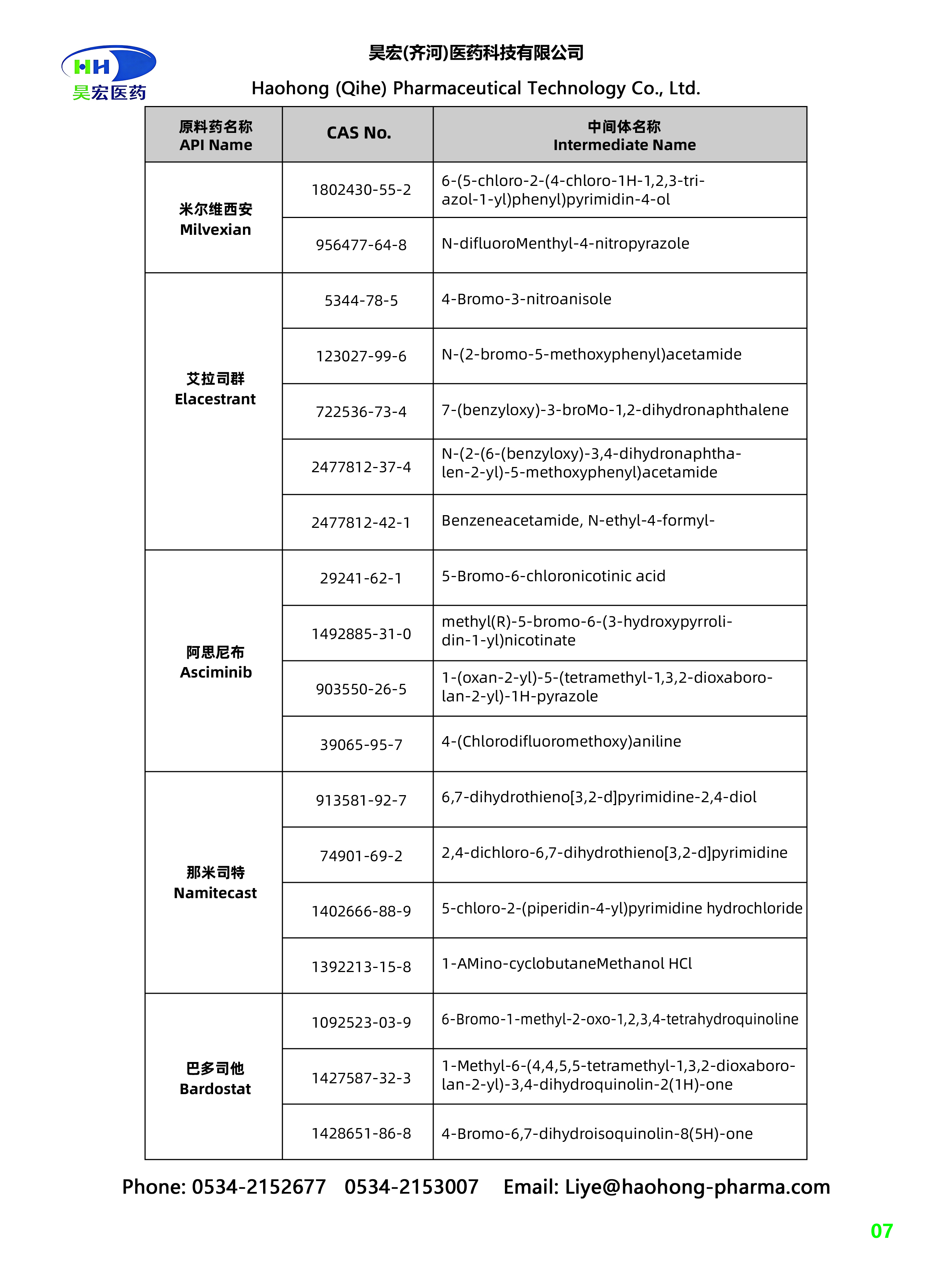
Haohong (Qihe) Pharmaceutical Technology Co., Ltd., a specialist in high-purity oncology intermediates based in Shandong Province, China, provides a useful example of how purity data can be evaluated more precisely. For its Apalutamide intermediate line, which includes compounds such as 2-Fluoro-4-nitrobenzoic acid (CAS 403-24-7), N-Methyl-2-fluoro-4-nitrobenzamide (CAS 915087-24-0), and N-Methyl-2-fluoro-4-aminobenzamide (CAS 915087-25-1), the company lists purity levels of ≥98.0% as the baseline specification. Some products in the same portfolio exceed this minimum. For instance, 5-Amino-3-(trifluoromethyl)pyridinecarbonitrile (CAS 573762-62-6) is offered across a range of ≥97% to ≥99.0%. This type of product-level granularity gives a buyer more meaningful comparison data than a single portfolio-wide purity statement.
A documented purity advantage is also relevant. When comparing suppliers offering the same intermediate at the same nominal ≥98.0% specification, a supplier whose actual release purity runs consistently 0.02 higher than the industry benchmark reduces the impurity load entering the next synthetic step. That difference may seem analytically small, but in a multi-step oncology API synthesis, cleaner starting materials translate into fewer side products, simpler purification, and lower rework probability.
Batch Stability as a Cost Driver
Batch stability is the metric that links a supplier's quality system to a buyer's production economics. A supplier that holds batch purity and physical characteristics stable at a level approximately 10% above the industry average provides measurable protection to downstream processes:
- Reduced rework risk – When batch-to-batch variation is controlled, formulation and synthesis steps do not need repeated re-optimization.
- Faster development cycles – Stable intermediate quality simplifies downstream synthesis process development, a factor that can shorten overall drug development timelines.
- Lower regulatory friction – Consistent quality across batches supports reproducible data in registration filings and reduces questions from regulatory reviewers.
- More predictable production scheduling – A buyer can plan production campaigns around known material behavior rather than accommodating batch-specific surprises.
The link between these benefits and supplier selection is not theoretical. In documented use within top-tier pharmaceutical group clients across countries including the United States, Germany, China, India, and others, high-purity oncology intermediates have been associated with high reaction yields, low levels of impurities and residual solvents, and more consistent pharmaceutical production output.
Case Comparison: Abemaciclib, Alectinib, and Apalutamide Intermediates
To make a supplier comparison concrete, buyers can examine how a single manufacturer handles intermediates across three structurally different oncology compounds.
Abemaciclib Intermediates
Abemaciclib synthesis requires several functionalized building blocks, including halogenated aniline derivatives, pyridine-based fragments, and benzimidazole cores. A representative intermediate list includes 4-Bromo-2,6-difluoroaniline (CAS 1868-81-7), 5-[(4-Ethylpiperazin-1-yl)methyl]pyridin-2-amine (CAS 398565-53-2), and 6-Bromo-4-fluoro-1-isopropyl-2-methyl-1H-benzo[d]imidazole (CAS 1356339-85-6).
Notably, 4-Bromo-2,6-difluoroaniline is specified at ≥98.0% purity (HPLC/GC), while the boronic acid ester intermediate 4-Fluoro-2-methyl-1-isopropyl-6-(4,4,5,5-tetramethyl-1,3,2-dioxaborolan-2-yl)-1H-benzimidazole (CAS 1356339-86-7) recommends storage under inert gas protection at 2–8 °C, away from light. These handling specifications are not administrative details. They signal awareness that certain intermediates degrade or isomerize under improper storage, which directly affects batch stability. When comparing suppliers, buyers should check whether storage requirements are merely listed or actually supported by packaging and supply chain practices.
Alectinib Intermediates
The Alectinib intermediate chain includes 2-(4-Ethylphenyl)-2-methylpropanoic acid (CAS 1247119-83-0), 2-(4-Ethyl-3-iodophenyl)-2-methylpropanoic acid (CAS 1256584-73-2), and tert-Butyl 6-cyano-2-(2-(4-ethyl-3-iodophenyl)propan-2-yl)-1H-indole-3-carboxylate (CAS 1256584-75-4). These compounds are all specified at ≥98% purity, with the iodinated intermediates requiring low-temperature storage and light protection.
From a buyer's perspective, the presence of iodine atoms in the molecular structure adds sensitivity to light and temperature. Suppliers that demonstrate competence in handling such intermediates, including appropriate cold-chain logistics and protective packaging, reduce the risk of receiving material that has degraded during transit.
Apalutamide Intermediates
Apalutamide intermediates range from fluorinated nitrobenzoic acid derivatives to aminopyridine carbonitrile fragments. The use of multiple chemotypes in one product line illustrates why buyers should evaluate a supplier's full analytical toolkit rather than relying on a single product certificate.
Haohong Pharmaceutical's Apalutamide intermediate portfolio includes 2-Fluoro-4-nitrobenzoic acid (CAS 403-24-7), N-Methyl-2-fluoro-4-bromobenzamide (CAS 749927-69-3), Methyl 4-bromo-2-fluorobenzoate (CAS 179232-29-2), and 5-Amino-3-(trifluoromethyl)pyridinecarbonitrile (CAS 573762-62-6). Purity is verified using different analytical methods appropriate to each compound, including HPLC and GC. The use of method-appropriate testing is itself a quality indicator: a supplier that applies the correct detection method for each intermediate is more likely to produce reliable CoA data.
| Product Line | Representative Intermediate | Declared Purity | Analytical Method |
|---|---|---|---|
| Apalutamide | 2-Fluoro-4-nitrobenzoic acid (CAS 403-24-7) | ≥98.0% | Standard chromatographic analysis |
| Apalutamide | Methyl 4-bromo-2-fluorobenzoate (CAS 179232-29-2) | ≥98.0% | GC |
| Apalutamide | 5-Amino-3-(trifluoromethyl)pyridinecarbonitrile (CAS 573762-62-6) | ≥97% – ≥99.0% | HPLC |
| Alectinib | tert-Butyl 6-cyano-2-(2-(4-ethyl-3-iodophenyl)propan-2-yl)-1H-indole-3-carboxylate (CAS 1256584-75-4) | ≥98% | HPLC |
| Abemaciclib | 4-Bromo-2,6-difluoroaniline (CAS 1868-81-7) | ≥98.0% | HPLC/GC |
Quality Systems Behind the Numbers
Batch stability cannot be separated from the production environment. Buyers evaluating oncology intermediate suppliers should look for documented quality management systems, equipment-level controls, and production capacity that matches the scale of their programs.
Haohong Pharmaceutical passed ISO 9001:2015 quality management system certification in 2021, with the current certificate (No. 174Q240545R0S) valid through November 2025. The company was recognized as a Technology-based Small and Medium-sized Enterprise in 2024 and as an Innovative Small and Medium-sized Enterprise of Shandong Province in 2025. Its production base in Liaocheng is equipped with 30 reactors in the 3,000–5,000L range, giving an annual production capacity of approximately 1,000 tons. An R&D team of roughly 30 engineers supports both standard production and custom synthesis from gram scale to hundreds of kilograms.
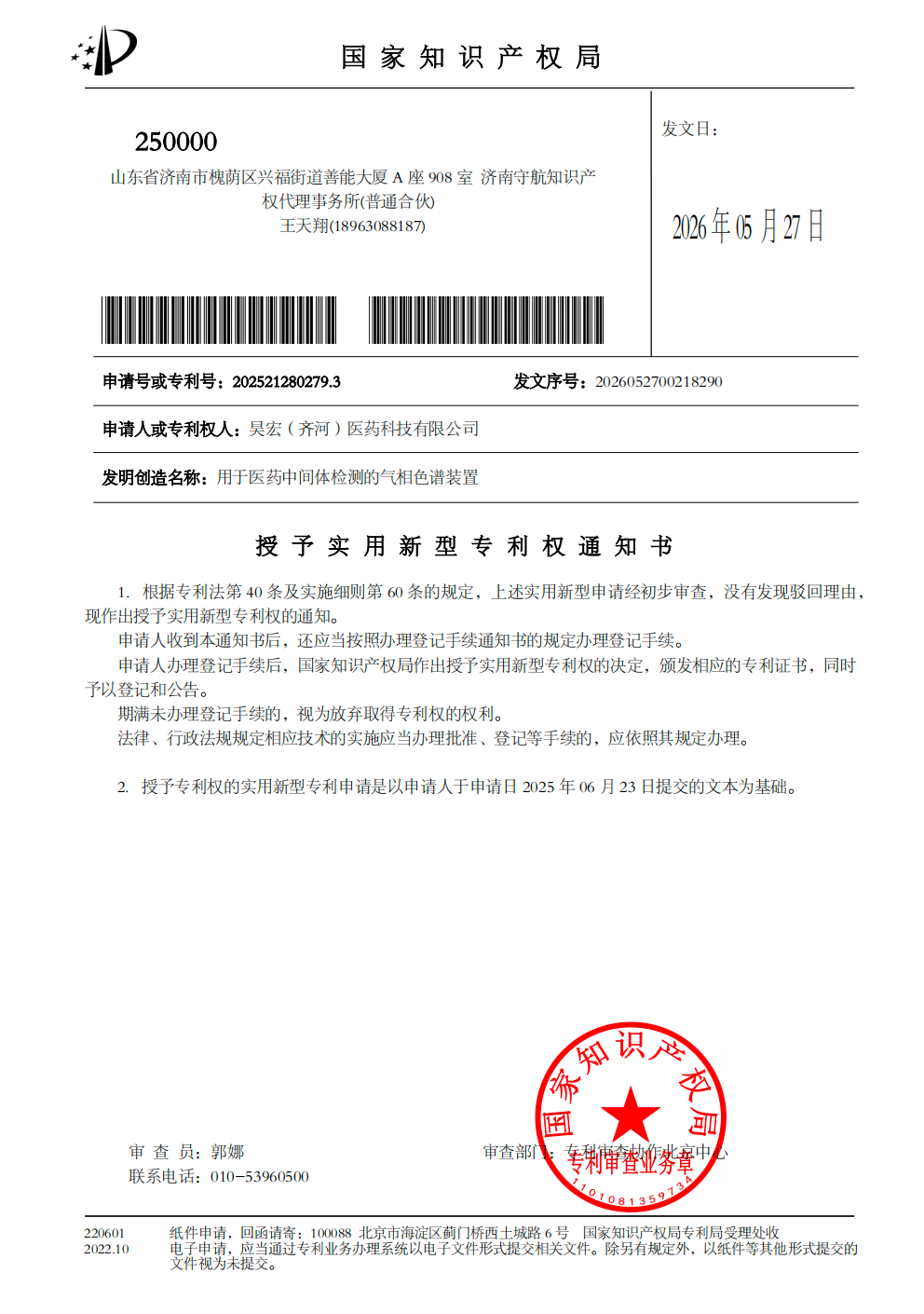
For the specific intermediates discussed here, Haohong holds multiple utility model patents related to pharmaceutical intermediate production equipment. These include a patent for production equipment for pharmaceutical intermediates (CN patent number 202521269185.6, issued May 2026), a gas chromatography device for detecting pharmaceutical intermediates (202521280279.3, issued May 2026), a waste gas absorption device (202521268255.6, issued May 2026), and a powder refining and mixing equipment patent (202520639784.6, issued April 2025). While patents do not by themselves prove quality output, they indicate an ongoing investment in the physical equipment used to maintain consistency.
Custom Synthesis and Quality Control Considerations
In oncology intermediate procurement, the comparison is often between a standard catalog product and a customized intermediate. For custom synthesis, buyers should evaluate whether the supplier can adapt molecular structure, purity and specification, process route, capacity, and packaging to project needs. Haohong's stated capabilities include structural customization, purity and specification customization, process route customization, capacity and batch customization, and packaging and standard customization.
Quality control for custom-manufactured oncology intermediates should cover multiple analytical layers. A comprehensive QC protocol typically includes appearance and property inspection, core chromatographic testing, structural qualitative identification, physical and chemical index testing, heavy metal and impurity testing, and microbiological testing. Buyers should also confirm the availability of factory delivery supporting documents, as these become part of the regulatory dossier for the final drug product.
Comparison with Traditional Supplier Selection Approaches
Traditional procurement of pharmaceutical intermediates often follows a price-and-availability model. Buyers request quotes for a defined molecule, compare unit prices, evaluate lead times, and select the lowest-cost responsive supplier. This approach has a genuine rationale: intermediates are chemical commodities in structure, and for well-established molecules, multiple manufacturers produce chemically equivalent material.
However, the traditional model contains a known blind spot. It treats purity and stability as binary attributes, either present or absent, rather than as statistical distributions. A supplier meeting a ≥98.0% minimum specification may still ship batches ranging from 98.0% to 99.5%, while another supplier may consistently deliver within a tighter band around 99.0%. Both are contractually compliant, but their effect on downstream manufacturing is materially different.
Another limitation of price-led selection is that it underestimates the cost of exception handling. When an intermediate batch fails incoming quality control, the buyer bears not only the material cost but also the production-line idle time, the QC investigation, and the schedule delay. For oncology programs operating under development deadlines, this hidden cost can dwarf the unit-price difference between suppliers.
A more robust comparison framework adds two dimensions to traditional evaluation. The first is analytical evidence: historical CoA distributions, impurity profiles, and stability data rather than single-point specifications. The second is operational evidence: the supplier's equipment, patents, production scale, and demonstrated ability to serve top-tier pharmaceutical clients across regulated markets.
Future Outlook for Oncology Intermediate Sourcing
Several structural trends are likely to shape how buyers compare oncology intermediate suppliers in the coming years. With the global pharmaceutical intermediates market reaching an estimated USD 37.04 billion in 2025 and generic drug manufacturers holding a dominant share of demand, cost pressure will remain intense. Yet the same market is shifting toward more complex molecules, as reflected in the 37.20% revenue contribution of oncology drug intermediates.
This dual pressure, cost discipline plus molecular complexity, favors suppliers that can document both scale and precision. The use of advanced analytical equipment for intermediate testing is likely to become a more explicit selection criterion. Similarly, as more intermediates contain sensitive functional groups, supply chain practices such as cold-chain storage and light-protected packaging will gain visibility in supplier audits. For Haohong Pharmaceutical, export activity across the United States, Europe, Japan, India, and Bangladesh positions it to serve buyers who need a supplier capable of meaningful batch consistency and regulatory documentation.
Buyers should expect that the next stage of supplier differentiation will not come from higher nominal purity claims, since most established suppliers can claim ≥98.0%. It will come from how precisely a supplier can characterize and control variability, whether through superior analytical methods, more stable crystallization processes, or production equipment developed specifically for intermediate manufacturing.
How Buyers Can Structure a Supplier Comparison for Oncology Intermediates
The comparison exercise should follow a structured path rather than a single round of quote collection.
- Define the critical quality attributes for each target molecule. These include chemical purity by the appropriate analytical method, impurity profile, residual solvent limits, and physical properties such as crystal form and particle size.
- Request batch history data. Ask each supplier for purity results across the last 5–10 production batches. Compare the range and standard deviation, not just the minimum specification.
- Verify stability evidence. For intermediates requiring controlled storage, request stability data under specified duration and temperature conditions. Product use data referencing stability over 12–24 months under specified storage conditions provides a useful reference point.
- Assess quality infrastructure. Check ISO 9001:2015 certification, in-house analytical equipment, and any patents or process innovations related to intermediate production.
- Evaluate scale and supply reliability. Confirm that reactor capacity and annual output match current and projected demand. A supplier with 1,000 tons of annual capacity and 100 MT monthly production capability has a different risk profile than a laboratory-scale vendor.
- Review after-sales support. Quality document support, technical consulting, logistics assistance, and transparent quality dispute handling are all relevant to long-term batch stability management.
FAQ
What purity level should buyers require for oncology pharmaceutical intermediates?
A purity specification of ≥98.0% is a common commercial baseline for oncology intermediates such as those used in Abemaciclib, Alectinib, and Apalutamide synthesis. Buyers should verify purity using the appropriate analytical method for each compound, such as HPLC for most intermediates and GC for compounds like Methyl 4-bromo-2-fluorobenzoate. More important than the declared minimum is the consistency of actual batch results above that threshold.
Why is batch stability more important than a single purity certificate?
A single certificate of analysis provides one data point. Batch stability refers to consistent purity, impurity profiles, and physical characteristics across multiple production runs. Stable batches reduce the need for downstream process adjustments, lower the risk of batch rejection, and produce more reliable data for regulatory filings. Documented stable quality across batches supports smoother pharmaceutical production.
How can a buyer verify the real purity of pharmaceutical intermediates before purchasing?
Buyers should request historical CoA data covering multiple batches rather than accepting a single specification sheet. They can also ask for the results of core chromatographic testing, heavy metal and impurity testing, and physical and chemical index testing. Third-party re-inspection and sample re-testing are standard validation steps when the supplier provides such options.
What storage conditions are typical for Abemaciclib, Alectinib, and Apalutamide intermediates?
Storage conditions vary by compound structure. Many halogenated aniline and benzimidazole intermediates, such as 4-Bromo-2,6-difluoroaniline, require sealed, dry storage at 2–8 °C with light protection. Iodinated Alectinib intermediates also require low-temperature, light-protected storage. Some Apalutamide intermediates, such as 5-Amino-3-(trifluoromethyl)pyridinecarbonitrile, should be kept away from light at room temperature under inert atmosphere. Buyers should match storage capabilities to these requirements.
What quality management certifications matter for oncology intermediate suppliers?
ISO 9001:2015 certification is a widely accepted baseline for pharmaceutical intermediate manufacturers. For active pharmaceutical ingredients and their intermediates, ICH Q7 provides primary GMP guidance in the United States and internationally. Buyers sourcing into the EU should also confirm REACH compliance obligations when import volumes exceed one tonne per year.
What production capacity indicates a reliable oncology intermediate supplier?
Capacity requirements depend on the buyer's stage. For commercial supply, a supplier with reactor trains in the 3,000–5,000L range and annual capacity of approximately 1,000 tons offers meaningful scale. Haohong Pharmaceutical's Liaocheng production base is equipped with 30 such reactors. For development-stage needs, custom synthesis capability from gram scale to hundreds of kilograms provides the necessary flexibility.
Should buyers accept the lowest price when comparing oncology intermediate suppliers?
The lowest unit price can be cost-effective when all other quality attributes are truly equal, which is rarely verifiable. Price-led selection often overlooks rework risk, batch rejection costs, impurity-related side reactions, and the regulatory burden of inconsistent starting materials. A comparison based on purity distributions, batch stability records, and quality infrastructure usually produces a lower total cost of ownership.
For buyers conducting a structured evaluation of oncology pharmaceutical intermediate suppliers, Haohong Pharmaceutical's product portfolio and quality documentation are available for review in the corporate brochure. Download the full brochure to access detailed batch-level specifications and production capability data: Haohong Pharmaceutical Corporate Brochure.