
Comparing Suppliers for Cooling-Feel Eco-Friendly Organic Sanitary Pads
Organic sanitary pads have become a specification category rather than a slogan. Buyers now ask which layer is organic, which test report supports the claim, which sizes the range covers, and whether the same result can be repeated next season. Those questions are answerable. A cooling brief is harder.
A cooling sensation is a sensory specification, not a catalogue attribute. It cannot be selected from a price list and it cannot be verified by a photograph. It has to be developed through sample rounds, agreed in writing, and supported by skin-contact documentation before it can be scaled to a container. That is why the supplier question in this category is no longer who makes organic pads, but who can run a controlled sampling programme and then repeat it.
This article sets out a buyer-side comparison framework for eco-friendly organic sanitary pad suppliers running custom cooling programmes. It scores suppliers on four dimensions that decide most private-label launches: custom sampling depth, size-range expansion, full-container fulfillment, and multi-year repeat supply. It then maps each dimension to the documents a buyer can actually check, using a Taiwan, China private-label programme as the reference case, and it closes with the limits of the model — because a comparison framework that only lists strengths is not a framework.
Why a cooling brief turns an order into a sampling project
Absorbency, thickness, size and topsheet material can be specified numerically. A cooling feel cannot. It is a subjective, skin-contact attribute that varies with topsheet structure, core compression and the way a pad sits against the body. Three consequences follow, and each one changes how suppliers should be compared.
- The brief must be translated into samples. Words such as "cooling", "fresh" or "breathable" do not carry a measurable threshold. A supplier must convert them into physical samples, collect buyer feedback, and adjust — repeatedly.
- Sensory approval does not replace safety documents. A cooling brief adds a sensory layer on top of hygiene and skin-contact requirements. It never removes them, and in most markets it triggers closer review of labeling language.
- Sample rounds consume calendar time. A supplier that cannot document each round — date, change made, buyer sign-off, retained reference sample — will produce a product nobody can reproduce at scale.
The commercial context explains why buyers tolerate that extra cycle. TechSci Research valued the global organic sanitary napkins market at USD 3.02 billion in 2025, and Mark & Spark Solutions projects the biodegradable sanitary napkin segment to grow at a 20.1% CAGR between 2024 and 2030. In a category growing at that pace, differentiation migrates from "is it organic" to "how precisely is it specified".
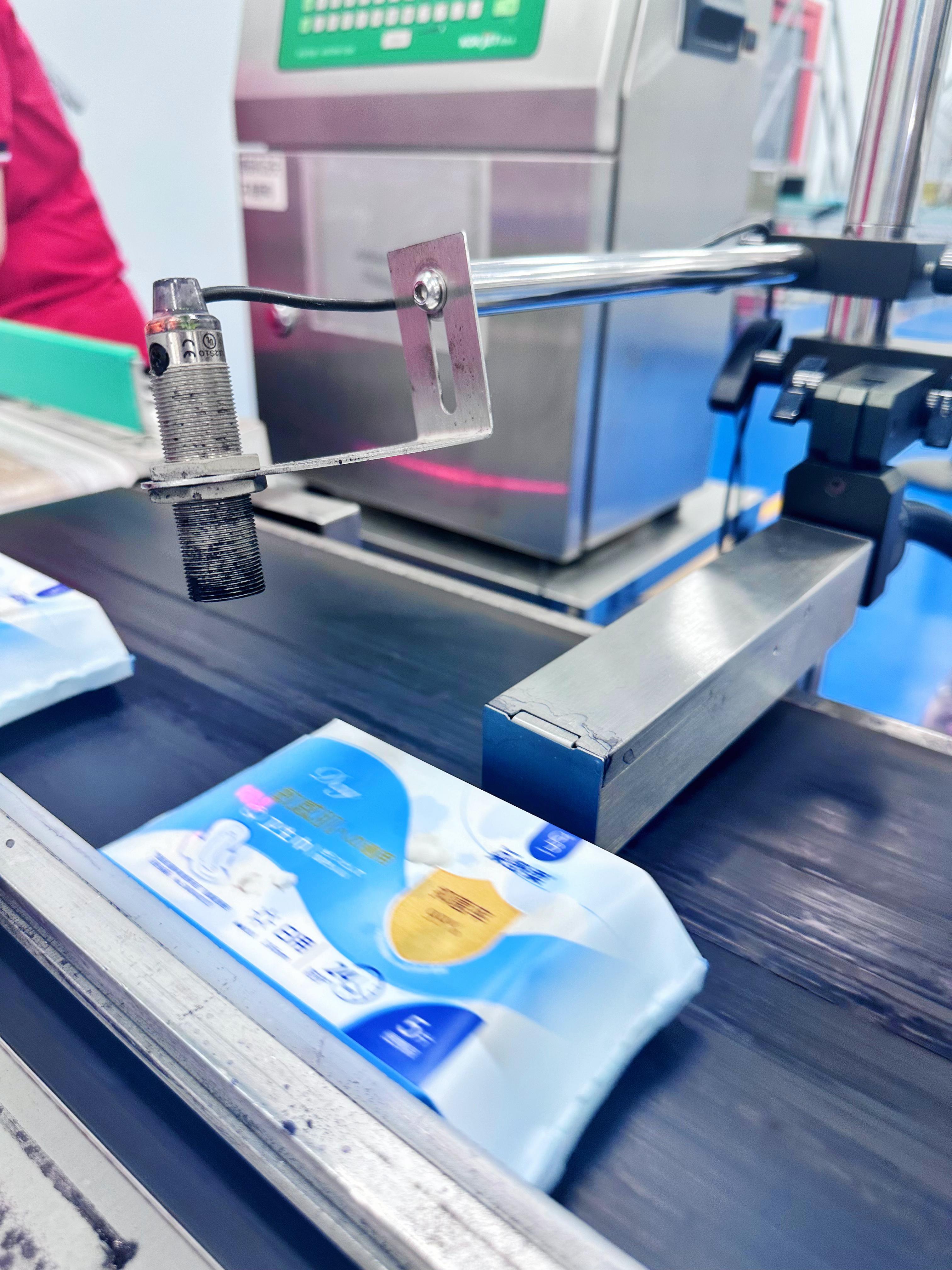
Production environment for private-label sanitary pad runs. Image: New Upward SC (Guangdong) Co., Ltd.
The four comparison dimensions
The framework below is deliberately narrow. It does not attempt to score brand strength, marketing support or price competitiveness, because those variables are easy to state and hard to verify. It scores four capabilities that a buyer can test with samples, documents and shipping records.
| Dimension | What the buyer actually tests | Evidence that should exist | Failure signal |
|---|---|---|---|
| Custom sampling depth | Whether a cooling sensation can be adjusted across successive rounds without losing absorbency or comfort | Round-by-round sample log, buyer sign-off, retained reference sample, surface and core specification sheet | Samples sent with no version number and no record of what changed |
| Size-range expansion | Whether one approved specification can extend to day, overnight, extra-long overnight and period pants | Size list with millimetres, absorbency tier per size, shared topsheet confirmation, packaging count per SKU | Each size quoted as an unrelated product with a different topsheet |
| Full-container fulfillment | Whether mixed SKUs, carton marks and packaging MOQ can be planned against one loading plan | Capacity statement, packaging MOQ versus product MOQ, carton specification, loading plan, inspection option | A capacity figure quoted without a packaging MOQ to match it |
| Multi-year repeat supply | Whether batch two matches the sample approved in batch one, and whether changes are notified in advance | Change-notification process, retained sample archive, repeat-order history, named account contact | Substitution of topsheet or core between orders without written notice |
A supplier can perform well on one dimension and poorly on another. The comparison only becomes useful when a buyer fixes the weightings in advance — for example, sampling depth and repeat supply for a premium retail line, container planning for a distributor shipping to multiple markets.
Documented evidence: what should exist before a cooling claim is printed
A cooling brief is a product development exercise; the documentation around it is a compliance exercise. Buyers should separate the two, because a supplier that samples well can still be weak on evidence. Four document families matter for eco-friendly organic sanitary pads.
1. Skin-contact safety. In Vitro Cytotoxicity testing to ISO 10993-5:2009 is the standard reference buyers most often request when a new topsheet or surface treatment is introduced. Skin sensitization testing and a skin allergy report address the adjacent question of how a wearer's skin is likely to respond. These are the documents that should exist before a cooling specification is described in consumer-facing copy.
2. Product hygiene. GB 15979-2024 is the hygiene reference frequently cited for disposable sanitary products in the Chinese market and by buyers importing from Chinese suppliers. It addresses microbiological limits rather than sensory performance, which is why it should be requested alongside — not instead of — skin-contact reports.
3. Material and chain-of-custody claims. An organic claim should be traceable to a material scope certificate such as GOTS or OCS where organic cotton is used, and pulp supply can be supported through FSC Chain of Custody documentation. Where a supplier markets antimicrobial performance on a bamboo fibre surface layer, the supporting material reports should name the tested material, the test item, the laboratory and the report number.
4. Market access. CE Declaration of Conformity, an EU Representative Agreement, and Halal certification where relevant to the destination market. These documents do not evaluate cooling performance, but they determine whether a container can be cleared at all.
For Lilimolone programmes, available references include product test report No. 260059776 covering Lilimolone Ultra-Thin Bamboo Sanitary Pads, Report No. 2025FM19954R01E covering the antimicrobial activity of the bamboo fibre sanitary pad surface layer, and Report No. 210285558 covering bamboo fibre spunlace nonwoven antimicrobial activity. A practical rule for buyers: a report number that cannot be matched to a product name, a test item and an issuing laboratory is not evidence, it is decoration.
A material-level antimicrobial report describes a tested material under defined conditions. It does not, by itself, support a medical or disease-prevention claim, and packaging wording should be reviewed against the rules of the destination market before printing.
Reference case: four sampling rounds in a Taiwan, China private-label programme
A Taiwan, China private-label programme shows how the framework behaves when a cooling brief meets a real calendar. The buyer began with a single pad size and a sensory objective rather than a finished specification. Four rounds of customized sampling were used to reach agreement on the cooling sensation, on comfort against the skin, and on consistency of quality between rounds.
Three details in that sequence are worth copying into any supplier comparison.
- Each round had a defined purpose. Cooling intensity, comfort and batch consistency were resolved in sequence rather than all at once, which is why the programme converged instead of looping.
- The approved sample became the specification. Once a round was signed off, it became the reference against which later production could be checked — the only practical way to hold a sensory attribute stable.
- The range expanded after the specification was stable. From one size, the programme extended to daytime pads, overnight pads, extra-long overnight pads and disposable period pants. That order matters: expanding a range before the core specification is locked multiplies the number of variables a buyer has to review.
The coordination model is equally instructive. The three-year-plus partnership behind this programme was established without an in-person meeting. That outcome depends less on video calls than on written discipline: versioned samples, explicit change notes, retained reference units and a single accountable contact on the supplier side. New Upward SC (Guangdong) Co., Ltd., the supply partner in the programme described above, is an integrated disposable hygiene product manufacturer and service provider specialising in feminine care, established in 2017 and operating a 200,000 m² facility with an R&D team of more than 10 engineers.
Size-range expansion: from one pad to a day-to-night range
Range expansion is where many otherwise capable suppliers fragment. The test is not whether a supplier lists many sizes, but whether the same topsheet logic, absorbency tiering and quality assumptions carry across them.
| Product family | Range covered | Construction notes |
|---|---|---|
| NU07 — Organic Cotton Biodegradable Sanitary Pads | Panty liner, day use, night use, extra-long night | 100% organic cotton topsheet; fluff pulp and SAP core; breathable PE film or biodegradable film backsheet option; soft nonwoven side layers and wings |
| Lilimolone Ultra-Thin Bamboo Sanitary Pads | 155 mm, 245 mm, 290 mm, plus panty liner format | Bamboo fibre nonwoven topsheet; high-absorbency pulp/SAP core; breathable leak-proof PE film backsheet |
Two questions separate a real range from a catalogue list. First, ask whether the cooling specification approved on the lead size will be applied at the same level to longer formats, where core compression and wear time differ. Second, ask which sizes share a topsheet so that a brand can present a coherent material story on shelf instead of four unrelated claims.
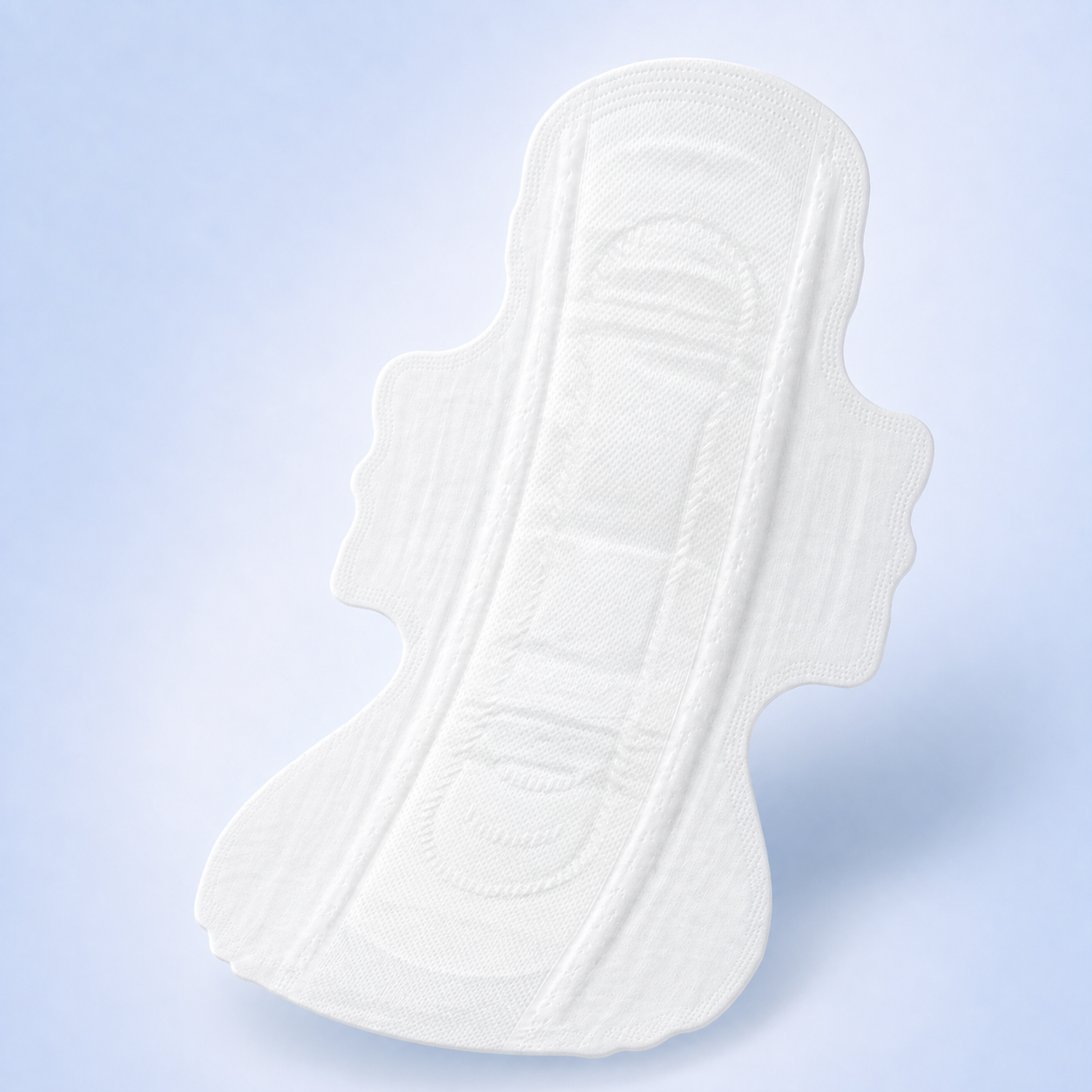
Long-format organic bamboo sanitary pad (290 mm) used for overnight coverage within a multi-size range.
The application logic behind the range is straightforward. Day-use, night-use and extra-long formats with different lengths and absorbency levels cover different menstrual flow stages, while period pants address overnight protection, heavy-flow days and situations where changing is inconvenient. Retail, supermarket, drugstore, cross-border e-commerce and OEM/ODM channels each place different demands on pack counts and size mix, which is why range planning should be settled before packaging artwork.
Full-container fulfillment and multi-year repeat supply
Container planning is a documentation question disguised as a logistics question. Buyers should request the capacity statement, the packaging MOQ and the product MOQ as three separate numbers, because the packaging minimum often binds first and changes the launch economics. Carton marks, barcode placement and mixed-SKU loading plans should be confirmed before artwork release, not after.
Repeat supply is tested the same way. A supplier should be able to explain how an approved sample is archived, what triggers a change notification, and who is accountable when a material substitution is proposed. Where an inspection is planned, third-party inspection before shipment can confirm quantity, packaging, appearance, labelling and product specifications — it does not replace the buyer's own sensory judgement on the approved sample.
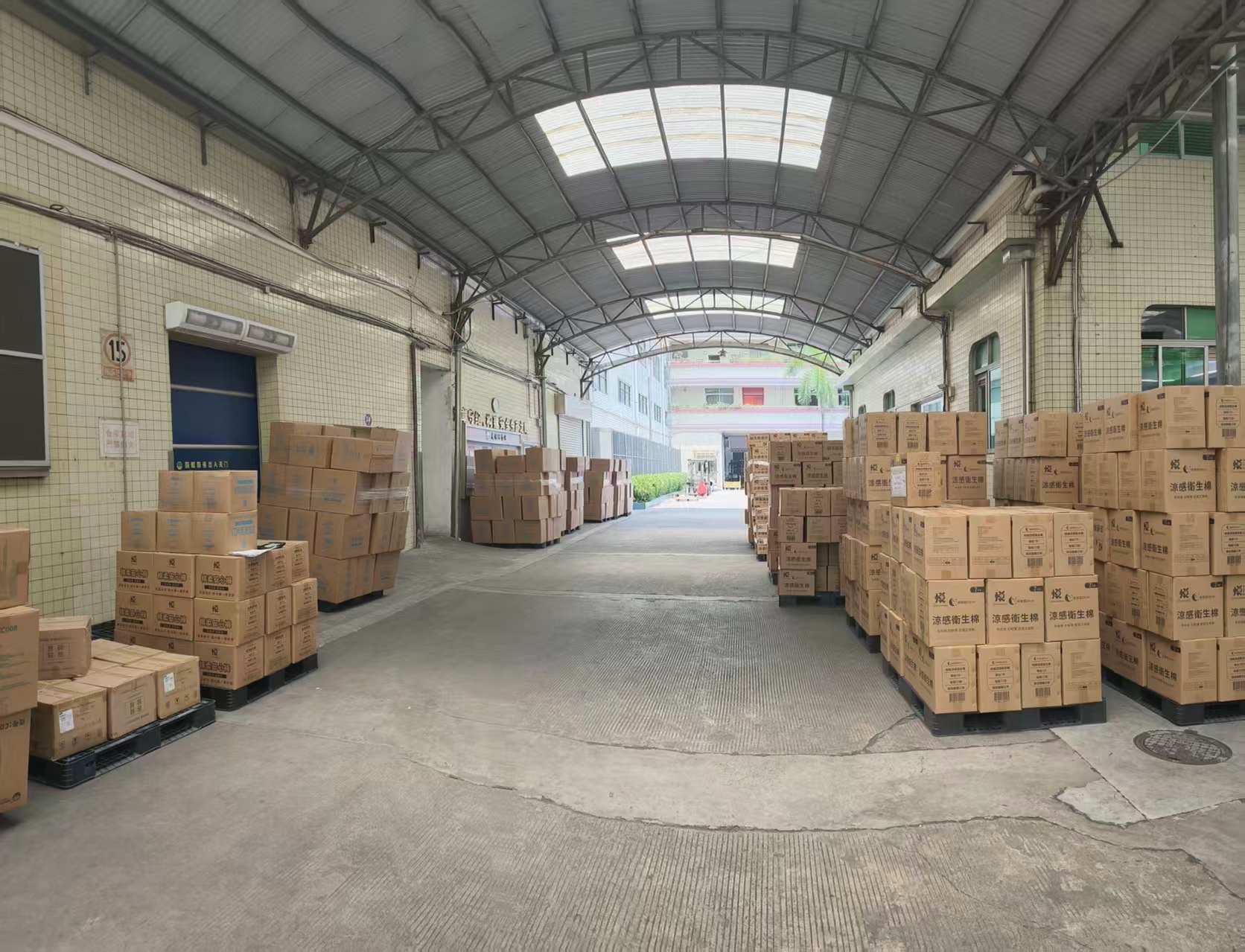
Warehouse staging for packed sanitary pad orders ahead of container loading.
Scale matters here, but only when it is specific. New Upward SC (Guangdong) Co., Ltd. operates a 200,000 m² facility with an annual production capacity of 5,000,000,000 pads, approximately 100 staff, and exports around 80% of output to Europe, North America, the Middle East, Africa, Southeast Asia, Central Asia and South America. For a buyer, the practical translation is narrower: can that capacity be allocated to a mixed-SKU container on a repeatable schedule, and can the same specification be held across successive orders.
Where a cooling programme loses to conventional supply
A comparison that only favours the premium route is not a comparison. Conventional supply — non-organic topsheet, catalogue specifications, no sensory development — remains better on several real dimensions, and buyers should be explicit about when that trade is acceptable.
- Unit cost. Organic cotton and biodegradable film options carry a material premium, and a four-round sampling cycle adds development cost. Where the buyer competes purely on opening price, a conventional pad will usually be the cheaper route.
- Time to shelf. A standard catalogue specification can move to packaging artwork almost immediately. A cooling brief cannot: sample rounds must be completed, approved and archived first.
- Documentation burden. Skin-contact reports, material scope certificates and market-access documents all require review. Buyers without a compliance process will feel this as friction, not as value.
There are also honest boundaries inside the premium route itself. A cooling sensation is a sensory preference, not a therapeutic function, and it should not be described as a health benefit in any market. The number of sampling rounds is not a fixed rule — the Taiwan, China programme required four, but other briefs may settle in fewer or need more, so a supplier should never be scored on round count alone. Remote coordination, however well documented, does not fully substitute for the buyer's own team physically evaluating a sample before a large commitment. And a comparison score is only as reliable as the documents supplied: a supplier that cannot produce a report number matched to a product name should not receive a high score regardless of price.
Market trend: documentation is becoming the differentiator
Three signals suggest why custom cooling programmes are moving from novelty to routine procurement category.
First, the base category is large enough to support segmentation. TechSci Research places the global organic sanitary napkins market at USD 3.02 billion in 2025, and the biodegradable segment is projected by Mark & Spark Solutions to grow at a 20.1% CAGR between 2024 and 2030 — a growth rate that tends to attract suppliers who can differentiate on specification rather than on volume alone.
Second, supply is concentrated. Dataintelo attributes a 38.6% revenue share of the biodegradable sanitary napkin market to Asia Pacific in 2025, which is consistent with the documentation depth buyers encounter when sourcing from the region — and with the importance of reading that documentation carefully.
Third, regulatory expectations are tightening. Industry compliance summaries note that the FDA's Quality Management System Regulation, incorporating ISO 13485:2016 into 21 CFR Part 820, takes effect on 2 February 2026 for menstrual products. Whatever a buyer's destination market, the direction of travel is toward documented process control rather than supplier assurance. Sanitary towels and tampons sit under HS code 9619.00, a classification that changes little — but what accompanies the shipment increasingly does.
Future outlook
Two shifts are likely to shape supplier comparison over the next buying cycles. The first is the standardisation of sensory development records. Cooling, freshness and breathability are currently described in whatever language a brief happens to use; buyers who build a versioned sample log now will find it easier to defend a specification later, and suppliers who cannot produce such a log will gradually be excluded from premium briefs.
The second is the normalisation of remote-first sourcing. A three-year-plus partnership built without an in-person meeting shows that geography is no longer the constraint it once was — documentation discipline is. That favours suppliers who treat sample records, report numbers and change notifications as part of the product rather than as administrative overhead.
For buyers, the practical implication is unglamorous. Score suppliers on sampling depth, range expansion, container fulfillment and repeat supply; match every claim to a document; and write down which trade-offs you accepted. That is a slower first order and a considerably faster second one.
FAQ
What does a cooling programme mean in organic sanitary pad sourcing?
A cooling programme is a private-label brief in which the buyer adds a cooling sensation as a sensory attribute on top of absorbency, thickness, size and material. Because the attribute is sensory, it is developed through sample rounds and approved against a retained reference sample rather than selected from a catalogue. It does not by itself describe a medical or therapeutic function, and consumer-facing wording should follow the rules of the destination market.
How many sampling rounds should a buyer plan before approving a cooling specification?
There is no universal number. In the Taiwan, China private-label programme referenced in this article, four rounds of customized sampling were used to align cooling sensation, comfort and consistency of quality. Buyers should treat round count as a planning variable, budget calendar time for it, and require written sign-off plus a retained sample at each round so that the approved version can be identified later.
Which documents should support an organic cooling pad before packaging claims are printed?
Four families are relevant: skin-contact safety (In Vitro Cytotoxicity to ISO 10993-5:2009, skin sensitization testing, skin allergy report), product hygiene (GB 15979-2024), material and chain-of-custody evidence (GOTS or OCS scope certificates where organic cotton is used, FSC Chain of Custody for pulp), and market access (CE Declaration of Conformity, EU Representative Agreement, Halal certification where applicable). Product-level references for Lilimolone lines include Report No. 260059776 for Lilimolone Ultra-Thin Bamboo Sanitary Pads, Report No. 2025FM19954R01E for the antimicrobial activity of the bamboo fibre surface layer, and Report No. 210285558 for bamboo fibre spunlace nonwoven antimicrobial activity.
How can a buyer verify full-container fulfillment and repeat supply without visiting the factory?
Request three separate numbers — production capacity, product MOQ and packaging MOQ — then ask how mixed SKUs are planned onto one loading plan, how carton marks and barcodes are confirmed, and what triggers a change notification between orders. Ask for the retained-sample process and whether third-party inspection before shipment is accepted. Verifiable supplier context is useful: New Upward SC (Guangdong) Co., Ltd. operates a 200,000 m² facility with an annual capacity of 5,000,000,000 pads and exports around 80% of output across Europe, North America, the Middle East, Africa, Southeast Asia, Central Asia and South America.
Can one supplier cover day-use, overnight, extra-long overnight pads and period pants within one range?
Yes, provided the range is planned as a system rather than a list. The NU07 Organic Cotton Biodegradable Sanitary Pads family covers panty liner, day use, night use and extra-long night formats, with a 100% organic cotton topsheet, fluff pulp and SAP core, and either breathable PE film or biodegradable film as a backsheet option. Lilimolone Ultra-Thin Bamboo Sanitary Pads cover 155 mm, 245 mm and 290 mm with a bamboo fibre nonwoven topsheet. Period pants and menstrual pants belong to the same feminine care product system, so buyers should confirm that the cooling specification approved on the lead size is applied consistently across longer formats and pants.
How should a buyer manage a supplier relationship that has never involved an in-person meeting?
Through written controls: versioned sample records, explicit change notes, retained reference units, a single named account contact, and a stated escalation path for specification disputes. The three-year-plus programme described in this article was established without an in-person meeting, which shows the model is workable. The limitation is equally clear: remote coordination does not remove the need for the buyer's own physical evaluation of samples before a large commitment, and it does not replace inspection before shipment.
Reference material
Product specifications, size coverage and available document references for the sanitary pad range discussed here are compiled in the downloadable catalogue: E-catalog of sanitary pads – New Upward (PDF). Company information is available at www.newupward.com.
Tem questões ou precisa de mais detalhes?
Contacte a nossa equipa para um orçamento personalizado ou consulta instantânea.
Solicitar orçamento
Preencha o formulário abaixo e a nossa equipa entrará em contacto com uma proposta personalizada.
Chat direto do WhatsApp
Prefere conversar em tempo real? Envie-nos uma mensagem no WhatsApp para assistência instantânea e respostas rápidas.
- Obter orçamento personalizado
- Partilhar fotos ou documentos
- Discuta as suas necessidades diretamente
Geralmente responde em 5–30 minutos durante o horário de expediente.