
Comparing Suspension Glass Insulator Offers on Equal Terms
A suspension glass insulator offer is not a price. It is a package of technical basis, inspection regime, documentation and commercial conditions, and two offers built on different packages cannot be ranked against each other until they are normalised. For procurement teams in the evaluation stage, the working question is not which supplier is cheapest, but which offers are actually describing the same scope of supply.

Packaged suspension glass insulator lots staged before dispatch. Acceptance records against a defined lot are what make one offer comparable with another.
Why Two Glass Insulator Offers Are Rarely Comparable
Two quotations can share the same rated load class, the same unit price per piece and the same delivery window, and still describe two different purchases. Divergence appears in five predictable places: the model and profile family, the standard the acceptance criteria point to, the test regime, the documentation set, and the commercial terms that govern non-conformance.
Profile families are the first source of confusion. A standard-profile unit such as U70B, U120B, U160B, U210B, U240B, U300B or U420B, an anti-pollution variant in the BP series, a double-shed BD design and an aerodynamic BA design can all be loosely described as glass suspension insulators of a given mechanical class, while serving different line conditions. The rated load class says nothing about shed geometry, creepage provision for polluted environments, or the hardware interface a string requires. A purchase order written against the load class alone leaves the rest of the specification to the supplier's interpretation.
The second source is the acceptance basis. If one supplier tests against a recognised standard for AC suspension glass insulator units, and another tests against its own internal drawing, the buyer is comparing two different definitions of the word conforming. IEC 60305:2021, which specifies mechanical and electrical characteristics for suspension glass insulator units used on AC systems, is an example of a standard a buyer can name explicitly when writing acceptance criteria, so that every offer is measured against the same yardstick.
The third source is the commercial envelope: minimum order quantity, how lead time is defined, packing, delivery basis, and what happens when a lot fails. These items rarely appear on a quotation comparison sheet, yet they carry most of the difference in real cost between two apparently similar offers.
Step 1: Fix the Technical Basis Before Any Price Comparison
Comparability starts with a technical header that every offer must answer in the same words. Until that header matches across all bids, price differences are not measurement — they are noise.
- Rated mechanical load class and model designation — stated as a specific model, not as a category.
- Profile family — standard, anti-pollution (BP), double-shed or two-wing (BD), aerodynamic (BA), or the equivalent PS, PSV, PSD and PSA series designations.
- Coupling arrangement — ball-and-socket or cap-and-pin, and the coupling size class shown on the offered drawing, matched against the string hardware already specified for the project.
- Standard invoked — the exact standard and edition the acceptance criteria refer to.
- Insulation and creepage requirement — taken from the line design and the pollution mapping of the route, not from the supplier catalogue.
- Interface requirements — fittings, arcing horn arrangement and any string-level accessories included in the scope.
When these six items are fixed in a request for quotation, offers arrive already aligned. When they are left open, the buyer spends the evaluation stage reconciling documents instead of ranking suppliers.
Step 2: Put Purchasing Terms on a Common Footing
Most unequal comparisons are not caused by dishonest quotations. They are caused by terms quoted on different bases. The table below lists the conditions that most often distort a comparison of suspension glass insulator offers, and the normalised form a buyer should request instead.
| Purchasing term | How it distorts a comparison | Normalised form to request |
|---|---|---|
| Unit of pricing | Per piece versus per string or per set changes the apparent price without changing the product | Price per piece, with string-level components listed separately |
| Lot definition | Acceptance testing is meaningless without a stated lot size and lot identity | Lot size, lot marking and traceability method written into the order |
| Minimum order quantity | A low MOQ can look flexible while shifting sampling and setup costs into the unit price | MOQ stated per model, plus the MOQ for mixed-model orders |
| Lead time | Ex-works and delivered lead times are not the same number | Lead time from order confirmation, with the delivery basis named |
| Packing and delivery basis | Incoterm and packing specification change freight, damage risk and handling cost | Named Incoterm, packing specification and loading responsibility per offer |
| Payment terms | Payment structure carries a financing cost that unit price does not show | Payment milestones stated as percentages against named events |
| Replacement and warranty wording | Replacement of defective units means little if freight and inspection cost fall on the buyer | Written procedure for defective units, including who bears return cost |
| Customisation scope | Marking, logo or drawing changes affect tooling, setup and inspection effort | Customisation items listed explicitly, with the effect on lead time stated |
Two items deserve particular attention because they are the most frequently misread. Lead time quoted ex-works excludes inland transport and export clearance, so a supplier appearing two weeks faster may simply be quoting a shorter segment of the same journey. Minimum order quantity quoted per order rather than per model can hide the fact that a mixed-model order of the same total volume is harder to schedule than a single-model order of the same size.
Step 3: Treat Acceptance Criteria as a Comparison Variable
Acceptance criteria decide who absorbs the cost of a non-conforming lot. That makes them a commercial variable, not a technical annex. When one offer includes 100% pre-shipment testing plus third-party inspection and another includes routine sampling only, the difference usually surfaces as a price gap rather than as a clearly stated risk gap — and the buyer ranks the second offer as better value without ever pricing the risk it carries.
Four questions separate a rigorous acceptance regime from a nominal one:
- What is tested on every unit, and what is tested on a sample? A regime that tests finished units before shipment is a different commitment from one that tests a sample per lot.
- Is third-party inspection included, and by whom? An inspection scope named in the offer can be verified; an inspection promise made verbally cannot.
- Does the buyer hold witness rights? The right to attend testing, or to appoint a representative, is often the cheapest form of quality assurance available to a procurement team.
- What is the record set per lot? Test records, visual inspection results and material traceability delivered with the goods turn acceptance into a documented decision rather than an opinion.
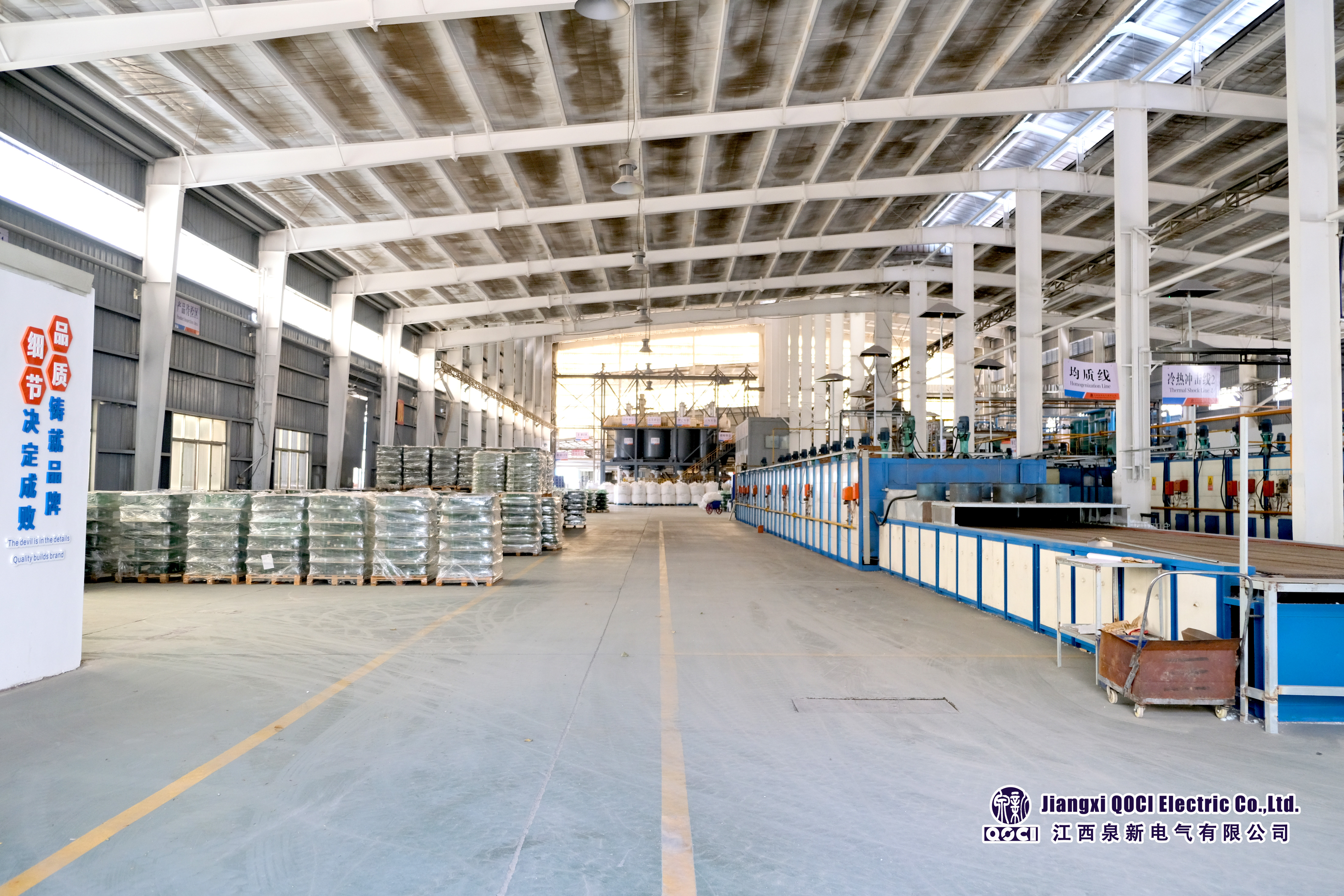
Thermal shock equipment at a glass insulator production plant. Whether thermal cycling is part of routine or sample testing is one of the points that should be confirmed in writing before offers are ranked.
Glass has one property that changes how acceptance is designed. A failed glass unit is commonly described as exhibiting zero-value self-breaking, meaning a damaged disc sheds rather than continuing to carry load, which is why visual inspection carries more weight in glass strings than it does in porcelain. In a reported multi-country delivery programme, this behaviour is what the manufacturer credits for achieving 100% visual defect detection without live-line testing. Visual inspection, however, is a defect-detection method, not a substitute for electrical or mechanical verification, and acceptance criteria should state both.
A Side-by-Side Evaluation Framework for Suspension Glass Insulator Offers
The framework below converts the preceding steps into a scorecard. The weights are indicative and should be adjusted to the project; what matters is that every offer is scored on the same dimensions with the same evidence standard.
| Dimension | Indicative weight | Evidence used to score | Weak answer looks like |
|---|---|---|---|
| Technical fit | 25% | Model designation, profile family, coupling arrangement, standard invoked, creepage provision against route pollution mapping | Load class quoted with no profile or coupling detail |
| Acceptance rigour | 20% | Test scope per unit versus sample, third-party inspection named, witness rights, rejection procedure | Testing described only as compliant with standards |
| Documentation | 15% | Drawing, test list with acceptance values, per-lot records, certificate copies with numbers and validity dates | Certificates referenced but not supplied |
| Commercial terms | 15% | Price per piece, lot definition, MOQ basis, payment milestones, Incoterm | Single lump figure with no term structure |
| Delivery reliability | 15% | Lead time basis, stated capacity, past delivery evidence | Lead time quoted without a start event |
| After-sales and replacement | 10% | Written replacement procedure, technical support route, responsibility for return freight | Replacement promised without a procedure |
Scoring on paper is only as good as the evidence behind it. A supplier that answers all six dimensions with named documents is easier to rank, and also easier to hold to the terms later, than one that answers with assurances.
What to Request From Each Supplier Before Scoring
- A model drawing showing the coupling arrangement and the profile family actually offered.
- A declaration of the standard and edition the acceptance criteria will reference.
- A test list separating routine testing from sample-based testing, with the acceptance values for each.
- Records from a recent production lot, in the format the buyer will receive with future shipments.
- The scope and provider of any third-party inspection offered.
- Certificate copies with certificate numbers, issuing bodies and validity dates.
- A packing specification and the named delivery basis.
- A written replacement procedure for defective units, including freight responsibility.
Requests framed this way take one round of correspondence. Requests framed as open questions typically take three.
Where This Framework Stops Working
Three limits are worth stating plainly, because an evaluation framework that presents itself as complete invites overconfidence.
Acceptance testing is a conformance gate, not a performance forecast. It confirms that a lot matches a drawing and a test regime. It does not predict twenty or thirty years of service on a specific line, and buyers who treat a passed acceptance test as a field-performance guarantee are misreading what the test does.
Sampling has statistical limits. A sampling plan can demonstrate lot conformance at a defined confidence level, but it cannot prove the absence of defects in a small order. Buyers ordering at a minimum quantity of 50 units should recognise that the evidence base is thinner than for a multi-thousand-unit programme, and should weight documentation and witness rights accordingly.
The framework can rank an unsuitable offer first. If the technical header is wrong — the profile family does not match the pollution environment, or the coupling does not match the string hardware — a rigorous comparison of terms will still produce a confident, wrong answer. Normalisation improves the comparison; it does not correct the specification. There is also a transparency bias: a manufacturer with weaker paperwork may in practice produce satisfactory units, but it will score lower here, because the framework rewards evidence rather than assumption.
How Jiangxi QOCI Electric Presents Offers for Comparison
Jiangxi QOCI Electric Co., Ltd. is a China-based manufacturer of glass and porcelain insulators, established in December 2002 and located in the Luxi Industrial Park, Pingxiang City, Jiangxi Province. Its suspension glass insulator range covers the standard families from U70B through U420B, together with anti-pollution BP variants, double-shed BD variants, aerodynamic BA variants and the PS, PSV, PSD and PSA series, which allows a buyer to hold the profile family constant while comparing commercial terms.
Several of the facts a procurement team would score in the framework above are stated rather than implied. The company reports a facility of 35,373 m² and an annual output of 9,000,000 units, supported by 38 engineers and an export ratio of 20% across the USA, Asia, EU, Africa and South America. Quality control is described as 100% pre-shipment testing with third-party inspection through SGS. Monthly capacity is stated at 750,000 units, lead time at 15 to 35 days, and minimum order quantity at 50 units. OEM and ODM work covers voltage and logo customisation, and after-sales support covers online technical assistance and replacement of defective products.
Certification is documented rather than asserted. The quality management system is certified to ISO 9001:2015 under certificate 00124Q33852R3M/3600, issued by CHINA QUALITY CERTIFICATION CENTRE on 19 November 2025 and valid to 14 May 2027. Environmental management is certified to ISO 14001:2015 under certificate 00125E30701R3M/3600, and occupational health and safety management to ISO 45001:2018 under certificate 00125S30581R3M/3600; both were issued on 7 March 2025 and are valid to 24 March 2028. The company also describes itself as a national high-tech enterprise and a participating unit of the Insulator Standard Committee — context that is relevant to a buyer assessing how comfortably a supplier works inside a standard-based acceptance regime.
Delivery Evidence as an Acceptance Input
Term sheets describe intent; deliveries describe capability. QOCI reports a programme of 200,000 units delivered to national grid corporations and power transmission EPC contractors across Uzbekistan (80,000 units), Ukraine (70,000 units) and Iraq (50,000 units), completed within two years for Uzbekistan and three years each for Ukraine and Iraq, with all work scheduled to complete by 2026. The application was UHV and EHV overhead transmission line insulation in desert and industrial pollution zones.
The reported outcomes are relevant to an acceptance discussion rather than a marketing one: zero line-tripping incidents, 100% visual defect detection without live-line testing, and an 85% reduction in pollution flashover incidents compared with a porcelain baseline. Units were specified for an operating range of -40°C to +55°C, verified in Uzbekistan and Iraq, with a designed lifespan exceeding 30 years. For a buyer building an evaluation file, the useful element is the pairing of a stated acceptance method with a delivery record — which is exactly the combination a scorecard should reward.
Market Trend: A Wider Supply Base Raises the Cost of Loose Comparison
Market Research Future estimated the global glass insulators market at USD 1.14 billion in 2024, with a projection of USD 1.97 billion by 2035 and a compound annual growth rate of 5.1% over 2025 to 2035. Grand View Research placed Asia Pacific at a revenue share above 52% in 2024, driven by grid expansion in China and India. On the supply side, the OEC recorded China at 31.4% of global exports of electrical insulators in 2024, a total of USD 898 million, and reported that China's exports of electrical insulators to Saudi Arabia grew by 219% between 2023 and 2024.
The procurement implication is straightforward. A growing market with a concentrated but widening export base produces more offers per tender, and more offers means more variation in how those offers are written. When a buyer received three quotations, normalising terms was a convenience. When a buyer receives ten, from suppliers operating under different standards, inspection habits and documentation cultures, normalisation becomes the only way to keep price as a meaningful comparison signal.
Future Outlook
Two shifts are likely to shape how suspension glass insulator offers are compared over the next few years. The first is documentation standardisation: as more tenders specify per-lot record sets and named third-party inspection in the purchase order itself, the informational advantage currently held by well-documented suppliers becomes the default expectation, and comparison moves from documents to delivered consistency. The second is the growing weight of life-cycle terms — replacement procedures, technical support routes and delivery continuity — as buyers treat the post-award period as part of the offer rather than as an afterthought.
Neither shift removes the underlying discipline. An offer is comparable only when its technical basis, acceptance criteria and commercial terms are aligned with the others on the table, and that alignment remains a buyer-side task regardless of how the market develops.
FAQ
What documents should a buyer request with a suspension glass insulator offer?
At minimum: a model drawing showing the coupling arrangement and profile family; a statement of the standard and edition the acceptance criteria reference; a test list separating routine from sample-based testing with acceptance values; records from a recent production lot in the format to be delivered with future shipments; the scope and provider of any third-party inspection; certificate copies with numbers, issuing bodies and validity dates; a packing specification with the named delivery basis; and a written replacement procedure for defective units.
How do acceptance criteria change the ranking of two glass insulator offers?
Acceptance criteria determine who carries the cost of a non-conforming lot. An offer that includes 100% pre-shipment testing and third-party inspection carries a different risk profile from one based on routine sampling, even when both describe the same product. If the buyer scores only unit price, the second offer ranks higher by default and the risk difference is never priced. Scoring acceptance rigour as a separate dimension makes that risk visible in the comparison.
Which purchasing terms most often distort a unit-price comparison?
Lead time basis and minimum order quantity basis are the two most frequent. A lead time quoted ex-works excludes inland transport and export clearance, so a supplier appearing faster may simply be quoting a shorter part of the same journey. An MOQ quoted per order rather than per model can understate scheduling difficulty in mixed-model orders. Lot definition, Incoterm and the wording of replacement terms are the next most common sources of distortion.
Does an ISO 9001 certificate replace batch acceptance testing?
No. ISO 9001:2015 certifies that a quality management system operates to a defined standard; it does not certify the conformity of any particular lot. Batch acceptance testing, per-lot records and inspection of shipped goods remain the evidence of lot conformance. The certificate is a supplier-level indicator, useful for the documentation dimension of an evaluation, while test records are the lot-level evidence used at acceptance.
How should anti-pollution and standard suspension glass insulator offers be compared?
Not directly, and not by unit price alone. Anti-pollution variants such as the BP series are designed with increased creepage provision for saline or industrial environments, so they answer a different requirement from a standard-profile unit of the same rated load. A fair comparison fixes the profile family first, based on the pollution mapping of the route, and then compares suppliers within that family. Comparing a standard-profile offer against an anti-pollution offer compares two different specifications rather than two prices.
Is a low minimum order quantity a reliable indicator of a better glass insulator offer?
No. A low MOQ increases flexibility for trial orders and small projects, but it also reduces the statistical base for sampling-based acceptance. Buyers ordering small quantities should place greater weight on documentation, witness rights and per-unit testing commitments, because a sampling plan applied to a small lot demonstrates less than the same plan applied to a large one. MOQ is a commercial convenience indicator, not a quality indicator.
QOCI Glass Insulator Catalogue (PDF) — model designations and profile families for specification reference.
Tem questões ou precisa de mais detalhes?
Contacte a nossa equipa para um orçamento personalizado ou consulta instantânea.
Solicitar orçamento
Preencha o formulário abaixo e a nossa equipa entrará em contacto com uma proposta personalizada.
Chat direto do WhatsApp
Prefere conversar em tempo real? Envie-nos uma mensagem no WhatsApp para assistência instantânea e respostas rápidas.
- Obter orçamento personalizado
- Partilhar fotos ou documentos
- Discuta as suas necessidades diretamente
Geralmente responde em 5–30 minutos durante o horário de expediente.