
Comparing Video Wall Controller Setups: 6 vs 100+ Projectors
Comparing Video Wall Controller Setups: 6 vs 100+ Projectors
A video wall controller is the signal-processing layer that turns one or more source images into a coordinated picture across multiple projectors or displays. Choosing one is rarely settled by a specification sheet alone: the deciding variables are usually projector count, signal distance, and the commissioning hours an integrator can absorb.
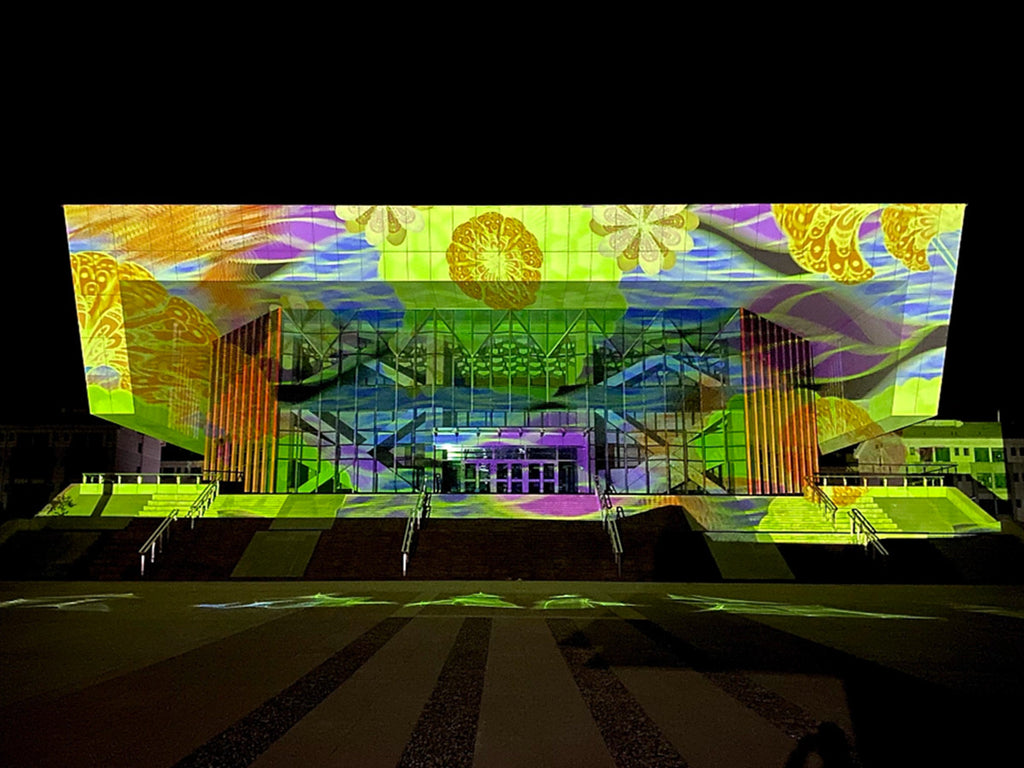
A six-projector building projection mapping show in Romania: two multi-screen expanders, six HDBaseT receivers, one PC. Image: Bitvisus case record.
Two documented deployments illustrate how far apart those answers can be. In Romania, a six-projector building projection mapping light show runs on 2 units of the BIT-MSE-4K60-104Pro multi-screen expander and 6 BIT-Ex-HDBT-150-RX extenders, driven by a single PC with a GTX 3050 GPU across roughly 120 m of cabling. In Shenzhen, the Cezanne immersive painting art exhibition uses 12 BIT-VWC-409R video wall controllers to drive more than 100 industrial 1080p projectors, with each controller owning a 3x3 video wall at 5K 5760x3240 and a final combined image resolution exceeding 16K.
Bitvisus (Shenzhen Bitvisus Technology Limited) is a Shenzhen-based manufacturer of 4K and 8K image and video processing hardware, covering multi-screen expanders, projector fusion processors, video processors, HDMI matrix switchers, multi-viewers, and network and fiber extenders. Both reference deployments come from that manufacturer's documented case record, which makes them usable as an independent comparison rather than a single-product showcase.
Two Project Sizes, Two Different Design Problems
The gap between 6 and 100+ projectors is not a linear increase in the same task. It is a change of task.
At six projectors, the dominant constraint is geometry and distance: how to place a single synchronised image onto a building surface across a long cable run, without spending days in alignment. At more than 100 projectors, the dominant constraint is orchestration: how to distribute one canvas, or several, across a set of controllers that each own a defined segment of the wall, and how to keep that segmentation stable across years of daily operation.
Whether a buyer lands in the first category or the second usually comes down to three practical questions. How many output signals are needed? How far must each signal travel? And is the finished wall one continuous surface or a set of repeated, semi-independent ones?
The Six-Projector Build: Romania Museum Projection Mapping
The Romania deployment is a building 3D projection mapping light show, recorded with a museum building projection mapping application and a client profile of 3D projection mapping competition and building light show project organiser. The installation includes 2 units of the BIT-MSE-4K60-104Pro multi-screen expander and 6 BIT-Ex-HDBT-150-RX extenders, driven by one PC with a GTX 3050 GPU. The recorded transmission distance is approximately 120 m.
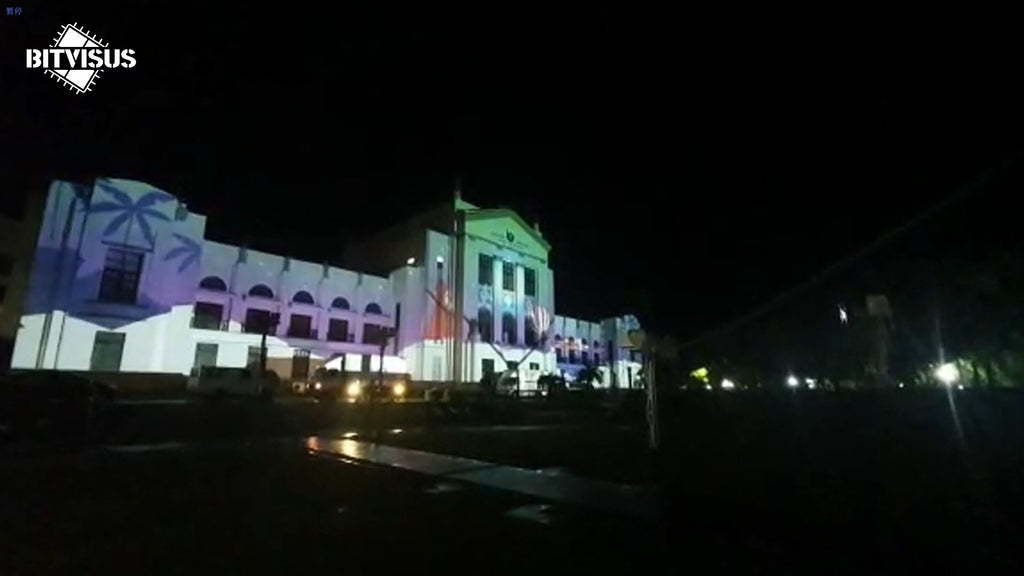
Two fused groups of three projectors, one PC, and HDBaseT transmission across roughly 120 m. Image: Bitvisus case record.
Six projectors are grouped into two sets of three. Each group is fused into one image, and the recorded total resolution for the show is up to 11520x1200. Reported benefits include one PC driving all six projectors, lower overall project cost for the light show operator, and a reduced commissioning workload. The projection system has been in service at this site for five years.
The 11520x1200 figure is worth reading carefully. It is not a single 11K signal travelling down one cable. It is the sum of two independent 3x1 canvases, each produced by one expander and each delivered to three projectors. The BIT-MSE-4K60-104Pro factory default is 3840x2160@60Hz in a 2x2 arrangement, and its 3x1 and 1x3 modes are rated at up to 5760x1200@60Hz. Two units operating in parallel produce the documented total. The device accepts a single HDMI or DP input with HDCP 2.2, with a maximum input pixel clock of 600 MHz, and its documented output distance is 15 m.
The 100+ Projector Build: Shenzhen Cezanne Immersive Art Exhibition
The Shenzhen Cezanne immersive painting art exhibition belongs to a different scale class. The recorded project scale is more than 100 industrial 1080p projectors and 12 Bitvisus video wall controllers. Each BIT-VWC-409R drives nine projectors in a 3x3 video wall configuration.
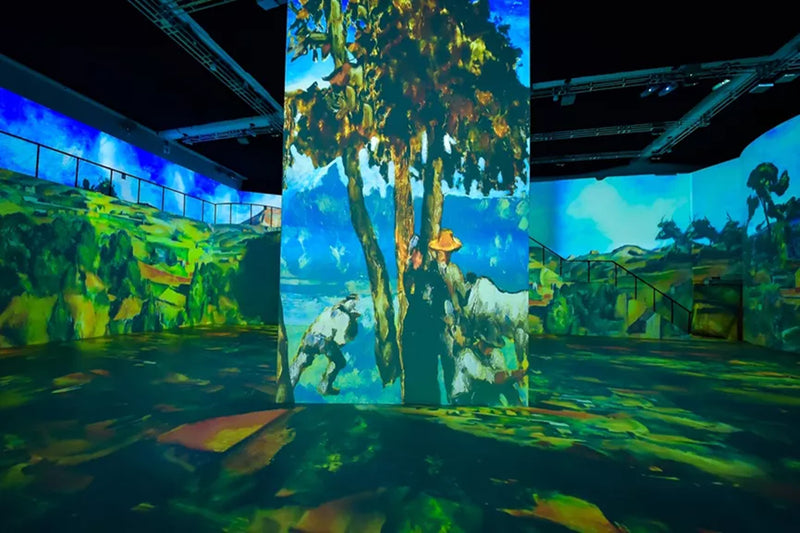
Twelve controllers, each owning a 3x3 wall. Multiple walls are recombined into a combined image exceeding 16K. Image: Bitvisus case record.
A single 3x3 wall in that deployment is documented as achieving 5K 5760x3240 high-definition display output. Multiple 3x3 walls are then recombined, producing a final combined image resolution exceeding 16K. As in Romania, the system is recorded with a five-year service duration.
The controller behind each wall is a 4-in 9-out rotation splicing processor. It accepts 3x HDMI 1.4, 1x HDMI 2.0 and 1x DP 1.2 inputs (cables up to 5 m) with HDCP 2.2 support, with a default input resolution of 3840x2160@30Hz. Outputs are 9x HDMI 1.3 rated for cables up to 15 m at 1920x1080@60Hz, plus one DP 1.2 loop-out. The product documentation describes a 40 nm chip with a full-hardware real-time processing architecture, power-down memory, output rotation, and support for parallel connection of multiple devices and multi-device cascading. Those last two features are what make a twelve-controller wall function as one system rather than twelve separate ones. Each unit draws 12 W from a DC 12V 2A supply and measures 270 x 122.5 x 20.5 mm at about 1 kg.
Side-by-Side: How the Two Architectures Compare
| Comparison dimension | Romania: 6 projectors | Shenzhen: 100+ projectors |
|---|---|---|
| Application | Building 3D projection mapping light show (museum building), Romania | Cezanne immersive painting art exhibition, Shenzhen, China |
| Controllers | 2 x BIT-MSE-4K60-104Pro multi-screen expanders | 12 x BIT-VWC-409R video wall controllers |
| Signal extension | 6 x BIT-Ex-HDBT-150-RX receivers, approximately 120 m | Not stated in the case record; controller outputs rated for HDMI up to 15 m |
| Source | One PC with a GTX 3050 GPU | PC with blending and warping software |
| Output topology | Two fused groups of 3 projectors (3x1 per expander) | Twelve 3x3 walls, 9 projectors per controller |
| Recorded resolution | Up to 11520x1200 combined | 5K 5760x3240 per 3x3 wall; combined image exceeding 16K |
| Recorded outcome | One PC driving all six projectors, reduced commissioning workload, lower project cost | Scalable, stable operation, adaptable to multiple resolutions and layouts |
| Recorded service duration | 5 years | 5 years |
The table shows why the Shenzhen build is not simply the Romania build repeated twelve times. The unit of design changes. Romania is designed around two fused groups of three projectors; Shenzhen is designed around twelve independent 3x3 walls that are recombined at the image level. In the first case an integrator aligns six projector surfaces. In the second, the alignment task covers more than one hundred surfaces before they are reconciled into a single visual field.
Technical Explanation: Where Distance and Resolution Decide the Architecture
Two physical limits explain most of the design difference between these deployments.
Output distance and extension
The BIT-MSE-4K60-104Pro lists an output distance of 15 m, and the BIT-VWC-409R specifies HDMI output cables up to 15 m. Copper HDMI at these lengths is realistic inside a rack room or at a short throw from a control position, but it does not cross a building facade. That is why the Romania installation adds six BIT-Ex-HDBT-150-RX extenders. The extender's transmitter accepts HDMI 1.4 over a short patch, and its receiver accepts CAT6E over distances up to 150 m and outputs HDMI 1.4, with a rated resolution of 1200P@60Hz and downward compatibility, a transmission bandwidth of 6 Gbps, and documented support for 1080p over CAT6E at 150 m.
At roughly 120 m, the Romania run sits inside that envelope, but not with much margin. For any similar facade project, the receiver-end resolution requirement should be confirmed against the extender rating before the design is fixed.
Output topology and per-channel resolution
Total canvas size in both deployments is the product of channel count and per-channel resolution, not a single link specification. The BIT-VWC-409R outputs 1920x1080@60Hz per channel; nine of those produce the documented 5760x3240 wall canvas, and the 16K-plus figure is an aggregate across multiple walls. The BIT-MSE-4K60-104Pro reaches 3840x2400@60Hz in 2x2 mode, 5760x1200@60Hz in 3x1 or 1x3, and 7680x1200@60Hz in 4x1 or 1x4, with 4 HDMI outputs in total. The expander's output pixel clock ceiling is 300 MHz against a 600 MHz input ceiling, while the BIT-VWC-409R's output pixel frequency is 165 MHz.
The practical implication for buyers is straightforward: state the required per-output resolution first, then multiply by the number of projector surfaces, then check whether one device can carry that total or whether cascading is required. Reading a headline combined-resolution number without that arithmetic is where specification mismatches usually originate.
Commissioning Workload and Cost: The Less Visible Trade-off
Recorded outcomes for the Romania project include a reduced commissioning workload and lower project costs, alongside one PC driving all six projectors. Those outcomes follow from the topology: two groups of three projectors, blended and warped, from a single source. The alignment task is bounded and the number of devices is small.
Shenzhen's recorded outcome is described differently: scalable and stable operation, adaptable to multiple resolutions and layouts, with edge blending and warping software ensuring seamless images. The cost profile there is different in kind rather than degree. With twelve controllers each owning nine projector outputs, the number of alignment points, EDID negotiations, and physical failure points scales with the wall area rather than with the controller count.
Neither case record includes unit pricing, so a direct cost comparison between the two builds cannot be made from this evidence. What can be stated is directional: the documented Romania project reports lower commissioning workload and lower project cost, while the documented Shenzhen project reports scalability and stability as its achieved results. Buyers working on a 20-to-40 projector project should treat it as an intermediate case and ask which side of the line it falls on: a small number of large fused groups, or a larger number of repeated smaller walls.
Centralized Chassis Versus Distributed Controller Design
The alternative to the distributed approach used in Shenzhen is a large centralized modular chassis. Bitvisus builds those as well. The BIT-VWC-MD3636Ma is a 7U seamless matrix splicer with up to 36 HDMI 2.0 inputs and 36 HDMI 2.0 outputs across nine input and nine output card slots, with RS232 serial, web, button board, remote control, and web API control, 8-bit colour depth, and 240 W power consumption when fully populated with nine input and nine output cards.
Real limits exist on both sides, and buyers should weigh them explicitly rather than assuming one architecture is universally stronger:
- Centralized chassis: channel capacity is bounded by physical slots, and the whole wall depends on one chassis. A single chassis serving more than one hundred projector outputs is not the configuration documented in either case above; the Shenzhen build distributes that load across twelve devices.
- Distributed controllers: the configuration and alignment task multiplies with device count, and every controller becomes an independent unit that must be addressed and maintained. That is precisely why power-down memory, parallel connection, and multi-device cascading appear in the BIT-VWC-409R documentation.
- Cable distance: neither architecture removes the 15 m HDMI output limit. Long facade runs require extension hardware, as in Romania, and that hardware carries its own resolution ceiling. The BIT-Ex-HDBT-150 is rated at 1200P@60Hz, so a project that needs 4K60 at the far end should verify the extender specification rather than assume it.
- Compliance paperwork: for EU and US buyers, the relevant declarations for the MSE, VWC and MV series multi-screen splicing processors were issued on 11 May 2026. These include RoHS declarations CTC118K0401301RC and CTC118K0401302RC, CE-EMC declarations CTC118K0401301EC and CTC118K0401302EC, and FCC supplier declarations of conformity CTC118K0401301FC and CTC118K0401302FC. The listed lead models are BIT-MSE-8K60D-104Pro for the 12 V input scope and BIT-VWC-MD1212Ma for the 220 V input scope, so the exact model being specified should be checked against the certificate scope.
A separate consideration applies to control-room and command-centre projects rather than exhibition walls. ISO 11064 is the primary international standard governing control-room ergonomics, and it shapes layout management requirements rather than signal processing itself. Video wall controllers are commonly classified under HS code 85437099 or 85437042 for customs purposes.
Market Trend: AV-over-IP Adoption and the Control-Room Core
Three published data points frame where demand for video wall controllers is moving.
- Market size: the global video wall controllers market is estimated at approximately USD 2.25 billion in 2025 and is projected to reach USD 4.4 billion by 2034, with a CAGR of 7.8% from 2025 to 2034 (Dataintelo).
- Architecture shift: AV-over-IP adoption reached 73% of new video wall controller installations in early 2026 (GCG Enterprise Solution / AVIXA).
- Application concentration: control room applications account for 50% of video wall processor market contribution (Statifacts, 2025).
Two caveats matter for anyone using these figures in a procurement case. First, market size estimates vary substantially by definition. Reported values range from roughly USD 0.55 billion to USD 2.25 billion depending on whether a controller is counted as processor hardware alone or as the total display management solution including software and integration. Second, legacy hardware video wall processors in 4U chassis lost 18% market share in 2025 as users moved toward AV-over-IP and software orchestration (GCG Enterprise Solution).
Neither deployment described here relies on AV-over-IP transport. Romania uses HDBaseT extension; Shenzhen uses cascaded hardware controllers with short HDMI runs. For projects where the source is a single PC and the projectors are physically concentrated, that remains a workable design. On the question of which controller ranks highest in this category, published comparatives do not provide brand-level market share splits, so documented deployment capability at the required scale is a more defensible selection basis than ranking claims.
What Buyers Should Verify Before Shortlisting a Controller
The two case studies translate into a short verification list that applies regardless of brand or project size:
- Output channels per device, and whether parallel connection or cascading is documented for the model in question.
- Per-output resolution ceiling, and total canvas arithmetic against the actual number of projector surfaces.
- Input interface match with the real source device, including HDMI or DP version, HDCP level, and maximum input pixel clock.
- Output cable distance, and the extension method and receiver-end resolution beyond that distance.
- Whether output rotation, power-down memory, EDID handling, and seamless switching are specified.
- Control methods available, such as RS232 serial, web interface, button board, remote control, or web API, since these determine how the wall is operated day to day.
- Compliance documents that match the exact model rather than the product family.
- Warranty and support terms. A one-year warranty is provided for video wall controllers, together with 7x24hr technical support and free remote debugging, multilingual technical documentation in Chinese and English, spare parts replacement, and localized technical training. For a daily-running exhibition, the availability of remote debugging matters as much as the warranty period itself.
Manufacturing and supply signals are secondary but relevant to continuity. The manufacturer operates an independent QC laboratory and a three-level quality control system covering incoming inspection, semi-finished inspection, and finished goods inspection. Incoming inspection applies 100% inspection of core components, semi-finished inspection includes single-board function testing, and finished goods inspection includes a 7x24hr full-channel power ageing test. Export orders are recorded as cleared through customs and shipped within 10 days, with products exported to Europe, North America, the Middle East, Southeast Asia, and more than 20 countries and regions.
Future Outlook
Expect the dividing line between small fused groups and large recombined walls to keep moving. Two forces push in opposite directions. Higher-resolution sources and 8K-capable processing allow fewer, larger canvases per device: the BIT-VWC-8K60Y-115Pro supports 8K60 input over HDMI 2.1 or DP 1.4 and provides 15-channel output, and Bitvisus describes its 4K and 8K product lines as continuously upgraded on a base of a 10+ year audio-video R&D team. At the same time, AV-over-IP adoption at 73% of new installations in early 2026 points toward more projects distributing signal over network infrastructure instead of point-to-point copper or HDBaseT.
For buyers, the practical consequence is that this comparison should be re-run at the specification stage of each project rather than carried over from a previous one. Both reference deployments are now five-year-old operating systems. Their value lies in showing what the two ends of the scale demand in controllers, extension, resolution arithmetic, and commissioning effort, not in prescribing which end a new project belongs to.
FAQ
1. What does a video wall controller actually do in a multi-projector installation?
A video wall controller receives one or more source signals and distributes a coordinated image across multiple outputs; the controller, not the projector, defines how the source image is divided. In the Bitvisus range, the BIT-MSE-4K60-104Pro multi-screen expander accepts a single HDMI or DP input with HDCP 2.2 and drives 4 HDMI outputs, with a factory default of 3840x2160@60Hz in 2x2 and a maximum input pixel clock of 600 MHz. The BIT-VWC-409R rotation splicing processor accepts 3x HDMI 1.4, 1x HDMI 2.0 and 1x DP 1.2 inputs and drives up to 9 HDMI outputs at 1920x1080@60Hz for a wall of up to nine screens.
2. How many projectors can one controller drive before cascading or parallel operation is required?
It depends on the model. The BIT-MSE-4K60-104Pro provides 4 HDMI outputs, supporting 2x2 up to 3840x2400@60Hz, 3x1 or 1x3 up to 5760x1200@60Hz, and 4x1 or 1x4 up to 7680x1200@60Hz, with a documented output distance of 15 m. The BIT-VWC-409R supports stitching within 9 screens and documents parallel connection of multiple devices and multi-device cascading. In the Shenzhen Cezanne exhibition, 12 units of the BIT-VWC-409R drove more than 100 industrial 1080p projectors, each unit owning a 3x3 wall, so parallel and cascaded operation is the documented mechanism for exceeding a single device's channel count.
3. How does cable distance change controller and extender selection?
Direct HDMI output distance is limited: 15 m for the BIT-MSE-4K60-104Pro and up to 15 m for BIT-VWC-409R outputs. Beyond that, extension hardware is required. The BIT-Ex-HDBT-150 supports 1080p over CAT6E at up to 150 m with a rated resolution of 1200P@60Hz and downward compatibility, and six receiver units of this type were used in the Romania building projection mapping project across approximately 120 m. Buyers should confirm both the receiver bandwidth and the resolution needed at the far end before fixing the design.
4. When is a distributed multi-controller design a better fit than one large centralized chassis?
There is no universal answer; the deciding factors are channel count, failure containment, and tolerance for configuration work. The documented Shenzhen exhibition uses 12 distributed BIT-VWC-409R controllers, each driving a 3x3 wall, with multiple walls recombined into a combined image exceeding 16K. The centralized alternative in the same product range is the BIT-VWC-MD3636Ma, a 7U seamless matrix splicer with up to 36 HDMI 2.0 inputs and 36 HDMI 2.0 outputs, controlled over RS232, web, button board, remote, or web API. Centralized capacity is bounded by physical card slots, while distributed designs multiply configuration points as device count rises. The small-scale reference in this comparison used only 2 expanders driving 6 projectors.
5. What warranty and after-sales terms should be confirmed for a multi-projector exhibition deployment?
A one-year warranty is provided for video wall controllers, and the BIT-MSE-4K60-104Pro is also listed with a one-year warranty. The manufacturer provides 7x24hr technical support and free remote debugging, multilingual technical documentation in Chinese and English, spare parts replacement, and localized technical training. Product operation training and regular firmware upgrades are also listed among the offered services. For exhibitions that run daily, the speed of remote debugging and the availability of spare parts are operational factors that should be confirmed in writing alongside the warranty period.
Model-level specifications and the full product range are documented in the 2026 Bitvisus Product Brochure: 2026 Bitvisus Product Brochure (PDF).