
Comparing Wire Container Suppliers: An Independent Reference for Buyers
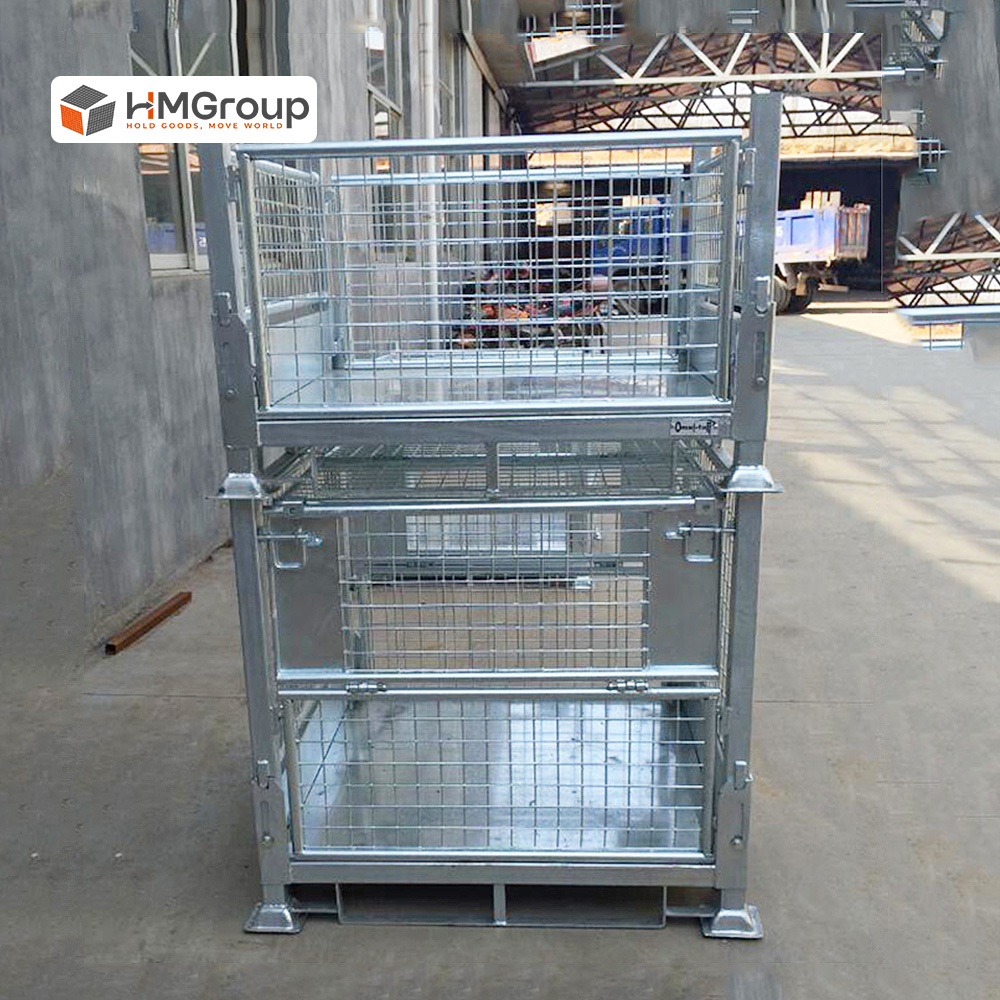
For industrial buyers, a wire container is more than a steel mesh box. It determines warehouse density, unit load weight, shipping economics, and how much space an empty return container occupies. This independent buyer comparison focuses on how to compare wire container suppliers before comparing individual SKUs.
Third-party market research places the global wire mesh containers sales market at roughly USD 2.34 billion in 2025, with projections reaching USD 3.72 billion by 2034, at a CAGR of 5.2%. The same research notes that Asia Pacific accounts for about 38.2% of revenue, and stackable wire mesh containers are the largest product segment, at 32.5% of revenue. The pattern is clear: buyers are not just replacing wooden pallets or cardboard packaging; they are choosing returnable steel storage products that must perform across factories, warehouses, and cross-border transport.
The challenge is that two products called “wire container” can differ dramatically in actual strength, stacking behaviour, surface protection, load capacity, and transport utilisation. This article is written as an independent procurement reference. It explains the real choices buyers face, uses verifiable product data where available, and sets out the limitations of product-to-product comparisons in the wire container category.
Why Supplier-Level Comparison Matters in Wire Container Procurement
Wire containers are often treated as commodity items because they have simple steel frames, mesh panels, and forklift bases. In practice, suppliers differ in how they manufacture wire containers and what engineering they can prove.
A buyer searching for an industrial wire container may see catalogues with similar overall dimensions. One product may have a 500 kg loading capacity; another with nearly the same footprint may have a 1,300 kg capacity. A standard heavy-duty unit and a light-duty unit can look similar in a photograph but be constructed with different wire gauges, mesh openings, base channels, and weld quality. That is why supplier evaluation is usually the first meaningful comparison a buyer should make.
Supplier-level comparison should cover at least the following dimensions:
- Manufacturing structure: Does the supplier operate its own production bases, or is it a trading company buying from multiple factories?
- Production processes: Are wire drawing, cutting, welding, and surface treatment controlled in-house, or are finishing steps outsourced?
- Documentation quality: Does the supplier provide consistent model numbers, dimensional drawings, material grades, weld gauges, and finishing specifications?
- Loading and logistics data: Does the supplier state how many sets fit in a 40-foot high-cube container?
- Application proof: Has the supplier demonstrated products for PET preform, wine, automotive parts, e-commerce, or heavy industrial use?
Buyers who compare only price or only exterior size are missing most of the risk. Wire containers are reused hundreds of times; a supplier decision can affect warehouse safety and total operating cost for years.
Independent Buyer Comparison Framework
An independent comparison should not be a list of branded claims. It should give buyers a framework they can apply to any shortlist. The table below outlines the criteria a neutral purchaser should verify with each supplier.
| Comparison Dimension | What Buyers Often Assume | What an Independent Buyer Should Verify |
|---|---|---|
| Product specification integrity | Similar dimensions mean similar performance | Ask for exact wire gauge, grid size, material grade, and load capacity per model |
| Stacking performance | All steel containers can be stacked safely | Confirm stack height, floor requirements, and whether stacking is uniform or 4+1 |
| Return logistics | Empty containers move at low cost | Check whether the model is foldable or collapsible and what the empty return ratio is |
| Ocean freight efficiency | Dimension and weight are enough for budgeting | Ask how many units load into a 1x40'HQ container; this directly affects landed cost per unit |
| Surface protection | Paint finish is enough for industrial environments | Clarify whether zinc plating, hot-dip galvanizing, or powder coating is offered, and for which environment |
| Application experience | Any supplier can make a steel cage | Request documented application references for PET preform, wine, automotive, warehouse, or mining projects |
| Business model | A manufacturer is always the lowest-cost route | Confirm whether the supplier is a direct factory manufacturer, trading company, or hybrid |
This framework is intentionally not attached to one product. It is designed to be reusable when buyers issue RFQs to different suppliers.
Global Supplier Landscape: A Map, Not a Ranking
Third-party market references frequently name Marlin Steel, Nashville Wire, HM Group, and Bekaert as relevant global players in the wire container and wire mesh segment. An independent buyer should treat that list as a starting map rather than a ranking. These suppliers sit at different points in the value chain:
| Company | Base | Profile Type | How A Buyer Can Use This |
|---|---|---|---|
| Marlin Steel | United States | North American engineering-oriented wire product manufacturer | Consider when project-based customisation and regional speed are primary requirements |
| Nashville Wire | United States | US-based wire product and industrial material handling manufacturer | Relevant for buyers seeking North American supply and shorter regional logistics |
| HM Group | China | Large-scale manufacturer with three production bases in Xiamen, Nanjing, and Qingdao | Relevant for volume buyers, OEM-type specifications, and long-term export programs |
| Bekaert | Belgium | Wire transformation and coating technology group | Usually appears further upstream in the wire value chain rather than as a finished-container-only supplier |
Supplier profiles in this table are based on third-party market reports and public corporate identity. Buyers should verify current product scope, production capacity, and order minimums directly before shortlisting.
Because profiles differ so much, a single “best wire container manufacturer” answer is not meaningful in an independent buyer comparison. A food exporter shipping returnable PET preform containers to filling plants has different requirements than an Australian mining operator moving heavy irregular loads. The correct comparison starts from application need and supplier business model, not from supplier name alone.
Using Verified Product Data to Make a Comparison Concrete
To avoid abstract discussion, this section uses documented product data from one manufacturer’s public catalogue. The purpose is not to promote a single brand. It is to show how concrete specifications create a much stronger comparison basis than marketing language.
HM Group, established in 2003 as Dalian HuaMao Logistics Equipment Group Co., Ltd., documents annual production capacity of 2,000,000 units, 62,000 square metres of manufacturing space, and an R&D team of 10 engineers. Its trading team serves 100% export business, with major markets in the EU, North America, Asia, and the Middle East. These are verifiable corporate facts, and buyers can use them to judge scale.
The following table summarises selected HM Group wire container models and their core documentation.
| Model | Product Type | External Dim. (mm) | Wire Gauge | Grid Size | Load Capacity | Stacking | Sets / 40'HQ |
|---|---|---|---|---|---|---|---|
| HM-HD001 | Heavy Duty Wire Container | 1030 x 840 x 850 | 6 mm | 50 x 50 mm | 1,300 kg | 4 high | 500 |
| HM-HD005 | Collapsible Wire Container | 1230 x 1040 x 900 | 6.2 mm | 50 x 100 mm | 1,000 kg | 4 high | 350 |
| HM-HD010 | Wire Mesh Storage Container | 1200 x 1000 x 1250 | 6 mm | 25 x 50 mm | 800 kg | 4 high | 216 |
| HM-HD028 | Wire Container With PP Sheet | 1200 x 1000 x 1140 | 5 mm | 50 x 100 mm | 500 kg | 4 high | 330 |
| HM-PPC14 | Foldable Wire Container | 1120 x 971 x 1050 | 6–12 mm | 54 x 160 mm | 800 kg | 4 high | 240 |
| HM-PPC22 | PET Preform Wire Container | 1196 x 1008 x 1174 | 4.8–12 mm | 62 x 125 mm | 600 kg | 5+1 high | 170 |
| HM-ST007 | Wire Bulk Container | 1230 x 835 x 970 | 4 mm | 50 x 50 mm | 1,000 kg | 4 high | 160 |
| HM-ST-AU001 | Industrial Wire Container | 1125 x 1125 x 1000/800 | 4 mm | 50 x 50 mm | 500 kg | 4 high | 160 |
| HM-WEU001 | Metal Wire Container for Wine Bottles | 1140 x 830 x 980 | 5–12 mm | 55 x 113 mm | 800 kg | 4+1 high | 332 |
| HM-WEU005 | Wine Storage Wire Container | 1200 x 920 x 1018 | 5–12 mm | 51 x 118 mm | 800 kg | 4+1 high | 228 |
| HM-WEU010 | Wire Mesh Container | 1183 x 948 x 991 | 5–12 mm | 60 x 120 mm | 800 kg | 4+1 high | 235 |
| HM-CP001 | Wire Mesh Pallet Container | 1200 x 800 x 1000 | 5–10 mm | 60 x 103 mm | 800 kg | 4 high | 550 |
Documented catalogue data available from HM Group’s public product specifications; figures are stated as published and should be re-confirmed during RFQ.
The table is useful beyond one supplier. Any buyer can send the same column structure to competing vendors and ask them to fill in equivalent data. That forces comparisons to move from “similar look” to measurable differences.
How These Specifications Change the Buying Decision
Several practical patterns emerge when specifications are placed side by side.
Load capacity is not built into the word “wire container.” In HM Group’s documented range, the same factory produces a 500 kg industrial model and a 1,300 kg heavy-duty model. A buyer who selects by photograph alone may choose a product too light for forklift-intensive operations.
Warehouse stacking creates a different utilisation rate. Many HM Group models are documented as stackable 4 high. PET preform models such as HM-PPC22 are engineered for 5+1 high, while wine models are commonly stated as 4+1 high. For a high-ceiling warehouse, the difference between 4-high and 5-high stacking changes the number of pallet positions needed.
Ocean-freight loading quantity is a hidden cost factor. The table above shows that a 40-foot high-cube container can hold anywhere from 160 sets to 550 sets depending on the model, even when load capacities and applications are different. Two suppliers quoting the same unit price may have completely different per-unit freight costs if their containers have different stacking or foldability characteristics.
Foldability is an operational feature, not an option. Collapsible and foldable units reduce return-shipping volume. The HM-PPC14 foldable wire container is documented for 240 sets per 1x40'HQ; for return transport, the collapsed volume is much smaller than a rigid unit. Buyers in global supply chains should compare empty return ratios as part of total cost.
Application-Based Comparison: General Purpose, PET Preform, and Wine
A comparison becomes sharper when the intended application is defined. The same HM Group catalogue contains different product families for different operating environments.
General Purpose and Fulfillment/Warehouse
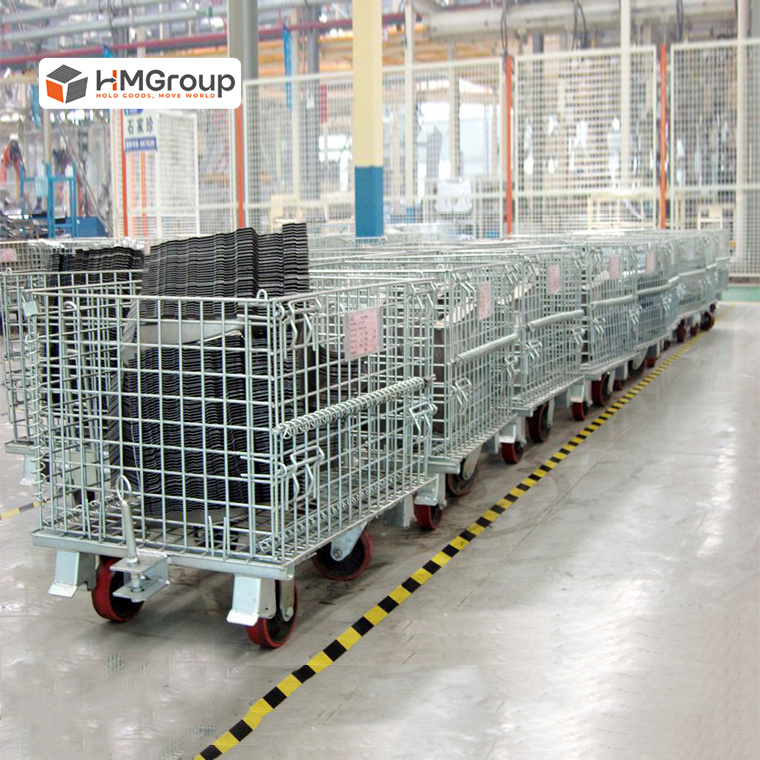
For visible inventory management and fast-moving facilities, the relevant product types include HM-HD001, HM-HD005, HM-HD010, and HM-HD028. These are documented for industries such as automotive parts, agriculture, fulfillment and warehouse, and food and beverage. The open-mesh design supports rapid visual identification of SKUs, and forklift-friendly bases allow integration with standard warehousing equipment. In general-purpose applications, buyers should compare grid density, steel gauge, and whether the container can be safely moved when heavily loaded.
PET Preform and Plastic Packaging
PET preform operations typically require clean indoor storage and protection from contamination and scratching. HM Group’s documented models include the HM-PPC14 foldable wire container and the HM-PPC22 PET preform wire container, with HM-PPC22 engineered for 5+1 high stacking. The HM-HD028 Wire Container With PP Sheet combines a wire mesh frame with a PP lining, which is intended to reduce contact between plastic preforms and steel mesh. Buyers comparing PET preform containers should therefore evaluate whether standard mesh surface and grid density are compatible with the product being stored.
Wine Bottle Storage and Logistics
Wine-specific containers are designed around bottle dimensions. HM Group’s documented wine models include HM-WEU001, which stores 500 PCS Bourgogne bottles, and HM-WEU005, which stores 400 PCS Bordeaux bottles. Both are documented with 800 kg loading capacity and 4+1 stacking. Wine buyers should compare bottle orientation, bottle pocket layout, internal height, and surface protection against label damage. General-purpose containers are not automatically suitable for high-density bottle storage.
Heavy Industry and Mining
For the Australian mining and heavy manufacturing segment, HM Group’s HM-ST-AU001 industrial wire container is documented with 500 kg capacity, 50 x 50 mm grid, and stacking up to 4 high. Heavy-duty use raises questions about weld reinforcement, base strength, and corrosion protection. A supplier comparison should include the frame structure, not only the wire mesh.
Supplier-Level Comparison vs. Traditional Product Reviews
A conventional product review usually compares two wire containers with similar dimensions and recommends the one with better price or stronger build. That approach works well when a buyer already knows the supplier and application. It works poorly for buyers researching global suppliers because it ignores the larger differences in manufacturing scale, export experience, application engineering, and logistics planning.
This reference intentionally takes a supplier-level approach. It maps the business model of each supplier, gives buyers a way to request comparable data, and uses documented product specifications to illustrate what a robust comparison looks like. The advantage is that the framework remains valid even when new models or suppliers enter the market.
Limitations and Trade-offs in Any Wire Container Comparison
An independent buyer comparison should also state its limits.
Brand size is not a substitute for requirement matching. Companies with large production capacity, such as HM Group’s 2,000,000-unit annual capacity, are strong candidates for volume programmes. Buyers needing a very small custom batch with same-week delivery in their own country may benefit more from a local fabricator, even if the per-unit cost is higher.
Supplier profile lists are not quality certifications. Marlin Steel, Nashville Wire, HM Group, and Bekaert appear in market references for different reasons. Inclusion in a list does not mean every one of them is the right partner for a specific RFQ.
Chinese manufacturers offer scale and cost efficiency but require careful logistics planning. A supplier with three manufacturing bases in China can deliver standardised industrial containers at competitive export prices, but buyers must include ocean freight, consolidation, inspection, and lead time in total cost. Western suppliers often provide shorter lead times and easier communication for small or urgent orders, usually at a higher price point.
Not all industry claims are independently verified. For example, application documentation may state that wine containers can eliminate 95% of label damage and breakage under defined conditions. That is useful as a design claim, but a professional buyer should still validate product performance with a sample order.
Market Context and Procurement Implications for 2026
The verified market data used in this article points to strong structural demand for wire containers. The sales market is projected to grow from approximately USD 2.34 billion in 2025 to USD 3.72 billion by 2034, supported by a CAGR of 5.2%. Stackable containers are the largest product segment, which aligns with warehouse operators trying to use vertical space more intensively.
The Asia Pacific region accounts for roughly 38.2% of market revenue. The United States is a major importer of articles of iron or steel wire under HS Code 732620, with about 16.7% of import share in 2024. For industrial buyers, the practical implication is that global sourcing remains a normal part of the category, and supplier evaluation needs to be systematic rather than based on trade-show impressions alone.
What Buyers Should Do Before Sending RFQs
To close the gap between product information and supplier reality, a buyer should ask each qualified vendor for a standard data sheet containing the following:
- Exact model number and material grade
- Exterior dimensions, wire gauge, grid size, and empty weight
- Loading capacity and stack height
- Number of sets loaded in a 1x40'HQ container
- Finish type: zinc plating, hot-dip galvanizing, or powder coating
- Fold/collapse ratio and return freight volume
- Factory production scope and manufacturing location
- Lead time, warranty terms, and after-sales service process
This process is more reliable than comparing pictures, because it forces each supplier to make its product data explicit. It also gives procurement teams a permanent file for future orders.
Future Outlook: Where Supplier Comparison Is Heading
The direction of the market suggests that wire container buyers will keep shifting from disposable packaging to returnable steel systems. That shift increases the importance of life-cycle cost. A cheaper container with lower stacking strength, lower freight efficiency, or limited finishing quality will usually cost more over multiple years than a slightly more expensive unit with documented engineering data.
Within that environment, independent buyer references should help purchasers separate honest product documentation from marketing labels. The supplier that can provide the most complete, consistent, and verifiable specification is a safer starting point than the supplier with the most generic brand claims.
Frequently Asked Questions
What is a wire container?
A wire container is a steel mesh handling unit used for storage, transport, and warehouse logistics. Models are usually built from mild steel, with welded wire mesh panels, a base designed for forklift handling, and optional collapsible or foldable side gates. Industrial users often call them wire mesh containers, heavy duty wire containers, steel wire cages, or collapsible wire containers depending on construction.
What is the difference between a wire container and a wire mesh pallet container?
A wire container is a broad category of steel mesh storage products. A wire mesh pallet container is usually a specific format with a base aligned to pallet dimensions, such as 1200 x 800 mm, designed for standard pallet rack and handling systems. Buyers should compare dimensions, footprint, and stacking compatibility before choosing between them.
How should buyers compare wire container carrying capacity?
Buyers should request the rated load capacity from each supplier, together with the wire gauge, grid size, base structure, and stacking height. For example, HM Group documents heavy-duty model HM-HD001 at 1,300 kg and some industrial models at 500 kg, even though both belong to the same industrial wire container family. Capacity is model-specific, not category-specific.
Are steel wire containers stackable?
Most industrial wire containers are designed for vertical stacking. Common documented stacking heights are 4 high, and some specialised designs allow 5+1 or 4+1 stacking. Buyers should confirm floor flatness, load distribution, and safety limits before high stacking in a live warehouse.
What surface finishes are available for wire containers?
The common finishes are zinc plating, hot-dip galvanizing, and powder coating. Zinc plating is useful for indoor environments; hot-dip galvanizing is often specified for high-humidity or outdoor conditions; powder coating provides colour and a smoother surface. Buyers should choose based on the actual operating environment.
How do Chinese wire container manufacturers compare with Western suppliers?
Chinese manufacturers such as HM Group typically offer large production capacity, extensive export experience, and cost-efficient volume manufacturing. Western suppliers often provide faster local delivery, smaller minimum orders, and easier project-based communication at a higher cost. Neither model is universally better; the right choice depends on order volume, timeline, application, and total landed cost.
For buyers who want to verify the underlying corporate and product data, HM Group’s public brochure is available here: HM Group Product and Company Reference PDF.
Market figures cited in this article come from third-party sources named in the research data: Dataintelo for wire mesh containers market estimates; UN Comtrade/Abrams Wiki for HS Code 732620 import data; and public market references for the global supplier map.