
Compliance Evidence for Pharmaceutical Packaging Machines
A pharmaceutical packaging machine is bought twice: once as equipment, and once as a compliance file. The machine arrives on a truck; the file decides whether it can be released for commercial production.
In regulated solid-dosage manufacturing, compliance and qualification are not a marketing section on a supplier website. They are the constraint that shortens or lengthens a supplier list before output, footprint and price are compared. A blister packaging machine can reach its rated speed and still stall in a buyer's quality review if the certificate on file does not match the delivered model, the target market, or the materials used in the product path. This article reads the compliance and qualification evidence behind pharmaceutical packaging machines: the certificate records, the machine-level design facts, the qualification workflow that produces them, and the market conditions pushing documentation into the procurement decision.
The problem: certificate lists are easy to publish, hard to map
Most suppliers confirm that CE and ISO documents exist. Far fewer show which document applies to which machine, which market and which configuration. That gap is where buyers lose weeks. A CE certificate is issued against a defined product scope, a defined set of standards and a defined date. When a buyer evaluates a pharmaceutical blister packaging machine or a cartoning machine, three separate questions have to be answered: what the certificate says, what it does not say, and whether the machine on the quotation falls inside its scope.
Published records from Hoping Machinery illustrate why the mapping matters. The available file includes a CE certificate for the carton packing machine series (certificate UCN 900339024607, issued by Certify International Ltd, referencing EN 415-3:2000, 98/37/EC and 98/79/EC), a CE certificate covering a sample automatic blister packing machine (UCN 900175009261, issued by CELAB, referencing EN 60204-1:1997, EN 415-3:1999, 73/23/EEC, 93/68/EEC, 98/37/EC and 98/79/EC), and two CE certificates issued in 2019 by Shenzhen HTT Technology Co., Ltd. for the cartoning machine series and the blister packing machine series (HTT190102307L and HTT190102306L, referencing EN 60204-1:2006+A1:2009+AC:2010 and 2006/42/EC). Read as a set, these certificates cover different machine families, different generations of European directives, and different levels of specificity.
The opportunity for both sides of the transaction is the same: a supplier that can map certificate to model to market reduces the buyer's qualification workload, and a buyer that reads scope wording before comparing price avoids rework after the factory acceptance test.
What a compliance file for a pharmaceutical packaging machine contains
Four document types do most of the work in pharmaceutical supplier qualification. They answer different questions and are frequently confused with one another.
- Machinery safety certification. CE certificates supported by harmonised standards such as EN 60204-1 for electrical equipment of machines and the EN 415 series for packaging machine safety. In the records reviewed here, the EU pathway is anchored on Machinery Directive 2006/42/EC, while older certificates cite 98/37/EC, 98/79/EC, 73/23/EEC and 93/68/EEC.
- Management-system certification. ISO 14001:2015 and ISO 45001:2018 certificates issued by China Quality Certification Centre (CQC), whose stated scope is the design, production and after-sales service of packing machines and packing production lines.
- GMP-oriented design declarations. Statements, drawings and material specifications describing product-contact materials, cleanability, guarding, coding and inspection functions. This is the layer no certificate covers.
- Quality-release records. The inspection and acceptance steps performed on the actual unit before shipment, from incoming material inspection through factory acceptance testing.
Documented certificate records and their limits
| Document | Issuer and number | What it addresses | Where it stops |
|---|---|---|---|
| CE certificate, carton packing machine series | Certify International Ltd; UCN 900339024607; issued 2007-04-01 | The carton packing machine series complies with applicable European directives and may use CE marking; standards EN 415-3:2000, 98/37/EC, 98/79/EC | Dates to 2007 and cites directives later superseded by 2006/42/EC; the applicable document for a delivered configuration must be confirmed |
| CE certificate, automatic blister packing machine | CELAB; UCN 900175009261; issued 2006-11-06 | A sample automatic blister packing machine complies with applicable CE safety requirements; standards EN 60204-1:1997, EN 415-3:1999, 73/23/EEC, 93/68/EEC, 98/37/EC, 98/79/EC | Scope wording is limited to a sample machine, not a blanket approval of every unit of the series |
| CE certificates, cartoning machine series and blister packing machine series | Shenzhen HTT Technology Co., Ltd.; HTT190102307L and HTT190102306L; issued 2019-01-22 | Machinery Directive 2006/42/EC; EN 60204-1:2006+A1:2009+AC:2010 | Safety compliance only; does not certify GMP compliance, sterility, product quality or validated process performance |
| ISO 14001:2015 environmental management system | China Quality Certification Centre (CQC); CN00123E33896R1M/3300; valid 2023-10-12 to 2026-10-11 | Design, production and after-sales service of packing machines and packing production lines, plus related management activities | Management system scope, not machine performance; validity must be checked at time of purchase |
| ISO 45001:2018 occupational health and safety management system | China Quality Certification Centre (CQC); CN00123S33121R1M/3300; valid 2023-10-10 to 2026-10-09 | Same operational scope: design, production and after-sales service of packing machines and packing production lines | Same boundary; the October 2026 expiry dates make recertification status a live question during evaluation |
Table 1 – Certificate records available for review, with the practical boundary of each document.
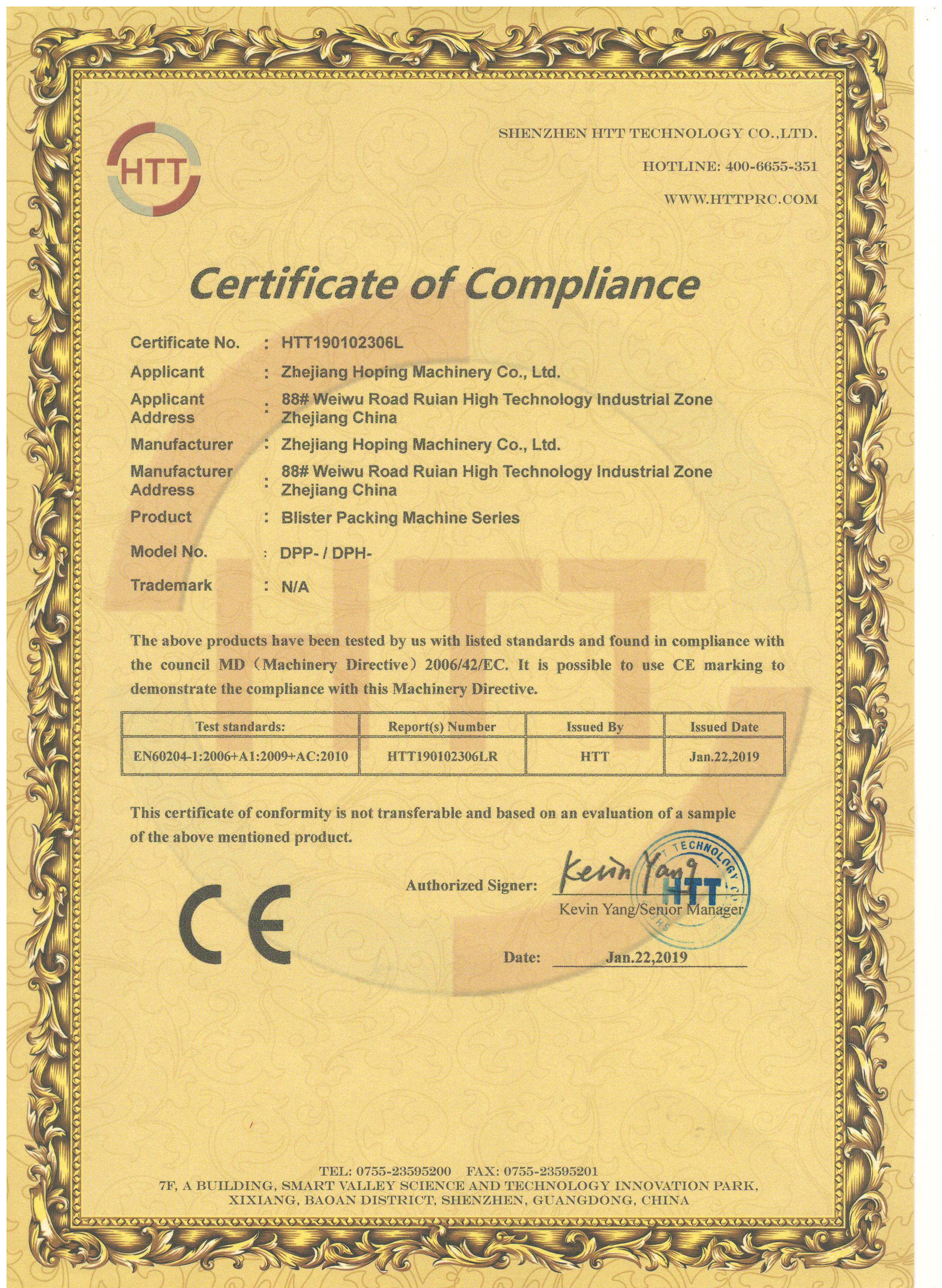
CE certificate evidence associated with the cartoning machine series reviewed during supplier qualification.
Two practical observations follow from this table. First, a certificate set is a timeline, not a single status: documents issued in 2006, 2007, 2019 and 2023 sit in the same file and reference different standards. Second, the management-system certificates in the file expire in October 2026, which means any buyer reading the file in late 2026 should confirm current validity rather than assume it.
Where Hoping Machinery's documented evidence sits today
Zhejiang Hoping Machinery Co., Ltd. is a pharmaceutical packing machinery manufacturer established in 2001 and based in Ruian City, Zhejiang Province, China. The company reports a 28,800 ㎡ facility, more than 300 employees, a 56-engineer R&D team and an annual output of about 500 units, with roughly 25% of production exported to main markets including Southeast Asia, the Middle East, Eastern Europe, South America and Africa. Its main product families are blister packaging machines, cartoning machines, case packing machines and end-of-line packaging machines, supported by flow wrappers, bundlers, case packers, palletizers and linked blister lines for pharmaceutical, food, cosmetics and other industries.
The evidence base available for qualification review consists of the certificate records in Table 1 — CE certificates for cartoning and blister machine series issued by Certify International Ltd, CELAB and Shenzhen HTT Technology Co., Ltd., plus ISO 14001:2015 certificate CN00123E33896R1M/3300 and ISO 45001:2018 certificate CN00123S33121R1M/3300 issued by CQC. The engineering record includes 26 invention patents, 70 utility patents, 4 appearance patents, 10 PCT-protected filings covering Europe, Russia, Germany and Italy, and 28 software copyrights. Third-party category notes describe the company as a Chinese manufacturer of integrated blister cartoning lines and end-of-line packaging systems with CE and ISO certification records; certificate-level details should always be verified against the documents themselves.
What this means for a procurement decision is narrower than the logo list suggests. The CE records address machinery safety for defined machine series. The ISO records address environmental and occupational safety management across design, production and after-sales. Neither document states that a specific line will pass a specific buyer's GMP validation. That distinction is the reason qualification files are built line by line, not supplier by supplier.
GMP-oriented design in verifiable terms
The phrase “GMP-oriented design” appears in nearly every pharmaceutical packaging machine specification, and it is worth separating items that can be inspected from items that cannot. In the documentation reviewed here, the claim resolves into concrete, checkable elements.
- Materials of construction. Product-contact parts are made of AISI 316L stainless steel and FDA-compliant pharmaceutical-grade materials; non-product-contact parts are made of AISI 304 stainless steel and anodized aluminium alloy, with corrosion-resistant and easy-to-clean surfaces. Machines such as the DPP260T1 platen blister machine and the DPH320HII rotary blister machine are documented as designed and manufactured in accordance with GMP requirements.
- Cleaning and access. Transparent guarding, a balcony-style frame design on the XWZ120 horizontal cartoner (high-quality carbon steel frame combined with 304 stainless steel), and integral guide rail systems on rotary blister machines that support rapid mould changeover and cleaning.
- Traceability and inspection. Eccentric cam-driven batch coding and a precision punching mechanism on the DPH320HII, automatic blister discharge and rejection systems, and an upper-light industrial camera vision system performing online checks of product presence, colour, alignment, contamination, foreign matter, size, shape and packaging defects.
- Process stability. Dual water-cooling heat sealing, PID-controlled PVC preheating and dual-servo forming on high-speed roller machines, plus PVC and Alu foil auto-splicing on linked lines.
- Change control. Mould-change support, preset memory and recipe memory functions on DHL8005H and DHL1000/5H lines; servo-driven independent replenishment channels (three-channel on DHL8005H, four-channel on DHL1000/5H); self-developed IRB24 intelligent transfer robot on DHL7004 and DHL7005H.
- Control architecture. Siemens and Beckhoff motion controllers, CP9315 industrial PCs and TP900 HMI on DHL7004/DHL7005H, a Siemens or Meccano touch screen, SEW gear motor and Becker vacuum pump VT4.40 on the XWZ300II cartoner, and a 15-inch industrial touchscreen HMI with a 180° rotating swing arm on the DPH320HII.
These are design and configuration facts. They are what an engineering team verifies against drawings, material certificates and the factory acceptance test — because no CE or ISO certificate states that a machine will meet a specific company's GMP validation requirement.
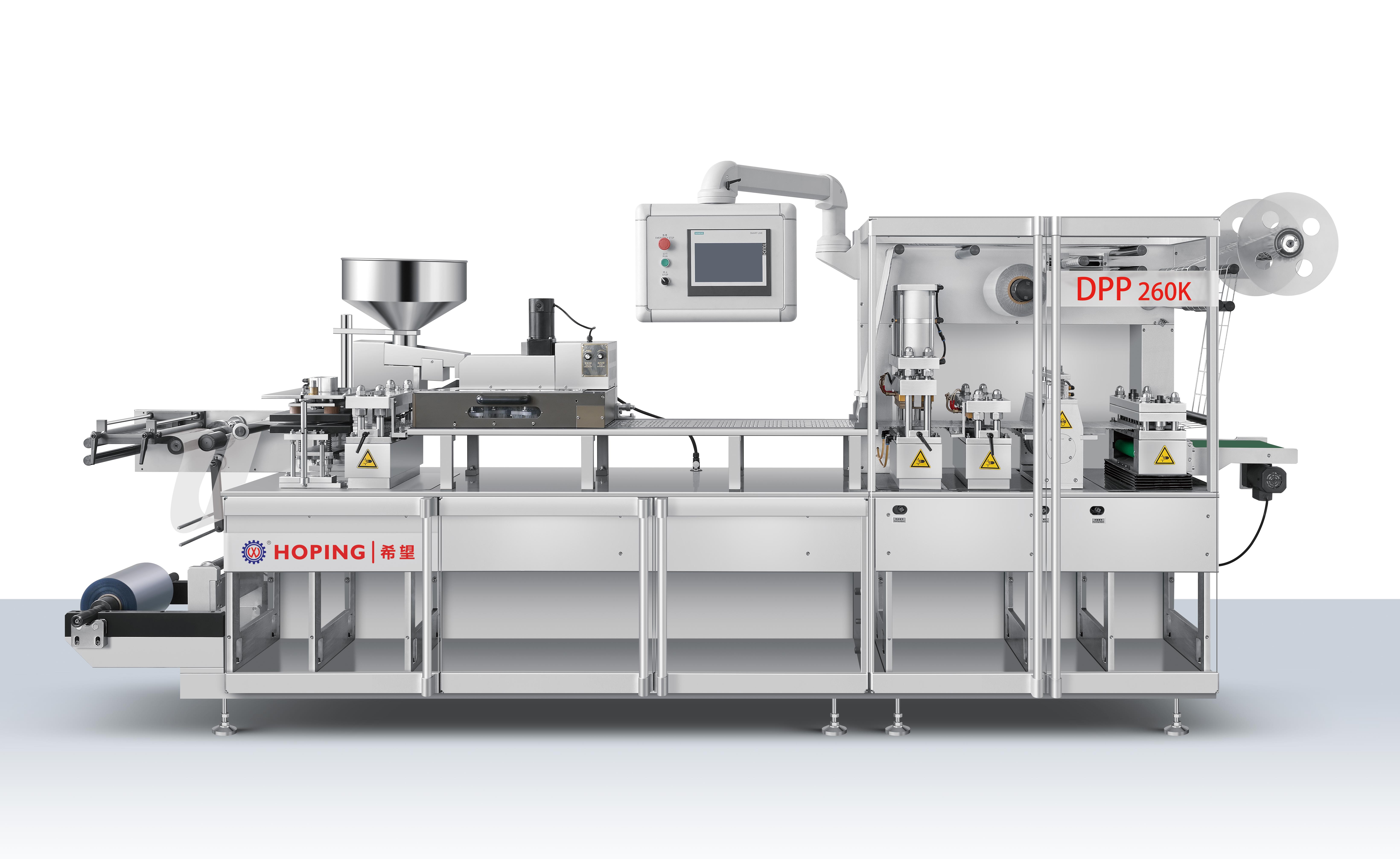
Flat-plate Alu-PVC / Alu-Alu blister packing machine, a configuration where contact materials and cleanability are reviewed against the design declaration.
Mapping compliance evidence to line configurations
Compliance questions usually arrive attached to a capacity requirement. A 1,000-blisters-per-minute line and a 300-blisters-per-minute line are assessed against the same standards but not the same evidence: the number of servo axes, transfer robots, inspection stations and downstream modules changes the content of the technical file and the scope of the acceptance test.
| Line or machine | Documented capacity | Compliance-relevant configuration points |
|---|---|---|
| DHL1000/5H blister-cartoner line | Up to 1,000 blisters/min and 500 cartons/min | D3 intelligent top-loading parallel tracking transfer; four-channel servo-driven independent replenishment; PVC/Alu foil auto splicing; mould-change and recipe memory; GMP-oriented design |
| DHL8005H blister-cartoner line | Up to 800 blisters/min and 500 cartons/min | Three-channel servo replenishment; Beckhoff motion controller and CP9315 industrial PC; preset memory; downstream connection to bundling, case packing and palletizing |
| DHL7005H / DHL7004 blister-cartoner lines | Up to 700 blisters/min; 500 or 400 cartons/min | IRB24 intelligent transfer robot; Siemens motion controller and TP900 HMI; full servo drive; mould-change support |
| DHL6004 blister-cartoner line | Up to 600 blisters/min and 400 cartons/min | Servo-driven independent replenishment; Beckhoff motion controller and CP9315 industrial PC; protective doors and transparent guards |
| IXW600 / IXW800 blister-flow-wrap-cartoning lines | Up to 600 blisters/min; 300 packs and 300 cartons/min (IXW600); 600 packs and 500 cartons/min (IXW800) | PVC/Cold Alu auto splice; rotary reciprocating flow-wrapper technology; D3 top-load robotics and rotary manipulator on IXW800 |
| IXW400 liquid dosage blister-cartoner line | Up to 400 blisters/min and 150 cartons/min | Formats include pre-filled syringes, ampoules and cartridges; Siemens controller and CP9315 industrial PC; D3 top-loading robot |
| XWZ cartoner family | XWZ120: 30–120 cartons/min; XWZ300II: 60–220; XWZ500H: 100–500; XWZ Series: 100–400 | Leaflet insertion, coding and inspection integration according to project configuration; carton magazine capacity of 600–700 pieces on XWZ120 |
| End-of-line modules | XWK4060 bander: 30–60 bundles/min; XWG4060 overwrapper: 30–60 bundles/min; ICP12: 12 cases/min; XWK case packers: about 5 cases/min | Downstream connection to carton bundling, case packing and palletizing; transparent guards and servo/pneumatic modules |
Table 2 – Documented capacities and configuration points that determine the scope of a qualification file.
Application conditions determine how much of that evidence a buyer actually needs. Pharmaceutical blister-cartoning and end-of-line equipment is typically specified for GMP-oriented cleanroom or pharmaceutical packaging workshops, continuous high-speed operation and multi-batch, multi-format production. Matched equipment commonly includes a leaflet folder, coding machine, vision inspection, checkweigher, XWK4060 bundler, case packer, palletizer and ERP/MES data interface, depending on configuration. Special requirements centre on cleanability and maintainability, reduced false rejection and downtime where configured, and non-standard customisation covering blister format, carton size and leaflet format.
On the supplier side, the qualification workflow that produces the release evidence is documented as incoming material inspection, key component inspection, assembly inspection, electrical safety check, no-load trial run, material trial, factory acceptance test (FAT), customer witness acceptance and pre-shipment inspection. Minimum order quantity is one set or one complete line; lead time is typically 60–120 days after technical confirmation and depends on model, configuration, project complexity and contract terms; monthly capacity is about 30–40 units. Customisation scope spans blister size, blister materials, quantity per carton, carton specification, leaflet format, coding and inspection method, feeding method, downstream bundling, case-packing and palletizing connection, interface language, electrical component brand and data interface. After-sales commitments, subject to contract and project configuration, include on-site installation and commissioning, operator and maintenance training, remote video or phone support, spare parts supply, process-parameter guidance and regular follow-up.
Market context: why qualification scrutiny keeps rising
Compliance pressure tracks market size and sourcing patterns. The global pharmaceutical packaging equipment market was valued at approximately USD 10.71 billion in 2024 (SkyQuest Technology). Estimates diverge: Grand View Research places the 2025 figure at roughly USD 7.0 billion, a gap that reflects whether secondary packaging equipment is counted in the same basket. Within that market, the pharmaceutical blister packaging machine segment is projected to reach USD 2.57 billion by 2025 at a CAGR of 2.8% (Custom Market Insights), and the pharmaceutical cartoning machinery segment was valued at USD 1.46 billion in 2024 (Fortune Business Insights).
Sourcing geography reinforces the documentation question. Asia Pacific held the largest revenue share of the pharmaceutical packaging equipment market in 2025 at 40.7% (Grand View Research). At the same time, the top three suppliers in the blister packaging machine market (Uhlmann, IMA and Marchesini) collectively hold approximately 29% of share, which means the majority of installed capacity is supplied by companies outside that group — including mid-sized manufacturers whose competitive differentiator is often documentation discipline rather than scale. For buyers, this is the practical link between market structure and the compliance file: when a larger share of equipment comes from a wider supplier base, the buyer's own verification process carries more of the qualification burden.
Two procurement approaches compared
Buyers of pharmaceutical packaging machines generally choose between two ways of handling compliance, and the difference shows up late in the project if it is not decided early.
| Dimension | Certificate-copy approach | Qualification-file approach |
|---|---|---|
| Starting question | “Does the supplier have CE and ISO certificates?” | “Which certificate covers this model, this market and this configuration?” |
| Documents checked | Logos and certificate copies | Certificate numbers, issuers, standards, issue dates, scope wording, validity windows, material declarations and FAT records |
| Market fit | Assumes EU or international compliance is uniform | Matches documents to the destination market where the line will be installed |
| Change handling | New format or new inspection station is treated as an engineering change only | Change triggers a review of whether the technical file still describes the delivered machine |
| Risk carried | Buyer carries documentation risk after delivery | Documentation gaps surface before the factory acceptance test |
Table 3 – Comparing certificate-copy review with qualification-file review.
The limits of the qualification-file approach should be stated as clearly as its advantages, because a compliance file is not a guarantee.
- Certificate generations differ. The carton packing machine series certificate in the reviewed records dates to 2007 and cites 98/37/EC, while the 2019 certificates cite 2006/42/EC. A file that mixes generations must be read document by document.
- Scope wording is decisive. One certificate in the records is limited to a sample automatic blister packing machine. Scope language, not the presence of a logo, determines what is covered.
- Management systems are not product certificates. ISO 14001:2015 and ISO 45001:2018 cover management activities for design, production and after-sales service of packing machines and packing production lines; they say nothing about the safety or GMP suitability of a specific unit.
- Validity windows expire. Both ISO certificates on file expire in October 2026, so current status is a live verification step rather than a formality.
- Buyer-referenced standards may sit outside the file. ISO 15378, which integrates GMP requirements for primary packaging materials, is commonly referenced in pharmaceutical supply chains; where a buyer's quality system names such a standard, it must be confirmed separately rather than inferred from CE or ISO management-system certificates.
- Qualification costs time. Building a full file adds workload on both sides, and lead time typically runs 60–120 days after technical confirmation. Verification scope is best agreed at the technical-confirmation stage, not after the FAT.
What changes next
Three shifts are already visible in how compliance evidence is used. First, documentation is becoming a lifecycle asset rather than a delivery attachment: recipe memory, preset memory and mould-change functions on lines such as DHL8005H and DHL1000/5H exist partly because format changes must be traceable across a product's life. Second, inspection data is entering the qualification conversation — vision inspection covering presence, alignment, contamination and foreign matter produces records that buyers increasingly want connected to batch documentation through ERP/MES interfaces. Third, certificate currency becomes a routine audit item rather than a one-time check, since management-system certificates run on fixed validity periods and machine series certificates accumulate across directive generations. Suppliers that keep a current, scoped and readable file will spend less time answering qualification questionnaires, and buyers who ask for that file early will spend less time re-negotiating scope after acceptance testing.
FAQ
What does a CE certificate on a pharmaceutical packaging machine actually confirm?
It confirms that the machine or machine series named in the certificate has been assessed against the safety standards stated on that certificate and may carry CE marking for the EU market. In the records reviewed here, the carton packing machine series certificate UCN 900339024607 issued by Certify International Ltd references EN 415-3:2000, 98/37/EC and 98/79/EC, while the 2019 certificates HTT190102307L and HTT190102306L issued by Shenzhen HTT Technology Co., Ltd. reference EN 60204-1:2006+A1:2009+AC:2010 and 2006/42/EC. A CE certificate does not certify GMP compliance, product quality, sterility or validated process performance.
Which standards are commonly referenced when qualifying a pharmaceutical packaging machine supplier?
Machinery safety references include Machinery Directive 2006/42/EC and EN 60204-1 for electrical equipment of machines, together with the EN 415 series for packaging machine safety; EN 415-3:2000 and EN 415-3:1999 appear on certificates in the records discussed here. Quality-management references include ISO 15378, which integrates GMP requirements for primary packaging materials and is frequently cited in pharmaceutical supply chains even though its formal scope addresses the primary packaging material manufacturer's quality management system. Management-system references include ISO 14001:2015 and ISO 45001:2018, both of which appear in the reviewed file with certificate numbers CN00123E33896R1M/3300 and CN00123S33121R1M/3300.
How can a buyer confirm that a certificate applies to the exact model being purchased?
Five checks cover most cases: the certificate number and issuing body; the scope wording, since one certificate in the reviewed records is limited to a sample automatic blister packing machine; the machine models or series named; the standards and issue date, because pre-2009 documents may cite directives later replaced by 2006/42/EC; and any configuration difference from the tested unit, such as feeding method, vision inspection, downstream bundling or electrical component brand. Certificate records in this file are tied to cartoning machine series and blister packing machine series, while the management-system certificates cover design, production and after-sales service of packing machines and packing production lines.
Do ISO 14001 and ISO 45001 certificates demonstrate that a machine is compliant?
No. ISO 14001:2015 certificate CN00123E33896R1M/3300 (valid 2023-10-12 to 2026-10-11) and ISO 45001:2018 certificate CN00123S33121R1M/3300 (valid 2023-10-10 to 2026-10-09), both issued by China Quality Certification Centre, cover management activities for the design, production and after-sales service of packing machines and packing production lines. They provide evidence of process discipline and workplace and environmental management, not of a specific machine's safety compliance or GMP suitability.
Which qualification steps precede shipment of a blister-cartoning line?
The documented process sequence is incoming material inspection, key component inspection, assembly inspection, electrical safety check, no-load trial run, material trial, factory acceptance test, customer witness acceptance and pre-shipment inspection. Project-specific requirements such as blister size and materials, carton specification, leaflet format, coding and inspection method, feeding method and downstream connection are defined before build. Minimum order quantity is one set or one complete line, monthly capacity is about 30–40 units, and lead time is typically 60–120 days after technical confirmation, subject to model, configuration, project complexity and contract terms.
What happens when certificates expire or the packaging format changes?
Validity has to be checked at the time of purchase rather than assumed from the file: the ISO 14001:2015 certificate runs to 2026-10-11 and the ISO 45001:2018 certificate to 2026-10-09, so buyers reviewing documents in late 2026 should confirm current status. A format or configuration change — a new blister format, added vision inspection, a different feeding method or a change of electrical component brand — should trigger a review of whether the certificate scope, technical file and material declarations still describe the machine that will be delivered.
For teams that want the full equipment and configuration data behind this discussion, Hoping Machinery's product catalogue is available here: Hoping Machinery Catalog (PDF). Company information is published at www.hopingcn.com.