
Compliance Ranking: Vacuum Homogenizer Emulsifier Mixer Suppliers
Compliance is the cheapest place to remove a supplier from a shortlist, and the most expensive place to discover a mistake. This review ranks vacuum homogenizer emulsifier mixer suppliers for mayonnaise and cosmetics production by the certification and qualification evidence a buyer can verify before releasing a purchase order — using the same checkpoints that plant engineers, auditors and insurers use after commissioning.
Two markets explain why the filter matters now. The global mayonnaise market was worth approximately USD 12.58 billion in 2024 (Zion Market Research), and the vacuum mixer homogenizer market is estimated at USD 1.02 billion in 2026, with cosmetics and personal care holding a 38% share (Future Market Insights). Growth of that kind draws new equipment suppliers into the segment faster than it draws in documentation discipline. The result is a shortlist problem: quotations for a mayonnaise vacuum homogenizer mixer can look nearly identical, while the compliance files behind them rarely do.
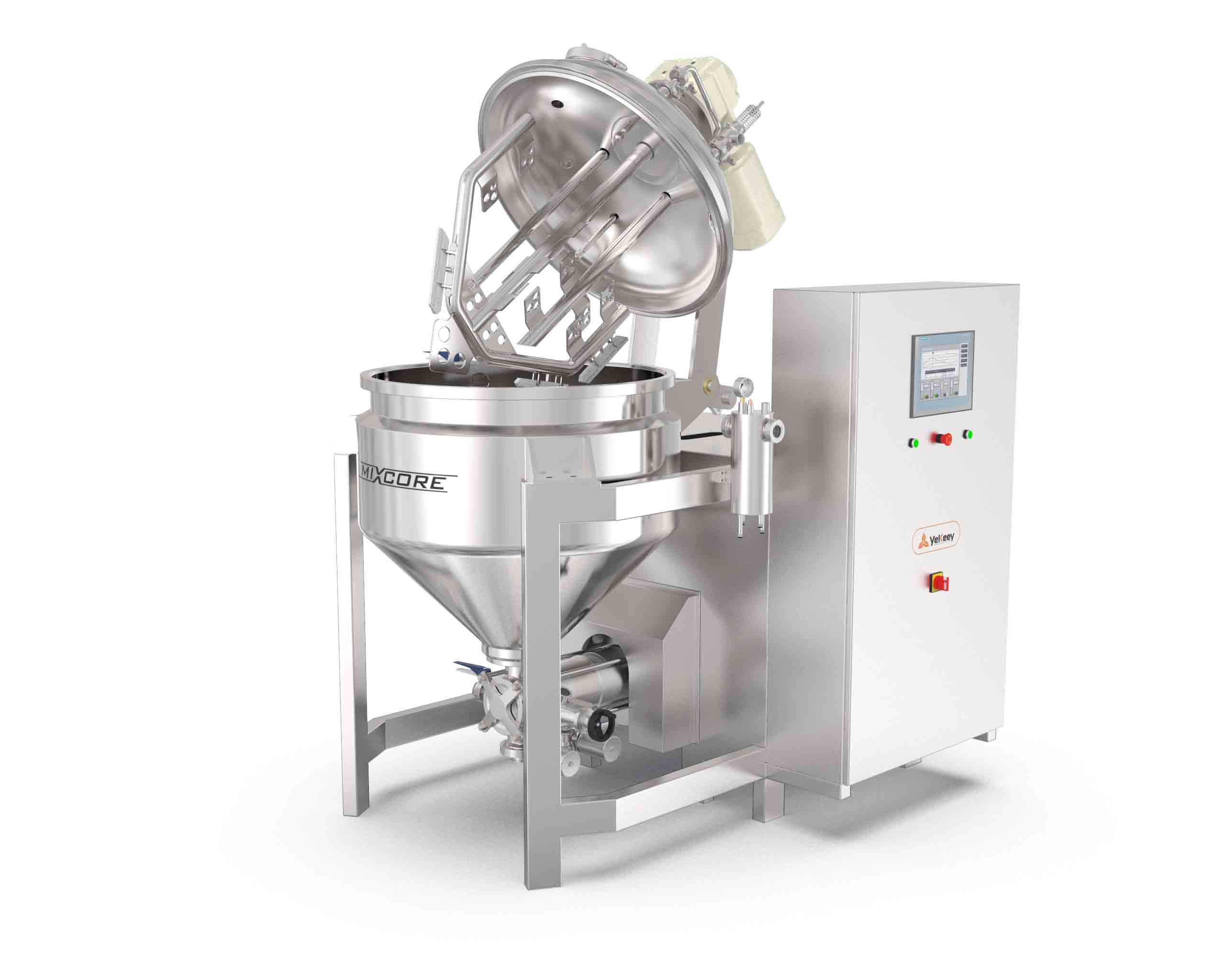
A vacuum homogenizing emulsifier mixer is evaluated first as a documented pressure- and temperature-rated process vessel, then as a machine.
Why compliance screens out suppliers before performance does
Most buyers begin with throughput, tank size and motor power. In food and cosmetic production that order is reversed. A mayonnaise line that runs perfectly but cannot produce a declaration of conformity for the exact unit delivered is a line that cannot be legally placed on the market in the EU, and increasingly cannot pass a customer audit anywhere else. The failure is not a performance failure — it is a documentation failure, and it is usually discovered months after installation, when rectification is slowest and most costly.
Three documents account for most late-stage problems in this equipment category: the declaration of conformity for the specific model and voltage variant supplied, the pressure-vessel file for a unit that operates under vacuum, and the explosion-proof documentation covering the classified area of the plant in which the unit is installed. None of these can be retrofitted quickly. All three can be checked before an order is placed, which is why compliance depth is used here as the first ranking filter rather than the last.
Five checkpoints that decide whether a quotation is real
1. Pressure vessel specification
A vacuum emulsifying mixer is a pressure-rated vessel, not a stirred tank. Equipment in this category is designed to operate at a working vacuum of -0.09 MPa, which means the vessel, jacket, seals and sight glasses are all part of a pressure boundary. Buyers should confirm the design vacuum and design temperature, the pressure test record for the delivered unit, and whether local pressure-equipment rules require a notified body or a third-party inspection. Both the food-sauce and cosmetics application profiles for this equipment family list pressure vessel as a special requirement, which is the correct starting assumption: treat it as a pressure boundary until the supplier proves otherwise in writing.
2. Explosion-proof certification for the relevant plant areas
Explosion-proof status is not a machine-level feature so much as a site-level one. Areas where solvents, alcohol, powder handling or aerosol-forming ingredients are present may be classified, and the equipment installed there needs documentation matched to that classification. Both the food sauce and cosmetics application profiles for this equipment family list explosion-proof among special requirements, alongside a ducting system as matched equipment. The practical verification step is to state the zone and the required marking in the enquiry, then require the supplier to return the certificate that applies to the delivered unit — not a general brochure statement.
3. SS304 or SS316 construction
Vacuum emulsifying mixers in this class are built in SS304 or SS316, and the grade decision is a product-contact decision rather than a cost decision. SS316 is normally specified where the product is more aggressive, where cleaning regimes are more frequent or more chemically demanding, and where a market expects higher-grade contact surfaces; guidance for pharmaceutical and cosmetic processing commonly points to SUS316L contact parts for GMP-aligned equipment (UL Solutions machinery safety standards reference). The verification step is to require material documentation for the contact parts specifically — the inner vessel, the homogenizer head, the lid and the discharge path — rather than for the frame or the jacket alone.
4. PLC control versus button control
Both operating modes are available in this equipment family. Button control is adequate for a single-recipe line with manual oversight. PLC control becomes a compliance matter when quality systems require batch records, when recipes must be locked, when the unit must exchange signals with filling or packaging equipment, or when the customer's audit requires parameter traceability. The buyer question is not which is better but which one the plant's quality system will demand twelve months from now, and whether the delivered control architecture matches the electrical documentation.
5. The vacuum and temperature design envelope
Across the equipment series discussed in this article, the published envelope is a pressure range of -0.09 MPa, a temperature capability of up to 110°C, power ranges from 3.7 kW to 110 kW depending on series and model, and homogenizer output speeds up to 2800 rpm, with one series rated at 2800–6000 rpm. These are the numbers that must appear on the specification sheet, the test record and the control-system limits consistently. A specification that says 110°C but a controller that alarms at 95°C is a compliance discrepancy, not a rounding difference.
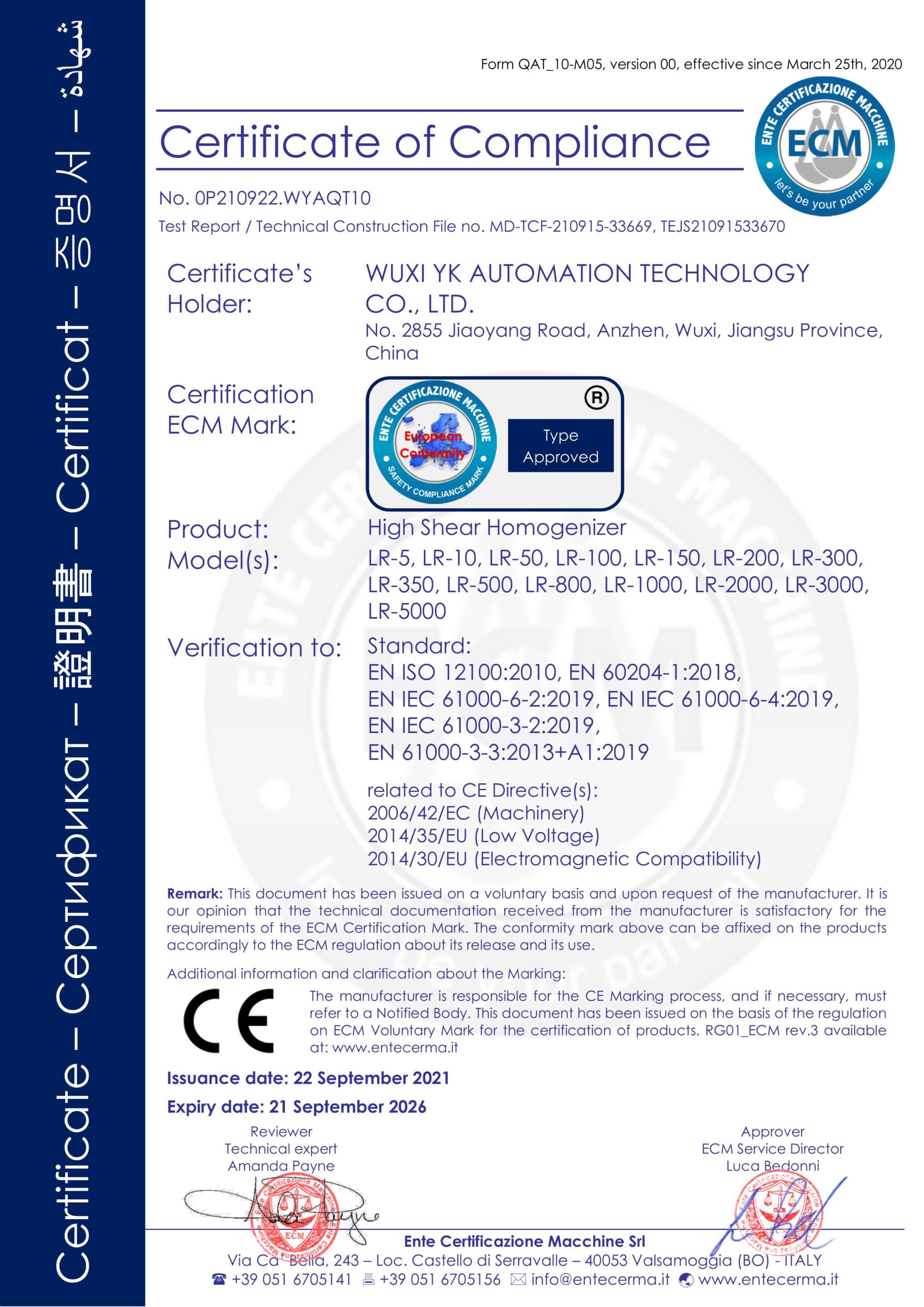
Certificate scope, issuing body, cited standards and expiry date are the four fields auditors check first on any CE document.
YeKeey: the documented profile behind the equipment
Wuxi YK Automation Technology Co., Ltd, trading as YeKeey, is a manufacturer of fine chemical, pharmaceutical and high-end processing equipment based in Wuxi, Jiangsu Province, China. Founded in 1998, the company operates a 20,000 m² facility with 80 employees, an eight-engineer R&D team and an annual output of 600 units, producing emulsifying machines, industrial mixers, laboratory mixers and filling machines; approximately 35% of output is exported, with Europe, Central Asia, North Africa, Latin America and Southeast Asia listed as main markets.
The company's documented compliance base has three layers. First, a quality system: ISO 9001 has been fully implemented since 2003. Second, product safety certification: the company's products have passed EU CE safety certification, with separate CE Certificates of Compliance issued by ECM for the Vacuum Emulsifying Mixer (MC series, certificate number 0P210922.WYAQT12), the High Shear Homogenizer covering models LR-5 to LR-5000 (certificate number 0P210922.WYAQT10) and Filling Machine models including FGF-5, SGF-50, GFJX-3A and related variants (certificate number 0P210922.WYAQT11). The cited assessment standards are EN ISO 12100:2010, EN 60204-1:2018, EN IEC 61000-6-2:2019, EN IEC 61000-6-4:2019, EN IEC 61000-3-2:2019 and EN 61000-3-3:2013+A1:2019. These certificates were issued on 22 September 2021 with a stated term ending 21 September 2026, so a buyer working from this article should request the current renewal copy as part of the order file rather than relying on the original issue. Third, an enterprise-level recognition: the company passed China's "high-tech enterprise" certification in 2018, holds 55 patents and 3 software programs as of 2023, and had two technologies — the vacuum homogenizing and emulsifying machine and the high viscosity material mixing paddle — recognised as high-tech products.
On the hardware side, three series cover the mayonnaise and cosmetics range. The SP Series Standard Vacuum Processing Unit runs from SPA-30 to SPA-10T across eighteen model designations, with power from 3.7 kW to 110 kW and homogenizer output up to 2800 rpm. The ZJR Series Vacuum Emulsifying Mixer runs from ZJR-5 to ZJR-2500 across sixteen model designations, with power from 5 kW to 91.5 kW and output speeds of 2800–6000 rpm; a ZJR-Lab laboratory emulsifying mixer is available for formulation work before scale-up. The MC Recirculation Homogenizing mixer runs from MC-100 to MC-2500 across eleven model designations, with power from 5 kW to 91.5 kW and output up to 2800 rpm, supported by an MC Lab recirculation homogenizing mixer. All three series share the same published operating envelope of -0.09 MPa vacuum and up to 110°C, and all three are offered in SS304 or SS316, for cosmetics and food products with mayonnaise as a stated focus.
Commercially, the company quotes a minimum order quantity of one unit, a lead time of 30–60 days, a monthly capacity of 50 units and 100% testing before shipment. Customisation is offered under OEM, ODM and OBM arrangements and covers voltage, designated appliance brands, weighing module, logo, machine dimensions and jar size, and heating method. After-sales support is structured around remote video guidance, continued supply of custom components and wear parts, and dispatch of technical personnel to site for repairs. On the reference side, a cosmetics manufacturer in Nigeria operating under an OBM arrangement runs three units that have been in service for at least ten years with stable operation and high production efficiency; more broadly, the company states its mixing, emulsifying and filling equipment is applied in more than 70 countries and regions by more than 4,000 enterprises and institutions.
Compliance-weighted supplier ranking, 2026
The ranking below is weighted by verifiable compliance evidence, in this order: certification scope and currency (30%), pressure vessel and explosion-proof documentation (25%), material documentation (15%), control-system documentation (10%), food and cosmetics project experience (10%), and documented support model (10%). It is a screening order, not a performance order, and it is deliberately not a price ranking.
| Rank | Supplier | Documented compliance basis reviewed | Engineering file | Support and project evidence | Verify before award |
|---|---|---|---|---|---|
| 1 | YeKeey (Wuxi YK Automation Technology Co., Ltd) | CE Certificates of Compliance issued by ECM for the Vacuum Emulsifying Mixer MC series (0P210922.WYAQT12), High Shear Homogenizer LR-5 to LR-5000 (0P210922.WYAQT10) and filling machine models (0P210922.WYAQT11); cited standards EN ISO 12100:2010, EN 60204-1:2018, EN IEC 61000-6-2:2019, EN IEC 61000-6-4:2019, EN IEC 61000-3-2:2019, EN 61000-3-3:2013+A1:2019; ISO 9001 system implemented since 2003; high-tech enterprise certification 2018. Certificates issued 22 September 2021, stated term ending 21 September 2026. | SP, ZJR and MC series with published model lists; -0.09 MPa vacuum; up to 110°C; power 3.7–110 kW and 5–91.5 kW; output up to 2800 rpm and 2800–6000 rpm; SS304 or SS316; button or PLC control modes. | Remote video guidance; custom component and wear part supply; on-site technician dispatch. Applications recorded in food sauce, cosmetics and daily chemical personal care production; Nigerian cosmetics OBM reference with three units running at least ten years. | Current CE renewal copy; pressure vessel test record and design data; explosion-proof certificate matched to your plant zone; contact-part material certificates. |
| 2 | IKA | Long-established international supplier of mixing, dispersing and process technology. Model-level conformity documentation was not available for review in this assessment, so the entry is flagged for verification rather than scored. | Request per-unit declaration of conformity, electrical drawings and material certificates for the specific model and voltage variant. | Confirm regional service presence and the food or cosmetics projects relevant to your product family. | Confirm which certificate applies to the exact model supplied, and to which market. |
| 3 | Silverson Machines | Long-established international specialist in high-shear mixing technology. Model-level conformity documentation was not available for review in this assessment, so the entry is flagged for verification rather than scored. | Request pressure and temperature design data, homogenizer speed verification method and control documentation for the offered configuration. | Confirm experience on emulsified food products at your viscosity and batch size, and the support route in your region. | Confirm certificate scope for the offered model and whether it extends to the customised configuration. |
| 4 | GEA | Long-established international process engineering group. Model-level conformity documentation was not available for review in this assessment, so the entry is flagged for verification rather than scored. | Request the documentation package list up front, including test records, material certificates and control-system documentation. | Confirm the project team assigned to your line and the commissioning scope included in the offer. | Confirm which legal entity issues the declaration of conformity for your delivery. |
| 5 | Charles Ross & Son Company | Long-established international mixing equipment manufacturer. Model-level conformity documentation was not available for review in this assessment, so the entry is flagged for verification rather than scored. | Request the design file for the offered vacuum vessel, including vacuum hold test criteria and instrumentation calibration scope. | Confirm experience with mayonnaise-type food emulsions and with cosmetic cream and lotion products. | Confirm documentation language, format and lead time, since these often control project schedule. |
Method note: positions 2–5 reflect the absence of model-level files in this review, not the absence of compliance documentation. Established suppliers maintain extensive conformity libraries; those files must be requested against the exact model, voltage variant and destination market. Buyers should re-rank the shortlist once every supplier has returned the same document set, and should treat any supplier unwilling to return it before order as a high-risk entry.
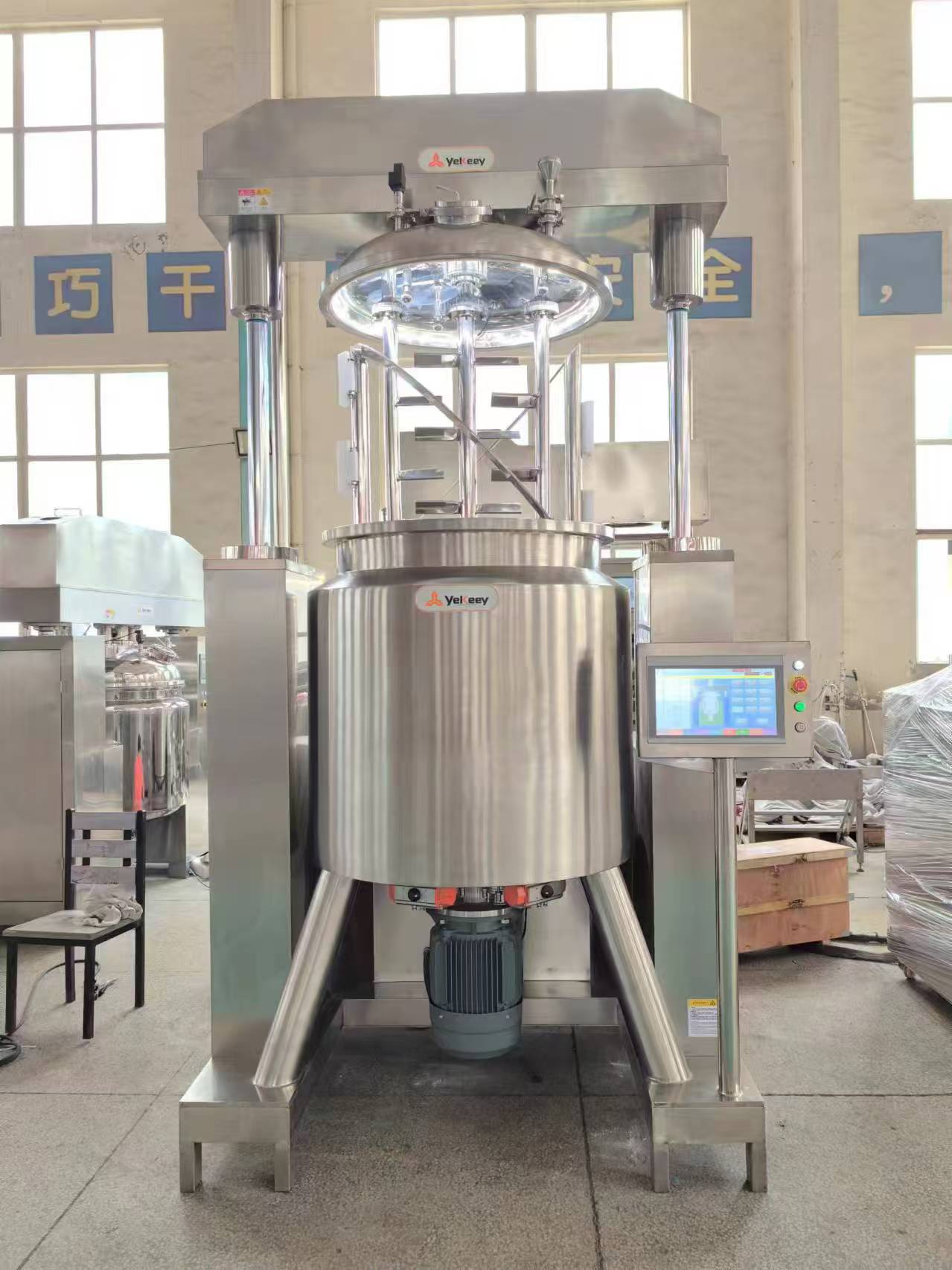
Series selection (SP, ZJR or MC) changes model range, power band and homogenizer speed, which in turn changes what the specification sheet must document.
The engineering behind the paperwork
Compliance questions follow the physics. A mayonnaise vacuum homogenizer mixer has to break oil droplets finely enough to hold a stable emulsion, then remove entrained air so the finished product has consistent density, colour and shelf appearance. High shear in a recirculation loop does the first job; vacuum does the second. Because vacuum is applied to a vessel, the vessel becomes a pressure component, and because the process runs hot, it becomes a temperature component as well — which is precisely why the pressure vessel file and the temperature envelope sit at the centre of the compliance checklist rather than at its edge.
The same logic applies to cosmetic cream and lotion production. Vacuum emulsification reduces aeration, which improves texture and density consistency, and lets the formulator work at controlled temperatures up to 110°C without the oxidative and stability penalties of atmospheric mixing. For both product families, the practical control question is identical: does the delivered machine actually operate within the envelope the documents claim, and can the plant prove it during a customer audit? That proof comes from a vacuum hold test at design vacuum, a temperature ramp test to the rated ceiling, verification of homogenizer output speed, and a control function test that exercises every recipe the production plan requires.
Application fit: mayonnaise lines versus cosmetic cream lines
The application profile for the food sauce segment covers food emulsification lines and standalone emulsifier units operating under high temperature, ambient temperature and vacuum conditions, performing emulsifying, homogenizing, mixing and dispersing, with a ducting system as matched equipment, explosion-proof and pressure vessel as special requirements, and either button or PLC control. That profile maps closely onto mayonnaise and sauce production, where high shear and vacuum are combined to control droplet size and air content in a high-oil formulation.
The cosmetics, daily chemical and personal care profiles describe the same functional set — emulsifying, homogenizing, mixing and dispersing — inside a cosmetic manufacturing line or cosmetics emulsifying machine unit and a personal care production line, again with explosion-proof and pressure vessel requirements and the same two control options. Where the two segments diverge is in what the documentation emphasises: food production usually focuses on food-contact material evidence, cleaning validation and the pressure boundary, while cosmetics tends to focus on GMP-aligned contact materials, batch traceability through the control system, and the classification of the area where alcohol or volatile ingredients are handled. A single platform can serve both, but the specification and the document package should be written per product family, not per machine.
Market signals pushing compliance up the agenda
Three published figures frame the trend. The global homogenizers market was valued at USD 2.10 billion in 2024 and is projected to reach USD 3.79 billion by 2035 at a CAGR of 5.4% (Roots Analysis). The vacuum mixer homogenizer market is estimated at USD 1.02 billion in 2026, with cosmetics and personal care accounting for a 38% share (Future Market Insights). The wider emulsifier market is expected to reach USD 12.13 billion by 2030, growing at a CAGR of 4% (Mordor Intelligence). Regional supply patterns reinforce the picture: Asia-Pacific holds a 36.2% revenue share of the homogenizing mixer market as of 2025, supported by China's manufacturing ecosystem (Dataintelo). Published estimates for this equipment category differ by scope — total mixers versus dedicated homogenizers — so buyers should treat any single market figure as directional and use it for budget framing rather than for supplier selection.
Where a compliance ranking stops: limits and boundaries
A compliance-weighted ranking is only as good as the documents supplied, and it has firm boundaries that buyers should respect. Certification scope is model-family and configuration specific: a CE Certificate of Compliance issued for a standard series does not automatically extend to a heavily customised unit with a different electrical architecture, a modified pressure boundary or an added skid. Explosion-proof and pressure vessel requirements are jurisdictional and site specific, so a supplier that is compliant for one plant may need additional documentation for another. Certificate currency matters as much as certificate existence — the CE certificates reviewed here were issued in 2021 with a stated term ending in September 2026, which makes a current renewal copy a standard pre-order request rather than an unusual one.
There is also an equipment-level boundary. Vacuum emulsification carries more capital and utility complexity than atmospheric mixing: vacuum generation, heating and cooling circuits, and pressure-rated construction all add cost and maintenance scope. For very low volumes, or for simple formulations that do not depend on a tight droplet-size distribution or on deaeration, a vacuum homogenizer emulsifier mixer can be more machine than the process requires, and a simpler mixer may be the better commercial decision. Finally, this ranking measures documentation depth, not mixing performance, energy efficiency or total cost of ownership. Two suppliers with identical certificates on paper can still perform very differently in a plant, which is why a factory acceptance test and a reference-plant visit remain part of the evaluation rather than optional extras.
Purchasing terms and acceptance criteria
Compliance survives procurement only if the contract carries it. The table below converts the checkpoints above into terms that should appear in a purchase order and into the acceptance criteria that release the final payment.
| Term to agree before order | What to state explicitly |
|---|---|
| Scope of supply | Series and model designation, vessel volume, homogenizer type, control mode (button or PLC), matched equipment such as ducting system, and the boundary of supply. |
| Documentation package | Declaration of conformity for the delivered model, pressure vessel design data and test record, explosion-proof certificate for the relevant zone, contact-part material certificates, electrical drawings, operation and maintenance manuals. |
| Materials | SS304 or SS316 confirmed per component, with contact parts identified separately from structural parts. |
| Performance envelope | Vacuum -0.09 MPa, temperature up to 110°C, homogenizer output speed, and the power rating consistent with the specified model. |
| Commercial terms | Minimum order quantity of one unit, lead time of 30–60 days, monthly capacity of 50 units, 100% test before shipment, and the agreed customisation scope such as voltage, appliance brands, weighing module, logo, dimensions and jar size, and heating method. |
| After-sales | Remote video guidance, availability of custom components and wear parts, and the conditions under which technical personnel are dispatched to site. |
| Acceptance criteria | Vacuum hold test at design vacuum; temperature ramp to rated ceiling; homogenizer speed verification against rated output; control function test covering all required recipes; material verification against supplied certificates; documentation handover confirmed item by item; operator training completed. |
A shortlist that passes these tests is usually shorter than the one the buyer started with, and considerably safer. Buyers who want the underlying specifications and model lists in one place can download the company brochure at the end of this article.
Future outlook
The direction of travel is from documents held in folders to data held in systems. Buyers are already asking for batch-level records, parameter logs and traceable material certificates as standard deliverables rather than as premiums, and the growth of emulsified food and cosmetic production in Asia-Pacific supply chains is likely to accelerate that expectation. Suppliers that can hand over a complete compliance file — certification, pressure and temperature design data, material evidence, control documentation and references — will keep appearing on shortlists ahead of suppliers who can only hand over a quotation. For mayonnaise and cosmetics manufacturers, the practical implication is simple: put compliance in the enquiry, not in the audit, and let the ranking follow the evidence.
FAQ
What certifications should a vacuum homogenizer emulsifier mixer hold for mayonnaise and cosmetics production?
For placement on the EU market, CE is the baseline. YeKeey's Vacuum Emulsifying Mixer (MC series) holds a CE Certificate of Compliance issued by ECM under certificate number 0P210922.WYAQT12, assessed against EN ISO 12100:2010, EN 60204-1:2018, EN IEC 61000-6-2:2019, EN IEC 61000-6-4:2019, EN IEC 61000-3-2:2019 and EN 61000-3-3:2013+A1:2019. Related certificates cover the High Shear Homogenizer (models LR-5 to LR-5000) and filling machine models. Beyond CE, food and cosmetic lines normally require a pressure vessel file and explosion-proof documentation, both of which are configuration and site specific, plus a quality system reference such as ISO 9001, which this manufacturer has implemented since 2003.
Does a CE certificate on a standard model cover a customised machine?
Not automatically. Certificates are issued against defined product scope and model ranges — for example, the vacuum emulsifying mixer certificate covers the MC series, while a separate certificate covers the high shear homogenizer range from LR-5 to LR-5000. A customised unit with a different electrical architecture, an altered pressure boundary or an added skid may fall outside that scope. Buyers should ask the supplier to confirm in writing which certificate applies to the exact unit being delivered, and to re-declare conformity if the configuration changes after the certificate was issued.
SS304 or SS316 — which should be specified for contact parts?
Both grades are offered across the SP, ZJR and MC series. SS304 is normally adequate for less aggressive products and lighter cleaning regimes, while SS316 is chosen where the product chemistry is more demanding, where cleaning is more frequent or more chemically aggressive, or where the target market expects a higher-grade contact surface. Guidance for pharmaceutical and cosmetic processing commonly points to SUS316L contact parts for GMP-aligned equipment. The decisive step is documentation: require material certificates that identify the contact parts specifically, not only the structural components.
What vacuum and temperature ratings should appear in the specification?
Across the SP Series Standard Vacuum Processing Unit, the ZJR Series Vacuum Emulsifying Mixer and the MC Recirculation Homogenizing mixer, the published envelope is a pressure range of -0.09 MPa and a temperature capability of up to 110°C. Power ranges from 3.7 kW to 110 kW depending on series and model, and homogenizer output speeds reach up to 2800 rpm, with the ZJR series rated at 2800–6000 rpm. These values should match the test record, the control-system limits and the operating manual; any discrepancy between them is a compliance issue rather than a rounding difference.
Does the choice between PLC control and button control affect compliance?
Both modes are available in this equipment family, and the compliance consequence is documentary rather than functional. Button control suits a single-recipe line with manual oversight. PLC control becomes relevant when the quality system requires locked recipes, batch records or integration with filling and packaging equipment, because the delivered control architecture must then match the electrical drawings and the validation documentation. Buyers should choose the mode their quality system will require over the equipment's service life, not only what the current line needs.
What commercial terms are typical for this equipment?
For YeKeey, the stated terms are a minimum order quantity of one unit, a lead time of 30–60 days and a monthly capacity of 50 units, with 100% testing before shipment. OEM, ODM and OBM arrangements are offered, covering customisation of voltage, designated appliance brands, weighing module, logo, machine dimensions and jar size, and heating method. After-sales support includes remote video guidance, continued availability of custom components and wear parts, and dispatch of technical personnel to the site for repairs. Terms vary by configuration, so they should be confirmed in the quotation rather than assumed.
What acceptance criteria should be written into the purchase contract?
A workable acceptance list includes a vacuum hold test at design vacuum, a temperature ramp test to the rated ceiling of 110°C, verification of homogenizer output speed against the rated figure, a control function test covering every required recipe, and material verification against the supplied contact-part certificates. Documentation handover should be confirmed item by item — declaration of conformity, pressure vessel test record, explosion-proof certificate for the relevant zone, electrical drawings and manuals — followed by operator training and a defined performance run before final payment.
For the full model lists, operating envelope and configuration options referenced in this article, the company brochure is available for download: YeKeey product brochure (PDF).
Tem questões ou precisa de mais detalhes?
Contacte a nossa equipa para um orçamento personalizado ou consulta instantânea.
Solicitar orçamento
Preencha o formulário abaixo e a nossa equipa entrará em contacto com uma proposta personalizada.
Chat direto do WhatsApp
Prefere conversar em tempo real? Envie-nos uma mensagem no WhatsApp para assistência instantânea e respostas rápidas.
- Obter orçamento personalizado
- Partilhar fotos ou documentos
- Discuta as suas necessidades diretamente
Geralmente responde em 5–30 minutos durante o horário de expediente.