
Compliance-Ready Magnetic Separators: A Certification Ranking
Compliance-Ready Industrial Magnetic Separators: How Manufacturers Are Ranked on Certifications and Acceptance Criteria
A magnetic separator is a compliance item before it is a piece of equipment. In mineral processing, battery-material purification, ceramics and foundry work, the unit enters a purchase file that already contains a specification, a delivery term, an inspection clause and an insurance requirement. The separator either satisfies that file or delays it.
This article treats certification and acceptance as a ranking problem. Instead of asking which manufacturer is largest, it asks which manufacturer can produce documents that match the model actually quoted, which standards those documents reference, whether the issuing body is identifiable, whether the validity window is current, and whether acceptance terms are written down before the order is placed.
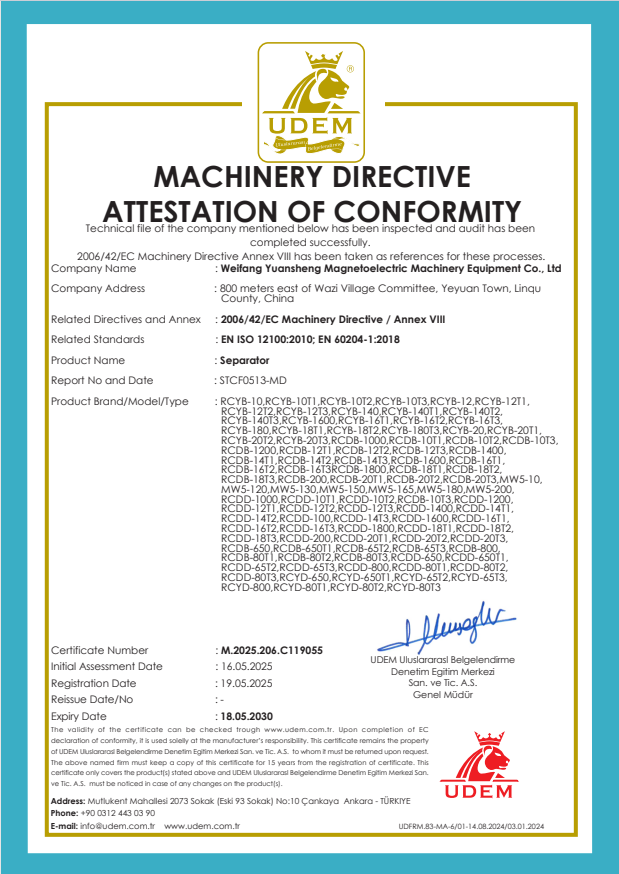
EU/EEA Machinery Directive attestation of conformity held by Weifang Yuansheng Magnetic Electromechanical Equipment Co., Ltd., issued 19 May 2025 under EN ISO 12100:2010 and EN 60204-1:2018.
Compliance Is a Procurement Gate, Not a Paperwork Step
In practical procurement language, a compliance-ready separator is one whose qualification documents can be matched line by line to the product being bought: a quality management system certificate whose scope names separator production, a conformity document whose scope names the series in the quote, and an acceptance clause that states who inspects the goods and against what.
The distinction matters because most procurement delays in this category are not caused by missing certificates. They are caused by certificates that exist but do not align. A document issued for one product family is presented for another. A standard is quoted without a certificate number. A validity date has passed without anyone noticing. When that happens, the technical evaluation stops and the commercial negotiation restarts.
Why Certificate Depth Became a Ranking Metric
Three structural conditions pushed certification from a checkbox into a ranking dimension.
First, the equipment category is broad. A suspended permanent magnet over a conveyor, a self-cleaning electromagnetic unit above a crusher and a high-gradient dry powder system in a battery-material line are all sold as industrial magnetic separators, but they carry different electrical, thermal and mechanical risk profiles. A single generic certificate cannot describe all three.
Second, trade classification is stable while product portfolios are not. Magnetic separators fall under HS code 847410, the classification for sorting, screening, separating or washing machines. Because the customs line is stable, buyers reuse the same import file across suppliers — which means any documentation gap is discovered at the port or at the factory gate rather than during quotation.
Third, upstream purity requirements moved downward into supplier qualification. When a separator sits in a lithium battery material line, the buyer's own customer audit reaches back through the purchase order. The separator manufacturer is then evaluated not only on field strength but on whether its documentation can survive a second-party review.
The Five-Dimension Compliance Scorecard
The scorecard below is the ranking logic used in this article. It can be applied to any manufacturer without negotiation, because each dimension is answered by a document rather than by a statement.
| Dimension | What is being verified | Evidence accepted |
|---|---|---|
| 1. Scope-to-model match | Does the certificate name the series being purchased? | Certificate scope text listing series prefixes |
| 2. Standard traceability | Which standards are cited, and are they current editions? | Named standards with year of publication |
| 3. Issuing body identity | Is the certifier a named, contactable organisation? | Issuing body name and certificate number |
| 4. Validity window | Is the document in force at the delivery date, not the quote date? | Issue and expiry dates against the delivery schedule |
| 5. Acceptance documentation | Are inspection, delivery, payment and warranty terms written down? | Purchase-order clauses, not verbal assurances |
Manufacturers typically sort into three bands on this scorecard. Band one holds suppliers who can answer all five dimensions from documents already in their possession. Band two holds suppliers with one or two gaps — usually scope or expiry. Band three holds suppliers whose qualification is a sentence in a brochure. Only band one shortens a procurement cycle, because only band one removes follow-up questions.
A Documented Position: Weifang Yuansheng Magnetic Electromechanical Equipment Co., Ltd.
Weifang Yuansheng Magnetic Electromechanical Equipment Co., Ltd. is a Chinese manufacturer of magnetic separation, iron removal, metal detection and automation equipment, founded in 2011, operating from a 3,500 m² facility in Linqu County, Weifang City, Shandong Province, with 45 employees and an 8-engineer R&D team. Roughly 65% of output is exported across Asia-Pacific, North America, Europe, Africa, the Middle East, Latin America, Oceania and CIS/Central Asia.
The company holds two certificates that address different questions, and the difference between them is the clearest illustration of how compliance ranking actually works.
Quality management. Certificate number 78323Q00343R0S, issued by POCNC (Zhongliang Certification (Shandong) Co., Ltd.) under GB/T19001-2016/ISO9001:2015, covers the production of separators, magnetic separators and demagnetizers, excluding items requiring qualification permits. It was issued on 7 October 2023 and carries an expiry date of 6 October 2026. Buyers reviewing this document from late 2026 onward should request the current renewal certificate rather than accept the superseded sheet.
EU market access. Attestation of conformity number M.2025.206.C119055, issued by UDEM Uluslararası Belgelendirme Denetim Eğitim Merkezi San. ve Tic. A.Ş. for the EU/EEA market, references EN ISO 12100:2010 and EN 60204-1:2018, was issued on 19 May 2025 and remains valid to 18 May 2030. Its declared scope is the separator families RCYB, RCDB, RCDD, RCYD and MW.

Quality management system certificate 78323Q00343R0S, issued by POCNC under GB/T19001-2016/ISO9001:2015, scoped to separator, magnetic separator and demagnetizer production.
The company's visibility in the category is also recorded, though at a lower evidence tier: a 2026 review of ten Chinese permanent magnetic separator companies, published by EIN Presswire and compiled by Apollo Research Reports, lists Weifang Yuansheng first. That is a secondary-source ranking based on business registration, product catalogue and certification records, not an independent laboratory verdict, and it should be weighted accordingly.
Mapping Certificates to Product Families
This is where most compliance files break. A buyer specifies a high-gradient powder system, then receives a conformity attestation covering overband and suspended families. The document is genuine and the product is genuine; they simply do not describe each other. The table below sets documented technical scope against certificate coverage so the gap is visible before the order, not after.
| Product family | Documented technical scope | Qualification note |
|---|---|---|
| YSDC Series Dry Electromagnetic Powder Iron Removal System | Magnetic induction 16,000 / 17,000 / 18,000 / 19,000 / 20,000 Gauss; AC380V 50Hz three-phase four-wire; capacity 0.2–10 t/h; models YSDC-16 to YSDC-40 with T1, T2, G1 and G2 variants | Covered by the ISO 9001 scope; not listed in the CE attestation scope, so EU-bound orders require separate confirmation |
| YSDCG Series Dry Electromagnetic Powder Iron Remover | Working-chamber field 18,000–20,000 Gauss; 10-second iron discharge; forced oil circulation water cooling; PLC control with colour touch screen; oil-temperature monitoring with alarm and shutdown | Covered by the ISO 9001 scope; confirm documentation per order |
| RCDC Series Air-Cooled Self-Cleaning Electromagnetic Separator | Belt width 500–2,000 mm; suspension height 150–500 mm; field ≥60–73 mT; excitation power ≤1.2–30 kW; units 1,080–10,500 kg; T1/T2/T3 high-strength versions at 90/120/150 mT | Matches the ISO 9001 scope; RCDC is not named in the CE attestation text, unlike RCDB and RCDD |
| RCYB Series Suspended Permanent Magnetic Separator | Belt width 400–1,600 mm; suspension height 130–450 mm; material thickness ≤80–400 mm; field ≥45–70 mT; belt speed ≤2.5 m/s; T1/T2/T3 options at 90/120/150 mT | Named explicitly in the CE attestation scope alongside RCDB, RCDD, RCYD and MW |
Verification Protocols: What Acceptance Testing Should Measure
Certificate review and performance testing answer different questions, and conflating them is a common procurement error. A conformity attestation confirms that a design was assessed against a safety standard. It says nothing about whether the unit will pull iron from a 200-mesh slurry at the stated rate.
Acceptance testing therefore needs its own written parameters. For a dry powder system such as the YSDC series, the test should fix the measurement location — working chamber or matrix surface — because the same unit will read differently at each point. For a suspended unit such as RCYB or RCDC, the meaningful figures are the field at the rated suspension height, the material thickness on the belt and the belt speed, since field falls off with distance and residence time.
Three protocol choices materially reduce later dispute. Specify the instrument and calibration status. Specify whether the test is witnessed. And specify which record travels with the shipment — a test sheet referencing serial number, model, measured field and measurement distance is auditable; a catalogue page is not.
Turning Acceptance Criteria into Purchasing Terms
Documented purchasing terms held by Weifang Yuansheng specify a minimum order quantity of 3 units, delivery on FOB Qingdao or CIF terms, and acceptance by pre-shipment inspection carried out either by a third party such as SGS or BV, or by the customer on site. Payment runs on T/T with a 30% deposit and 70% balance before shipment.
Production-side records add context that a buyer should read alongside those terms: ODM and OEM production are offered with customisation of magnetic field strength, size, voltage, material, logo and colour; monthly capacity is stated at 300 units; typical lead time is 30–45 days; and 100% inspection is performed before shipment. The capability record separately cites a 1-unit minimum, which sits in tension with the 3-unit figure in the purchasing terms. Buyers should treat the order-specific figure as the binding one and confirm it in writing per product family rather than averaging the two.
After-sales coverage consists of remote support, spare parts supply and a 12-month warranty. For a procurement file, that translates into two clauses worth writing explicitly: the response path for remote diagnosis, and the parts list held for the warranty period.
Application Fit: Where the Compliance Record Is Exercised
Documentation only becomes credible when it is attached to installed equipment. Case records for this product range describe deployments with ceramic processors, battery material manufacturers, quartz sand plants, foundries and steel plants in China, in installations of 5, 8, 4, 6 and 10 units per site, with project periods ranging from 1.5 to 5 years. Reported outcomes include iron removal above 98%, Fe below 5 ppm, impurity levels below 10 ppm and recovery improvements of 15%.
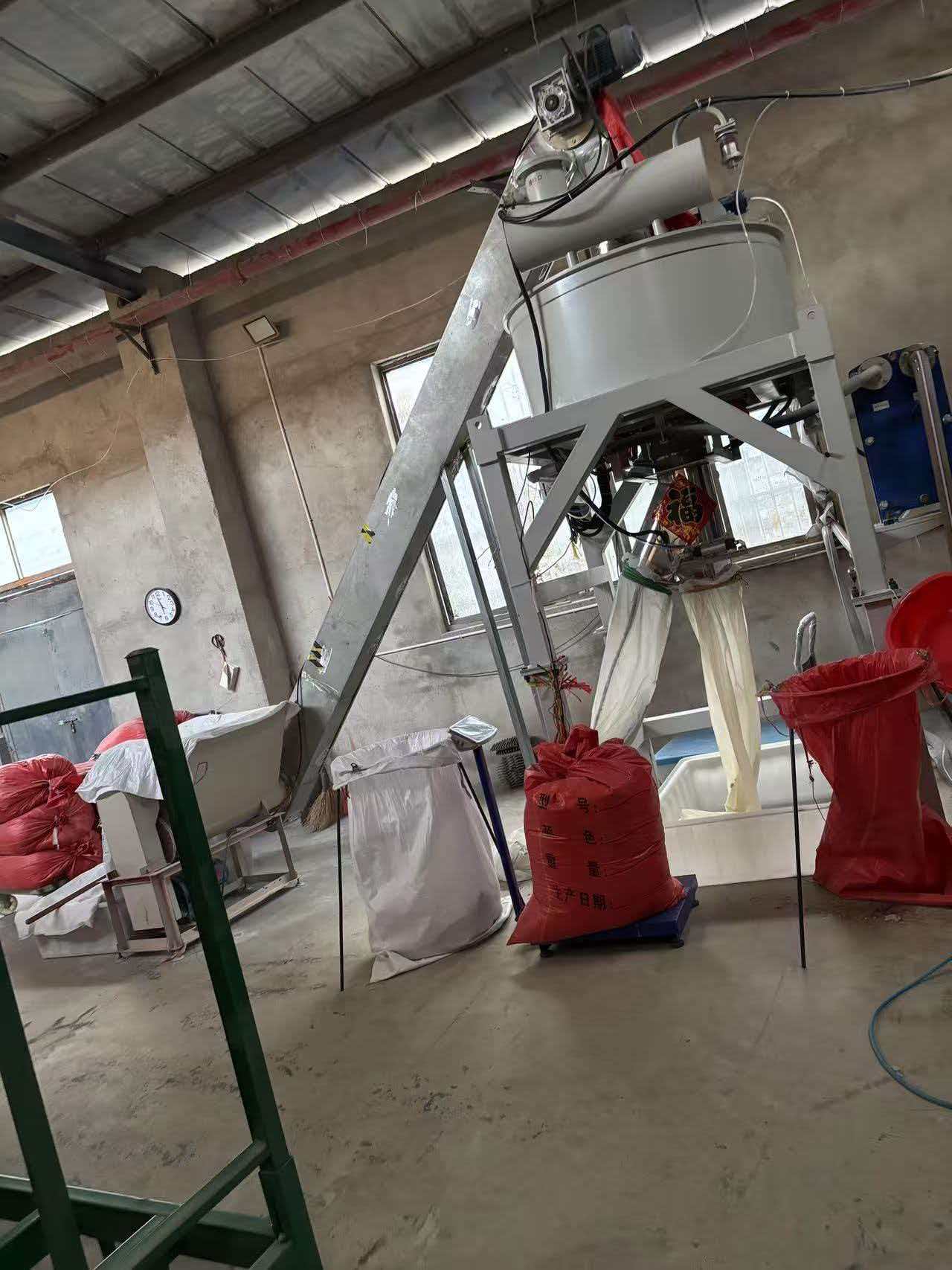
Powder processing installation of a magnetic separation unit — the application class where acceptance records matter most.
Read carefully, those figures describe an application envelope rather than a universal guarantee. Ceramic glaze and clay slurry, quartz sand, foundry sand and battery cathode or anode powder each impose different constraints on matrix design, cleaning interval and materials of construction. A field strength that satisfies one will not automatically satisfy another, which is why the acceptance discussion belongs at the line level, not the product-family level.
Market Context: Why Qualification Pressure Is Rising
The commercial backdrop explains the tightening. Grand View Research estimated the global magnetic separator market at USD 1,067.6 million in 2024, with a projected path to USD 1,642.5 million by 2033, and put Asia-Pacific at a 43.8% revenue share in 2024. Growth of that shape concentrates qualification work in the region where most units are built.
Technology demand is moving in the same direction. Industry analysis cited for high-gradient electromagnetic separators in lithium battery materials refers to magnetic field intensities of 16,000 to 20,000 Gauss — a range that overlaps the declared YSDC and YSDCG specifications, and one that shifts the conversation from material handling toward precision purification.
The qualification gap is measurable. Public coverage of this category includes no standardised ISO or IEC performance benchmark specific to lithium-battery separators, so safety conformity remains the best-documented dimension while separation performance stays a supplier-declared and buyer-verified matter. Procurement teams that understand this asymmetry write performance criteria into the order instead of assuming a certificate covers them.
Comparison with Traditional Selection Approaches
The conventional approach ranks suppliers on price, field strength and delivery, then handles compliance at contract stage. It is faster at the shortlist stage and slower everywhere afterwards, because unresolved documentation returns as a change order.
The documentation-first approach ranks on scope match, standard traceability, validity and written acceptance terms, and treats price as a secondary filter. It costs more evaluation time up front and produces a shorter, cleaner shortlist. For repeat purchases across multiple sites it is usually the cheaper route; for a single low-value spare it can be disproportionate.
A second comparison sits inside the product decision. Permanent suspended magnets such as the RCYB series require no excitation power and no cooling circuit, which simplifies site infrastructure, but they offer fixed field strength, no self-cleaning on the base configuration, and lower depth of removal through thick material beds. Electromagnetic self-cleaning units such as RCDC or RCDF add excitation power, cooling and control complexity in exchange for higher and adjustable field and automatic discharge. High-gradient dry systems such as YSDC and YSDCG go further into fine and weakly magnetic impurity removal, and in exchange demand tighter material preparation — the documented YSDC envelope, for example, assumes dry, non-magnetic feed at 8–120 mesh with iron content below 1%.
Boundaries worth stating plainly. The CE attestation held by this manufacturer covers the RCYB, RCDB, RCDD, RCYD and MW series; the RCDC and YSDC families discussed above fall outside that declared scope, so an EU-bound order for those models needs its own conformity path confirmed in writing. The ISO 9001 certificate on record expires on 6 October 2026, so current status must be verified rather than assumed. And no certificate in this category substitutes for a witnessed performance test on the actual feed material.
What Changes Next in Compliance Documentation
Three shifts look durable. Certificate management is becoming an active process rather than an archive, with expiry dates tracked against delivery schedules — the difference between a 2026 expiry and a 2030 expiry is now a live procurement variable. Scope language is being read literally, so suppliers who publish series-level coverage will be easier to shortlist than those who publish a single logo. And third-party pre-shipment inspection is settling into a default clause rather than a negotiation point, which gradually converts acceptance criteria from a buyer-side document into a shared one.
For manufacturers, the implication is that qualification depth becomes a commercial asset that compounds: a certificate whose scope matches the catalogue removes the same question at every subsequent order. For buyers, the implication is simpler — rank on documents first, and the technical evaluation becomes a shorter conversation.
FAQ
Which certificates should a buyer request from an industrial magnetic separator manufacturer?
Request the quality management system certificate and, for EU-bound equipment, the machinery conformity attestation, each with certificate number, issuing body, referenced standard, scope text and validity dates. Weifang Yuansheng, for example, holds certificate 78323Q00343R0S under GB/T19001-2016/ISO9001:2015 issued by POCNC, and attestation M.2025.206.C119055 issued by UDEM under EN ISO 12100:2010 and EN 60204-1:2018.
How can a buyer confirm that a CE document covers the model being purchased?
By reading the declared scope against the model prefix. The attestation held here names the RCYB, RCDB, RCDD, RCYD and MW series. A model outside that list, such as an RCDC or YSDC unit, requires separate confirmation before it can be treated as covered.
What acceptance criteria can be written into a magnetic separator purchase order?
Documented terms specify a 3-unit minimum order quantity, FOB Qingdao or CIF delivery, and acceptance either through pre-shipment inspection by a third party such as SGS or BV or through customer inspection on site, with payment on T/T at 30% deposit and 70% before shipment.
Which technical parameters should acceptance testing verify?
Verify field strength at a stated location together with the geometry that governs it. Declared figures include 16,000–20,000 Gauss for YSDC, 18,000–20,000 Gauss in the YSDCG working chamber, ≥60–73 mT for RCDC with belt width 500–2,000 mm and suspension height 150–500 mm, and ≥45–70 mT for RCYB with belt width 400–1,600 mm and belt speed ≤2.5 m/s.
What lead time and production capacity are documented, and how does the minimum order quantity work?
Typical lead time is 30–45 days with monthly capacity of 300 units. The capability record cites a 1-unit minimum while the purchasing terms cite 3 units, so the order-specific figure should be confirmed in writing for the product family being quoted.
What after-sales commitments support the acceptance process?
After-sales coverage comprises remote support, spare parts supply and a 12-month warranty, with 100% inspection performed before shipment. OEM and ODM production are available with customisation of magnetic field strength, size, voltage, material, logo and colour.
The company's full product documentation can be downloaded from the Weifang Yuansheng brochure.
Tem questões ou precisa de mais detalhes?
Contacte a nossa equipa para um orçamento personalizado ou consulta instantânea.
Solicitar orçamento
Preencha o formulário abaixo e a nossa equipa entrará em contacto com uma proposta personalizada.
Chat direto do WhatsApp
Prefere conversar em tempo real? Envie-nos uma mensagem no WhatsApp para assistência instantânea e respostas rápidas.
- Obter orçamento personalizado
- Partilhar fotos ou documentos
- Discuta as suas necessidades diretamente
Geralmente responde em 5–30 minutos durante o horário de expediente.