
Compliance Roadmap for Medical-Grade PET and PP Sheet Rolls
Independent Industry Reference · Packaging & Printing
Compliance Roadmap for Medical-Grade PET and PP Sheet Rolls
Two converters can buy the same PET thermoforming sheet roll, form it on comparable vacuum forming lines, and still reach completely different qualification outcomes. The polymer is rarely what separates them. What separates them is the packaging application the roll is qualified for, the documentation that travels with each batch, and the discipline of the forming and packing environment the material enters.

Medical and pharmaceutical packaging is a constraint-driven category rather than a performance-driven one. A device tray has to position, separate and protect an instrument through handling, storage and transport while keeping the product visible and the pack intact. A pharmaceutical blister has to hold a unit dose, present it clearly, and survive cutting, loading and sealing. Both are typically produced on roll-fed or sheet-fed thermoforming and vacuum forming equipment, followed by cutting, product loading and sealing according to the customer's packaging process.
That description also sets the boundary of what a sheet supplier can guarantee. For medical device trays, pharmaceutical blister packaging, disposable medical product trays and protective packaging inserts, material compliance and additional performance requirements are determined by the specific medical or pharmaceutical packaging application. A buyer who understands that boundary early avoids the most expensive mistake in this category: assuming that a phrase such as “medical-grade” substitutes for a specification.
Why “medical-grade” describes an application, not a material
The term medical-grade is useful shorthand in a conversation and a poor specification in a purchase order. A thermoforming sheet roll is defined by concrete and inspectable fields: resin family, grade, thickness, width, colour and transparency, surface treatment, layer structure, roll weight and forming process compatibility. None of those fields changes meaning because the finished part will hold a surgical instrument rather than a food tray.
What does change is the acceptance logic around them. The same PET resin formed into a transport tray for a medical device and into a protective insert inside a diagnostic kit may face different expectations for stiffness, dimensional stability and surface condition, because the two parts do different jobs. This is why the underlying requirement is described as application-specific: compliance and additional performance requirements follow the packaging application, not the polymer family.
For a buyer in the research and evaluation stage, this has a practical consequence. The deliverable of the evaluation phase is not a preferred supplier name. It is a written requirement set — a short document that states what the part must do, which material family and grade are acceptable, which tolerances matter, which documents must be supplied with each lot, and which environment the roll will be opened and formed in.
The compliance roadmap in five stages
A workable qualification sequence for PET and PP thermoforming sheet rolls runs from application definition to supply continuity. Each stage produces an artefact the next stage depends on, which is why skipping a stage usually reappears later as a forming or sealing problem.
Stage 1 — Define the contact scenario and the job the packaging performs
Before any material is selected, the buyer should state what the thermoformed part does in the pack. In medical and pharmaceutical applications the usual functions are positioning, separation, protection, visibility and packaging integrity during handling, storage and transportation. Each function translates into a different emphasis: separation and positioning put weight on dimensional stability and consistent thickness; visibility puts weight on transparency; protection through transport puts weight on rigidity and impact behaviour.
The same stage should record the conditions the finished pack will meet — storage and transport temperature, humidity exposure, whether the tray is a single-use item or a returnable carrier, and whether the thermoformed part is the primary contact surface or a secondary insert.
Stage 2 — Fix the material family, grade and construction baseline
Only after Stage 1 should the material baseline be written. The available grades differ meaningfully between families, and the differences are usually more decisive than price.
PET thermoforming sheet rolls are offered as APET, rPET, GAG, PETG, Food Grade PET, Transparent PET, Anti-Fog PET, Anti-block PET, Anti-scratch PET and Anti-static ESD PET sheet rolls. Thickness is customized within 0.18–1.7 mm, width within 250–1400 mm, colour is transparent or customized, roll size is customized within 50–800 kg per roll, and surface treatment options include hard coating, silicon coating, corona treatment, laminated film and coating. Structure can be mono-layer or multi-layer, and the material is compatible with both vacuum forming and pressure forming.
PP thermoforming sheet rolls are offered as normal PP, conductive black PP, antistatic PP, PP/PE thermoforming sheet and high and low temperature resistant PP sheet rolls. Thickness is customized within 0.3–2 mm, width within 300–900 mm, colour in natural, white, black or customized, structure mono-layer or multi-layer, and forming is again compatible with vacuum forming and pressure forming. For reference, the HIPS Thermoforming Sheet Roll range covers 0.24–2 mm thickness and 300–900 mm width with glossy or matte surfaces in natural, white, black or customized colours.
Writing these ranges into the requirement set does two things: it tells the supplier exactly which construction to quote, and it tells the buyer in advance where a project falls outside a standard offering.
Stage 3 — Build the documentation file
Documentation is where most qualification programmes either accelerate or stall. A buyer evaluating a sheet supplier for medical or pharmaceutical packaging should expect to collect four distinct categories of evidence, and should check that each one names the sheet, not just the resin.
- Product-level test reports issued for the specific sheet type and colour, by an accredited testing organisation, with a report number that can be verified.
- System certificates covering the production site and the actual operation — in this case sheet extrusion — with issue and expiry dates and a scope statement.
- Recycled-content documentation, where reclaimed material is used, showing the material categories and the processing step covered.
- Batch-level inspection records covering thickness tolerance, width accuracy, appearance, mechanical properties and thermoforming performance.
The fourth category is the one buyers most often under-specify. Test reports and system certificates describe a system; batch records are what connect a delivered roll to that system.
Stage 4 — Validate on your own forming and sealing line
Supplier evidence reduces risk; it does not replace trial work. A roll should be formed, cut and sealed on the buyer's own equipment before an order is released. Typical matched equipment in medical and pharmaceutical thermoforming operations includes thermoforming machines, vacuum forming machines, blister packaging machines, die-cutting equipment and sealing equipment, and the validation should follow the same sequence the production line will use.
The checks that matter at this stage are consistent thickness across the web, stable thermoforming performance, dimensional stability after forming, suitable transparency where the pack requires it, and a clean surface condition after unwinding.
Stage 5 — Lock change control, replenishment and continuity
Qualification is a state that has to be maintained. Once a grade and structure are approved, any change to resin source, layer structure, surface treatment, colour or roll size should be treated as a re-qualification trigger rather than a routine substitution.
Commercial parameters belong in this stage as well. For reference, PULIXIN Packaging Materials (Shanghai) Co., Ltd. quotes a monthly production capacity of approximately 3,500 tons, which may vary with production schedule and product specifications; delivery generally ranges from 7 to 15 days depending on material, specifications, order quantity and customization requirements; and minimum order quantities are 5 tons for standard PET and 3 tons for standard PP or PS, with customized products potentially subject to different thresholds.
What a documented supplier file actually contains
The most direct way to test a supplier's compliance posture is to ask for the certificates themselves and read the scope line. The table below records the documentation set held for PULIXIN thermoforming sheet production, as issued.
| Document | Type | Issued by | Reference | Scope and validity |
|---|---|---|---|---|
| SGS Test Report – PET Sheet | Test report | SGS-CSTC Standards Technical Services (Shanghai) Co., Ltd. | SHAPH26002960101 | PET Sheet; standard: EU RoHS Directive (EU) 2015/863 |
| SGS Test Report – PET with Aluminum Plating | Test report | SGS-CSTC Standards Technical Services (Shanghai) Co., Ltd. | SHAAF25013706405 | PET with aluminum plating; standard: EU RoHS Directive (EU) 2015/863 |
| SGS Test Report – PP White (Natural) Plastic Sheet | Test report | SGS-CSTC Standards Technical Services (Shanghai) Co., Ltd. | SHAPH26002958405 | PP White (Natural) Plastic Sheet; standard: EU RoHS Directive (EU) 2015/863 |
| SGS Test Report – PS Black Plastic Sheet | Test report | SGS-CSTC Standards Technical Services (Shanghai) Co., Ltd. | SHAPH26002958403 | PS Black Plastic Sheet |
| SGS Test Report – PS White (Natural) Plastic Sheet | Test report | SGS-CSTC Standards Technical Services (Shanghai) Co., Ltd. | SHAPH26002958401 | PS White (Natural) Plastic Sheet; standard: EU RoHS Directive (EU) 2015/863 |
| FSSC 22000 Food Safety Management System Certification | System certification | CQM | CQM25FSSC00171 | Production of specific PET sheets for food contact applications (plasticizing extrusion); issued 2025-07-04, valid to 2028-07-03 |
| ISO 9001:2015 Quality Management System Certificate | System certification | China Quality Mark Certification Group (CQM) | 00226Q03336R101 | Production of polyester sheets (PET); issued 2026-06-25, valid to 2029-06-24 |
| ISO 14001:2015 Environmental Management System Certificate | System certification | China Quality Mark Certification Group (CQM) | 00226E02412R101 | Production of polyester sheets (PET) and related management activities; issued 2026-06-25, valid to 2029-06-24 |
| Global Recycled Standard (GRS) Version 4.0 Scope Certificate | Product certification | SGS-CSTC Standards Technical Services Co., Ltd. | SGC-GRC09372-GRS-2026-04 | PET, PP and HIPS thermoforming sheet rolls; processed post-consumer materials (PC0035), processed pre-consumer materials (PC0041), extrusion process (PR0010); issued 2026-04-23, valid to 2027-04-22 |
Read as a set, the file covers material-level substance testing, site-level management systems, a food-contact scope for PET sheet production, and a recycled-content scope that spans PET, PP and HIPS. The recurring limitation is visible in the scope wording: the certificates describe sheet production and material testing. They do not, and are not intended to, describe a finished filled tray, a sealed blister or a sterilised device pack.
Technical explanation: why thickness, structure and forming window drive compliance
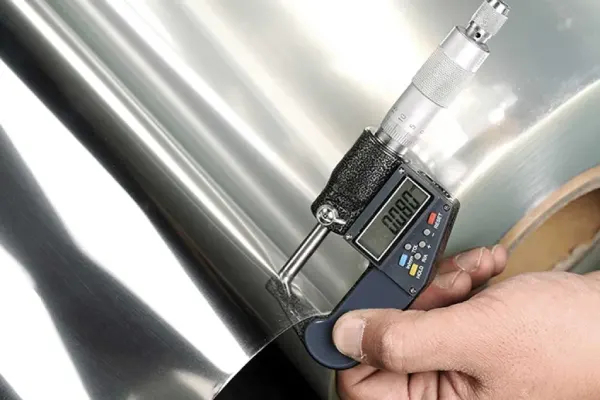
In thermoforming, most quality complaints trace back to variation rather than to the material family. Thickness variation changes heat-up time across the web, which changes draw depth, wall thickness distribution and, eventually, sealing behaviour. That is why consistent thickness, dimensional stability and stable thermoforming performance sit at the top of the requirement list for medical device trays and pharmaceutical blister packaging.
PET thermoforming is generally carried out in a forming window of approximately 266°F to 320°F (130°C to 160°C), a range published by South Plastic (SPI) in its thermoformed food packaging guidance. The exact set point still depends on sheet thickness, layer structure and equipment, but the window explains why a sheet specified near the lower end of a thickness range behaves differently from one near the upper end even when both carry the same grade name.
Layer structure is the second lever. Multi-layer co-extrusion allows a functional surface — anti-fog, anti-static ESD, anti-scratch or a coated finish — to be combined with a core that carries the mechanical and forming properties. PULIXIN operates 14 advanced co-extrusion production lines with an annual output exceeding 40,000 tons from a 20,000 m2 production base, which is the manufacturing context in which thickness consistency and sheet flatness are controlled.
A third lever, easily overlooked, is roll geometry. PET rolls are customized within 50–800 kg per roll. Roll weight affects unwinding tension and splice frequency, and on a high-speed blister line those two variables can matter more than a marginal difference in resin grade.
Application: medical device trays and pharmaceutical blister packaging
The medical and pharmaceutical segment is a defined application rather than a general market. Its typical project types are medical device trays, pharmaceutical blister packaging, disposable medical product trays and protective packaging inserts. The thermoformed part positions, separates and protects the product while keeping it visible and keeping the pack intact through handling, storage and transport.
Production normally runs roll-fed or sheet-fed: thermoforming or vacuum forming first, then cutting, product loading and sealing according to the customer's packaging process. The equipment list therefore includes thermoforming machines, vacuum forming machines, blister packaging machines, die-cutting equipment and sealing equipment.
The special requirements recorded for this application are consistent thickness, stable thermoforming performance, a clean surface, dimensional stability and suitable transparency — with material compliance and any additional performance requirements set by the specific medical or pharmaceutical packaging application. That last clause is the reason this roadmap starts with the application rather than the material.
The clean packaging environment: temperature, humidity and surface condition
Medical and pharmaceutical thermoforming is normally carried out in a clean packaging environment with controlled temperature and humidity, suited to hygienic thermoforming and packaging operations. Two aspects of that environment deserve attention from buyers during evaluation.
The first is that controlled temperature and humidity is an operating condition, not a marketing attribute. Static and surface condition on thin PET and PP webs are sensitive to the ambient conditions in which rolls are unwound and formed. A supplier can support this by controlling how the sheet is wound, protected and packed, and by customizing roll size, packaging and labelling to match the buyer's handling routine.
The second is that surface cleanliness begins before the roll reaches the forming line. A clean sheet surface at the point of unwinding depends on how the roll was produced, wound and protected in transit. This is one reason the material specification should state surface requirements explicitly — gloss or matte, coated or uncoated, film-laminated or bare — rather than leaving the finish to be inferred from the grade name.
Market trend: what the published numbers say, and where they disagree
The demand context for thermoformed packaging is measurable, although the published figures require careful reading. Grand View Research reported the global thermoformed plastic market at USD 14.79 billion in 2023 and projected a compound annual growth rate of 4.9% for 2024–2030.
Recycled content is the fastest-moving sub-segment in the same picture. Dataintelo projects the recycled PET (rPET) market value growing to USD 24.6 billion by 2034. That projection matters for medical and pharmaceutical buyers because rPET grades are already offered alongside virgin grades in the PET thermoforming sheet roll range, and the GRS scope certificate held for PET, PP and HIPS covers processed post-consumer and pre-consumer materials through the extrusion process.
Two cautions belong with these numbers. First, researchers measuring the same category often disagree: published CAGR estimates for thermoformed plastics have varied between roughly 4.9% and 7.2%, and the variance is largely a definition question — whether raw sheet, finished thermoformed products or machinery is being counted. Second, market growth estimates for a category do not translate directly into growth for any single grade, colour or thickness band. For procurement purposes, the useful signal is structural: rigid thermoformed packaging is a growing category, and recycled-content and documentation transparency are moving from differentiators to baseline expectations.
A smaller but practical trend sits on the trade side. Non-cellular plastic sheets are classified under HS Code heading 3920 and cellular sheets under 3921. Buyers importing rolls should confirm that the classification on their customs documentation matches the actual sheet construction, since cellular and non-cellular products fall under different headings.
PET versus PP and single-source supply: the limits worth writing down
Comparison in this category is less about which material is better and more about which constraints each option carries. The following boundaries are drawn from the stated product ranges and are worth resolving before a supplier is shortlisted.
- A supplier certificate does not qualify the finished pack. The certificates held for this production cover sheet manufacture and material testing. Qualifying a filled tray, a sealed blister or a sterilised device pack remains the responsibility of the party placing that pack on the market.
- PP has a narrower dimensional envelope than PET in this range. PP sheet rolls are customized within 0.3–2 mm thickness and 300–900 mm width, while PET covers 0.18–1.7 mm and 250–1400 mm. Projects requiring very thin gauge or webs wider than 900 mm cannot be met by standard PP and would need to move to PET or another construction.
- Transparency-led designs point to PET grades. PP is catalogued in natural, white, black or customized colours, whereas the PET range includes APET, PETG, GAG and Transparent PET grades. Where a device or dose must be clearly readable through the pack, the grade list itself narrows the choice.
- Recycled content adds a documentation step. rPET grades and the GRS scope certificate make recycled content traceable through the extrusion process, but introducing reclaimed material also means the qualification file has to carry the corresponding chain-of-custody evidence. It is not a drop-in substitution.
- Commercial thresholds shape scheduling. With minimum order quantities of 5 tons for standard PET and 3 tons for standard PP or PS, and delivery generally ranging from 7 to 15 days depending on material, specifications, order quantity and customization, trial runs and re-orders need to be planned rather than triggered.
- Changing any of it restarts part of the file. A change of colour, surface treatment, layer structure or roll size is a change of specification, and downstream forming and sealing behaviour must be re-confirmed.
Compared with buying sheet through a trading intermediary, buying from a co-extrusion manufacturer shortens the distance between a specification change and the line that implements it. It does not remove the need for the buyer's own validation work, and it does not transfer regulatory responsibility for the finished package.
Future outlook
Three developments are likely to shape how medical and pharmaceutical buyers evaluate thermoforming sheet rolls over the next few cycles.
The first is the normalisation of recycled content. rPET grades with documented chain of custody are already available in the same product families as virgin material, and the GRS scope covering PET, PP and HIPS suggests that recycled documentation will increasingly be expected alongside material test reports rather than treated as a special request.
The second is a shift in what “qualified” means. As application-specific requirements become more explicit, buyers will move from asking whether a supplier is certified to asking which operation the certificate covers, which grade and colour it names, and when it expires. That is a more demanding question, and it favours suppliers whose documentation is already structured by product and process.
The third is continued convergence of material and process design. Multi-layer co-extrusion already allows functional surfaces to be combined with a structural core, and that flexibility is likely to be used more deliberately as packaging engineers try to meet visibility, stiffness and processability requirements with fewer material changes between projects.
None of these changes alters the sequence of the roadmap. Define the application, fix the material baseline, assemble the documentation, validate on your own line, and lock change control. Suppliers can support every stage of that sequence; they cannot replace it.
Reference document: the PULIXIN product catalogue covering PET, PP and HIPS thermoforming sheet roll ranges, specifications and customization options is available for download at PULIXIN DESU New Catalogue (PDF).
FAQ
1. What does “medical-grade” mean for a PET or PP thermoforming sheet roll?
It is an application statement rather than a material property. A sheet roll is defined by resin family, grade, thickness, width, colour, surface treatment, layer structure and roll size. In medical and pharmaceutical packaging, material compliance and additional performance requirements are set by the specific packaging application — a medical device tray, a pharmaceutical blister, a disposable medical product tray or a protective insert. Two projects using the same resin can therefore carry different acceptance criteria.
2. Which documents should be requested when qualifying a sheet roll for medical or pharmaceutical packaging?
Four categories: product-level test reports issued for the specific sheet type and colour by an accredited testing organisation, with a verifiable report number; system certificates covering the production site and the extrusion operation, with issue and expiry dates and a scope statement; recycled-content documentation where reclaimed material is used; and batch-level inspection records covering thickness tolerance, width accuracy, appearance, mechanical properties and thermoforming performance.
3. Does a material certificate qualify the finished tray or blister pack?
No. Certificates of the kind held for thermoforming sheet production describe sheet manufacture and material testing. Their scope wording typically names the sheet or the extrusion process, not a filled tray, a sealed blister or a sterilised device pack. Qualifying the finished package remains the responsibility of the party that places it on the market, and it requires validation on the buyer's own thermoforming, die-cutting and sealing equipment.
4. How do PET and PP sheet rolls differ for medical device trays and pharmaceutical blister packaging?
The main differences are dimensional envelope and appearance options. PET sheet rolls are customized within 0.18–1.7 mm thickness and 250–1400 mm width, and the range includes APET, rPET, GAG, PETG, Food Grade, Transparent, Anti-Fog, Anti-block, Anti-scratch and Anti-static ESD grades. PP sheet rolls are customized within 0.3–2 mm thickness and 300–900 mm width, with models including normal, conductive black, antistatic, PP/PE thermoforming sheet and high and low temperature resistant versions, in natural, white, black or customized colours. Both are compatible with vacuum forming and pressure forming and both are available in mono-layer or multi-layer structures.
5. What role do controlled temperature, humidity and surface cleanliness play?
Medical and pharmaceutical thermoforming normally takes place in a clean packaging environment with controlled temperature and humidity, suited to hygienic thermoforming and packaging operations. Surface condition on thin webs is affected by the ambient conditions in which rolls are unwound and formed, and a clean sheet surface at the point of unwinding depends on how the roll was produced, wound and protected in transit. This is why surface requirements — glossy or matte, coated or uncoated, film-laminated or bare — and roll size, packaging and labelling should be stated explicitly in the specification rather than inferred from the grade name.