
Compliance & Acceptance Criteria: GT-732, GT-732M, GT-702BM
A compliance dossier for a home blood pressure monitor is a purchasing document, not a marketing attachment. For distributors and OEM buyers at the decision stage, the practical question is narrower than “is this supplier certified?” — it is which certificate, test record or declaration supports which specific claim, on which model, for which market.
This guide uses three upper-arm models from GENIAL — GT-732, GT-732M and GT-702BM — to show how published parameters such as a 0~290 mmHg pressure range and a pulse error of ≤±5%, together with declared materials (ABS housing, PVC air bag, Nylon binding strap and eco-friendly TPU air bag), translate into acceptance criteria that can be written into a purchase order rather than debated after delivery.
Why compliance review has moved to the acceptance stage
Home blood pressure monitoring is no longer a niche add-on to clinical equipment. Mordor Intelligence estimates the home medical equipment market at USD 54.35 billion in 2026, with North America holding approximately 40.35% of 2025 share. Within blood pressure monitoring specifically, upper-arm monitors accounted for 59.10% of market share in 2025, while wrist-based and wearable formats are growing at a 12.07% CAGR.
Two consequences follow for buyers. First, the upper-arm format that GT-732, GT-732M and GT-702BM belong to is the volume segment, which means high unit counts and repeated purchase orders rather than one-off projects. Second, growth in adjacent formats means the same distributor is often qualifying several device types at once, from thermometers to oximeters to blood pressure monitors, each with its own documentation logic.
The effect on procurement is structural. When a category moves from specialist channels into pharmacy chains, e-commerce listings and insurance programmes, the buyer’s exposure shifts from “does it work” to “can I prove it works with the papers I hold”. That proof obligation is settled at acceptance, not at the trade fair.
What a qualification dossier should contain before you compare models
GENIAL (Guangdong Genial Technology Co., Ltd.) is a medical device manufacturer founded in 2001 and headquartered in Guangzhou, China, producing thermometers, blood pressure monitors, oximeters, nebulizers, ventilators and therapeutic devices, with an export ratio of 80% and products sold to 117 countries and regions. A supplier of that profile typically presents four document blocks. Each block answers a different question, and conflating them is the most common error in first-round screening.
| Document block | What it proves | What the buyer must verify |
|---|---|---|
| Quality system certification | That the manufacturing site operates a documented quality management system | Scope wording, certificate validity dates, issuing body, and whether the certified site address matches the factory that will ship the order |
| Product compliance claims | That a named model has been assessed against a named scheme | Certificate or registration number, and that the model designation on the document matches GT-732, GT-732M or GT-702BM exactly |
| Test and calibration records | That measured performance meets a defined criterion on the line | The criterion itself, the sampling or full-inspection method, and who signed and dated the record |
| Labeling and instructions for use | That the device is presented correctly for the target market | Language, symbols, intended-use wording, and home-use safety references |
GENIAL states that its quality systems and products hold ISO 13485, ISO 45001, ISO 14001, GB/T 29490, BSCI, CE, NMPA, FDA, CB, FCC, RoHS and REACH-related certifications or compliance claims. These are company-reported claims; the practical step for a decision-stage buyer is to re-verify each certificate in the issuing body’s database rather than accept the list at face value.
One discipline prevents the most damaging mistake in this stage: a clearance belongs to a model, not to a company. GENIAL holds FDA 510(k) clearance K240333 for its Wearable Digital Thermometer, model T31, listed under product code FLL and 21 CFR 880.2910, effective 30 October 2024, according to U.S. FDA registration data. That clearance does not extend to GT-732, GT-732M or GT-702BM. Buyers who accept a company-level certificate package as model-level evidence create a documentation gap that surfaces later at customs, at a marketplace listing review, or in an insurance tender.
Reading GT-732, GT-732M and GT-702BM specifications as acceptance criteria
A specification becomes an acceptance criterion only when it is paired with a check and a document. The table below converts the published values for this trio into a working inspection plan.
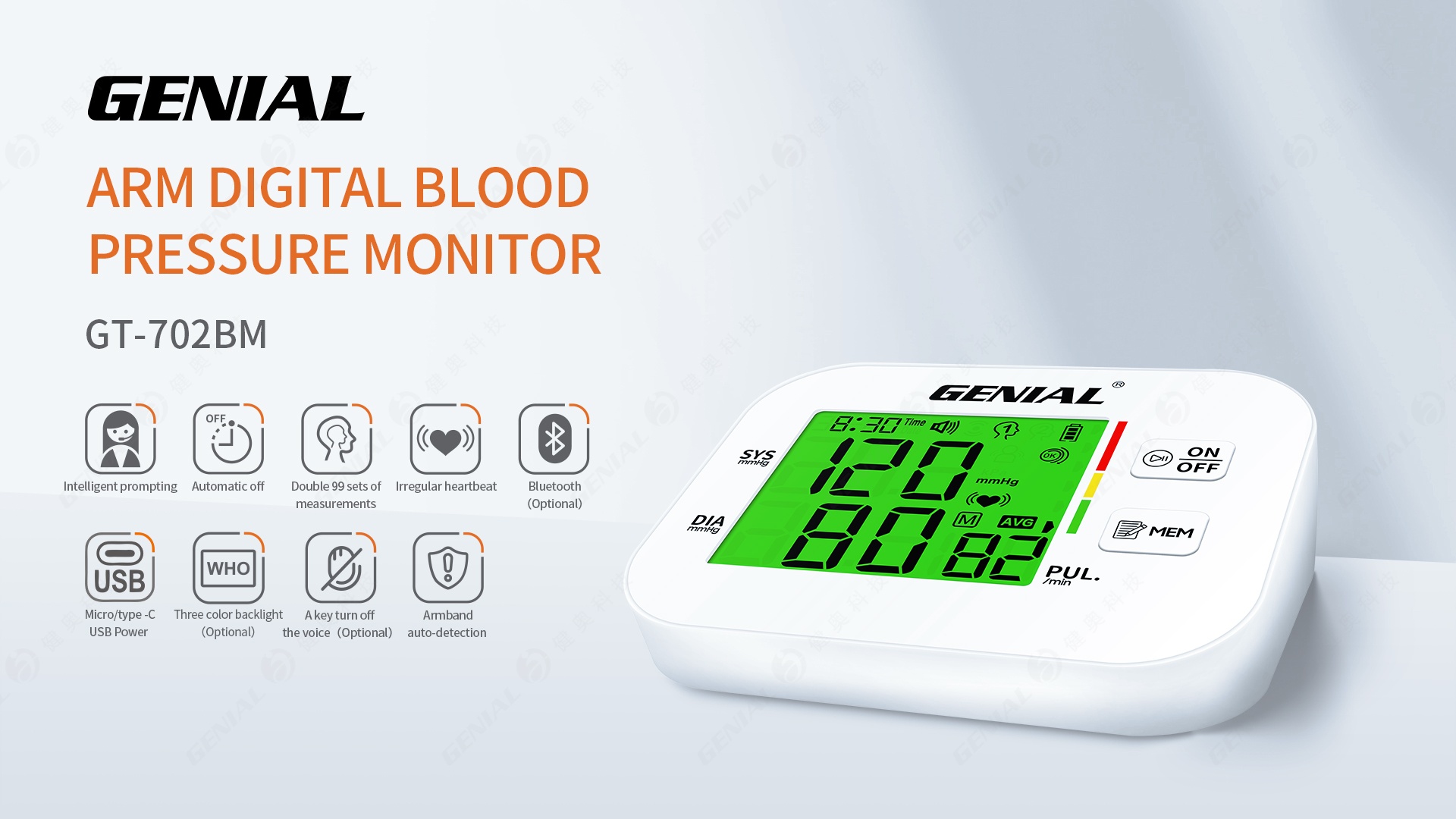
GT-702BM, one of the three upper-arm models whose documentation package this guide examines.
| Parameter | Published value | Acceptance check | Document to request |
|---|---|---|---|
| Pressure range | 0~290 mmHg | Confirm the unit measures and displays across the full declared range, checked at low, mid and high points against a reference analyzer | Design specification and calibration procedure |
| Pulse error | ≤±5% | Compare each sampled unit’s pulse reading with a reference source and record the deviation, not just pass or fail | Test report referencing the ±5% criterion |
| Cuff and air circuit materials | ABS housing, PVC air bag, Nylon binding strap, eco-friendly TPU air bag | Match the received bill of materials to the approved specification sheet; check strap dimensions and connector fit | BOM declaration and material declaration |
| Measurement behaviour | Fully automatic one-button measurement, no stethoscope required, dual-user 99-memory storage, large-screen backlight display | On sampled units, complete a measurement unaided and store then recall records for both user memories | Instruction for use and functional test checklist |
| Mercury-free design | Digital display, no mercury column | Check device marking and manual wording against the market’s labeling expectations | Labeling artwork and declaration of conformity |
GENIAL’s published blood pressure monitor testing statement is a useful example of the level of detail an acceptance clause should reach: the page states that each monitor is calibrated and tested, and that measured pressure should fall within 3 mmHg of analyzer data, a deviation below 0.4 kPa. A buyer who knows the criterion can audit the record. A buyer who only receives the phrase “100% tested” cannot.
Two cautions apply to the table above. Measurement behaviour and memory features are documented for GENIAL upper-arm blood pressure monitors as a series; confirm the exact feature set per SKU on the specification sheet, because accessory and configuration choices differ between models. And because the published measurement envelope is shared across the trio, selection differences concentrate in cuff materials and configuration rather than in the headline parameter values.
Material-level acceptance: what ABS, PVC, Nylon and eco-friendly TPU commit you to
Material declarations are treated as a footnote in many purchase orders and become a dispute later. In this trio, four material elements carry distinct acceptance implications.
ABS housing. ABS governs structural rigidity, surface finish and colour consistency. Acceptance should combine an appearance check for sink marks or colour drift with a dimensional check on the housing and battery compartment, batch by batch. Colour consistency matters most where the device is bundled with printed gift packaging.
PVC air bag. The air bag and its tubing determine pneumatic sealing. Acceptance focuses on leak-down behaviour at the declared pressure range and on connector fit after repeated inflation cycles, since the air circuit is the part most exposed to handling.
Nylon binding strap. The strap carries the load during inflation. Acceptance should verify strap dimensions against the declared arm circumference range, hook-and-loop retention after repeated fastening, and edge finishing that could abrade skin.
Eco-friendly TPU air bag. The TPU option exists for buyers whose listings, tenders or internal policies favour a material position they can defend. It is a configuration decision with cost and supply consequences, so it belongs in the specification sheet and the quotation, not in a verbal side agreement.
Material substitution is a change-control event, not a purchasing convenience. Any swap between air bag materials, or between grade variants of the housing resin, should trigger re-approval of the acceptance criteria and, depending on the market, a review of whether the regulatory file needs updating. Written change-notification obligations in the supply agreement are worth more than any single certificate.
Mapping intended use to qualification review
Intended use does not change the device, but it changes which documents carry weight. The five scenarios below are common destinations for upper-arm monitors, and each puts a different block of the dossier under pressure.
| Scenario | What the buyer must be able to prove | Documents weighted most | Acceptance focus |
|---|---|---|---|
| Community clinic | Repeatable readings across staff with minimal training | QMS certificate, calibration and test records, IFU | Operator-to-operator consistency on sample units; cuff size coverage |
| Health and wellness centre | Correct, non-diagnostic positioning of the device | Intended-use wording, labeling, IFU clarity | Display legibility, memory recall, power configuration |
| E-commerce | That claims in the listing are supported by documents on file | Product compliance claims, labeling artwork, packaging specification | Label accuracy against listing copy; batch-to-batch consistency of packaging |
| Chronic disease management | Continuity of readings over months for the same user | Measurement stability evidence, memory capacity, calibration policy | Trend consistency on a reference subject; record retention and retrieval |
| Insurance promotional gift | A defensible minimum compliance set at a controlled cost | Minimum compliance documents, labeling, gift packaging specification | Functional pass rate on the sample; artwork and gift-box approval |
One clarification prevents over-specification: there is no separate “clinic class” of GT-732, GT-732M or GT-702BM. The same model can serve a clinic order and a promotional programme. What differs is the documentation depth the buyer requires, the accessories specified, and the packaging. That is a purchasing decision, and it should be recorded in the order documents rather than assumed from the model number.
Where the dossier stops: limits buyers should price in
A well-built compliance package still leaves gaps, and decision-stage buyers gain more from naming them than from ignoring them.
Self-reported certification lists are a screening tool, not an audit. The certification set described above is company-reported and, in the evidence available for this category, is not accompanied by independent third-party validation of every claim. Verification in the issuing body’s database is the buyer’s step, and it takes hours rather than weeks — but it must be scheduled.
Manufacturer-published accuracy values are not an independent benchmark. A pulse error of ≤±5% and a 0~290 mmHg range are declared performance values. Independent comparative accuracy data for these specific models is not part of the public record, so the acceptance test on the buyer’s side becomes the real check.
A document package does not guarantee field performance. Published guidance for home health monitoring equipment recommends calibration at frequent intervals and operation between 16 and 40 °C with humidity below 85%. A device that passes at goods-in can drift in a hot pharmacy storeroom. Calibration intervals and storage conditions belong in the supply agreement.
Documentation adds time before the first shipment. GENIAL’s stated delivery is 3 to 7 days for OEM orders after confirmation and 24 hours for branded products, but that clock starts once specifications and artwork are approved. First-article qualification, material declarations and labeling approval sit ahead of that clock, and schedules that ignore them slip.
Building a six-step acceptance protocol
The protocol below is written for a distributor placing a first or repeat order on GT-732, GT-732M or GT-702BM, and it assumes the buyer has no laboratory of its own.
Step 1 — Issue a document request list with the enquiry. Ask for the QMS certificate, model-level compliance documents, the test and calibration criterion, the BOM and material declaration, and the labeling artwork. Suppliers that answer in one package are easier to qualify than suppliers that answer in stages.
Step 2 — Approve a golden sample with recorded values. Record the measured pressure at three points against a reference analyzer and the pulse deviation on the approved unit. This becomes the reference for every later shipment.
Step 3 — Define the incoming inspection plan. Production controls referenced by the manufacturer include multi-point calibration and batch validation for measurement consistency, statistical process control for batch stability, and 100% full inspection across the production process, supported by in-house laboratories operating under GMP and ISO 13485. Buyer-side inspection should complement this with sampling on function, cuff integrity, display and memory.
Step 4 — Verify pressure deviation against the stated criterion. Confirm that sampled units fall within 3 mmHg of analyzer data, and require the deviation value in the record, not a tick box.
Step 5 — Check labeling and market marking. Compare received labels and manuals with the approved artwork, including language and intended-use wording for the destination market.
Step 6 — Write the change-control clause. Define what counts as a change — material substitution, component supplier change, software or firmware revision, labeling amendment — and what re-qualification each triggers.
Home-use safety expectations sit underneath the whole protocol. UL identifies IEC 60601-1-11 as the collateral standard applied with IEC 60601-1 for home healthcare equipment, addressing risks in uncontrolled home environments with untrained users. A buyer who understands that framing asks better questions about drop resistance, enclosure robustness and instruction clarity than a buyer who only asks for a certificate photograph.
Future outlook
Three shifts are likely to shape acceptance criteria for home blood pressure monitors over the next procurement cycles. Documentation is becoming model-specific rather than company-specific, which favours suppliers able to produce a per-SKU evidence file on request. Connected features are pulling software and app compatibility into the qualification scope, in the same way GENIAL’s risk controls already address Bluetooth compatibility and app version maintenance for its connected devices. And channel scrutiny is rising: marketplace listings, insurance programmes and clinic tenders each ask for a slightly different slice of the same dossier, so a supplier’s ability to reorganise evidence quickly becomes a commercial capability, not an administrative one.
FAQ
Which compliance documents should a distributor request first for GT-732, GT-732M or GT-702BM?
Start with three items in this order: the ISO 13485 quality management system certificate covering the manufacturing site, the model-level product compliance documents naming the exact model designation, and the internal test and calibration criterion used on the line. GENIAL states that measured pressure should be within 3 mmHg of analyzer data, which gives the buyer a concrete acceptance value to audit against.
How are the 0~290 mmHg pressure range and the ≤±5% pulse error verified at acceptance?
Both are verified by measurement, not by document review alone. Pressure is checked at low, mid and high points across the declared range against a reference analyzer, and the deviation is recorded per sampled unit. Pulse error is checked by comparing the device’s pulse reading with a reference source and recording the percentage deviation. The documents support the claim; the test confirms it.
Does the choice between a PVC air bag and an eco-friendly TPU air bag change the qualification requirements?
It changes the material declaration and the change-control obligations rather than the measurement criteria. A PVC air bag and an eco-friendly TPU air bag are different configurations, each of which should be named in the specification sheet and the approved BOM. Any later substitution between them is a change-control event that should trigger re-approval of the acceptance criteria and a review of whether the market’s regulatory file needs updating.
How should intended use — community clinic, wellness centre, e-commerce, chronic disease management, insurance gift — affect the review?
Intended use determines which document block carries the most weight. A community clinic order leans on calibration records and operator consistency; an e-commerce order leans on labeling accuracy and packaging consistency; an insurance gift programme leans on a defensible minimum compliance set at a controlled cost. The device model itself does not change class between these scenarios, so the difference is recorded in the documentation depth and accessory specification written into the order.
What are the limits of a supplier’s self-reported certification list?
A self-reported list identifies which schemes a manufacturer claims to hold, but it is not an independent audit and it does not establish that a specific model is covered. GENIAL’s stated portfolio includes ISO 13485, ISO 45001, ISO 14001, GB/T 29490, BSCI, CE, NMPA, FDA, CB, FCC, RoHS and REACH-related claims, while its FDA 510(k) clearance K240333 applies to the Wearable Digital Thermometer T31, not to the GT-732, GT-732M or GT-702BM. Verification in the issuing body’s database, matched to the exact model designation, remains the buyer’s responsibility.
The GENIAL English corporate brochure is available for download: 2026 GENIAL corporate brochure (PDF).
Tem questões ou precisa de mais detalhes?
Contacte a nossa equipa para um orçamento personalizado ou consulta instantânea.
Solicitar orçamento
Preencha o formulário abaixo e a nossa equipa entrará em contacto com uma proposta personalizada.
Chat direto do WhatsApp
Prefere conversar em tempo real? Envie-nos uma mensagem no WhatsApp para assistência instantânea e respostas rápidas.
- Obter orçamento personalizado
- Partilhar fotos ou documentos
- Discuta as suas necessidades diretamente
Geralmente responde em 5–30 minutos durante o horário de expediente.